 Download Free Sample



Get a Quote
Receive a tailored pricing based on your needs.
- Choose license type
- Multiple user options
- Custom scope & coverage
- Fast turnaround
"Designing Growth Strategies is in our DNA"
 Listen to Audio Version
The global mental health apps market size was valued at USD 7.50 billion in 2025 and is projected to grow from USD 8.68 billion in 2026 to USD 25.45 billion by 2034, exhibiting a CAGR of 14.39% during the forecast period. North America dominated the global mental health apps industry, accounting for 47.2% of the market share in 2025.
The global market comprises various applications used for stress reduction, anxiety and depression support, and virtual counselling. The burden of mental health disorders, such as depression, anxiety, bipolar disorder, Post-Traumatic Stress Disorder (PTSD), and schizophrenia, is increasing significantly. These mental health applications help diagnose, prevent, and manage these disorders. The demand for these applications is increasing as individuals face growing mental health concerns. These applications help improve access to mental health resources, encourage early intervention, support regular engagement, and extend care beyond conventional clinical settings.
Furthermore, major players, such as Teladoc Health, Inc., Headspace, Inc., Calm, and Lyra Health, Inc., are actively pursuing strategic collaborations and acquisitions, as well as investment initiatives to expand their offerings, enhance market access, and strengthen their market presence.
2025 global estimates put mental health conditions among more than one billion people worldwide, highlighting an access gap digital services can help address but cannot solve alone. Mental health apps now sit between consumer wellness and formal care, spanning meditation, sleep, mood tracking, structured self-help, conversational support, and online therapy navigation. Their value depends on matching each function to users’ needs and making escalation to professional care straightforward for more users.
The market is separating into consumer wellness products, evidence-informed digital interventions, and integrated care platforms. Calm and Headspace combine mindfulness content with broader support; Talkspace connects users with licensed therapists; Wysa and Woebot Health focus on digital conversational support; Lyra Health combines employer distribution with clinical networks. Retention will determine durability.
Employer benefits, health plans, healthcare providers, and public services can reduce acquisition friction, but require implementation support, accessible design, and accountable reporting.
Conversational interfaces can reduce friction and guide users toward relevant exercises, but they can also produce inaccurate reassurance, blur the line between wellness and treatment, or encourage overreliance. Privacy, human escalation, and explicit limits must be designed into the product rather than added after launch.
Research indicates that smartphone interventions can improve some depression and anxiety symptoms, although average effects are generally modest and results vary by intervention. Buyers should examine published studies, target populations, adverse-event processes, accessibility, and data governance before procurement.
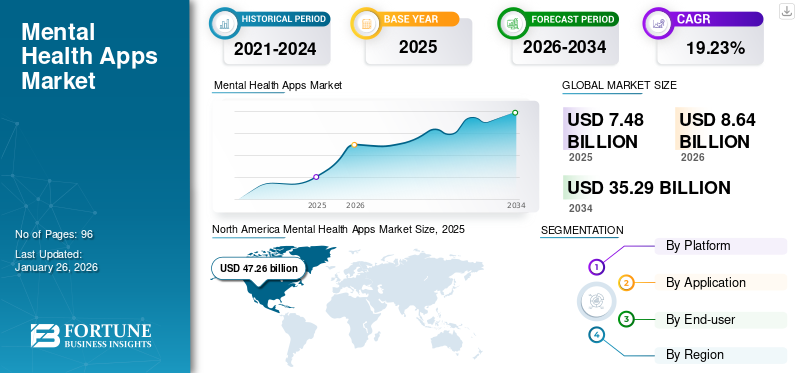
Download Free sample to learn more about this report.
 Global Market Size & Forecast
 Market Share
 Key Regional Highlights
North America
North America led the market, supported by high smartphone penetration and strong adoption of digital health services.
Europe
Europe is projected to grow at a CAGR of 13.70% and reach USD 1.99 Billion in 2026.
Asia Pacific
Asia Pacific is estimated to reach USD 1.82 Billion in 2026, driven by smartphone adoption and growing mental health awareness.
U.S.
The market is estimated at USD 3.74 Billion in 2026, accounting for approximately 43.07% of global revenue.
Japan
The market is estimated at USD 0.94 Billion in 2026, accounting for approximately 10.86% of global revenue.
Read More

Expanding Use of Mental Health Applications in Employee Wellness Programs to be a Significant Market Trend
Employers are increasingly integrating mental health applications into workplace wellness programs to help employees manage stress, burnout, and other emotional health concerns. The growing focus on employee productivity, retention, absenteeism reduction, and workplace satisfaction is encouraging companies to offer app-based mental health support as part of their benefit packages.
Moreover, digital platforms enable employers to extend support across remote, hybrid, and geographically dispersed workforces. As organizations seek accessible and scalable mental health solutions, the adoption of employer-sponsored mental health applications is emerging as a global market trend.
Mental health apps are moving from content libraries toward personalized support, integrated services, and clinical pathways. The strategic distinction is whether personalization helps users act appropriately or simply generates more interaction.
Conversational artificial intelligence is becoming an interface. It can simplify navigation, help users reflect, and recommend resources. However, emotional disclosures create heightened obligations around privacy, response boundaries, transparency, and escalation. Human support remains important when needs exceed the product’s intended scope.
Leading products will combine adaptive interfaces with evidence-informed content, transparent limitations, and routes to professional care. Consumer brands are expanding into employer benefits, health plans, coaching, and therapy, while clinical platforms add self-guided tools. This broadens reach but increases implementation demands, reporting requirements, and responsibility for handoffs.
Buyers increasingly need to distinguish general wellbeing from therapeutic interventions and assess products against privacy, clinical foundation, usability, accessibility, and integration. Wearable data may help tailor prompts, but sensitive inference requires consent and interpretation.
The commercial winners will not be those that maximize screen time. They will make support more accessible, preserve user trust, and demonstrate that personalization improves the care experience without overstating clinical capability.
|
Impact of AI on the Mental Health Apps Market |
|
Download Free sample to learn more about this report.
Limited Availability of Mental Health Professionals to Increase Demand for Digital Support Solutions
The shortage and uneven distribution of trained mental health professionals are limiting access to timely care in several countries. Long waiting periods, high consultation costs, and limited availability of specialists in rural areas are therefore encouraging individuals to use mental health applications for immediate support. These platforms provide self-guided therapy exercises, mental health coaching, symptom tracking, meditation, and virtual consultations without requiring frequent in-person visits.
Although these applications do not replace professional treatment for serious conditions, they can support early intervention, extend the reach of clinicians, and serve individuals with mild-to-moderate mental health needs. Thus, the continued shortage of mental health professionals is expected to increase the adoption of scalable digital support solutions.
Mental health apps address barriers that conventional services do not resolve: cost, stigma, travel, scheduling, and limited clinical capacity. Self-guided exercises give users an accessible starting point, while digital navigation can help them find professional support.
Employers and health plans have an incentive to make support available earlier, reduce navigation friction, and connect members with existing benefits. Healthcare providers can use apps between appointments to reinforce treatment plans, collect symptom reflections, and support continuity, provided clinical responsibility remains explicit.
Artificial intelligence adds an adoption driver. Conversational interfaces can make information easier to navigate and tailor recommendations to a person’s goals. Personalization is most credible when it draws on validated content, communicates uncertainty, and offers human support when the user needs more than a self-guided tool.
|
Rank |
Market Drivers |
Expected Impact on Market Growth |
Estimated Gross Market Growth Contribution (USD Billion) |
Impact: 2026-2028 |
Impact: 2029-2031 |
Impact: 2032-2034 |
|
1 |
Shortage of mental health professionals and limited access to conventional care |
High |
5.10 |
High |
High |
High |
|
2 |
Rising prevalence and awareness of anxiety, depression, stress, and burnout |
High |
4.35 |
Medium |
High |
High |
|
3 |
Growing smartphone, internet, and digital-health adoption |
High |
3.70 |
High |
High |
Medium |
|
4 |
Integration of AI for personalized and continuous mental health support |
Medium-High |
3.20 |
Medium |
High |
High |
|
5 |
Increasing adoption by employers, insurers, and healthcare providers |
Medium |
2.80 |
Medium |
Medium |
High |
|
6 |
Others |
Low |
1.85 |
Low |
Low |
Low |
|
Total Gross Growth Contribution |
21.00 |
|
Product Name |
Company Name |
Description |
|
Tee |
Talkspace, Inc. |
Tee is an AI-based mental health companion developed for adults seeking real-time support for stress, anxiety, relationships, and everyday life challenges. It incorporates risk-identification features, clinician oversight, and pathways for human intervention when higher-risk situations are detected. |
|
Headspace on Apple Watch |
Headspace |
Introduced on May 13, 2026, the updated Apple Watch experience provides personalized meditations, haptic breathing prompts, an SOS tap-to-calm function, and sleep-support content. With user permission, it can use Apple Health information such as heart-rate variability to personalize mindfulness prompts. |
|
Koa Care 360 |
Koa Health |
Koa Care 360 is a unified digital mental health platform that provides prevention, self-care, and clinical treatment through personalized care pathways. The platform combines evidence-based digital interventions, online therapy, care navigation, and population-level analytics, while allowing employers and health plans to connect users with appropriate mental health resources through a single digital access point. |
|
Lyra AI |
Lyra Health |
Lyra AI provides continuous conversational support for mild-to-moderate concerns such as burnout, stress, and sleep difficulties. The solution includes risk-flagging capabilities and escalation pathways connecting members with Lyra’s human care team. |
Growing Concerns Regarding User Data Privacy and Cybersecurity to Restrict Market Adoption
One of the major concerns hampering the global mental health apps market growth is data privacy. Mental health applications collect highly sensitive information, including users’ emotional conditions, behavioral patterns, symptoms, therapy interactions, medication details, and personal identifiers.
Weak data protection practices, unauthorized third-party sharing, and cybersecurity breaches can therefore expose users to privacy violations and misuse of confidential health information. Such risks may discourage individuals from sharing complete and accurate information through digital platforms, thereby reducing the effectiveness of app-based mental health support. Therefore, growing concerns regarding the security and commercial use of sensitive mental health data are expected to restrict user confidence and market adoption.
Mental health apps handle sensitive disclosures, including emotional states, symptoms, medication routines, and personal histories. Poor consent, unclear retention, opaque sharing, or reuse for advertising can damage users and undermine institutional trust. Buyers need rules for data collection, storage, access, deletion, security incidents, and model-training practices.
Clinical evidence presents a second constraint. Products range from general wellness content to interventions intended for defined conditions, but marketing often blurs these categories. Evidence for one intervention cannot automatically validate another. Procurement teams must review published studies, intended populations, limitations, and outcome measures.
Artificial intelligence introduces additional risks. A conversational system may generate inaccurate guidance, reinforce harmful interpretations, or fail to recognize urgent distress. Clear boundaries, tested escalation procedures, clinical governance, and human oversight are essential. Apps must disclose limits and provide routes to help.
|
Rank |
Market Restraints |
Expected Impact on Market Growth |
Estimated Reduction in Market Size (USD Billion) |
Impact: 2026-2028 |
Impact: 2029-2031 |
Impact: 2032-2034 |
|
1 |
Data privacy, cybersecurity, and user-trust concerns |
High |
1.50 |
High |
High |
Medium |
|
2 |
Limited clinical validation, safety concerns, and regulatory uncertainty |
Medium-High |
1.20 |
High |
Medium |
Medium |
|
3 |
Low long-term engagement, app attrition, and subscription fatigue |
Medium |
0.95 |
Medium |
Medium |
Low |
|
4 |
Others |
Low |
0.58 |
Low |
Low |
Low |
|
Total Market Reduction |
4.23 |
Expansion of Condition-specific Applications for Anxiety, Depression, PTSD, and Substance-use Disorders to Create Market Opportunities
The development of applications designed for specific mental health conditions is expected to create significant growth opportunities for market participants. Unlike general wellness apps, condition-specific platforms can provide targeted cognitive behavioral therapy exercises, symptom assessments, relapse-prevention support, medication reminders, and clinician-guided care based on the needs of a particular patient group. This specialization can improve clinical relevance, user engagement, and confidence among healthcare providers. The introduction of clinically validated applications across multiple indications is expected to widen the addressable population and support new prescription, employer-sponsored, and healthcare-provider-based revenue models.
The opportunity lies between recognizing distress and receiving support. Self-guided programs can deliver psychoeducation, structured exercises, mood reflection, relaxation, and sleep guidance without requiring a clinician for every interaction.
Employers, health plans, and providers offer distribution through trusted relationships. Employer programs can connect users to benefits, while clinicians can recommend digital exercises between sessions. Payer partnerships can also support navigation, triage, and follow-up, provided individual privacy is protected and clinical accountability remains clear.
Product opportunities include evidence-informed cognitive behavioral exercises, culturally adapted material, multilingual interfaces, accessible design, low-bandwidth delivery, and specialized support for sleep, stress, and emotional wellbeing. Governed artificial intelligence can reduce navigation friction and personalize resource discovery, but it must not imply diagnosis or replace treatment.
Difficulty in Sustaining Long-term User Engagement Remains a Significant Challenge for Market Growth
Mental health applications may achieve high initial downloads and activation; however, maintaining regular usage over several weeks or months remains difficult. Users may discontinue an application when its content becomes repetitive, does not match their changing needs, requires frequent daily participation, or provides limited human guidance. Declining engagement reduces treatment adherence and restricts the ability of applications to generate measurable improvements in mental health outcomes. Therefore, companies need to invest continuously in personalization, reminders, user-centred design, and appropriate human support to retain users and build sustainable revenue models.
|
SWOT Analysis |
|
|
Strengths |
|
|
Weaknesses |
|
|
Opportunities |
|
|
Threats |
|
Android Segment Dominated Owing to Its Large Global User Base and Wider Device Accessibility
Based on platform, the market is categorized into iOS, Android, and web-based & others.
Android
Android expands access across device types, price levels, languages, and connectivity conditions. Fragmentation increases testing demands and can affect notifications, accessibility, and performance on older hardware. Buyers should examine security updates, data consumption, language quality, and ease of use. Reach matters only when people can use the product reliably and understand its guidance
By platform, the Android segment dominated the mental health apps market share in 2025. The dominance is attributed to the platform’s extensive global reach across developed and emerging economies. The broad device availability makes mental health applications accessible to a larger population, including users in price-sensitive markets where affordable smartphones are the primary means of accessing digital health services. As a result, mental health app providers can achieve higher download volumes, expand into underserved regions, and reach consumers beyond premium smartphone user groups, supporting the segment’s leading market share.
iOS
The iOS segment is expected to grow at a CAGR of 14.67% over the forecast period. iOS apps compete through polished design, accessibility, notification controls, and device integration. Wearable connections may support sleep reflection or timely prompts, but emotional inference requires clear consent. Enterprise buyers should assess device-management compatibility, identity controls, data separation, and policies for managed or personal phones. The interface must help people complete useful activities and find professional support when needed.
Web-based
Web-based services suit employer portals, clinical programs, universities, and provider workflows. They can offer clinician and administrator dashboards without requiring app installation. Secure authentication, session management, accessibility, and responsive design are essential on shared devices. Buyers should assess record integration, data export, and notification privacy. Web products perform best when they connect support and referrals without creating another disconnected destination.
To know how our report can help streamline your business, Speak to Analyst
High Burden of Common Mental Health Conditions Supported Dominance of Depression & Anxiety Management Segment
Based on application, the market is categorized into depression & anxiety management, stress & burnout management, meditation & mindfulness, sleep & relaxation, mood tracking & emotional wellbeing, and others.
Depression and Anxiety Management
Depression and anxiety apps range from psychoeducation to structured cognitive behavioral therapy, behavioral activation, symptom reflection, and guided self-help. Their clinical implications exceed those of broad wellness content. Buyers should distinguish relevant evidence from testimonials and engagement metrics. Eligibility, limitations, outcome measurement, and professional-care pathways must be clear. Screening and escalation need clinical input; completing exercises must never be portrayed as a substitute for urgent assessment when serious risk appears.
The depression & anxiety management segment captured a significant share in the market in 2025, owing to the widespread occurrence of these conditions. Symptoms such as persistent worry, low mood, poor concentration, sleep disturbance, and emotional distress can be monitored and managed through digital tools. These applications provide users with immediate support before, during, or alongside professional treatment, thereby serving a larger population than applications developed for less common mental health conditions. The growing treatment gap also encourages individuals experiencing mild-to-moderate symptoms to begin with easily accessible app-based support. As anxiety and depressive disorders represent a substantial share of the global mental health burden, applications addressing these conditions generate high download volumes and frequent user demand.
Stress and Burnout Management
Stress and burnout apps serve employees, caregivers, students, and people facing sustained pressure. Breathing exercises, journaling, cognitive reframing, and relaxation can offer practical support. Workplace programs must protect individual disclosures from employer misuse. Aggregate reporting should not expose identifiable health information. Products should also recognize that excessive workload and poor management cannot be solved through resilience exercises alone. Buyers should examine confidentiality, accessibility, engagement quality, and referral options.
Sleep and Relaxation
The sleep & relaxation segment is expected to grow at a CAGR of 16.82% over the forecast period. Sleep apps offer stories, soundscapes, breathing, routines, and behavioral education. They can support healthier habits, but persistent insomnia or related symptoms may require assessment. Wearable integration and adaptive sound can personalize experiences, while sleep data needs clear consent and use limitations. Buyers should review claims, referral guidance, privacy, and content quality. Audio libraries are easy to imitate; trustworthy design and evidence-informed advice are harder to sustain.
Mood Tracking and Emotional Wellbeing
Mood trackers record feelings, triggers, habits, medication routines, and contextual changes. Yet repeated logging can become burdensome or encourage rumination, and automated interpretations can create false certainty. Products should explain trends carefully, enable export and deletion, and make clinician sharing optional. Risk flags need validation and human review. Value lies in useful reflection, not accumulating sensitive data or silently implying diagnosis.
Accessibility and Lower Dependence on Professional Support Enabled Self-Guided Segment to Dominate
Based on delivery model, the market is categorized into self-guided, therapist/coach-assisted, and hybrid.
Self-guided
Self-guided products provide exercises, lessons, reminders, reflection prompts, and assessments without routine human contact. They suit wellness, prevention, and structured self-help for appropriate users. Accountability remains limited and motivation matters. Designers should avoid manipulative notifications, describe product boundaries, and explain when professional care is needed. Buyers should examine outcomes alongside completion and feedback. Lower service intensity does not remove responsibility for safety, privacy, and honest marketing.
On the basis of the delivery model, the self-guided segment held the largest market share in 2025. The segment enables users to independently access mental health resources without waiting for a therapist or arranging scheduled consultations. Self-guided applications provide meditation sessions, educational modules, cognitive behavioral exercises, mood tracking, journaling, and structured wellness programs that can be completed according to the user’s preferred time and pace. The model is particularly suitable for individuals seeking preventive care, stress management, emotional wellness support, or assistance with mild symptoms. Increasing adoption of these self-guided apps is expected to propel segmental growth in the upcoming years.
Therapist or Coach-assisted
Assisted delivery combines digital tools with coaching, therapist messaging, check-ins, or live sessions. Human support can contextualize user information, reinforce adherence, and recognize changing needs. It also adds staffing costs, scheduling, credential verification, and jurisdictional requirements. Buyers must distinguish coaching from licensed treatment and clarify supervision, response expectations, emergency procedures, and clinical responsibility. Effective models allocate human attention where judgment adds value instead of creating unstructured administrative work.
Hybrid
The hybrid segment is expected to grow at a CAGR of 19.69% over the forecast period. Hybrid delivery combines self-guided resources with human support and escalation appropriate to user needs. It can connect lighter-touch interventions to coaching or clinical care. The operating model must define triage, handoffs, consent, record access, response times, and accountability. Fragmented systems force users to coordinate their own care. Hybrid value comes from continuity and understandable transitions, not merely bundling content with appointments.
Ease of Direct App Access and Wider Consumer Reach Supported B2C Segment Dominance
Based on business model, the market is categorized into B2C, B2B, B2B2C, and hybrid.
B2C
Business-to-consumer services sell directly to individuals through free access or paid memberships. Direct distribution offers rapid feedback on onboarding and product experience, but exposes providers to acquisition costs, cancellations, platform fees, and changing willingness to pay. Consumer trust matters because disclosures are intimate. Growth should not depend on distress-driven prompts or confusing renewals. Investors should distinguish retention rooted in meaningful benefit from friction or emotional dependence.
By business model, the B2C segment dominated the market in 2025. Most mental health applications can be downloaded and purchased directly by consumers through mobile application stores and company websites. This model enables companies to reach users without depending on employer contracts, insurance coverage, hospital procurement, or institutional approval. Consumers can select applications according to their personal needs, begin with a trial, and upgrade to premium programs covering meditation, anxiety management, sleep, mood improvement, or emotional wellness. As a result, the B2C model supports faster customer acquisition, broad geographic availability, and greater control over product positioning and pricing.
B2B
Business-to-business contracts serve employers, universities, healthcare organizations, and institutions. Buyers can provide distribution and connect apps with existing benefits, but require security reviews, accessibility, implementation support, and credible reporting. Employer dashboards should use aggregated information without exposing individual disclosures. Contract value depends on engagement, service capacity, renewal, and administrative cost. Institutional access does not guarantee adoption: successful programs combine clear communications, confidential use, user support, and defined evaluation.
B2B2C
Business-to-business-to-consumer models distribute apps through health plans, insurers, benefit platforms, providers, or public services. Intermediaries can improve credibility and reduce acquisition friction. They also add eligibility rules, reporting requirements, and integration work. Vendors must support consent, referrals, member communications, and clear responsibility for unresolved needs. Buyers should verify that availability leads to activation and suitable support rather than assuming distribution alone produces outcomes.
Hybrid
The hybrid segment is expected to grow at a CAGR of 18.70% over the forecast period. Hybrid businesses combine direct subscriptions with employer contracts, health-plan distribution, provider relationships, or licensing. Channel diversity can reduce dependence on one source and connect wellness content with clinical services. Complexity grows when permissions, pricing, reporting, and service levels vary by customer. Executives should review channel contribution, implementation costs, renewal exposure, and customization burdens. A shared secure foundation enables flexibility without weakening clinical consistency or accountability.
Recurring Access to Continuously Updated Content Supported Subscription-based Segment Dominance
Based on payment model, the market is categorized into freemium, subscription-based, one-time purchase, and others.
Freemium
Freemium models provide basic content or exercises at no cost while charging for advanced programs, personalization, or professional access. Free entry reduces barriers, but conversion depends on perceived value. Advertising or opaque data use can undermine credibility. Buyers should check what the free tier collects, what remains accessible, and whether premium prompts exploit distress. Essential safety information should never be hidden behind payment. Paid offers must be transparent.
Subscription-based
Subscriptions create recurring revenue for content, tracking, coaching, or clinical services. They fund continuing development, but cancellations rise when engagement fades or benefits feel indistinct. Transparent pricing, easy cancellation, and clear renewal terms protect trust. Buyers should compare cost with actual use, service availability, and alternatives. Durable subscriptions reflect an ongoing useful service, not a collection of features users rarely open.
By payment model, the subscription-based segment accounted for the largest share in 2025. Mental health support generally requires continuous engagement. Monthly and annual subscriptions give users ongoing access to guided programs, therapy exercises, meditation libraries, sleep content, AI-based support, progress tracking, and newly added features. For developers, recurring payments create more predictable revenue and provide funds for content development, clinical review, platform maintenance, and personalization. Subscription applications can also offer different pricing tiers, enabling companies to serve both casual wellness users and consumers requiring more comprehensive support.
One-time Purchase
One-time purchases suit standalone courses, downloadable materials, or programs designed for completion. Users receive a defined cost without recurring billing, while vendors have less revenue for ongoing support. Maintenance, security, accessibility, and clinical updates still require resources. Buyers should confirm access duration, update commitments, refund terms, and future guidance changes. This model suits bounded education better than services requiring monitoring, escalation, or ongoing clinical oversight.
The others segment is expected to grow at a CAGR of 20.46% over the forecast period.
Convenience, Privacy, and Continuous Access Supported Dominance of Homecare Settings Segment
Based on end user, the market is categorized into healthcare providers, homecare settings, and others.
Healthcare Providers
Healthcare providers use apps for psychoeducation, symptom reflection, between-session practice, waiting-list support, and treatment continuity. Digital tools must reinforce clinical workflows rather than transfer decisions to algorithms. Buyers should assess evidence, consent, record interoperability, clinician dashboards, access control, retention, and escalation. Clinical leaders must define suitable populations and exclusions. Useful app-generated information is understandable and actionable, not another inbox. Adoption depends on fit with care routines and trust among clinicians and patients.
Homecare Settings
Homecare users include individuals managing daily wellbeing, families supporting relatives, and caregivers coordinating routines between appointments. Apps can extend access when travel, stigma, cost, or local shortages constrain services. Home environments vary in connectivity, privacy, language, disability access, and caregiver availability. Simple navigation, low-bandwidth performance, accessible language, and optional caregiver involvement improve usability. Apps should complement homecare, never imply automated monitoring replaces assessment or human attention.
The homecare settings segment dominated the market in 2025. These applications allow users to access therapy exercises, meditation, mood tracking, coaching, and virtual consultations from the privacy of their homes. Home-based use removes the need to travel to clinics, reduces scheduling barriers, and enables individuals to seek support during evenings, weekends, or periods of immediate emotional distress. The familiar home environment may also make users more comfortable discussing sensitive concerns and completing self-guided programs regularly.
The healthcare providers segment is expected to grow at a CAGR of 14.56% over the forecast period.
By geography, the market is categorized into Europe, North America, Asia Pacific, Latin America, and the Middle East & Africa.
North America Mental Health Apps Market Size, 2025 (USD Billion)
To get more information on the regional analysis of this market, Download Free sample
North America held the leading share in 2024 at USD 3.08 billion and maintained its leading position in 2025 at USD 3.54 billion. High smartphone penetration, strong awareness of mental health, and widespread adoption of digital health services are some of the factors supporting market growth across North America.
North America combines consumer wellness brands, employer-sponsored programs, digital therapy, and health-plan distribution. Buyers increasingly want apps that connect self-guided support with professional care while preserving privacy. The United States drives much of the region’s technology and commercial activity; Canada adds publicly oriented care pathways, while Mexico’s opportunity depends on affordability, localization, and service access. Enterprise procurement will emphasize evidence, security, accessibility, and measurable outcomes.
Given North America's substantial contribution and the U.S. dominance in the region, the U.S. market is estimated at around USD 3.74 billion in 2026, accounting for roughly 43.07% of the global market. The United States combines direct-to-consumer subscriptions with employer benefits, payer relationships, and online therapy. Products compete on brand recognition, engagement, clinical credibility, and integration. Regulatory obligations vary by intended use, making clear separation between wellness and medical claims essential. Buyers will scrutinize sensitive-data handling, AI boundaries, crisis escalation, accessibility, and outcomes. Employer distribution can expand reach, but renewal depends on demonstrated value and user trust.
Europe is projected to grow at a CAGR of 13.70% over the coming years, the second highest among all regions, and reach a valuation of USD 1.99 billion by 2026. Growing public focus on mental well-being and increasing acceptance of remote mental healthcare are driving the adoption of mental health applications across Europe.
Europe’s mental-health app market reflects diverse national health systems, privacy expectations, language requirements, and reimbursement policies. The General Data Protection Regulation creates a significant baseline for personal-data governance, while medical-purpose software may face additional requirements. Commercial success will depend on localization, clinical evidence, interoperability, and procurement fit. Public healthcare partnerships can improve reach, but adoption pathways will differ materially between national systems and individual markets.
The U.K. market is estimated at USD 0.48 billion in 2026, accounting for roughly 5.53% of the global market. The United Kingdom combines private wellness subscriptions with NHS services, employer benefits, and online therapy. Digital tools can support waiting-list navigation, guided self-help, and between-session practice, but must complement established care pathways. NHS procurement emphasizes evidence, accessibility, safety, and interoperability. Suppliers will need clear escalation arrangements and realistic claims. The strongest opportunities connect digital support with local services rather than operating as isolated content libraries.
Germany's market is projected to reach approximately USD 0.48 billion in 2026, equivalent to around 5.48% of the global market. Germany offers a distinctive route for clinically oriented apps through its DiGA framework, which allows eligible digital health applications to be prescribed and reimbursed through statutory health insurance. That pathway rewards evidence, data protection, and medical quality rather than consumer appeal alone. Wellness products operate differently. Suppliers must distinguish clinical applications from lifestyle tools and prepare for documentation, integration, clinician acceptance, and sustained patient engagement.
Asia Pacific is estimated to reach USD 1.82 billion in 2026 and secure a leading place in the market. A large smartphone-using population, growing mental health awareness, and limited access to professionals in several countries are increasing demand for app-based support. The expansion of affordable, multilingual, and locally adapted platforms is further improving adoption across the Asia Pacific.
Asia-Pacific is heterogeneous, spanning mature health systems, large mobile-first populations, and markets with uneven access to clinical services. Localization is fundamental: language, cultural context, affordability, connectivity, and attitudes toward mental health determine adoption. Employers and digital health ecosystems can extend reach, while regulatory rules differ significantly between jurisdictions. Products will need region-specific content, privacy controls, clinical partnerships, and clear pathways to professional support across markets.
The Japanese market is estimated at around USD 0.94 billion in 2026, accounting for approximately 10.86% of the global market. Japan’s opportunity combines workplace mental-health programs, consumer wellbeing, and digital support within a mature healthcare system. Products must account for language, privacy, usability, and varying comfort with disclosure. Workplace distribution can create reach, but employers must not access identifiable personal disclosures. Local clinical partnerships and culturally appropriate content will improve credibility. Apps should clarify when self-guided support is insufficient and how users reach qualified professionals.
China's market is projected to be among the largest globally, with 2026 revenues estimated at around USD 0.30 billion, accounting for approximately 3.49% of global sales. China’s mental-health app landscape is shaped by mobile platforms, digital ecosystems, evolving data governance, and public efforts to broaden psychological support. Localization and platform compliance are central. Products should provide clear content boundaries, appropriate moderation, and pathways to human assistance. Distribution reach will not establish clinical credibility. Buyers and partners will evaluate data handling, service reliability, cultural fit, and the distinction between wellness and treatment.
The Indian market is estimated at around USD 0.12 billion in 2026, accounting for roughly 1.39% of global revenue.
The Latin America and Middle East & Africa regions are expected to witness growth in this market during the forecast period. The market in Latin America is estimated to reach a valuation of USD 0.56 billion in 2026. Shortages of mental health professionals and high treatment costs are encouraging consumers to use affordable digital alternatives. Improving internet access and increasing awareness of anxiety, depression, and workplace stress are supporting market expansion.
Middle East and Africa encompass differing health systems, languages, connectivity, and levels of clinical capacity. Apps can extend psychoeducation, guided self-help, and care navigation, but must fit local culture and service availability. Low-bandwidth design, privacy, affordable access, and trusted partnerships will shape uptake. Ministries, employers, nongovernmental organizations, and local clinicians can support deployment, while escalation pathways must reflect available services.
Latin America has unmet mental-health needs, while access, affordability, and specialist availability vary across countries. Spanish and Portuguese localization, low-data delivery, and mobile-first design will influence adoption. Employers, public-health agencies, universities, and local providers can provide distribution. Commercial success requires culturally adapted content, transparent pricing, privacy safeguards, and clear crisis pathways. Partnerships with clinicians will help products address differences in care systems and user expectations.
The GCC market is set to reach USD 0.11 billion in 2026.
The South African market is projected to reach approximately USD 0.08 billion by 2026, accounting for roughly 0.96% of global revenue.
|
Regulatory Body |
Region |
Description |
|
U.S. FDA |
U.S. |
The FDA regulates mental health applications that perform a medical-device function, such as diagnosing, treating, monitoring, or providing patient-specific treatment recommendations for a mental health condition. |
|
European Commission, EU Competent Authorities, Notified Bodies and Data Protection Authorities |
Europe |
Mental health apps with an intended medical purpose may qualify as Medical Device Software under Regulation (EU) 2017/745. Manufacturers must establish the software’s intended purpose, determine its risk classification, generate clinical evidence, implement quality and post-market surveillance systems, and obtain CE marking through a Notified Body where required. |
|
Pharmaceuticals and Medical Devices Agency (PMDA) and Ministry of Health, Labour and Welfare (MHLW) |
Japan |
Under Japan’s PMD Act, software intended to diagnose or treat a disease may be regulated as Software as a Medical Device. The PMDA performs scientific review, regulatory consultation, compliance assessment, and post-market safety evaluation, while the MHLW grants the applicable marketing authorization. |
|
National Medical Products Administration (NMPA) and Cyberspace Administration of China (CAC) |
China |
The NMPA regulates mental health software that qualifies as a medical device. Products are subject to filing or registration according to their medical-device classification, with higher-risk products requiring formal review of safety, effectiveness, clinical evidence, software documentation, and quality-management systems before commercialization. |
Product Innovation and Platform Expansion by Key Companies to Strengthen Market Competition
The global mental health apps market is moderately fragmented, with competition led by companies offering meditation and mindfulness applications, virtual therapy, mental health coaching, AI-based support, digital therapeutics, and employer-sponsored care platforms.
Major global vendors include Headspace, Calm, BetterHelp, Talkspace, Lyra Health, Spring Health, and Wysa, while emerging and specialized players such as Woebot Health, Limbic, and Happify Health compete through narrower clinical, AI, or behavioral-health propositions. The strongest platforms increasingly combine self-guided content with coaching, therapy, assessment, referral, and employer reporting.
Major players such as Teladoc Health, Inc., Headspace, Inc., Calm, and Lyra Health, Inc., are strengthening their market positions through product launches, artificial intelligence integration, clinical-service expansion, partnerships with employers and health plans, and wider geographical availability. The increasing focus on personalized care, continuous engagement, measurable clinical outcomes, and integration of self-guided tools with professional support is expected to improve commercial acceptance and strengthen competition among leading companies.
Mental health app competition is splitting into four tiers as wellness brands expand toward clinical care.
The Care Continuum Advantage connects self-guided support, human care, and appropriate escalation while protecting privacy and clinical responsibility.
Leaders:
Headspace and Calm combine consumer brands with expanding distribution. Headspace offers mindfulness, coaching, therapy, and Ebb; Calm spans meditation, sleep, and Calm Health. Calm Health’s LifeStance partnership adds referral pathways to licensed clinicians, while its Solera relationship broadens benefits distribution. Competition is shifting beyond content libraries toward care navigation.
Visionaries:
Wysa and Woebot Health focus on conversational support and structured digital interventions. Differentiation depends on evidence, bounded AI, clear disclosures, and escalation. Lyra Health connects digital tools with employer-sponsored care and specialist support. Buyers will distinguish validated outcomes and governance from chatbot fluency.
Challengers:
Talkspace combines digital access to licensed therapists with payer-oriented delivery. BetterHelp competes through online counseling, while past regulatory scrutiny over sensitive-data practices shows how trust failures damage standing. Emerging providers differentiate through condition-specific programs, coaching, and referrals.
Niche Players:
Daylio, Finch, and specialist sleep or meditation products focus on mood reflection, habit formation, or targeted content. Local providers also build apps for particular populations and workflows. Their advantage is relevance; their constraint is distribution and clinical integration.
Other notable participants in the market include Big Health, Meru Health, Wysa, MindDoc, and Woebot Health. These companies are expected to focus on clinically validated digital programmes, conversational AI, hybrid human-and-digital care, condition-specific applications, mood tracking, gamification, and integration with clinical referral systems. The market is expected to remain strongly innovation-driven, with established players maintaining stronger near-term positions due to large subscriber bases, employer relationships, clinical networks, and recognized brands. In contrast, specialized companies are likely to compete through condition-specific solutions, culturally adapted content, stronger clinical evidence, and more focused user experiences.
Partnerships are becoming a primary route to scale. Headspace has expanded through employer and health-plan ecosystems, while Lyra has built distribution through benefits platforms and healthcare organizations. Talkspace has similarly expanded its partner network across virtual care, specialty services, and benefits navigation.
The global mental health apps market report provides market size and forecast for all the segments included in the study, such as platform, application, delivery model, business model, payment model, end user, and geography. The market outlook also details the key drivers, restraints, trends, opportunities, and challenges expected to influence market growth during the forecast period. It offers information on the prevalence of anxiety, depression, stress, sleep disorders, and other mental health conditions across major regions and countries. The report further covers key industry developments, new application and feature launches, artificial intelligence integration, partnerships, collaborations, mergers, and acquisitions. It also provides a comprehensive global market analysis. It includes a detailed competitive landscape with information on the estimated market shares, product portfolios, strategic initiatives, and profiles of leading companies.
Request for Customization to gain extensive market insights.
| ATTRIBUTE | DETAILS |
| Study Period | 2021-2034 |
| Base Year | 2025 |
| Estimated Year | 2026 |
| Forecast Period | 2026-2034 |
| Historical Period | 2021-2024 |
| Growth Rate | CAGR of 14.39% from 2026 to 2034 |
| Unit | Value (USD billion) |
| Segmentation | By Platform, Application, Delivery Model, Business Model, Payment Model, End User, and Region |
| By Platform |
|
| By Application |
|
| By Delivery Model |
|
| By Business Model |
|
| By Payment Model |
|
| By End User |
|
| By Region |
North America (By Platform, Application, Delivery Model, Business Model, Payment Model, End User, and Country)
Europe (By Platform, Application, Delivery Model, Business Model, Payment Model, End User, and Country/ Sub-Region)
Asia Pacific (By Platform, Application, Delivery Model, Business Model, Payment Model, End User, and Country/ Sub-Region)
Latin America (By Platform, Application, Delivery Model, Business Model, Payment Model, End User, and Country/ Sub-Region)
Middle East & Africa (By Platform, Application, Delivery Model, Business Model, Payment Model, End User, and Country/ Sub-Region)
|
Approach 1: Revenues and Market Share of Major Mental Health App Players
Approach 2: Product-Level Subscription and Sales Analysis
Approach 3: User Adoption and Monetization Model
Approach 1: Parent Market and Addressable Endocrine Testing Revenue Analysis
Supply Side Interviews: 60%

Fortune Business Insights says that the market value stood at USD 7.50 billion in 2025 and is projected to reach USD 25.45 billion by 2034.
In 2025, the market value in North America stood at USD 3.54 billion.
The market is predicted to exhibit a CAGR of 14.39% during the forecast period of 2026-2034.
By platform, the android segment led the market.
Limited availability of mental health professionals’ increases demand for digital support solutions and drives market growth.
Teladoc Health, Inc., Headspace, Inc., Calm, and Lyra Health, Inc. are the top players in the market.
Get 30-60 hrs Free Customization
Expand Regional and Country Coverage, Segments Analysis, Company Profiles, Competitive Benchmarking, and End-user Insights.













.webp)






Related Reports
Get In Touch With Us
US +1 833 909 2966 ( Toll Free )
Receive a tailored pricing based on your needs.
Discuss your questions with our industry experts.
Have questions? Get quick answers before you purchase.

