Dry Battery Electrode Market Size, Share & Industry Analysis, By Electrode Type (Lithium Iron Phosphate (LIP) Dry Electrodes, Nickel Manganese Cobalt (NMC) Dry Electrodes, Nickel Cobalt Aluminum (NCA) Dry Electrodes, Graphite-Based Dry Electrodes, and Silicon-Based Dry Electrodes), By Manufacturing Technology (Fibrillation-Based Dry Electrode Process, Electrostatic Spray Deposition (ESD), and Dry Powder Coating / Roll-to-Roll Dry Coating), By End-Use Industry (Automotive, Energy & Utilities, Consumer Electronics, Industrial, Aerospace & Defense, and Others), and Regional Forecast, 2026-2034
 Download Free Sample
DRY BATTERY ELECTRODE MARKET SIZE AND FUTURE OUTLOOK
 Listen to Audio Version
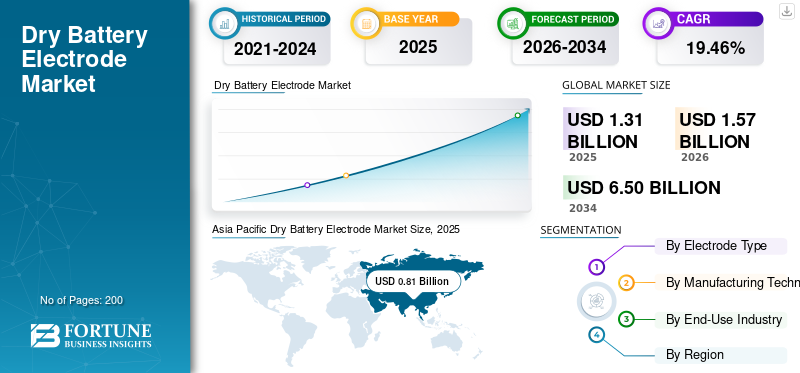
The global dry battery electrode market size was valued at USD 1.31 billion in 2025. The market is projected to grow from USD 1.57 billion in 2026 to USD 6.50 billion by 2034, with a CAGR of 19.46% over the forecast period. Asia Pacific dominated the dry battery electrode market with a market share of 61.83% in 2025.
A dry battery electrode is a battery electrode manufactured using a solvent-free dry coating process, in which active materials, conductive additives, and binders are mixed and directly applied onto a current collector without the use of liquid solvents. Unlike conventional wet electrode manufacturing, which requires slurry preparation, coating, solvent recovery, and drying steps, dry electrode technology eliminates these energy-intensive processes, resulting in lower manufacturing costs, reduced energy consumption, a smaller production footprint, and improved environmental sustainability. The long-term outlook for the dry battery electrode market remains highly positive, driven by the global transition toward electric mobility, renewable energy integration, and sustainable battery manufacturing.
The market is driven by the rapid growth of EVs and energy storage systems, which are increasing the demand for high-performance and cost-efficient battery manufacturing technologies. Dry electrode technology eliminates the need for solvents, slurry mixing, and energy-intensive drying processes used in conventional electrode production, significantly reducing manufacturing costs, energy consumption, and carbon emissions. Battery manufacturers are increasingly adopting dry electrode processes to improve production efficiency, enable thicker electrode designs, and achieve higher energy density batteries that support longer EV driving ranges and enhanced storage performance. The growing demand for high-performance dry battery electrodes is being driven by the need for batteries that offer higher energy density, longer cycle life, faster charging capabilities, and improved overall efficiency.
The market vendors are primarily focused on developing and commercializing solvent-free electrode manufacturing technologies to improve battery performance, reduce production costs, and increase manufacturing efficiency. Battery manufacturers such as Tesla, LG Energy Solution, Panasonic Energy, Samsung SDI, CATL, and SK On are investing in dry electrode processes to eliminate energy-intensive drying stages, accelerate battery production, and support large-scale EV battery manufacturing. The market is growing rapidly as it addresses some of the biggest challenges in battery manufacturing, including high production costs, energy consumption, environmental impact, and scalability. The lithium-ion batteries segment dominates the market owing to the widespread adoption of lithium-ion technology in EVs, battery energy storage systems (BESS), consumer electronics, and industrial applications.
Download Free sample to learn more about this report.
DRY BATTERY ELECTRODE MARKET KEY TAKEAWAYS
 Global Market Size & Forecast
- 2025 Market Size: USD 1.31 billion
- 2026 Market Size: USD 1.57 billion
- 2034 Forecast Market Size: USD 6.50 billion
- CAGR: 19.46% from 2026-2034
 Market Share
- Asia Pacific dominated the dry battery electrode market with a market share of 61.83% in 2025.
- The Nickel Cobalt Aluminum (NCA) dry electrodes is expected to be the fastest-growing segment with a 20.53%.
- The fibrillation-based dry electrode process segment dominated in 2025 by accounting for 67.88% market share.
 Key Regional Highlights
North America
North America recorded a market size of USD 0.18 billion in 2024 and USD 0.24 billion in 2025.
Europe
In 2025, Europe’s dry battery electrode market was valued at USD 0.20 billion and is expected to reach USD 0.24 billion in 2026.
Asia Pacific
Asia Pacific is the dominating region with 2025 revenues hitting USD 0.81 billion and 2026 revenues expected at USD 0.98 billion.
U.S.
The U.S. stood at around USD 0.22 billion in 2025.
Japan
Japan is actively investing in advanced battery manufacturing technologies to improve efficiency and reduce costs.
Read More

DRY BATTERY ELECTRODE MARKET TRENDS
Rapid Growth in Electric Vehicle Production and Battery Demand Will Drive Market Growth
The rapid growth of the EV industry is a major factor driving the expansion of the dry battery electrode market. As global automakers accelerate the transition toward electrification, demand for high-performance lithium-ion batteries continues to rise, creating pressure on battery manufacturers to increase production capacity while reducing manufacturing costs. Dry electrode technology addresses these challenges by eliminating solvent-based slurry preparation and energy-intensive drying processes, enabling faster production cycles, lower energy consumption, and reduced manufacturing expenses. In addition, the technology supports the production of thicker electrodes with higher active material loading, helping manufacturers achieve greater energy density and improved battery performance.
- In April 2026, Tesla announced that at Gigafactory Texas, it is currently manufacturing the anode and cathode of its 4680 battery cells utilizing a fully dry-electrode process. This is one of the first big commercial uses of dry electrode technology in the making of EV batteries, and it should lower manufacturing costs, energy usage, and the size of the factory.
MARKET DYNAMICS
MARKET DRIVERS
Download Free sample to learn more about this report.
Advancements in Next Generation Battery Technologies to Drive Market Growth
The continuous advancement of next-generation battery technologies is expected to drive significant market growth. Emerging battery chemistries such as high-nickel lithium-ion, silicon-anode, lithium-metal, and solid-state batteries require electrodes with higher active material loading, improved structural stability, and enhanced energy density. Dry electrode manufacturing enables the production of thicker electrodes without the challenges associated with conventional wet-coating processes, making it particularly suitable for these advanced battery designs. By eliminating solvents and reducing manufacturing complexity, dry electrode technology also helps improve electrode uniformity, lower production costs, and increase manufacturing throughput.
In March 2025, LG Energy Solution’s research team in collaboration with Yonsei University developed innovative dry electrode manufacturing techniques for electric car batteries. Electrodes, a critical part impacting battery performance, are often made with a wet process that includes solvents to make a slurry, which is then placed on a metal foil and dried. This procedure uses a lot of energy and time, necessitates significant facility investments, and restricts the electrodes' energy density.
MARKET RESTRAINTS
High Initial Capital Investment and Process Development Costs to Restrain Market Growth
The high initial capital investment required for implementing dry electrode manufacturing technology is a key factor restraining the dry battery electrode market growth. Unlike conventional wet-coating processes, dry electrode production requires specialized equipment, advanced powder handling systems, precision coating technologies, and process optimization capabilities, which can significantly increase upfront investment costs. Battery manufacturers must also invest in pilot production lines, research and development activities, workforce training, and quality control systems to ensure consistent electrode performance and manufacturing yields. In addition, the transition from established wet-electrode production infrastructure to dry manufacturing involves extensive testing, validation, and process refinement, particularly for automotive-grade batteries where reliability and safety standards are stringent.
MARKET OPPORTUNITIES
Increasing Focus on Sustainable and Solvent-Free Battery Manufacturing to Drive Market Growth
The growing emphasis on sustainable and environmentally responsible battery manufacturing is expected to significantly drive the growth of the market. Conventional electrode production relies on solvent-based slurry coating processes that require large quantities of solvents, such as N-Methyl-2-pyrrolidone (NMP), along with energy-intensive drying and solvent recovery systems. These processes increase manufacturing costs, energy consumption, carbon emissions, and environmental compliance requirements. In contrast, dry electrode technology eliminates the need for solvents altogether, simplifying the manufacturing process while reducing energy usage, greenhouse gas emissions, and waste generation.
In October 2024, the battery sector reached a turning point as AM Batteries, a leader in dry battery electrode (DBE) technology, delivered its first rolls of electrodes to a prominent battery cell maker. These samples are the first to be made using the company's engineering pilot line. They are a crucial test of its POWDER TO ELECTRODE dry coating technology for use in gigafactories for lithium-ion batteries. The accomplishment emphasizes the increasing industrial shift toward environmentally friendly and solvent-free battery manufacturing, as AM batteries’ dry electrode process eliminates the use of toxic solvents and the energy-intensive dry steps required in conventional electrode manufacturing. The technology facilitates more environmentally sustainable battery production by decreasing energy usage, lowering carbon emissions, reducing manufacturing waste, and streamlining production workflows. At the same time, it allows cost-effective, high-volume manufacturing of next-generation batteries for electric cars and energy storage systems.
MARKET CHALLENGES
Limited Commercial Manufacturing Experience to Hamper Market Growth
Limited commercial manufacturing experience is expected to restrain the growth of the dry battery electrode market, as the technology remains in the early stages of large-scale commercialization compared to conventional wet electrode manufacturing. While dry electrode processes offer significant advantages in terms of sustainability, energy efficiency, and cost reduction, only a limited number of battery manufacturers have successfully demonstrated commercial-scale production. Many companies are still operating pilot lines or conducting validation trials to optimize electrode quality, production yields, and manufacturing consistency. Furthermore, the absence of established industry standards, limited long-term operational data, and uncertainties regarding large-scale process reliability may make battery manufacturers cautious about transitioning from proven wet-coating technologies.
Segmentation Analysis
By Electrode Type
Increasing Adoption of LFP batteries in EVs and Energy Storage Systems Support Lithium Iron Phosphate (LFP) Dry Electrodes Growth
Based on electrode type, the market is classified into lithium iron phosphate (LIP) dry electrodes, nickel manganese cobalt (NMC) dry electrodes, nickel cobalt aluminum (NCA) dry electrodes, graphite-based dry electrodes, and silicon-based dry electrodes.
Lithium iron phosphate (LIP) dry electrodes led the market in 2025 and accounted for a 37.23% market share. The segment is expected to dominate the dry battery electrode market share owing to the rapid adoption of LFP batteries in EVs and stationary energy storage systems. LFP batteries offer several advantages, including lower cost, enhanced thermal stability, longer cycle life, and improved safety compared to other lithium-ion chemistries. As automakers and battery manufacturers increasingly prioritize affordability and safety, demand for LFP batteries continues to rise, particularly in mass-market EVs and large-scale energy storage applications.
- In December 2024, the Kavian dry electrode manufacturing platform from Sakuu Corporation is one noteworthy progress that supports the growth of the Lithium Iron Phosphate (LFP) dry electrode market. Sakuu stated that its technology can effectively dry-print anodes and cathodes, including LFP chemistries, without using traditional wet-coating procedures or solvents. The technology aims to decrease production costs, the factory's environmental impact, and energy usage while simultaneously enabling large-scale battery manufacturing.
The Nickel Cobalt Aluminum (NCA) dry electrodes is expected to be the fastest-growing segment with a 20.53% CAGR during the forecast period due to the increasing demand for high-energy-density batteries in premium electric vehicles and long-range transportation applications. NCA batteries are widely recognized for their superior energy density, high specific capacity, and ability to deliver extended driving ranges compared to many other lithium-ion chemistries.
By Manufacturing Technology
Fibrillation-Based Dry Electrode Processing Dominates Due to its Proven Scalability, and Solvent-Free Manufacturing
By manufacturing technology, the market is categorized into fibrillation-based dry electrode process, electrostatic spray deposition (ESD), and dry powder coating / roll-to-roll dry coating.
The fibrillation-based dry electrode process segment dominated in 2025 by accounting for 67.88% market share. Fibrillation-based dry electrodes segment dominates owing to their established role in enabling effective solvent-free electrode manufacturing. This approach utilizes fibrillating binders, typically polytetrafluoroethylene (PTFE), which form a strong fibrous network that binds active materials and conductive additives together without the need for liquid solvents.
- In April 2024, AM Batteries (AMB), a pioneer in lithium-ion dry-electrode technologies, announced its collaboration with Tokyo-based Zeon Corporation (Zeon) to create a novel and innovative binder for use in dry battery electrode (DBE) production.
- In December 2022, Zeon made an investment in AM Batteries through its investment division, Zeon Ventures. Zeon collaborated closely with AM Batteries to assist in the commercialization of the company's electrode manufacturing solution for lithium-ion batteries as part of this agreement.
The electrostatic spray deposition (ESD) is estimated to grow with a CAGR of 20.26% over the forecast period due to its ability to produce highly uniform electrode coatings while minimizing material waste and energy consumption. ESD technology uses an electric field to atomize and deposit charged particles onto a current collector, enabling precise control over electrode thickness, porosity, and material distribution. Compared to conventional coating methods, ESD can improve active material utilization, enhance electrode homogeneity, and support the fabrication of advanced battery architectures required for next-generation lithium-ion and solid-state batteries.
By End-Use Industry
To know how our report can help streamline your business, Speak to Analyst
Automotive Segment is Growing Fueled by the Rapid Expansion of EV Production
By end-use industry, the market is categorized into automotive, energy and utilities, consumer electronics, industrial, aerospace & defense, and others.
The automotive segment captured the largest market share, accounting for 35.85% in 2025 fueled by the rapid growth of EV production and the increasing demand for high-performance, cost-effective batteries. As global automakers accelerate their transition toward electrification, battery manufacturers are investing heavily in advanced manufacturing technologies that can improve production efficiency, reduce costs, and enhance battery performance.
- In July 2024, the automotive industry's increasing emphasis on economical, sustainable, and scalable battery manufacturing is highlighted by Tesla's ongoing progress in dry electrode production for 4680 EV batteries and SK On's investments in dry-process battery production. These advancements emphasize the increasing usage of dry battery electrode technologies throughout the EV value chain and solidify the automotive segment's position.
Energy & utilities is the fastest-growing segment depicting a CAGR of 20.18% over the estimated timeframe due to the increasing deployment of battery energy storage systems (BESS) to support renewable energy integration and grid modernization initiatives. As countries expand solar and wind power generation, utilities are investing in large-scale energy storage solutions to address intermittency challenges and ensure a reliable electricity supply.
DRY BATTERY ELECTRODE MARKET REGIONAL OUTLOOK
By geography, the market is categorized into Europe, North America, Asia Pacific, Latin America, and the Middle East & Africa.
Asia Pacific
Asia Pacific Dry Battery Electrode Market Size, 2025 (USD Billion)
To get more information on the regional analysis of this market, Download Free sample
Asia Pacific is the dominating region with 2025 revenues hitting USD 0.81 billion and 2026 revenues expected at USD 0.98 billion. Its growth is supported by the region’s dominance in battery manufacturing, rapid expansion of EV production, and increasing investments in energy storage systems. China, Japan, South Korea, and India are leading global battery production and are actively investing in advanced battery manufacturing technologies to improve efficiency and reduce costs.
China Dry Battery Electrode Market
China captured USD 0.28 billion in 2025 driven by the country's leadership in lithium-ion battery manufacturing, electric vehicle (production, and advanced battery technology development. China accounts for a significant share of global battery production capacity and is home to major battery manufacturers such as CATL, BYD, and EVE Energy, which are continuously investing in innovative manufacturing processes to improve efficiency and reduce costs.
· In June 2026, in order to support its data center battery efforts and increase manufacturing in the U.S., Panasonic announced to invest USD 2 billion. Panasonic Group targets battery storage demand driven by AI data center expansion with increased manufacturing capacity in Osaka, a new US production line, and an expanded footprint in Mexico. It aims to increase revenues from DC energy storage by threefold.
India Dry Battery Electrode Market
Indian reached around USD 0.17 billion in 2025, accounting for roughly 21.20% of the global market with its rapidly expanding EV industry, increasing investments in battery manufacturing, and government initiatives aimed at strengthening domestic battery production. Programs such as the Production Linked Incentive (PLI) Scheme for Advanced Chemistry Cell (ACC) Batteries and the National Electric Mobility Mission Plan (NEMMP) are encouraging local battery manufacturing and reducing dependence on imports.
North America
North America recorded a market size of USD 0.18 billion in 2024 and USD 0.24 billion in 2025. The region's growth is backed by the commercialization of dry electrode manufacturing technologies and the rapid expansion of large-scale battery production facilities. Unlike other regions where dry electrode technology remains largely in the pilot phase, North America is home to several innovators and early adopters, including Tesla, AM Batteries, and major battery manufacturers actively scaling dry electrode production for commercial applications.
U.S. Dry Battery Electrode Market
The U.S. stood at around USD 0.22 billion in 2025. Due to the country's strong innovation environment, extensive research and development initiatives, and leadership in advanced battery manufacturing technologies, its market is observing rapid growth. To improve battery performance and manufacturing efficiency, the U.S. has a number of ground-breaking businesses and research facilities that are actively creating and marketing dry electrode manufacturing procedures. Additionally, the increasing partnership between battery manufacturers, technology developers, automotive OEMs, and national laboratories is hastening the move from pilot-scale projects to commercial-scale deployment.
Europe
In 2025, Europe’s dry battery electrode market was valued at USD 0.20 billion and is expected to reach USD 0.24 billion in 2026. Due to the region's strong emphasis on sustainable battery production, carbon reduction initiatives, and attempts to create a localized battery value chain, the industry in Europe is witnessing expansion. European countries are making significant investments in their own battery manufacturing in order to lessen their reliance on imported batteries and to support the region's burgeoning electric car sector. Simultaneously, battery makers are being urged to use greener and more energy-efficient production methods due to strict environmental laws and ambitious climate goals.
U.K. Dry Battery Electrode Market
The U.K. achieved USD 0.03 billion in 2025, representing roughly 13.66% of the global market and is observing stable growth as the country is prioritizing battery innovation, sophisticated manufacturing skills, and building a domestic battery ecosystem to facilitate the move to electric mobility. The U.K. has become a major hub for battery R&D thanks to substantial investments in pilot-scale manufacturing facilities, next-generation battery projects, and battery technology centers.
GERMANY Dry Battery Electrode Market
Germany accounted for USD 0.04 billion, accounting for roughly 19.46% of the global market in 2025.
Latin America & Middle East Africa
Latin America and the Middle East & Africa (MEA) stood at USD 0.03 billion and USD 0.019 billion, respectively, in 2025. Latin America is witnessing growth as countries across the region increasingly position themselves within the global battery value chain through investments in battery materials, electric mobility, and energy transition initiatives. Unlike more mature markets that are driven primarily by battery manufacturing capacity, Latin America's growth is closely linked to its abundant reserves of critical minerals such as lithium, nickel, and graphite, which are essential for battery production. Governments and private sector stakeholders are actively working to capture more value from these resources by encouraging local battery processing, component manufacturing, and clean technology investments.
The Middle East & Africa (MEA) is experiencing growth due to increasing investments in energy diversification, grid modernization, and large-scale renewable energy projects across the region. Many countries in the Middle East are actively transitioning toward cleaner energy sources and reducing dependence on conventional fossil fuels through ambitious national sustainability programs. This transition is driving demand for battery energy storage systems that can support renewable power integration, grid stability, and energy security.
GCC Dry Battery Electrode Market
The GCC market in 2025 achieved USD 0.01 billion as countries across the Gulf region increasingly invest in advanced manufacturing industries as part of their long-term economic diversification strategies. Governments in Saudi Arabia, the UAE, and other GCC nations are actively promoting the development of high-tech industries, clean technologies, and localized manufacturing capabilities to reduce dependence on hydrocarbon revenues.
COMPETITIVE LANDSCAPE
Key Industry Players
Key Players are Investing in Cutting-Edge Solvent-Free Production Techniques to Gain Market Share
Vendors in the dry battery electrode market are actively commercializing and developing creative technologies that aim to improve battery performance, lower manufacturing costs, and facilitate large-scale sustainable manufacturing. Sakuu, SK On, CATL, Panasonic Energy, LG Energy Solution, AM Batteries, and Tesla are among the companies that are investing into cutting-edge dry coating systems, fibrillation-based electrode technologies, electrostatic deposition techniques, high-performance binder materials, and next-generation electrode designs.
- In October 2025, Dürr unveiled X.Cellify DC, a dry electrode coating technology that generates a standalone layer of active battery material without the need for solvents or drying ovens. According to the company, the technology has the potential to decrease energy usage by as much as 70% and production space needs by as much as 65% when compared to standard wet coating methods. The system is intended for solid-state battery manufacturing in the future and for lithium-ion batteries.
LIST OF KEY DRY BATTERY ELECTRODE COMPANIES PROFILED
- Tesla, Inc. (U.S.)
- LG Energy Solution (South Korea)
- AM Batteries (U.S.)
- Panasonic Energy (Japan)
- CATL (Contemporary Amperex Technology Co., Ltd.) (China)
- Samsung SDI (South Korea)
- SK On (South Korea)
- Sakuu Corporation (U.S.)
- Zeon Corporation (Japan)
- Matthews International (U.S.)
- Ford Motor Company (U.S.)
- General Motors (GM) (U.S.)
- Ola Electric (India)
- SVOLT Energy Technology (China)
- Fraunhofer FFB / Fraunhofer ISIT (Germany)
- DURR Group (Germany)
KEY INDUSTRY DEVELOPMENTS
- June 2026: At its Development Center in Vreden, Germany, Matthews International revealed that its MEODEO dry electrode production line had opened. The facility was created to assist battery manufacturers in verifying and scaling up the production of dry battery electrodes while lowering manufacturing expenses and energy use. The business announced that the platform facilitates electrode production without the need for solvents and accelerates the market adoption of cutting-edge battery production methods.
- April 2026: Panasonic established facilities to confirm advanced battery manufacturing technologies, such as dry electrode processes, as part of its wider strategy to promote high-energy-density batteries and enhance production competitiveness. According to industry experts, Panasonic is one of the major global battery producers competing to commercialize dry electrode technology with Tesla, CATL, LG Energy Solution, Samsung SDI, and SK On.
- June 2025: GM's Battery Cell Development Center in Michigan is significantly investing in next-generation battery technology. The company is seeking several sophisticated battery chemistries, such as lithium manganese-rich (LMR), solid-state, sodium-ion, and silicon-based batteries. Advanced electrode architectures and production techniques are necessary for these next-generation battery platforms in order to raise energy density, decrease expenses, and enable scalable manufacturing.
- April 2025: LiCAP Technologies and SK On signed a Letter of Intent (LOI) to assess and commercialize LiCAP's Activated Dry Electrode (ADE) technology for upcoming lithium-ion batteries. Under the terms of the agreement, LiCAP will deliver dry electrodes, and SK On will evaluate the technology for industrialization in its EV battery manufacturing operations. The partnership seeks to improve battery performance, lower manufacturing expenses, and facilitate more eco-friendly battery production.
- February 2025: The Dürr Group partnered with Cellforce Group (a Porsche subsidiary) and LiCAP Technologies to create a novel pilot line in Germany for dry coating battery electrodes. The project intends to replace conventional wet coating processes with a solvent-free dry coating technology that significantly lowers carbon emissions, production time, and energy usage. The technology may cut energy usage by up to 40%, shorten production time by around 20%, and eliminate the need for the toxic solvents used in conventional electrode manufacturing.
REPORT COVERAGE
The global dry battery electrode market analysis provides an in-depth study of the market size & forecast across all market segments included in the report. It contains details on the market dynamics and market trends expected to drive the market in the forecast period. It offers information on technological advancements, new product launches, key industry developments, and partnerships, mergers & acquisitions. The market research report also includes a detailed competitive landscape, providing market share and profiles of key players.
Request for Customization to gain extensive market insights.
Report Scope & Segmentation
| ATTRIBUTE | DETAILS |
| Study Period | 2021-2034 |
| Base Year | 2025 |
| Estimated Year | 2026 |
| Forecast Period | 2026-2034 |
| Historical Period | 2021-2024 |
| Growth Rate | CAGR of 19.46% from 2026-2034 |
| Unit | Value (USD Billion) |
| Segmentation | By Electrode Type, Manufacturing Technology, End-Use Industry, and Region |
| By Electrode Type |
|
| By Manufacturing Technology |
|
| By End-Use Industry |
|
| By Geography |
|
Frequently Asked Questions
Fortune Business Insights says that the global market value stood at USD 1.31 billion in 2025 and is projected to reach USD 6.50 billion by 2034.
The market is expected to exhibit a CAGR of 19.46% during the forecast period (2026-2034).
Automotive is the dominating segment in the market.
Advancements in next generation battery technologies is one of the key factors driving market growth.
Zeon Corporation, Tesla, Inc., and OLA Electric are among the top players in the market.
North America dominates the market in terms of share.
Increasing focus on sustainable and solvent-free battery manufacturing will assist in product adoption.



- 2021-2034
- 2025
- 2021-2024
- 200
Get 30-60 hrs Free Customization
Expand Regional and Country Coverage, Segments Analysis, Company Profiles, Competitive Benchmarking, and End-user Insights.



















Related Reports
-
US +1 833 909 2966 ( Toll Free )
-
Get In Touch With Us