Drywall Finishing Robots Market Size, Share & Industry Analysis, By Automation Level (Fully Autonomous and Semi-Autonomous), By Function (Taping, Mudding, Sanding, Skimming & Finishing, and Surface Inspection), By Construction Type (New Construction, Renovation & Remodeling, and Modular & Prefabricated Construction), By Deployment Model (Direct Purchase, Rental/Leasing, and Robotics-as-a-Service (RaaS)) and Regional Forecast, 2026 – 2034
 Download Free Sample
Drywall Finishing Robots Market Size and Future Outlook
 Listen to Audio Version
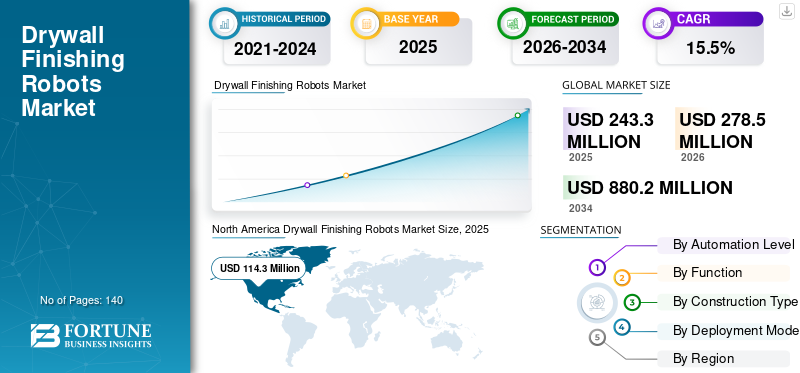
The drywall finishing robots market size was valued at USD 243.3 million in 2025. The market is projected to grow from USD 278.5 million in 2026 to USD 880.2 million by 2034, exhibiting a CAGR of 15.5% during the forecast period. North America dominated the drywall finishing robots market with a market share of 46.97% in 2025.
Drywall finishing robots comprises autonomous and semi-automated robotic systems robot designed to automate drywall surface preparation and interior finishing activities across residential commercial and industrial construction environments. These robotic systems support the integration of robotic technologies including advanced machine vision systems, AI-enabled navigation software, robotic arms, sensor modules, surface scanning systems, automated compound application tools, and precision sanding technologies to deliver high quality finishes across modern construction workflows. Drywall finishing robots enable contractors to improve workflow efficiency, reduce project timelines, minimize manual labor dependency, lower material wastage, and enhance efficiency worker safety across large-scale interior construction and infrastructure projects. Increasing labor shortages in construction trades, rapid urbanization, rising demand for productivity optimization, and growing adoption of automated solutions are accelerating deployment of these solutions across global building sectors. These systems are increasingly utilized across commercial industrial and infrastructure developments including commercial buildings, high-rise residential projects, modular construction facilities, healthcare infrastructure, airports, hospitality projects, and smart city developments where precision finishing, scalable automation, and operational efficiency are becoming critical construction requirements. In addition, growing focus on distribution channel segmentation, including sales distributors online sales platforms and contractor-focused equipment deployment models, is further supporting commercialization of robotic drywall finishing technologies globally.
- For instance, in July 2024, Canvas introduced its next-generation drywall finishing robotic platform with enhanced AI-driven surface analysis capabilities, automated sanding optimization, and integrated dust-control technology designed to improve productivity and finishing accuracy across commercial interior construction applications.
Canvas, Okibo Ltd., Hilti Corporation, Built Robotics Inc., Dusty Robotics, Advanced Construction Robotics, Wintor, CyBe Construction, Construction Robotics LLC, and Toggle Robotics are among the major companies operating in the market. Their market positioning is supported by expertise in autonomous construction technologies, robotic finishing systems, AI-enabled construction automation platforms, machine vision integration, robotic mobility systems, and smart jobsite solutions. Additionally, continued investments in autonomous navigation software, BIM-integrated robotics platforms, cloud-connected construction analytics, precision finishing technologies, and scalable robotics-as-a-service deployment models supports evolving digital construction and labor optimization requirements.
Download Free sample to learn more about this report.
DRYWALL FINISHING ROBOTS MARKET KEY TAKEAWAYS
 Global Market Size & Forecast
- 2025 Market Size: USD 243.3 million
- 2026 Market Size: USD 278.5 million
- 2034 Forecast Market Size: USD 880.2 million
- CAGR: 15.50% from 2026–2034
 Market Share
- North America dominated the market with a 46.97% share in 2025.
- The Semi-autonomous segment held the largest market share in 2025.
- The Sanding segment held the largest market share in 2025.
 Key Regional Highlights
North America
Reached USD 114.3 million in 2025, driven by construction automation, labor shortages, and AI-enabled robotic systems.
Europe
Growth is supported by increasing adoption of construction robotics, modular construction, and smart building initiatives.
Asia Pacific
Reached USD 52.8 million in 2025, driven by robotic drywall systems and growing commercial and residential construction.
U.S.
The market is projected to reach USD 108.5 million by 2026, driven by strong adoption of AI-enabled drywall finishing robots and commercial construction modernization.
Japan
The market is projected to reach USD 10.7 million by 2026, accounting for 3.8% of global sales.
Read More

DRYWALL FINISHING ROBOTS MARKET TRENDS
Rising Adoption of AI-Enabled Construction Automation and Robotic Surface Finishing Systems is Emerging Market Trend
Demand for drywall finishing robots is increasingly being driven by the growing adoption of AI-enabled construction automation systems, robotic surface finishing technologies, and autonomous interior construction solutions across commercial and residential building sectors. As construction companies continue facing severe skilled labor shortages, rising labor costs, and increasing pressure to improve project productivity, contractors are investing in advanced drywall finishing robots capable of supporting automated sanding, mudding, skimming, surface inspection, and precision finishing operations across large-scale construction environments. The market is witnessing growth in demand for AI-powered robotic navigation systems, machine vision-enabled surface analysis platforms, automated compound application technologies, BIM-integrated robotics systems, and cloud-connected construction automation solutions that can improve finishing consistency, reduce rework rates, minimize project delays, and support high-efficiency digital construction workflows.
- For instance, in December 2025, Okibo announced the launch of its EG7+ robot following its successful premiere at Hensel Phelps Innovation Day. The fully autonomous, AI-guided robot is designed for high-wall sanding, painting, and Level 4 drywall finishing applications, with a reach of up to 24 feet and claimed productivity gains for Level 4 and Level 5 sanding jobs.
MARKET DYNAMICS
MARKET DRIVERS
Download Free sample to learn more about this report.
Rising Construction Automation, Labor Shortages, and Demand for Productivity Optimization Drives Market Growth
The drywall finishing robots market growth is increasingly being driven by rapid adoption of construction automation technologies, growing labor shortages across drywall and interior finishing trades, and rising demand for productivity optimization within commercial and residential construction sectors. As contractors continue facing issues related to project backlogs, skilled workforce limitations, rising labor costs, and tighter project completion timelines, construction companies are investing heavily in autonomous and semi-autonomous drywall finishing systems capable of supporting automated sanding, mudding, skimming, surface inspection, and precision finishing operations across large-scale building environments. Drywall finishing robots are becoming a critical component within modern digital construction ecosystems as contractors seek to improve finishing consistency, reduce rework rates, minimize project delays, optimize labor utilization, enhance workplace safety, and improve operational scalability across complex interior construction workflows.
- For instance, in January 2026, JLG acquired Canvas, a San Francisco-based drywall-finishing robotics company, to expand its construction automation portfolio. The acquisition strengthened JLG’s roadmap for robotic jobsite solutions by adding Canvas’ drywall finishing platform, which automates repetitive interior finishing tasks and reduces physical strain on workers.
MARKET RESTRAINTS
High Deployment Costs, Construction Site Complexity, and Limited Contractor Readiness Restricts Wider Market Penetration
The growth of the market is constrained by high deployment costs associated with advanced construction robotics systems, complex jobsite integration requirements, and the operational challenges involved in deploying autonomous finishing technologies across dynamic construction environments. Unlike traditional fixed industrial automation systems, drywall finishing robots must operate within constantly changing construction sites characterized by uneven surfaces, variable layouts, unfinished infrastructure conditions, dust-intensive environments, and continuously shifting worker activity. This creates significant navigation, calibration, and workflow synchronization challenges for robotics providers and contractors. In addition, robotic drywall finishing systems often require substantial upfront capital investment for robotic hardware, AI-enabled vision systems, software integration, training, maintenance, and project-specific deployment customization, resulting in higher adoption barriers for small and medium-sized contractors.
MARKET OPPORTUNITIES
Rising Adoption of Modular Construction and Robotics-as-a-Service Models Creates Long-Term Market Opportunities
A major opportunity emerging within the market is increasing adoption of modular construction methodologies, prefabricated building systems, and robotics-as-a-service (RaaS) deployment models across global construction sectors. As contractors and developers continue seeking faster project completion timelines, scalable labor alternatives, and improved construction productivity, demand is increasing for robotic drywall finishing systems capable of supporting high-volume, repeatable, and precision-driven interior finishing operations across commercial and residential construction environments. This is creating substantial opportunities for vendors offering AI-enabled robotic sanding systems, autonomous surface finishing platforms, BIM-integrated robotics technologies, cloud-connected construction analytics solutions, and service-based robotic deployment models optimized for large-scale construction automation ecosystems.
- For instance, in March 2026, Okibo announced a strategic trade partnership with Autonomous Workforce – AI Solutions LLC to accelerate its Southern U.S. expansion. The collaboration includes bringing Okibo’s construction robotic technology to regional jobsites and establishing a training facility for construction leaders and operators.
MARKET CHALLENGES
Dynamic Construction Site Conditions and Limited Workflow Standardization Challenges Large-Scale Commercial Adoption
One of the major challenges affecting the market is the operational complexity associated with deploying autonomous robotic systems across highly dynamic and non-standardized construction environments. Unlike fixed industrial manufacturing facilities, construction sites continuously evolve throughout project lifecycles, creating significant challenges for robotic navigation, surface mapping, workflow synchronization, and precision finishing consistency. Drywall finishing robots must frequently operate across uneven flooring conditions, incomplete infrastructure layouts, variable wall geometries, dust-intensive environments, changing lighting conditions, and active multi-trade construction zones, which can impact robotic accuracy, operational stability, and overall deployment efficiency. In addition, the fragmented nature of global construction workflows creates challenges related to contractor-specific finishing standards, inconsistent drywall installation quality, varying material specifications, and project-specific customization requirements that often limit seamless robotic scalability across different jobsite environments.
Segmentation Analysis
By Automation Level
Semi-Autonomous Segment Led Market Owing to Faster Commercial Adoption across Large-Scale Construction Projects
By automation level, the market is segmented into fully autonomous and semi-autonomous level system.
Semi-autonomous segment held the largest market share as these systems currently offer the most commercially viable and operationally flexible solution across modern drywall finishing environments. Construction contractors are increasingly adopting semi-autonomous robotic systems capable of supporting automated sanding, mudding, skimming, and surface finishing operations while still allowing human supervision and workflow adjustments across dynamic construction sites. Compared to fully autonomous systems, semi-autonomous drywall finishing robots provide lower deployment complexity, improved jobsite adaptability, reduced integration risk, and greater compatibility with existing construction workflows, making them more suitable for current commercial construction environments. Growing labor shortages, increasing pressure to improve project productivity, and rising demand for safer interior finishing operations across commercial buildings, healthcare facilities, hospitality projects, airports, and modular construction sites have significantly accelerated adoption of semi-autonomous drywall finishing robots globally. In addition, contractors continue favoring semi-autonomous systems as they require lower operational standardization while enabling gradual transition toward broader construction automation adoption.
- For instance, in March 2026, Okibo unveiled its BLASTER double-nozzle spray technology for EG7 and EG7+ robots, designed to improve spraying efficiency and repeatability across large-scale construction jobsites.
Fully autonomous is expected to witness the highest growth rate, with a CAGR of 17.4%, driven by increasing advancements in AI-enabled robotic navigation, machine vision technologies, and autonomous surface mapping systems. Additionally, BIM-integrated construction automation platforms and rising contractor demand for fully automated interior finishing workflows capable of reducing labor dependency and improving large-scale construction productivity also boosts segment growth.
To know how our report can help streamline your business, Speak to Analyst
By Function
Sanding Segment Dominates Owing to High Labor Intensity and Growing Demand for Automated Surface Finishing Operations
By function, the market is segmented into taping, mudding, sanding, skimming & finishing, and surface inspection.
Sanding held the largest drywall finishing robots market share as drywall sanding remains one of the most labor-intensive, repetitive, and physically demanding activities within interior construction workflows. Construction contractors are increasingly deploying robotic drywall sanding systems to improve finishing consistency, reduce airborne dust exposure, minimize worker fatigue, and accelerate project completion timelines across large commercial and residential construction projects. Robotic sanding systems are witnessing strong adoption across office buildings, healthcare infrastructure, hospitality projects, educational facilities, airports, and modular construction environments where high-volume drywall finishing operations require consistent surface quality and scalable labor efficiency. In addition, increasing focus on workplace safety regulations, dust-control requirements, and labor productivity optimization is further accelerating deployment of automated drywall sanding technologies globally.
Surface inspection is expected to witness the highest growth rate, with a CAGR of 17.0%, driven by increasing adoption of AI-enabled defect detection systems, machine vision-based wall analysis technologies, automated quality verification platforms, and smart construction inspection solutions designed to improve finishing precision and reduce rework rates across complex interior construction environments.
By Construction Type
New Construction Segment Dominates Due to Rising Deployment of Automated Interior Finishing Technologies across Large-Scale Building Projects
By construction type, the market is segmented into new construction, renovation & remodeling, and modular & prefabricated construction.
New construction held the largest market share as large-scale commercial, residential, healthcare, hospitality, and infrastructure development projects continue driving demand for automated drywall finishing technologies across global construction environments. Construction contractors are increasingly deploying robotic drywall finishing systems across new building projects to improve labor productivity, accelerate project timelines, reduce finishing inconsistencies, and support scalable interior construction workflows within high-volume development environments. Automated sanding, mudding, skimming, and surface finishing systems are witnessing strong adoption across office towers, airports, educational institutions, hospitals, mixed-use developments, and smart building projects where construction firms are under increasing pressure to optimize workforce utilization and improve operational efficiency.
Modular & prefabricated construction is expected to witness the highest growth rate, with a CAGR of 16.8%, driven by increasing adoption of factory-controlled construction workflows, standardized interior finishing environments and off-site building manufacturing technologies. Additionally, automation-driven prefabrication systems requiring repeatable, high-efficiency robotic drywall finishing capabilities across scalable modular construction operations also propels segment growth.
By Deployment Model
Direct Purchase Segment Dominates Due to Rising Capital Investments in Large-Scale Construction Automation Infrastructure
By deployment model, the market is segmented into direct purchase, rental/leasing, and Robotics-as-a-Service (RaaS).
Direct purchase held the largest market share as large construction contractors, commercial drywall specialists, and modular construction companies continue investing directly in robotic drywall finishing systems to support long-term automation strategies and improve operational scalability across high-volume construction environments. Major contractors are increasingly purchasing robotic sanding, mudding, and surface finishing systems to reduce dependency on skilled labor, improve project execution efficiency, lower long-term operational costs, and strengthen competitive positioning within large commercial construction markets. Direct ownership also enables construction firms to integrate robotic systems more effectively within internal project workflows, workforce planning strategies, and digital construction ecosystems while maintaining greater operational control over equipment utilization and deployment scheduling.
Robotics-as-a-Service (RaaS) is expected to witness the highest growth rate, with a CAGR of 18.0%, driven by increasing contractor preference for flexible subscription-based robotics deployment models, lower upfront capital requirements, reduced maintenance responsibility, and growing demand for scalable construction automation solutions among mid-sized and regional construction firms.
Drywall Finishing Robots Market Regional Outlook
By geography, the market is categorized into Europe, North America, Asia Pacific, South America, and the Middle East & Africa.
North America
North America Drywall Finishing Robots Market Size, 2025 (USD Million)
To get more information on the regional analysis of this market, Download Free sample
The North America region dominated the global market and reached USD 114.3 million in 2025, supported by increasing adoption of construction automation technologies, rising labor shortages across drywall finishing trades, and growing investment in AI-enabled robotic construction systems across the U.S., Canada, and Mexico. Regional demand is strongly influenced by increasing deployment of robotic sanding systems, autonomous drywall finishing platforms, machine vision-enabled surface inspection technologies, and smart construction automation solutions across commercial office developments, healthcare infrastructure, hospitality projects, educational facilities, airports, and industrial construction environments. The region benefits from advanced construction technology adoption, high labor costs, strong contractor investment capacity, expanding modular construction activities, and the presence of major construction robotics innovators. These companies are highly investing in autonomous navigation systems, robotic finishing technologies, and AI-driven digital construction platforms.
U.S. Drywall Finishing Robots Market
The U.S. is expected to dominate the regional market with an estimated revenue of about USD 108.5 million in 2026, driven by strong adoption of construction automation technologies, increasing shortage of skilled drywall finishers, and rising investment in large-scale commercial construction modernization initiatives. The country has emerged as one of the leading adopters of robotic drywall sanding and finishing systems integrated with AI-enabled navigation technologies, machine vision platforms, BIM-connected construction workflows, and cloud-based project monitoring systems. Demand for drywall finishing robots remains particularly strong across commercial office buildings, healthcare facilities, airports, educational institutions, hospitality projects, mixed-use developments, and data center construction environments. In these environments, contractors increasingly require automation-driven productivity improvement, reduced finishing inconsistencies, enhanced worker safety, and accelerated project completion capabilities.
Europe
The Europe market is driven by rising adoption of construction robotics technologies, increasing labor shortages within interior finishing trades, and growing investment in smart building and modular construction infrastructure across Germany, the U.K., France, Italy, Spain, the Nordics, and other European construction markets. Regional demand is closely associated with commercial building modernization, sustainable construction initiatives, industrial prefabrication growth, and expanding implementation of AI-enabled construction automation platforms designed to improve productivity, reduce rework, and optimize labor utilization across interior construction workflows.
U.K. Drywall Finishing Robots Market
The U.K. market in 2026 is estimated at around USD 11.7 million, representing roughly 4.2% of global sales.
Germany Drywall Finishing Robots Market
Germany market is projected to reach approximately USD 14.9 million in 2026, equivalent to around 5.4% of global sales.
Asia Pacific
Asia Pacific remains the significant market and generated revenue of USD 52.8 million in 2025 globally. Regional market expansion is strongly associated with growing deployment of robotic drywall sanding systems and autonomous surface finishing platforms across commercial office developments and residential high-rise projects. Moreover, healthcare infrastructure, transportation hubs, hospitality facilities, and industrial construction environments are also adopting machine vision-enabled inspection technologies and smart construction automation solutions.
China Drywall Finishing Robots Market
China’s market is projected to remain the dominant in the Asia Pacific region, with 2026 revenues estimated at around USD 22.0 million, representing roughly 7.9% of global sales.
Japan Drywall Finishing Robots Market
The Japan market in 2026 is estimated at around USD 10.7 million, accounting for roughly 3.8% of the global sales.
India Drywall Finishing Robots Market
The India market in 2026 is estimated at around USD 9.0 million, accounting for roughly 3.2% of global sales.
Middle East & Africa
The Middle East & Africa market is driven by increasing investment in smart construction technologies, large-scale commercial infrastructure development, and growing adoption of construction automation systems across GCC countries, Israel, South Africa, and North Africa. Demand for drywall finishing robots is closely associated with rising deployment of robotic sanding systems, autonomous surface finishing platforms, AI-enabled construction robotics, and digital jobsite automation technologies across commercial office developments, hospitality projects, healthcare infrastructure, transportation hubs, industrial facilities, and smart city construction environments.
GCC Drywall Finishing Robots Market
The GCC market is projected to reach around USD 6.1 million in 2026, representing roughly 2.2% of the global sales.
South America
The South America market growth is driven by increasing construction modernization activities, gradual adoption of construction automation technologies, and rising investment in commercial and infrastructure development projects across major economies such as Brazil, Argentina, and Chile. Demand for drywall finishing robots in the region is primarily associated with commercial construction projects, hospitality infrastructure, healthcare facilities, mixed-use developments, industrial buildings, and urban residential construction rather than highly advanced large-scale digital construction ecosystems seen in North America or parts of Europe and Asia Pacific.
Brazil Drywall Finishing Robots Market
The Brazil market is projected to reach around USD 4.5 million in 2026, representing roughly 1.6% of the global sales.
COMPETITIVE LANDSCAPE
Key Industry Players
Increasing Adoption of Autonomous Construction Robotics and AI-Enabled Navigation Technologies by Key Players Drives Market Competition
The market is highly specialized and emerging in nature, with competitive positioning shaped by capabilities in autonomous construction robotics, AI-enabled surface finishing technologies, machine vision integration, robotic mobility systems, BIM-connected construction workflows, and intelligent jobsite automation platforms. Leading companies including Okibo Ltd., Canvas, Hilti Corporation, Built Robotics Inc., Dusty Robotics, Advanced Construction Robotics, Construction Robotics LLC, CyBe Construction, Toggle Robotics, and Wintor maintain competitive market positions through robotic construction platforms capable of supporting automated sanding, mudding, skimming, surface inspection, and precision drywall finishing operations across commercial and industrial construction environments.
Competitive differentiation is increasingly influenced by the ability to support AI-driven robotic navigation, autonomous wall scanning, machine vision-based defect detection, dust-controlled robotic sanding systems, cloud-connected project monitoring, and scalable robotics-as-a-service deployment models across modern digital construction ecosystems. Companies are continuously investing in autonomous mobility technologies, robotic arm optimization, BIM-integrated construction software, real-time jobsite analytics, edge AI construction platforms, and precision surface finishing systems. This aids in improving project productivity, reduce labor dependency, enhance worker safety, accelerate project execution timelines, and support broader construction automation adoption across commercial buildings, healthcare infrastructure, hospitality projects, airports, modular construction facilities, and smart city developments.
- For instance, in September 2025, Okibo partnered with PCI for deployment of its drywall finishing robotics technologies at the King of Prussia development project in Pennsylvania, supporting automated drywall sanding and finishing operations across large commercial construction environments.
LIST OF KEY DRYWALL FINISHING ROBOTS COMPANIES PROFILED
- Okibo Ltd. (Israel)
- Canvas (U.S.)
- Raise Robotics (U.S.)
- CyBe Construction (The Netherlands)
- Construction Robotics, LLC (U.S.)
- Baubot GmbH (Austria)
- Universal Robots USA, Inc. (U.S.)
- RobotATTA (Japan)
- HP Development Company (U.S.)
- Steadfast Entities LLC (U.S.)
KEY INDUSTRY DEVELOPMENTS
- April 2026: Okibo Ltd. introduced upgraded AI-enabled robotic path planning capabilities for its drywall finishing platforms aimed at improving autonomous movement efficiency and reducing manual intervention across large commercial construction sites.
- March 2026: Canvas expanded robotics-as-a-service deployment offerings for commercial contractors seeking flexible automated drywall sanding and finishing solutions without high upfront equipment investment requirements.
- February 2026: Construction Robotics, LLC increased focus on robotic interior construction automation technologies through expanded development initiatives targeting automated wall finishing and construction productivity optimization applications.
- January 2026: Advanced Construction Robotics, Inc. strengthened its construction automation portfolio through continued investment in autonomous robotic technologies designed to improve labor productivity and operational efficiency across large-scale construction environments.
- November 2025: Dusty Robotics expanded integration capabilities between robotic construction layout technologies and digital construction management platforms to improve workflow coordination across automated construction environments.
REPORT COVERAGE
The global drywall finishing robots market analysis includes a comprehensive study of the market size & forecast by all the market segments included in the report. It includes details on the market dynamics and market trends expected to drive the market over the forecast period. It provides information on key aspects, including an overview of technological advancements, the regulatory environment, and product launches. Additionally, it details partnerships, mergers & acquisitions, and key industry developments and prevalence by key regions. The global market research report also provides a depth competitive landscape with information on the market share and profiles of key operating players.
Request for Customization to gain extensive market insights.
Report Scope & Segmentation
| ATTRIBUTE | DETAILS |
| Study Period | 2021-2034 |
| Base Year | 2025 |
| Estimated Year | 2026 |
| Forecast Period | 2026-2034 |
| Historical Period | 2021-2024 |
| Growth Rate | CAGR of 15.5% from 2026-2034 |
| Unit | Value (USD Million) |
| Segmentation | By Automation Level, Function, Construction Type, Deployment Model and Region |
| By Automation Level |
|
| By Function |
|
| By Construction Type |
|
| By Deployment Model |
|
| By Region |
|
Frequently Asked Questions
According to Fortune Business Insights, the global market value is anticipated at USD 278.5 million in 2026 and is projected to reach USD 880.2 million by 2034.
In 2025, North America’s market value stood at USD 114.3 million.
The market is expected to exhibit a CAGR of 15.5% during the forecast period (2026-2034).
By deployment model, the direct purchase segment leads the market.
Construction labor shortages, rising automation adoption, modular construction growth, AI-enabled robotics, productivity optimization, and demand for efficient finishing drive market growth.
Okibo Ltd., Canvas, Raise Robotics, CyBe Construction, Construction Robotics, LLC, and Baubot GmbH are the top players in the market.
North America held the largest market share in 2025.



- 2021-2034
- 2025
- 2021-2024
- 140
Get 30-60 hrs Free Customization
Expand Regional and Country Coverage, Segments Analysis, Company Profiles, Competitive Benchmarking, and End-user Insights.















Related Reports
-
US +1 833 909 2966 ( Toll Free )
-
Get In Touch With Us