Electric Vehicle Repair Service Market Size, Share & Industry Analysis, By Service Type (Battery Services, Electrical & Powertrain Services, Diagnostics & Software Services, General Maintenance Services, and Charging System Services), By Vehicle Type (Passenger Cars, Light Commercial Vehicles (LCVs), and Heavy Commercial Vehicles (HCVs)), By Electric Vehicle Type (Battery Electric Vehicles (BEVs), Hybrid Electric Vehicles (HEVs), and Others), By Service Mode (Workshop-based and Mobile/On-demand), and Regional Forecasts, 2026-2034
 Download Free Sample
(Offer valid till 30th Sep 2026)

Electric Vehicle Repair Service Market Size and Future Outlook
 Listen to Audio Version
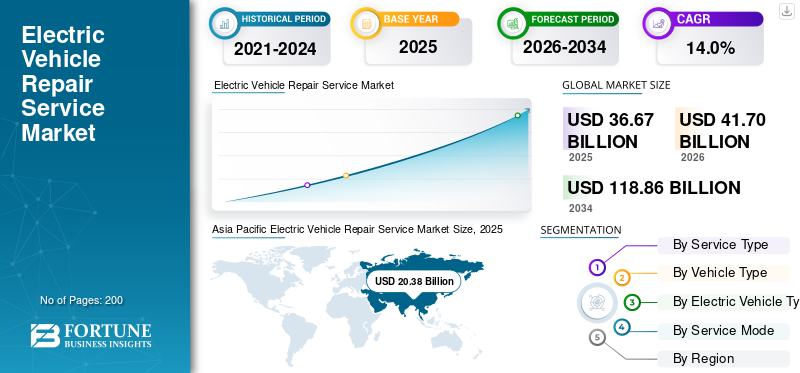
The global electric vehicle repair service market size was valued at USD 36.67 billion in 2025. The market is projected to grow from USD 41.70 billion in 2026 to USD 118.86 billion by 2034, exhibiting a CAGR of 14.0% during the forecast period. Asia Pacific dominated the electric vehicle repair service market with a market share of 55.58% in 2025.
The electric vehicle repair service market represents the ecosystem of maintenance, diagnostics, and repair services required to support the growing fleet of battery electric vehicles (BEVs), plug-in hybrid electric vehicles (PHEVs), and other electrified mobility solutions. Unlike traditional vehicles powered by internal combustion engines, EVs rely heavily on advanced electronics, high-voltage systems, and software-driven architectures, which are transforming the role of the modern service center. As the number of electric cars increases globally, demand for electric vehicle repair services is expanding steadily.
This market is driven by rapid EV adoption supported by government incentives, stricter emission norms, and investments in charging infrastructure. The shift toward electrification is particularly visible in regions such as the Asia Pacific and North America, where EV penetration continues to rise. Additionally, the increasing complexity of EV systems requires specialized diagnostics, software updates, and battery maintenance, creating new revenue streams for service providers.
The market is also evolving with the integration of digital tools, remote diagnostics, and predictive maintenance technologies. As EV fleets mature, out-of-warranty vehicles will further increase the need for independent repair services. Moreover, the inclusion of commercial vehicles in electrification strategies will contribute significantly to future growth.
In the coming years, the market is expected to grow as more global EV manufacturers expand their after-sales networks. Leading players such as Bosch, Volkswagen, and Tesla are investing in technician training, expanding service infrastructure, and forming partnerships to enhance their market share and improve service efficiency.
Download Free sample to learn more about this report.
ELECTRIC VEHICLE REPAIR SERVICE MARKET KEY TAKEAWAYS
 Market Size & Forecast
- 2025 Market Size: USD 36.67 Billion
- 2026 Market Size: USD 41.70 Billion
- 2034 Forecast Market Size: USD 118.86 Billion
- CAGR: 14.0% from 2026–2034
 Market Share
- Asia Pacific dominated the electric vehicle repair service market with a 55.58% share in 2025.
- Battery services held the largest market share owing to high battery repair and replacement costs.
- Passenger vehicles dominated the market due to their large installed EV base and strong service demand.
 Key Regional Highlights
Asia Pacific
Asia Pacific led the global market with USD 20.38 billion in revenue in 2025.
Europe
Europe is expected to remain the second-largest regional market, driven by regulatory support, sustainability initiatives, and growing electric vehicle penetration.
North America
North America is projected to witness strong growth due to rising EV adoption, advanced service center networks, and increasing use of digital diagnostics and software updates.
U.S.
The market generated USD 5.97 billion in 2025.
Japan
The market is benefiting from increasing EV adoption, advanced automotive service infrastructure, and continued investments in electric mobility technologies.
Read More

ELECTRIC VEHICLE REPAIR SERVICE MARKET TRENDS
Increasing Integration of Software-Driven Diagnostics Fuels Market Trend
The EV repair market is witnessing a growing trend toward digitalization, with increasing use of remote diagnostics and software updates to identify and resolve issues efficiently. These advancements reduce downtime and improve service accuracy, particularly for connected global EV fleets. The shift toward software-centric maintenance is transforming traditional repair processes and enhancing overall operational efficiency.
- For instance, in February 2024, Rivian introduced enhanced remote diagnostics capabilities that allow vehicles to be monitored and issues identified without physical inspection, improving service efficiency and reducing downtime.
Market Dynamics
MARKET DRIVERS
Download Free sample to learn more about this report.
Rising EV Adoption Accelerated by Government Incentives Boosts Market Expansion
The electric vehicle repair service market growth is driven by the increasing adoption of EVs, supported by government incentives and the expansion of charging infrastructure. As more electric cars enter the global fleet, the need for specialized services such as battery maintenance and diagnostics increases. This growing installed base directly contributes to higher demand for EV repair services across regions.
- For instance, in April 2024, the IEA reported global EV sales exceeding 14 million units, driven by strong policy incentives and infrastructure expansion.
MARKET RESTRAINTS
Limited Availability of Skilled Technicians for Advanced EV Systems Restrains the Market Growth
The shortage of skilled technicians trained in EV-specific technologies acts as a major restraint on market growth. Unlike internal combustion engines, EVs require expertise in electronics, software, and high-voltage systems, which are not widely available across all service providers. This limits the scalability of repair networks and increases reliance on OEM-operated service centers.
- For instance, in January 2024, the U.S. Department of Energy highlighted a growing skills gap in EV maintenance and repair services.
MARKET OPPORTUNITIES
Expansion of Independent Service Networks for Out-of-Warranty EVs Curates New Opportunities
The growing number of out-of-warranty EVs presents a strong opportunity for independent service providers to expand their offerings. As EV adoption increases, cost-conscious customers are likely to seek alternatives beyond OEM service centers. This creates opportunities for multi-brand service providers to capture a larger market share and deliver cost-effective solutions across regions.
- For instance, in June 2024, Bosch expanded its EV service network to support independent workshops across Europe.
MARKET CHALLENGES
High Cost of EV Components Increases Overall Repair Expenses, Leading to Challenges for the Market
The high cost of EV components, particularly batteries and power electronics, presents a significant challenge to market growth. Repairs involving these components are expensive, which may discourage customers from frequent servicing. This cost barrier affects the adoption of advanced repair services and limits the affordability of maintenance compared to conventional vehicles.
- For instance, in August 2024, reports indicated EV battery replacement costs remain significantly higher than traditional vehicle repairs.
Segmentation Analysis
By Service Type
Increasing Repair and Replacement Costs Drive the Dominance of the Battery Services Segment
Based on service type, the market is segmented into battery services, electrical & powertrain services, diagnostics & software services, general maintenance services, and charging system services.
Battery services dominated the electric vehicle repair service market share due to their high repair and replacement costs, which significantly contribute to overall revenue. Even though service frequency is lower compared to other categories, the high value of battery-related repairs, such as diagnostics and module replacement, drives dominance in value share. Also, the increasing demand for battery maintenance further strengthens this segment.
- For instance, in May 2024, CATL introduced battery repair solutions to extend the lifecycle and reduce replacement costs.
The charging system services segment is expected to grow at a 20.9% CAGR over the forecast period.
To know how our report can help streamline your business, Speak to Analyst
By Vehicle Type
Passenger Vehicles Dominate Due to High EV Adoption Rates Among Individual Consumers
Based on vehicle type, the market is segmented into passenger cars, light commercial vehicles (LCVs), and heavy commercial vehicles (HCVs).
Passenger vehicles dominated the market due to widespread adoption of EVs among individual consumers. The growing number of electric cars and supportive policies have accelerated demand for repair services. Compared to commercial vehicles, passenger EVs have a larger installed base, leading to higher service demand and a stronger contribution to overall market revenue.
- For instance, in April 2024, Tesla reported strong global growth in passenger electric vehicle deliveries, reinforcing the dominance of passenger cars in the EV fleet and associated repair service demand.
The heavy commercial vehicles segment is expected to grow at a CAGR of 19.5% over the forecast period.
To know how our report can help streamline your business, Speak to Analyst
By Electric Vehicle Type
Battery Electric Vehicles Dominate Due to the Requirement of Specialized Maintenance and Repair Services
Based on electric vehicle type, the market is divided into battery electric vehicles (BEVs), hybrid electric vehicles (HEVs), and others.
Battery Electric Vehicles (BEVs) dominated the market as they rely entirely on electric systems, requiring specialized maintenance and repair services. Unlike vehicles, PHEVs and BEVs depend more on electrical components, increasing service complexity and demand. This results in a higher contribution to the EV repair market compared to other vehicle types.
- For instance, in April 2024, BYD reported that battery electric vehicles accounted for a significant share of its global EV sales, reflecting growing demand for fully electric platforms requiring specialized repair services.
The Hybrid Electric Vehicles (HEVs) segment is expected to grow at a CAGR of 12.9% over the forecast period.
By Service Mode
Workshop-Based Services Dominate Due to Infrastructure Requirements for EV Repairs
Based on service mode, the market is segmented into workshop-based and mobile/on-demand.
Workshop-based services dominated due to the specialized equipment and safety infrastructure needed for EV repairs. Handling high-voltage systems and complex diagnostics is not feasible outside controlled environments. As a result, most repairs are conducted in dedicated service center facilities, ensuring safety, efficiency, and compliance with technical standards.
- For instance, in March 2024, Tesla continued expanding its mobile service fleet, enabling on-site diagnostics and minor repairs, reducing dependence on traditional workshop-based service centers.
The mobile/on-demand segment is expected to grow at a 18.5% CAGR over the forecast period.
Electric Vehicle Repair Service Market Regional Outlook
By region, the market is categorized into North America, Europe, Asia Pacific, and the Rest of the World.
Asia Pacific
Asia Pacific Electric Vehicle Repair Service Market Size, 2025 (USD Billion)
To get more information on the regional analysis of this market, Download Free sample
Asia Pacific held the dominant share in 2025, valued at USD 20.38 billion, and also maintained the leading share in 2024, with USD 15.92 billion. The Asia Pacific dominates the regional market due to its large and rapidly expanding EV fleet, particularly in China. The region benefits from strong government incentives, high adoption of battery electric vehicles, and continuous expansion of charging infrastructure. The increasing electrification of commercial vehicles and the rising demand for battery maintenance further contribute to growth. Additionally, improvements in service ecosystems and rising demand for electric vehicle repair are strengthening the region’s dominant global position.
- For instance, in 2024, IEA reported that China exceeded 11 million electric vehicles, significantly increasing demand for repair services and strengthening its dominance in the global EV ecosystem.
China Electric Vehicle Repair Service Market
China’s market is projected to be one of the largest worldwide, with revenues at around USD 16.17 billion in 2025, representing roughly 44.1% of the market revenue.
India Electric Vehicle Repair Service Market
The Indian market in 2025 was at around USD 0.91 billion, accounting for roughly 2.5% of revenues.
Europe
Europe is estimated to reach USD 9.28 billion in 2026 and secure the position of the second-largest region in the market. Europe is expected to grow steadily due to strong regulatory support and increasing adoption of electric car models. The presence of advanced service networks and the rising penetration of vehicles drives demand. The growing focus on sustainability and the expansion of charging infrastructure are further supporting demand for electric vehicles across key countries.
Germany Electric Vehicle Repair Service Market
The German market in 2025 was at around USD 2.03 billion, accounting for roughly 5.5% of revenues.
U.K. Electric Vehicle Repair Service Market
The U.K. market in 2025 was at around USD 1.74 billion, accounting for roughly 4.7% of revenues.
North America
North America is projected to grow at 14.7% over the coming years and reach a valuation of USD 0.36 billion by 2026. North America is experiencing strong growth driven by rising EV adoption and high service costs. U.S. leads the region with a strong presence of OEM networks and advanced service center infrastructure. Also, the increasing use of software updates and digital diagnostics is improving service efficiency and driving market expansion.
U.S. Electric Vehicle Repair Service Market
Given North America’s strong contribution and the U.S. dominance in the region, the U.S. market accounted for USD 5.97 billion in 2025, roughly 16.3% of market revenue.
Rest of the World
The rest of the world is gradually expanding as EV adoption increases and infrastructure improves. The growth is supported by rising investments in charging infrastructure and growing awareness of EV benefits. Adoption of fuel cell electric vehicles and other technologies is expected to support long-term market development.
COMPETITIVE LANDSCAPE
Key Industry Players
Service Network Expansion and Digital Capabilities Strengthen the Market Position
The competitive landscape of the electric vehicle repair service market is evolving rapidly as OEMs, independent service providers, and specialized EV companies compete to strengthen their market share. Companies are increasingly focusing on expanding their service center networks to support the growing fleet of battery electric vehicles BEVs, plug-in hybrid vehicles (PHEVs), and other electrified platforms. This expansion is particularly evident in regions such as the Asia Pacific and North America, where EV adoption is accelerating.
One of the primary strategies adopted by key players is the development of advanced diagnostic capabilities and the integration of software updates into repair services. Since EVs rely heavily on digital systems rather than internal combustion engines, companies are investing in remote diagnostics, predictive maintenance, and connected vehicle technologies to improve service efficiency. This enables faster issue detection and enhances customer satisfaction.
Another key strategy involves strengthening capabilities in battery maintenance and high-voltage system repair. As battery systems represent the most critical and expensive component of an EV, companies are investing in specialized training programs and tools to handle complex repairs safely and efficiently. In addition, partnerships with battery manufacturers and technology providers are becoming increasingly common to improve service offerings.
Companies are also targeting emerging opportunities in servicing commercial vehicles, as electrification expands beyond passenger cars. This includes fleet maintenance solutions and customized service contracts, which are expected to significantly increase demand for electric vehicle repair services in the coming years.
Overall, the market is driven by the industry players focusing on technological innovation, geographic expansion, and service differentiation. As the number of EV vehicles increases, competition is expected to intensify, encouraging continuous improvement in service capabilities and operational efficiency.
LIST OF KEY ELECTRIC VEHICLE REPAIR SERVICE COMPANIES PROFILED
- Tesla In (U.S.)
- BYD Company Ltd. (China)
- Hyundai Motor Company (South Korea)
- Nissan Motor Co. Ltd. (Japan)
- BMW Group (Germany)
- Bosch (Germany)
- LKQ Corporation (U.S.)
- Bridgestone Corporation (Japan)
- Halfords Group (U.K.)
- GoMechanic (India)
KEY INDUSTRY DEVELOPMENTS
- January 2026: BMW announced that direct battery recycling had begun at its Cell Recycling Competence Center in Salching with partner Encory. This is highly relevant to EV repair because advanced recycling systems support the economics of battery replacement, component reuse, and sustainable aftersales operations.
- September 2025: Stellantis began real-world testing of its Intelligent Battery Integrated System, which combines charger and inverter functions to simplify maintenance. This innovation can reduce component complexity and may change how EVs are diagnosed and serviced in the future.
- July 2025: GM and Redwood Materials signed a memorandum to pursue the use of second-life GM EV packs and U.S.-built batteries for energy-storage applications. This is important for the repair market because second-life pathways improve battery lifecycle economics and can support refurbishment and end-of-life battery service models.
- June 2025: Free2move, Fiat 500e, and Ample rolled out modular battery-swapping technology in Madrid for car-sharing operations. The move shows how automakers and mobility operators are using swappable battery systems to reduce downtime and create new service models linked to EV maintenance and fleet support.
- June 2025: Ford started mass assembly of battery packs for Explorer and Capri EVs at Cologne. Localized battery-pack assembly can improve service support, replacement logistics, and regional availability of high-voltage components for future repair operations.
- April 2025: GM outlined its work to scale U.S. battery technology, supply chains, and production for EVs. While broader than aftersales alone, this is relevant to the repair market because stronger domestic battery capability supports future replacement, remanufacturing, and resilience in service parts.
- March 2025: NIO and CATL formed a strategic partnership to build a battery-swapping network for passenger vehicles and work on standardization across the battery-swap ecosystem. This matters for the EV repair market because it enables faster battery replacements, improves service uptime, and strengthens the long-term service infrastructure for battery systems.
REPORT COVERAGE
The global electric vehicle repair service market analysis provides an in-depth study of the market size & forecast by all the market segments included in the report. It includes details on the market dynamics and market trends expected to drive the market in the forecast period. It offers information on technological advancements, new product launches, key industry developments, and partnerships, mergers & acquisitions. The research report also includes a detailed competitive landscape, including market share and profiles of key operating players.
Request for Customization to gain extensive market insights.
Report Scope & Segmentation
| ATTRIBUTE | DETAILS |
| Study Period | 2021-2034 |
| Base Year | 2025 |
| Estimated Year | 2026 |
| Forecast Period | 2026-2034 |
| Historical Period | 2021-2024 |
| Growth Rate | CAGR of 14.0% from 2026-2034 |
| Unit | Value (USD Billion) |
| Segmentation | By Service Type, Vehicle Type, Electric Vehicle Type, Service Mode, and Region |
| By Service Type |
|
| By Vehicle Type |
|
| By Electric Vehicle Type |
|
| By Service Mode |
|
| By Region |
|
Frequently Asked Questions
Fortune Business Insights says that the global market value stood at USD 36.67 billion in 2025 and is projected to reach USD 118.86 billion by 2034.
In 2025, Asia Pacific’s market value stood at USD 20.38 billion.
The market is expected to grow at a CAGR of 14.0% over the forecast period.
The passenger cars segment led the market by electric vehicle type.
Rising EV adoption, accelerated by government incentives and infrastructure development, is driving the market.
Bosch, BMW, LKQ, and Tesla are some of the top players in the market.
Asia Pacific dominated the market in 2025.



- 2021-2034
- 2025
- 2021-2024
- 200
-
(Offer valid till 30th Sep 2026)
Get 30-60 hrs Free Customization
Expand Regional and Country Coverage, Segments Analysis, Company Profiles, Competitive Benchmarking, and End-user Insights.




















Related Reports
-
US +1 833 909 2966 ( Toll Free )
-
Get In Touch With Us