Exosome Research Market Size, Share & Industry Analysis, By Offering (Products {Reagents & Kits and Instruments} and Services {Analytical Characterization Services, Profiling Services and Others}), By Workflow (Isolation & Purification, Characterization, Profiling and Others), By Application (Biomarker Discovery & Liquid Biopsy Research, Exosome Therapeutics Research and Others), By End User (P Pharmaceutical & Biotechnology Companies, Academic & Research Institutes and Others), and Regional Forecast, 2026-2034
 Download Free Sample
KEY MARKET INSIGHTS
 Listen to Audio Version
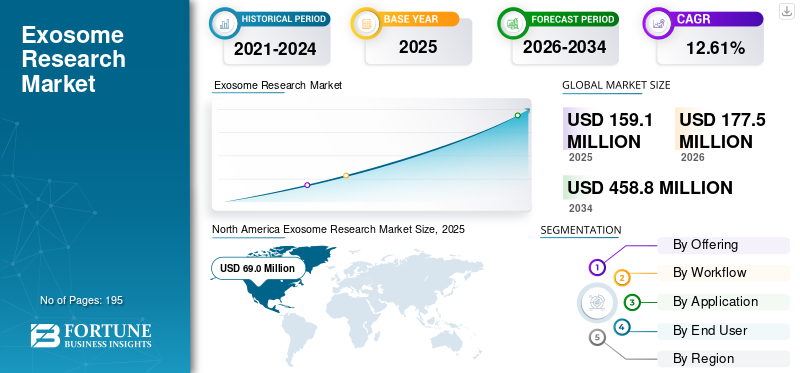
The global exosome research market size was valued at USD 159.1 million in 2025 and is projected to grow from USD 177.5 million in 2026 to USD 458.8 million by 2034, exhibiting a CAGR of 12.61% during the forecast period. North America dominated the global exosome research market with a market share of 43.37% in 2025.
The exosome research comprises of tools and technologies that are used to study exosomes. These are nano-sized extracellular vesicles secreted by cells that mediate intercellular communication. Exosome research supports biomarker discovery, disease mechanism studies, diagnostics development and exploration of novel therapeutic delivery systems. This marketspace is witnessing a strong growth driven by rising cancer burden, emphasis on biomarker discovery and shifting focus on personalized medicine development.
Various key industry players, such as Thermo Fisher Scientific Inc. QIAGEN, and others play an important role in shaping this marketspace. Emphasis on innovative product offerings to maintain their market presence is a key strategy adopted by these market entities.
Download Free sample to learn more about this report.
Exosome Research Market KEY TAKEAWAYS
 Market Size & Forecast
- 2025 Market Size: USD 159.1 million
- 2026 Market Size: USD 177.5 million
- 2034 Forecast Market Size: USD 458.8 million
- CAGR: 12.61% from 2026–2034
 Market Share
- North America dominated the exosome research market with a 43.37% share in 2025.
- The isolation & purification segment is projected to hold a 36.0% share in 2026.
- The biomarker discovery & liquid biopsy research segment is projected to account for a 53.1% share in 2026.
 Key Regional Highlights
North America
North America maintained its leading position in the market, reaching a value of USD 69.0 million in 2025.
Europe
Europe is expected to emerge as the second-largest regional market, reaching USD 46.0 million by 2026
Asia Pacific
Asia Pacific is projected to attain a market value of USD 35.0 million in 2026, ranking as the third-largest regional market.
U.S.
U.S. The market is projected to reach approximately USD 73.2 million in 2026, supported by strong research and biotechnology activities.
Japan
Japan The market is estimated to reach around USD 6.4 million in 2026, driven by growing investments in life sciences and precision medicine research.
Read More

EXOSOME RESEARCH MARKET TRENDS
Integration with Multi-omics Platforms is a Significant Trend Observed in Market
In recent years, proteomics, transcriptomics, and metabolomics are being combined with exosome analysis for deeper biological insights. Multi-omics improves biomarker robustness by combining multi-omics signals, but it also requires more spending on standardized isolation, higher-quality characterization, and advanced bioinformatics/AI pipelines. This trend is further supported by growing interest in understanding EV heterogeneity, where multi-omics helps link vesicle subtypes to biological function and disease state. These factors are supporting the overall exosome research market growth.
- For instance, in June 2025, Mursla Bio announced the commercial launch of its AI Precision Medicine Platform built on organ-specific EV isolation and multi-omics profiling from plasma to enable AI-powered biomarker discovery and diagnostic translation.
Download Free sample to learn more about this report.
MARKET DYNAMICS
MARKET DRIVERS
Rising Global Cancer Burden Driving Biomarker and Liquid Biopsy Research is Propelling Market Growth
Rising global cancer burden is a major driver for the market as it expands the pool of patients who need earlier detection, risk stratification and treatment monitoring, where liquid biopsy is a preferred option. As case volumes rise, researchers increasingly pursue high-throughput biomarker discovery, boosting demand for exosome isolation kits, characterization and omics profiling services. Moreover, exosomes are especially attractive as they circulate in bio fluids and carry tumor-derived molecular cargo, enabling signal-rich liquid biopsy approaches. All these factors cumulatively drive demand for diagnostic biomarkers in turn boosting the overall market growth.
- For instance, according to a data published by WHO in February 2024, the estimated number of new cancer cases is predicted in 2050 to reach over 35 million.
MARKET RESTRAINTS
High Cost of Advanced Analytical Instruments to Limit Market Growth
High cost of advanced analytical instruments is a key restraint for the market. This is because robust EV analysis often requires specialized platforms such as nanoparticle tracking analysis (NTA), nano-flow cytometry, or related high-sensitivity systems. These high upfront costs are often compounded by service contracts, software, accessories and training, further raising total cost of ownership. This results in limiting the market growth to certain extent.
- For instance, according to an article published in International Journal of Molecular Sciences in October 2023, the Nanosight instrument costs over USD 94,000.
MARKET OPPORTUNITIES
Expansion of Translational and Preclinical Research Pipelines to Offer Market Growth Opportunities
Expansion of translational and preclinical research pipelines is a major market opportunity. As more exosome programs are moving beyond basic biology into validated preclinical packages, there is a significant increase in spending on repeatable isolation, advanced characterization, and multi-omics profiling. As candidates progress, developers need tighter CQAs/QC, scalable processes and standardized analytics, in turn driving demand for specialized instruments and outsourced services. All these factors would drive the market growth in the coming years.
- For instance, in March 2025, Lonza announced that Exogenus Therapeutics selected Lonza to develop a GMP-compliant manufacturing process for Exo-101.
MARKET CHALLENGES
Lack of Universally Accepted Isolation and Characterization Standards Pose a Critical Challenge to Market Growth
Lack of universally accepted isolation and characterization standards is a major market challenge. This could be due to exosome preparations vary widely depending on the method used, which changes yield, purity and co-isolated contaminants. This makes results hard to reproduce across labs. Even for characterization, different platforms can produce non-comparable outputs if sample handling and reporting are inconsistent. This weakens confidence in biomarker signatures and slows translation as stakeholders need rigorous, transparent and reproducible datasets. All the factors cumulatively affect the market growth.
- For instance, according to an article published in April 2025, comparing studies is highly challenging due to the lack of validated methodologies for isolation/determination and the lack of well-characterized reference standards.
Segmentation Analysis
By Offering
Rising Demand for Products to Propel Segmental Growth
Based on the offering, the market is divided into products and services.
The product segment is expected to capture the largest exosome research market share. This can be attributed to higher usage of reagents and kits, strong focus on research applications using exosome products and other factors.
- For instance, companies such as Thermo Fisher Scientific, Inc., QIAGEN, and others offer products for exosome research.
The services segment is anticipated to rise with a CAGR of 14.90% over the forecast period.
To know how our report can help streamline your business, Speak to Analyst
By Workflow
Importance of Isolation and Purification Step in Every Application to Boost Segmental Growth
On the basis of workflow, the market is divided into isolation & purification, characterization, profiling, and others.
The isolation & purification segment dominated the global market in 2025. Every downstream activity depends on first recovering exosomes from complex matrices such as plasma or cell cultures media. Laboratories spend heavily since isolation is repeat-purchase intensive and is run across large sample volumes in biomarker studies. Furthermore, the segment is set to hold 36.0% share in 2026.
The characterization segment is anticipated to rise with a CAGR of 11.76% over the forecast period.
By Application
High Focus in Biomarker Discovery to Boost Segmental Growth
On the basis of application, the market is divided into biomarker discovery & liquid biopsy research, exosome therapeutics research, and others.
The biomarker discovery & liquid biopsy research segment captured the highest share of the global market in 2025. Exosomes are attractive biomarker carriers since they circulate in many body fluids and contain molecular cargo that reflects the cell of origin, supporting disease detection and monitoring. This results in their higher usage and demand in biomarker discovery. Furthermore, the segment is set to hold 53.1% share in 2026.
- For instance, according to an article published in July 2025, by the College of American Pathologists, incorporating exosomes into liquid biopsy can improve the sensitivity and comprehensiveness of cancer diagnostics and monitoring.
The exosome therapeutics research segment is anticipated to rise with a CAGR of 18.19% over the forecast period.
By End User
Higher Demand from Academic & Research Institutes Supported their Leading Position
Based on end user, the market is segmented pharmaceutical and biotechnology companies, academic & research institutes, and others.
The academic & research institutes segment captured a dominating position in the global market. As majority of the exosome studies are still discovery-driven, academic & research institutes are the primary end users of the products and services in this market. These institutions also run core facilities and dedicated EV centers that centralize high-cost tools and drive recurring spend on kits, characterization and profiling across many projects, in turn supporting the segment growth. Furthermore, the segment is set to hold 49.3% share in 2026.
- For instance, in July 2025, the University of Florida College of Pharmacy reported an NIH award supporting an extracellular vesicle loading platform to advance EV-based gene therapy development.
In addition, pharmaceutical and biotechnology companies are projected to grow at a CAGR of 16.28% during the study period.
Exosome Research Market Regional Outlook
By geography, the market is segmented into North America, Europe, Asia Pacific, Latin America, and the Middle East & Africa.
North America
North America Exosome Research Market Size, 2025 (USD Million)
To get more information on the regional analysis of this market, Download Free sample
North America market was valued at USD 62.0 million in 2024 and captured the dominating position. The region also maintained its dominance in 2025, with USD 69.0 million of value. North America leads adoption due to strong life science funding, advanced research infrastructure and early uptake of novel molecular analysis technologies.
U.S Exosome Research Market
The U.S. market dominated the North American market and is valued approximated at around USD 73.2 million in 2026, accounting for roughly 41.3% of global market.
Europe
Europe’s market size is projected to witness a CAGR of 12.37% in the coming years. The region is anticipated to become the second highest globally. It would reach a market size of USD 46.0 million by 2026. Europe benefits from collaborative academic networks and strong cancer and biomarker research programs, which drives the market growth.
U.K Exosome Research Market
The U.K. market in 2026 is estimated to be valued at USD 10.3 million, representing roughly 5.8% of global revenues.
Germany Exosome Research Market
Germany’s market size is projected to reach approximately USD 9.4 million in 2026, equivalent to around 5.3% of global sales.
Asia Pacific
Asia Pacific market size is projected to be valued at USD 35.0 million in 2026 and secure a position of the third-largest region in the global industry. The regional market growth is driven by expanding biomedical research investment and infrastructure development in the Asian countries.
Japan Exosome Research Market
The Japan market in 2026 is estimated to be around USD 6.4 million, accounting for roughly 3.6% of global revenues.
China Exosome Research Market
China’s market is projected to reach revenues of around USD 10.5 million in 2026, representing roughly 5.9% of global sales.
India Exosome Research Market
The India’s market in 2026 is estimated at around USD 6.2 million, accounting for roughly 3.5% of global revenues.
Latin America and Middle East & Africa
The Latin America and the Middle East and Africa regions are anticipated to witness a slower growth rate in this coming years. The Latin America exosome research market size is set to reach a valuation of USD 10.3 million in 2026. The improvements in research funding and laboratory capabilities are anticipated to drive the market growth.
COMPETITIVE LANDSCAPE
Key Industry Players
Emphasis on Strategic Initiatives and New Product Launches by Leading Players to Strengthen Market Share
The global market for exosome research is represents a semi-fragmented structure. This is characterized by the presence of several well-established as well as new innovative start-ups in the market. Prominent players such as Thermo Fisher Scientific Inc., QIAGEN, and LONZA are anticipated to account for the major share of the global market. Factors such as strong global presence, wide distribution network and broad portfolio with advanced products have supported the dominance of these companies.
Other key players in the market include System Biosciences, LLC., Danaher, FUJIFILM Corporation, and others. New product development, collaborations & partnerships, and product enhancements are some of the strategies undertaken by these players to gain market share.
LIST OF KEY EXOSOME RESEARCH COMPANIES PROFILED
- Thermo Fisher Scientific Inc. (U.S.)
- QIAGEN (Germany)
- Lonza (Switzerland)
- System Biosciences, LLC. (U.S.)
- Danaher (U.S.)
- FUJIFILM Corporation (FUJIFILM Wako Pure Chemical Corporation) (Japan)
- IZON Science LTD (New Zealand)
- STEMCELL Technologies (Canada)
- RoosterBio, Inc. (U.S.)
- Spectris (U.S.)
KEY INDUSTRY DEVELOPMENTS
- July 2025: CD Bioparticles introduced Purified Exosomes to support drug delivery and therapeutic research applications.
- April 2025: Thermo Fisher Scientific Inc. and RoosterBio Inc. announced a collaboration to advance cell & exosome therapy manufacturing, combining RoosterBio’s hMSC/exosome platform with Thermo Fisher’s GMP manufacturing capabilities
- April 2025: Particle Metrix introduced ZetaView Evolution, a next-generation nanoparticle tracking analysis system positioned for EV/particle characterization.
- April 2025: Daicel showcased its novel exosome isolation system combining automated process combining chromatography and tangential flow filtration at ISEV 2025.
- January 2024: EXO Biologics launched ExoXpert, an exosome-focused CDMO offering an MSC-based exosome manufacturing platform used in European clinical trials.
REPORT COVERAGE
Request for Customization to gain extensive market insights.
Report Scope & Segmentation
|
ATTRIBUTE |
DETAILS |
|
Study Period |
2021-2034 |
|
Base Year |
2025 |
|
Estimated Year |
2026 |
|
Forecast Period |
2026-2034 |
|
Historical Period |
2021-2024 |
|
Growth Rate |
CAGR of 12.61% from 2026-2034 |
|
Unit |
Value (USD Million) |
|
Segmentation |
By Offering, Workflow, Application,, End User, and Region |
|
By Offering |
· Products o Reagents & Kits o Instruments · Services o Analytical Characterization Services o Profiling Services o Others |
|
By Workflow |
· Isolation & Purification · Characterization · Profiling · Others |
|
By Application |
· Biomarker discovery & liquid biopsy research · Exosome Therapeutics Research · Others |
|
By End User |
· Pharmaceutical & Biotechnology Companies · Academic & Research Institutes · Others |
|
By Region |
· North America (By Offering, Workflow, Application,, End User, and Country) o U.S. o Canada · Europe (By Offering, Workflow, Application,, End User, and Country/Sub-region) o Germany o U.K. o France o Spain o Italy o Scandinavia o Rest of Europe · Asia Pacific (By Offering, Workflow, Application,, End User, and Country/Sub-region) o China o Japan o India o Australia o Southeast Asia o Rest of Asia Pacific · Latin America (By Offering, Workflow, Application,, End User, and Country/Sub-region) o Brazil o Mexico o Rest of Latin America · Middle East & Africa (By Offering, Workflow, Application,, End User, and Country/Sub-region) o GCC o South Africa o Rest of Middle East & Africa |
Frequently Asked Questions
According to Fortune Business Insights, the global market value stood at USD 159.1 million in 2025 and is projected to reach USD 458.8 million by 2034.
In 2025, the market value stood at USD 69.0 million.
The market is expected to exhibit a CAGR of 12.61% during the forecast period of 2026-2034.
By offering, the products segment is expected to lead the market.
Rising global cancer burden driving biomarker and liquid biopsy research is primarily driving market expansion.
Thermo Fisher Scientific Inc., QIAGEN, and LONZA are some of the major players in the global market.
North America dominated the market in 2025.



- 2021-2034
- 2025
- 2021-2024
- 195
Get 30-60 hrs Free Customization
Expand Regional and Country Coverage, Segments Analysis, Company Profiles, Competitive Benchmarking, and End-user Insights.













.webp)






Related Reports
-
US +1 833 909 2966 ( Toll Free )
-
Get In Touch With Us