Satellite Data Services Market Size, Share & Industry Analysis, By Type (Satellite Data and Value Added Services), By Industries (Defense & Intelligence, Maritime, Environmental, Agriculture, Energy & Power, and Others), By End Use (Government and Military, and Commercial), and Regional Forecast, 2026-2034
 Download Free Sample
(Offer valid till 15th Aug 2026)
Satellite Data Services Market Size and Future Outlook
 Listen to Audio Version
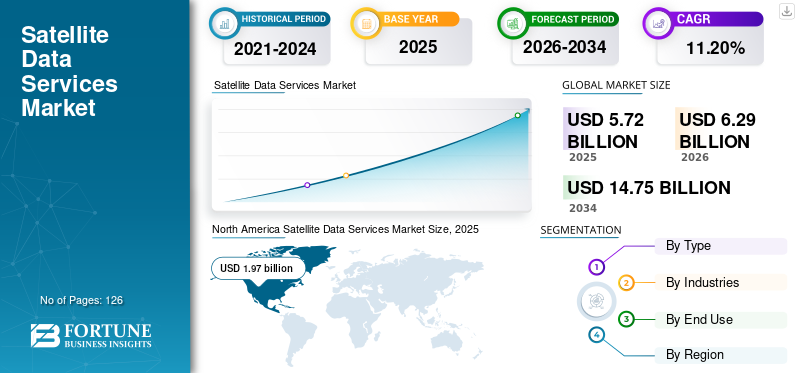
The global satellite data services market size was valued at USD 5.72 billion in 2025. The market is projected to grow from USD 6.29 billion in 2026 to USD 14.75 billion by 2034, exhibiting a CAGR of 11.2% during the forecast period. North America dominated the global market with a market share of 34.44% in 2025.
Satellite data services enable the transport, processing, and delivery of digital information between space assets (satellites, hosted payloads, and on‑orbit processors) and terrestrial users, platforms, and cloud ecosystems. These services span raw telemetry and payload downlinks, value‑added geospatial and temporal analytics, managed data relay and backhaul, mission planning and command-and-control feeds. They also include verticalized data products for sectors such as Earth Observation (EO), climate monitoring, maritime/aviation tracking, remote infrastructure monitoring, agriculture, energy, and defense ISR.
Industry players such as ICEYE, Planet Labs, Inc, Capella Space, and specialized suppliers including satellite operators, ground‑segment integrators, cloud providers, analytics ISVs, subsystem vendors, and new‑space firms are building integrated satellite data suites. These suites combine high‑throughput payloads and optical/ RF relay links, onboard and edge processing, scalable ground and cloud ingest, data‑management platforms, and end‑to‑end vertical services.
Download Free sample to learn more about this report.
SATELLITE DATA SERVICES MARKET TRENDS
Constant Innovation and Technological Advancements is Emerging as a Defining Market Trend
The market is witnessing continuous innovation across sensor payloads, onboard processing, data-fusion platforms, cloud-based delivery, artificial intelligence, and automated geospatial analytics. Service providers are increasingly investing in advanced optical, SAR, hyperspectral, thermal, RF, and climate-focused remote sensing capabilities to improve the quality, speed, and commercial usability of satellite-derived data.
These advancements are enabling more precise monitoring of vegetation health, methane emissions, land-use change, maritime activity, infrastructure movement, mining operations, disaster zones, and environmental risks. The trend is also strengthening the transition toward analytics-ready datasets, API-based data access, and near-real-time monitoring services for government and commercial users.
- In August 2024, Planet launched Tanager-1, a hyperspectral satellite developed with technology from NASA’s Jet Propulsion Laboratory as part of the Carbon Mapper Coalition. The satellite carries an advanced greenhouse-gas-detection instrument designed to identify and quantify methane & carbon dioxide emissions.
This development is significant for the satellite data services market as it expands the use of commercial EO data into climate accountability, emissions monitoring, environmental compliance, mineral mapping, biodiversity assessment, and water-quality analysis.
MARKET DYNAMICS
MARKET DRIVERS
Download Free sample to learn more about this report.
Expansion of Space Economy and Rise in the Launch of Earth Observation Satellites is Propelling Market Growth
The market is being driven by the rapid expansion of the space economy, increasing satellite launch activity, rising deployment of Earth observation satellites, and growing demand for satellite-derived intelligence across commercial, government, climate, and security applications. Earth observation satellites are becoming central to agriculture monitoring, urban planning, disaster response, maritime surveillance, environmental compliance, infrastructure mapping, insurance assessment, and climate-risk analytics.
As launch costs decline and satellite manufacturing cycles become faster, EO operators are able to deploy larger constellations, improve revisit frequency, and provide more reliable datasets to downstream users. This is shifting satellite data services from one-time imagery procurement toward recurring monitoring, analytics subscriptions, and decision-support platforms.
- In July 2025, Space Foundation reported that the global space economy reached USD 613 billion in 2024, growing 7.8% year-on-year, while the launch industry recorded 149 launches in the first half of 2025. This reflects stronger commercialization of space infrastructure and a more active satellite deployment environment, both of which support the expansion of satellite data services.
The rise of advanced EO missions is also increasing the quality and range of satellite data available in the market. In April 2025, ESA launched the Biomass satellite to measure global forest biomass and improve understanding of forest carbon stocks.
Surge in Demand for Satellite Data and Services across Various Industries Propel Market Growth
The market is being driven by the rising use of satellite data across agriculture, insurance, energy, mining, infrastructure, maritime, logistics, disaster management, climate monitoring, urban planning, and defense applications. Satellite data is increasingly being adopted as an operational intelligence layer for asset monitoring, risk assessment, change detection, field-condition validation, and faster decision-making. Industries with large physical assets and geographically distributed operations are using satellite data services to gain wide-area visibility, improve monitoring frequency, and support evidence-based planning with reduced dependence on ground-based assessments.
As demand shifts from standalone image data toward actionable intelligence, satellite data service providers are expanding analytics-ready datasets, subscription-based monitoring, API-based delivery, change-detection tools, and sector-specific dashboards. In agriculture, satellite data supports crop health monitoring, flood assessment, drought tracking, yield estimation, and insurance verification. In energy and infrastructure, it supports pipeline monitoring, construction tracking, land movement analysis, and environmental compliance. In maritime and defense, it supports vessel detection, port monitoring, border surveillance, and activity intelligence. This widening industry adoption is creating recurring demand for both raw satellite data and value-added analytical services.
- In September 2025, NOAA’s NESDIS Commercial Data Program announced Radio Occultation Data Buy 2 delivery order awards totaling USD 35.5 million to acquire near-real-time commercial satellite data for weather forecasting and space weather applications.
MARKET RESTRAINTS
High Initial Investment Cost to Limit Market Expansion
The satellite data services market faces growth restraint due to the high capital intensity required to build, launch, operate, and continuously upgrade satellite-based data infrastructure. Earth observation data service providers require significant upfront investment in satellite manufacturing, advanced payloads, launch procurement, ground stations, data downlink infrastructure, cloud storage, processing platforms, analytics software, cybersecurity systems, and skilled technical teams. These costs are especially high for operators deploying optical, SAR, hyperspectral, or multi-sensor constellations, where service quality depends on image resolution, revisit frequency, calibration accuracy, data latency, and long-term operational reliability.
High investment requirements can limit the entry of smaller companies and delay the commercial scaling of new satellite data service providers. Even after deployment, operators must fund satellite replenishment, payload upgrades, data-processing infrastructure, licensing compliance, insurance, and customer-facing analytics platforms.
This increases the payback period and creates pressure to secure long-term government, defense, enterprise, or institutional contracts before reaching stable profitability. For customers in price-sensitive sectors, high service costs may also slow adoption, particularly where ground-based surveys, aerial imagery, or open-source satellite datasets remain viable alternatives.
MARKET OPPORTUNITIES
Growing Institutional Procurement of Commercial Earth Observation Data Presents Growth Opportunities for the Market
The increasing procurement of commercial earth observation data by government agencies, research institutions, environmental agencies, and public-sector users is creating a strong opportunity for satellite data service providers.
Many agencies require reliable satellite-derived datasets to support climate monitoring, disaster assessment, agricultural analysis, infrastructure development, environmental protection, and scientific research. This is opening opportunities for commercial providers that can offer high-quality optical imagery, SAR data, hyperspectral datasets, weather-related satellite data, and analytics-ready geospatial products through long-term service contracts.
The opportunity is especially strong as public agencies are increasingly using commercial satellite data to complement government-owned Earth observation missions. Commercial providers can support faster revisit rates, wider geographic coverage, specialized sensor capabilities, and flexible data access models. This helps agencies reduce pressure on public satellite systems while improving the availability of data for operational and research use cases.
As a result, satellite data service providers with proven data quality, calibration standards, delivery reliability, and application-specific analytics capabilities are well positioned to secure recurring institutional demand.
MARKET CHALLENGES
Spectrum Congestion and Regulatory Fragmentation to Challenge Market Expansion
Rising spectrum congestion and regulatory fragmentation constrain the satellite data services market by increasing operational complexity and costs. As terrestrial networks and growing numbers of non‑geostationary satellites compete for finite frequency bands, service providers face higher interference risk and throughput variability.
Differing national spectrum allocations and licensing regimes force providers to negotiate multiple approvals and implement region‑specific mitigations, slowing deployment. Compliance‑driven redesigns, additional filtering and dynamic spectrum‑sharing technologies raise capital and OPEX, compressing margins. These challenges disproportionately affect smaller operators and niche service providers, limiting market entry and innovation.
Segmentation Analysis
By Type
Processed Geospatial Intelligence Demand to Propel Value Added Services Segment Growth
Based on type, the market is divided into satellite data and value added services.
The value added services segment holds a leading share in the market due to increasing demand for processed, decision-ready geospatial intelligence across defense, agriculture, maritime, infrastructure, environmental monitoring, insurance, and energy applications. The segment is also benefiting from the growing volume of satellite imagery and sensor data being generated by EO constellations.
- In August 2025, Planet released Planet Browser within its Planet Insights Platform. Further, enabling users to analyze Planet and public satellite imagery, create time lapses, generate time-series views, build composites, calculate indices, and work with PlanetScope, SkySat, and Planetary Variables data.
The satellite data segment is anticipated to rise with a steady growth rate of 10.3% over the forecast period.
By Industries
Defense Surveillance and Near-Real-Time Monitoring Requirements to Support Defense & Intelligence Segment Dominance
By industries, the market is segmented into defense & intelligence, maritime, environmental, agriculture, energy & power, and others.
The defense & intelligence segment dominated the satellite data services market share owing to sustained demand for geospatial intelligence, border surveillance, military site monitoring, maritime security, conflict-zone assessment, and strategic infrastructure observation. Defense agencies are moving toward commercial satellite data services to improve revisit frequency, reduce collection gaps, and strengthen near-real time data monitoring.
- In May 2026, the National Reconnaissance Office announced additional Strategic Commercial Enhancements Commercial Solutions Opening awards to EarthDaily, ICEYE, and Pixxel.
The agriculture segment is set to register the fastest CAGR of 14.1% over the forecast period.
To know how our report can help streamline your business, Speak to Analyst
By End Use
National Security, Disaster Response, and Public-Sector Data Requirements to Support Government and Military Segment Growth
Based on end use, the market is divided into government and military, and commercial.
The government and military segment holds a leading share in the market driven by sustained demand from defense agencies, intelligence organizations, civil government departments, emergency management authorities, space agencies, & public research institutions. These users require advanced satellite data for national security, border monitoring, disaster response, infrastructure planning, environmental monitoring, agricultural assessment, climate programs, & scientific research.
- In June 2026, NASA selected eight new companies and added new data products from six existing Commercial Satellite Data Acquisition contract holders. It is to expand the range of commercial satellite data available to researchers, civil agencies, and decision-makers.
The commercial segment is anticipated to rise with the fastest growth rate of 11.7% over the forecast period.
Satellite Data Services Market Regional Outlook
By region, the market is segmented into North America, Europe, Asia Pacific, Latin America, and the Middle East & Africa.
North America
North America Satellite Data Services Market Size, 2025 (USD Billion)
To get more information on the regional analysis of this market, Download Free sample
North America dominated the market in 2025 with a valuation of USD 1.97 billion, growing to USD 2.14 billion in 2026. North America is expected to remain a leading region in the satellite data services market due to strong adoption across defense, civil government, weather forecasting, disaster response, agriculture, insurance, infrastructure monitoring, and climate-risk applications.
The region benefits from the presence of major satellite data providers, advanced geospatial analytics platforms, mature cloud infrastructure, and consistent institutional procurement from agencies such as NASA, NOAA, NGA, and NRO. Demand is also supported by the increasing use of commercial satellite data to supplement government-owned Earth observation and intelligence systems.
- In June 2026, NASA expanded its Commercial Satellite Data Acquisition program by selecting eight new companies and adding new data products from existing providers.
U.S. Satellite Data Services Market
Based on North America’s strong contribution and the U.S. dominance within the region, the U.S. market was approximated at around USD 1.57 billion in 2025. The U.S. is expected to remain the leading country in the market, supported by strong commercial Earth observation operators, large federal data acquisition programs, and defense and intelligence demand. Other factors include climate monitoring requirements, disaster response needs, agriculture analytics, maritime surveillance, infrastructure monitoring, and energy-sector applications.
Europe
Europe is expected to be the fastest-growing region in the market. The region is expected to witness steady growth in the satellite data services market due to strong institutional demand from Copernicus, ESA, national space agencies, defense users, climate programs, insurance providers, agriculture platforms, and infrastructure operators. Europe’s competitive position is strengthened by its established satellite data ecosystem, open-access Sentinel data framework, and advanced downstream analytics capabilities, where Earth observation datasets are increasingly converted into decision-ready services for government, commercial, industrial, and security users.
- In September 2024, ESA launched Sentinel-2C under the Copernicus program to support the continuity of high-resolution optical data for land monitoring, agriculture, emergency response, water management, and climate-related applications.
U.K. Satellite Data Services Market
The U.K. market in 2025 was estimated at around USD 0.40 billion, representing roughly 7.06% of global revenues.
France Satellite Data Services Market
France market value reached approximately USD 0.25 billion in 2025, equivalent to around 4.40% of global sales.
Asia Pacific
Asia Pacific is projected to record strong adoption growth in the market, driven by large agricultural economies, disaster-prone geographies, coastal surveillance requirements, maritime activity, urban infrastructure expansion, mining operations, and rising sovereign Earth observation investments. China, India, Japan, Australia, South Korea, Indonesia, Thailand, Singapore, and New Zealand are expected to support regional growth through national EO missions, commercial hyperspectral, and SAR constellations.
- In July 2025, NASA and ISRO launched NISAR, a dual-frequency synthetic aperture radar Earth observation satellite designed to monitor changes in land, ice, water, vegetation, ecosystems, and infrastructure.
Japan Satellite Data Services Market
The Japan market in 2025 was estimated at around USD 0.29 billion, accounting for roughly 5.10% of global revenues.
China Satellite Data Services Market
China’s market is projected to be one of the largest worldwide, with 2025 revenues estimated at around USD 0.78 billion, representing roughly 13.63% of global sales.
India Satellite Data Services Market
The Indian market size in 2025 was estimated at around USD 0.40 billion, accounting for roughly 7.04% of global revenues.
Latin America
Latin America is expected to register steady growth in the market, supported by environmental monitoring, deforestation tracking, precision agriculture, mining oversight, disaster response, defense surveillance, and maritime monitoring. Brazil and Argentina are expected to remain key regional contributors, while Chile, Mexico, Colombia, and Peru are likely to support demand through agriculture analytics, land-use management, infrastructure planning, natural-resource monitoring, and climate-risk assessment.
- In May 2025, Entel and Starlink completed a Direct to Cell connectivity test in Peru, demonstrating SMS transmission from a conventional mobile phone in an area without standard mobile coverage.
Brazil Satellite Data Services Market
The Brazil market size in 2025 was estimated at around USD 0.11 billion, accounting for roughly 1.87% of global revenues.
Middle East & Africa
The Middle East & Africa region is expected to expand in the market. It is supported by sovereign space programs, national security requirements, smart-city planning, border surveillance, maritime monitoring, oil & gas infrastructure management, water-resource monitoring, agriculture, climate resilience, and disaster-risk reduction.
UAE Satellite Data Services Market
The UAE market size in 2025 was estimated at around USD 0.12 billion, accounting for roughly 2.03% of global revenues.
COMPETITIVE LANDSCAPE
Key Industry Players
Key Players Focus on Data Quality, Analytics Capability, and Delivery Speed to Drive Competitive Leadership
The global satellite data services market is characterized by competition among Earth observation satellite operators, geospatial analytics providers, SAR and optical imagery companies, hyperspectral data specialists, defense intelligence providers, cloud-based geospatial platforms, and value-added satellite data service companies. Competitive leadership is increasingly shaped by providers that can deliver reliable, high-resolution, frequently updated, and application-ready satellite data for defense intelligence. Other factors include agriculture monitoring, infrastructure planning, maritime surveillance, climate risk assessment, disaster management, insurance analytics, mining, energy, and environmental monitoring.
LIST OF KEY SATELLITE DATA SERVICES COMPANIES PROFILED
- ICEYE (Finland)
- Planet Labs, Inc. (U.S.)
- Capella Space (U.S.)
- Airbus (Netherlands)
- BlackSky (U.S.)
- Vantor (Maxar Technologies) (U.S.)
- Spire Global (U.S.)
- EOS Data Analytics, Inc. (U.S.)
- L3Harris Technologies, Inc. (U.S.)
- Satellite Imaging Corporation (U.S.)
KEY INDUSTRY DEVELOPMENTS
- June 2026: Planet secured an eight-figure NGA contract extension for maritime surveillance and a new award for crisis response monitoring. The awards expand Planet’s role in delivering satellite-derived monitoring and intelligence support for global security applications.
- January 2026: Airbus SE and Hisdesat signed an agreement to commercialize imagery and applications from the future PAZ-2 radar satellites. The PAZ-2 mission is expected to provide radar imagery with improved resolution up to 10 cm, coverage of 6.7 million km² per day per satellite, and near-real-time service latency of around five minutes.
- December 2025: ICEYE and Rheinmetall received a major German Armed Forces order for space-based reconnaissance data through exclusive access to a SAR satellite constellation. The scope includes a high volume of SAR imagery, full operations, ground station management, and AI-driven image evaluation, with the contract valued at approximately USD 1.95 billion.
- April 2025: NOAA declared GOES-19 fully operational as GOES East, with the L3Harris Advanced Baseline Imager delivering critical data from orbit. The ABI supports detection and tracking of severe thunderstorms, wildfires, hurricanes, and other weather hazards.
- February 2025: BlackSky received a six-figure contract from a new strategic international customer for subscription-based Gen-2 imagery and analytics services. The contract includes access to the AI-powered BlackSky Spectra platform and training on broad-area search and discovery tools.
REPORT COVERAGE
The global market analysis provides an in-depth study of market size & forecast by all the market segmentation included in the report. It includes details on the market dynamics, and key market trends, and regional analysis expected to drive the market in the forecast period. The market report includes porter’s five forces analysis which illustrates the potency of buyers and suppliers in the market. The market forecast offers information on the technological advancements, new product launches, key trends, major industry developments, and details on partnerships, mergers & acquisitions. The satellite data services market analysis also encompasses detailed competitive landscape with information on the market share and profiles of key players.
Request for Customization to gain extensive market insights.
Report Scope & Segmentation
| ATTRIBUTE | DETAILS |
| Study Period | 2021-2034 |
| Base Year | 2025 |
| Estimated Year | 2026 |
| Forecast Period | 2026-2034 |
| Historical Period | 2021-2024 |
| Growth Rate | CAGR of 11.2% from 2026-2034 |
| Unit | Value (USD Billion) |
| Segmentation | By Type, By Industries, By End Use, and Region |
| By Type |
|
| By Industries |
|
| By End Use |
|
| By Region |
|
Frequently Asked Questions
According to Fortune Business Insights, the global market value stood at USD 5.72 billion in 2025 and is projected to reach USD 14.75 billion by 2034.
In 2025, the market value stood at USD 1.97 billion.
The market is growing at a CAGR of 11.2% during the forecast period.
By industries, the defense & intelligence segment is expected to lead the market.
Expansion of space economy and rise in the launch of earth observation satellites is driving market expansion.
Vantor (Maxar Technologies), Planet Labs, Inc., Capella Space, and Airbus are some of the major players in the global market.
North America dominated the market in 2025.



- 2021-2034
- 2025
- 2021-2024
- 126
-
(Offer valid till 15th Aug 2026)
Get 30-60 hrs Free Customization
Expand Regional and Country Coverage, Segments Analysis, Company Profiles, Competitive Benchmarking, and End-user Insights.




















-
US +1 833 909 2966 ( Toll Free )
-
Get In Touch With Us