Fertilizer Bag Market Size, Share & Industry Analysis, By Material (Polypropylene (PP), Polyethylene (PE), Paper, Jute & Natural Fiber, and Others), By Capacity (Below 10 kg, 10-25 kg, 26-50 kg, 51-100 kg, and 100 kg & Above), By End Use (Chemical Fertilizers, Organic Fertilizers, Seed Treatment, Agrochemicals, and Others), and Regional Forecast, 2026-2034
 Download Free Sample
(Offer valid till 31st Oct 2026)

Fertilizer Bag Market Size and Future Outlook
 Listen to Audio Version
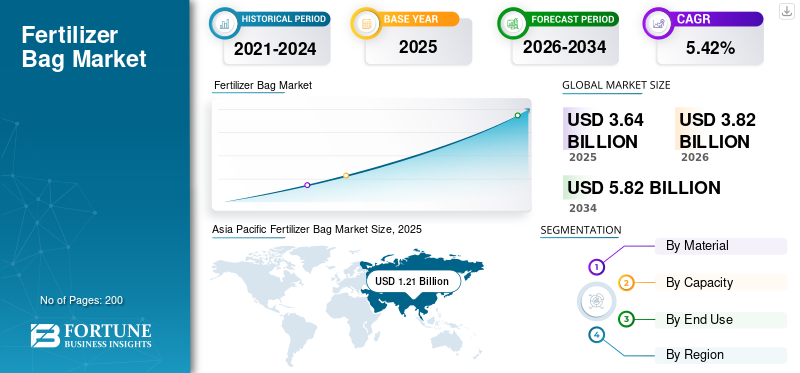
The global fertilizer bag market size was valued at USD 3.64 billion in 2025 and is projected to grow from USD 3.82 billion in 2026 to USD 5.82 billion by 2034, exhibiting a CAGR of 5.42% during the forecast period. Asia Pacific dominated the fertilizer bag market with a market share of 33.24% in 2025.
The global market includes the manufacturing, distribution, and sale of packaging solutions tailored for the storage, transportation, and protection of fertilizers in solid and granular forms. The increasing global consumption of fertilizers, fueled by heightened food demand and intensified agricultural practices, is amplifying the requirement for robust, moisture-resistant, and cost effective packaging. The growth of bulk fertilizer trade and the adoption of mechanized farming techniques are further propelling the demand for high-performance bags in both developed and emerging agricultural markets, thereby driving the global market growth.
Furthermore, many key industry players, such as Amcor Plc, Mondi, and ProAmpac LLC, operating in the market, are focusing on developing innovative products and conducting R&D.
Download Free sample to learn more about this report.
FERTILIZER BAG MARKET KEY TAKEAWAYS
 Global Market Size & Forecast
- 2025 Market Size: USD 3.64 Billion
- 2026 Market Size: USD 3.82 Billion
- 2034 Forecast Market Size: USD 5.82 Billion
- CAGR: 5.42% from 2026-2034
 Market Share
- Asia Pacific dominated the market with a 33.24% share in 2025.
- Polypropylene (PP) was the leading material segment.
- Below 10 kg was the dominant capacity segment in 2025.
 Key Regional Highlights
North America
North America held the second-leading position with a market value of USD 1.02 billion in 2025.
Europe
Europe reached USD 0.76 billion in 2025 and is projected to grow at a 5.05% CAGR.
Asia Pacific
Asia Pacific dominated with a market value of USD 1.21 billion in 2025, driven by strong agricultural activity in India and China.
U.S.
The market reached USD 0.80 billion in 2025, supported by large-scale agribusiness and fertilizer use.
Japan
The market reached USD 0.23 billion in 2025, driven by precision agriculture and high-quality packaging demand.
Read More

FERTILIZER BAG MARKET TRENDS
Growing Adoption of Sustainable and Circular Packaging Solutions Emerges as a Prominent Trend
Sustainability has emerged as a pivotal trend in the global market, prompting manufacturers to increasingly create recyclable, reusable, and lightweight packaging solutions that comply with environmental regulations and meet customer expectations. Fertilizer producers are transitioning from traditional multilayer packaging to mono-material polypropylene bags, recyclable woven sacks, and paper-based alternatives that promote circular economy initiatives. Furthermore, companies are investing in thinner yet more robust bag structures to minimize raw material usage without sacrificing product protection. Additionally, the integration of post-consumer recycled (PCR) content and eco-friendly printing technologies is becoming more prevalent. These advancements enable manufacturers to lower carbon emissions, enhance resource efficiency, and adhere to sustainability commitments while ensuring packaging performance for storage, transportation, and handling.
MARKET DYNAMICS
MARKET DRIVERS
Download Free sample to learn more about this report.
Rising Global Fertilizer Consumption Due to Expanding Agricultural Production to Drive Market Growth
The main factor driving the global fertilizer bag market growth is the rising consumption of fertilizers, which is a result of increased agricultural production and heightened food demand. Population growth, diminishing arable land per capita, and the necessity to enhance crop yields have prompted farmers to utilize greater quantities of chemical and specialty fertilizers. This trend directly boosts the demand for dependable packaging that can safeguard fertilizers from moisture, contamination, and physical damage during storage and transportation. Emerging economies are experiencing a surge in fertilizer adoption, supported by government initiatives and modern agricultural practices, while developed nations continue to invest in precision agriculture. As a result, fertilizer products and their manufacturers are in need of robust, cost-efficient, and high-strength bags that maintain product integrity throughout increasingly intricate domestic and international supply chains.
MARKET RESTRAINTS
Volatility in Polypropylene and Raw Material Prices May Hinder Market Growth
The fluctuating prices of polypropylene, polyethylene, and other raw materials for packaging continue to pose a significant challenge for the global market growth. Given that woven polypropylene bags represent a considerable portion of fertilizer packaging, fluctuations in crude oil prices and the supply of petrochemicals have a direct impact on manufacturing expenses. The increasing costs of raw materials diminish profit margins for bag manufacturers, often resulting in elevated packaging costs for fertilizer producers. Smaller manufacturers encounter more difficulties in managing these price fluctuations due to their limited purchasing power and reliance on long-term procurement agreements. Additionally, price volatility complicates production planning, inventory control, and pricing strategies for customers, thereby restricting investments in product innovation and expansion, even as demand from the agricultural sector continues to rise.
MARKET OPPORTUNITIES
Surging Demand for Smart and High-Performance Fertilizer Packaging Offers Potential Growth Opportunities
The increasing focus on efficient agricultural logistics and product traceability is generating substantial opportunities for advanced and high-performance fertilizer bags. Manufacturers are incorporating features such as QR codes, RFID tags, anti-counterfeiting labels, UV protection, moisture barriers, and improved sealing technologies into fertilizer packaging. These advancements enhance inventory tracking, supply chain transparency, and product verification while minimizing losses due to contamination and improper storage. There is also a rising demand for customized packaging with exceptional mechanical strength as the global fertilizer trade continues to grow. Additionally, premium specialty fertilizers necessitate sophisticated packaging solutions that maintain product quality over extended periods, allowing packaging manufacturers to distinguish their products through value-added technologies and enhanced functionality.
MARKET CHALLENGES
Balancing Sustainability with Cost and Performance Requirements Poses Critical Challenges for Market Growth
A significant challenge for industry players is the pursuit of sustainability goals without sacrificing packaging effectiveness or cost efficiency. Fertilizer bags need to endure substantial weights, rough handling, extended storage periods, and moisture exposure, all while remaining affordable for large-scale agricultural use. While recyclable materials and bio-based options are becoming more popular, they frequently entail increased production expenses or necessitate changes to current manufacturing methods. Simultaneously, customers demand competitive pricing, especially in price-sensitive developing markets where fertilizer prices greatly affect buying choices. Consequently, manufacturers must find a balance between environmental regulations, product resilience, operational effectiveness, and cost competitiveness, all while continuously adapting to changing regulatory requirements and customer expectations.
Segmentation Analysis
By Material
Superior Strength, Moisture Resistance, and Cost Efficiency to Drive the Dominance of the Polypropylene (PP) Segment
Based on material, the market is divided into polypropylene (PP), polyethylene (PE), paper, jute & natural fiber, and others.
The polypropylene (PP) segment leads the global market due to its ideal blend of mechanical strength, moisture resistance, lightweight characteristics, and cost efficiency. Woven PP bags exhibit remarkable tensile strength, puncture resistance, and dimensional stability, all while being cost-effective for large-scale production. Furthermore, polypropylene allows for high-quality printing for branding and product details, is suitable for lamination and UV-resistant coatings, and can be recycled through established collection systems. Its adaptability across retail, industrial, and bulk fertilizer packaging applications, combined with its widespread manufacturing availability, positions PP as the material of choice for fertilizer producers and packaging manufacturers globally.
The paper material segment is expected to grow at a CAGR of 5.60% over the forecast period.
By Capacity
Growing Retail Fertilizer Sales and Convenience for Small-Scale Farming to Drive the Below 10 kg Capacity Segment Dominance
Based on capacity, the market is segmented into below 10 kg, 10-25 kg, 26-50 kg, 51-100 kg, and 100 kg & above.
In 2025, the below 10 kg capacity segment dominated the global fertilizer bag market share, primarily due to its extensive application in retail distribution, home gardening, and small-scale agricultural practices. Bags of smaller capacity are more manageable, easier to transport, store, and apply, making them the preferred choice for individual farmers, hobby gardeners, nurseries, and urban consumers. Furthermore, they minimize product wastage by enabling users to buy only the amount needed for specific applications. Moreover, the increasing demand for specialty fertilizers, micronutrients, and high-quality plant nutrition products, which are generally offered in smaller packages, further bolsters the need for fertilizer bags with capacities under 10 kg.
The 10-25 kg segment is projected to grow at a CAGR of 5.55% over the forecast period.
By End Use
To know how our report can help streamline your business, Speak to Analyst
High Production Volume and Extensive Distribution to Drive the Dominance of the Chemical Fertilizers Segment
Based on end use, the market is segmented into chemical fertilizers, organic fertilizers, seed treatment, agrochemicals, and others.
The chemical fertilizers segment is expected to hold the largest share over the forecast period as synthetic fertilizers represent the predominant share of global fertilizer production and consumption. These fertilizers necessitate robust, moisture-resistant packaging that safeguards product quality throughout storage, transportation, and handling within extensive supply chains. Moreover, government-backed fertilizer subsidy initiatives, the growing cultivation of high-value crops, and the rising adoption of precision farming practices continue to drive the demand for chemical fertilizers in both developed and emerging markets. The substantial production volumes, standardized packaging requirements, and continuous distribution of chemical fertilizers position this segment as the largest consumer of packaging bags globally.
The agrochemicals segment is projected to grow at a CAGR of 5.64% over the forecast period.
Fertilizer Bag Market Regional Outlook
By geography, the market is categorized into Europe, North America, Asia Pacific, Latin America, and the Middle East & Africa.
Asia Pacific
Asia Pacific Fertilizer Bag Market Size, 2025 (USD Billion)
To get more information on the regional analysis of this market, Download Free sample
Asia Pacific reached USD 1.21 billion in 2025 and held the position of the dominating region. The dominance is owing to its substantial agricultural foundation in nations such as India and China. The increasing population, necessity for food security, and the rising consumption of fertilizers are major factors driving product demand. The growth of rural farming initiatives, government subsidies, and the heightened adoption of chemical fertilizers facilitate the extensive utilization of affordable and long-lasting fertilizer packaging solutions.
Japan Fertilizer Bag Market
The Japanese market touched a valuation of around USD 0.23 billion in 2025, accounting for roughly 6.29% of global revenues. The market in Japan is propelled by the adoption of advanced precision agriculture, the scarcity of arable land, and the implementation of high agricultural productivity farming techniques. The nation prioritizes packaging that is of superior quality, long-lasting, and resistant to contamination.
China Fertilizer Bag Market
The China market is projected to be one of the largest markets worldwide. This country market is estimated to touch a revenue of around USD 0.39 billion in 2025, representing roughly 10.63% of global sales.
India Fertilizer Bag Market
In 2025, the India market reached a valuation of around USD 0.33 billion, accounting for roughly 9.02% of global high-revenue markets.
North America
North America held the second-dominant share in 2024, valued at USD 0.97 billion, and maintained a second-leading position in 2025, with a value of USD 1.02 billion. The regional market is primarily influenced by extensive commercial agriculture, especially in the U.S. and Canada, where mechanized farming and elevated crop yields necessitate the handling of fertilizers in bulk. The robust logistics infrastructure and the growing implementation of precision farming methods additionally enhance the demand for sustainable packaging solutions that are durable, high-strength, and resistant to moisture.
U.S. Fertilizer Bag Market
Based on North America's strong contribution and the U.S. dominance within the region, the U.S. market reached around USD 0.80 billion in 2025, accounting for roughly 21.96% of global sales. This market is propelled by large-scale agribusiness activities, significant fertilizer application in the cultivation of corn, wheat, and soybeans, as well as a robust export-focused agricultural sector. The need for efficient packaging solutions is further strengthened by automation in supply chains, an increasing focus on product traceability, and the prevalent use of woven bags made from polypropylene.
Europe
The Europe market is projected to grow at a CAGR of 5.05% over the analysis period, the second-highest in the global market. The regional market reached a valuation of USD 0.76 billion in 2025 and its growth is impelled by stringent environmental regulations that advocate for recyclable and sustainable packaging materials. The production of high-value crops and the implementation of advanced farming techniques necessitate the use of protective, eco-friendly bags. Additionally, the region prioritizes the reduction of plastic waste, fostering innovation in reusable and mono-material packaging solutions throughout agricultural supply chains.
U.K. Fertilizer Bag Market
The U.K. market touched a value of USD 0.14 billion in 2025, representing approximately 3.80% of global revenues.
Germany Fertilizer Bag Market
The Germany market reached approximately USD 0.15 billion in 2025, equivalent to around 4.18% of global sales.
Latin America
The Latin America region is expected to witness moderate growth during the forecast period. The regional market reached USD 0.37 billion in 2025 and is propelled by the extensive cultivation of soybeans, sugarcane, coffee, and corn, particularly in Brazil and Argentina. Farming that focuses on exports and a rise in fertilizer application to improve yields pushes the demand for durable packaging.
Middle East & Africa
In the Middle East & Africa, the South Africa market reached USD 0.08 billion in 2025. Dry climatic conditions heighten the dependence on fertilizers for enhancing soil quality. The growth of agricultural initiatives and reliance on fertilizer imports additionally generates a consistent need for robust and moisture-resistant bags.
Saudi Arabia Fertilizer Bag Market
The Saudi Arabia market touched a valuation of approximately USD 0.10 billion in 2025, accounting for roughly 2.83% of global revenues.
COMPETITIVE LANDSCAPE
Key Industry Players
Leading Players’ Focus on Product Launch and Partnerships to Strengthen their Market Positions
The global market has a semi-consolidated structure, with prominent players including Amcor Plc, Mondi, and ProAmpac LLC. The market shares of these industry participants is due to an array of strategic initiatives such as research-focused partnerships among operating entities.
- For instance, in March 2026, Mondi declared the enhancement of its industrial flexible packaging capabilities in Central and Eastern Europe, with an emphasis on recyclable polypropylene-based woven sacks intended for agricultural and fertilizer uses. This investment aimed at meeting the increasing demand for sustainable bulk packaging options throughout Europe and in export markets.
LIST OF KEY FERTILIZER BAG COMPANIES PROFILED
- Amcor Plc (Switzerland)
- Mondi (U.K.)
- ProAmpac LLC (U.S.)
- Uflex Ltd. (India)
- Greif, Inc. (U.S.)
- RKW Group (Germany)
- Bischof + Klein SE & Co. KG (Germany)
- Emmbi Industries Ltd. (India)
- Rishi FIBC Solutions Pvt. Ltd. (India)
- Bulk Corp International Pvt. Ltd. (India)
- LC Packaging International B.V. (Netherlands)
- Knack Packaging Pvt. Ltd. (India)
- United Bags, Inc. (U.S.)
- Jumbo Bag Ltd. (India)
- J & C Packaging (Thailand)
KEY INDUSTRY DEVELOPMENTS
- January 2026: Greif enhanced its industrial packaging operations in North America by upgrading its manufacturing facilities for FIBC and woven polypropylene bags. This improvement aims to boost production efficiency for bulk packaging in fertilizers, chemicals, and agriculture. The company has implemented advanced automation systems to minimize operational waste and enhance output consistency.
- September 2025: Amcor unveiled a new collection of recyclable flexible packaging solutions tailored for agricultural inputs, such as fertilizers. This product line focuses on mono-material structures that feature improved barrier properties to safeguard against moisture and contamination. The introduction of these solutions is in line with Amcor's commitment to sustainability, aiming to minimize multilayer plastics and enhance recyclability.
- May 2025: Uflex increased its production capacity for woven polypropylene sacks and FIBC bulk bags in India to meet the rising demand from the fertilizer and agrochemical sectors. This expansion involves the installation of advanced high-speed extrusion and weaving machinery to boost output efficiency.
- October 2024: Mondi introduced a new series of lightweight industrial bags aimed at fertilizers and construction materials. These bags are designed to decrease raw material consumption while ensuring high tensile strength and puncture resistance. This innovation aids fertilizer manufacturers in optimizing costs while also reducing environmental impact.
- July 2024: LC Packaging enhanced its FIBC manufacturing capabilities in Asia to address the increasing demand from the agricultural and fertilizer industries. The newly added capacity is dedicated to the production of bulk bags that incorporate enhanced safety features, UV resistance, and moisture protection. This expansion fortifies the company’s supply chain in the Asia Pacific region, where fertilizer usage is on the rise due to intensive agricultural practices.
REPORT COVERAGE
The fertilizer bag market analysis includes a comprehensive study of market insights, size & forecast across all market segments included in the report. It includes details on the market dynamics, regional insights, and trends expected to drive the market over the forecast period. It provides information on key aspects, including technological advancements, pipeline candidates, the regulatory environment, and product launches. Additionally, it details partnerships, mergers & acquisitions, and key industry developments. The global market research report also provides a detailed competitive landscape, including market share and profiles of key operating players.
Request for Customization to gain extensive market insights.
Report Scope & Segmentation
| ATTRIBUTE | DETAILS |
| Study Period | 2021-2034 |
| Base Year | 2025 |
| Estimated Year | 2026 |
| Forecast Period | 2026-2034 |
| Historical Period | 2021-2024 |
| Growth Rate | CAGR of 5.42% from 2026-2034 |
| Unit | Value (USD Billion) |
| Segmentation | By Material, Capacity, End Use, and Region |
| By Material |
|
| By Capacity |
|
| By End Use |
|
| By Region |
|
Frequently Asked Questions
According to Fortune Business Insights, the global market value stood at USD 3.64 billion in 2025 and is projected to reach USD 5.82 billion by 2034.
In 2025, the Asia Pacific market value stood at USD 1.21 billion.
The market is expected to grow at a CAGR of 5.42% over the forecast period of 2026-2034.
By material, the polypropylene (PP) segment leads the market.
Rising global fertilizer consumption due to expanding agricultural production is a key factor driving market growth.
Amcor Plc, Mondi, and ProAmpac LLC are the major players in the global market.
Asia Pacific dominated the market in 2025.



- 2021-2034
- 2025
- 2021-2024
- 200
-
(Offer valid till 31st Oct 2026)
Get 30-60 hrs Free Customization
Expand Regional and Country Coverage, Segments Analysis, Company Profiles, Competitive Benchmarking, and End-user Insights.







Related Reports
-
US +1 833 909 2966 ( Toll Free )
-
Get In Touch With Us