Fertilizer Mixtures Market Size, Share & Industry Analysis, By Nutrient Composition (NPK Compound / Blends, NP Blends, NK Blends, PK Blends, and Customized / Micronutrient Blends), By Form (Granular Dry Blends, Powdered Blends, Liquid Mixtures, and Suspension Fertilizers), By Application Method (Soil Broadcasting, Band Placement, Fertigation, and Foliar Application), By Crop Type (Cereals & Grains, Oilseeds, Fruits & Vegetables, Plantation & Specialty Crops, and Turf & Ornamentals), and Regional Forecast, 2026-2034
 Download Free Sample
(Offer valid till 15th Oct 2026)

Fertilizer Mixtures Market Size and Future Outlook
 Listen to Audio Version
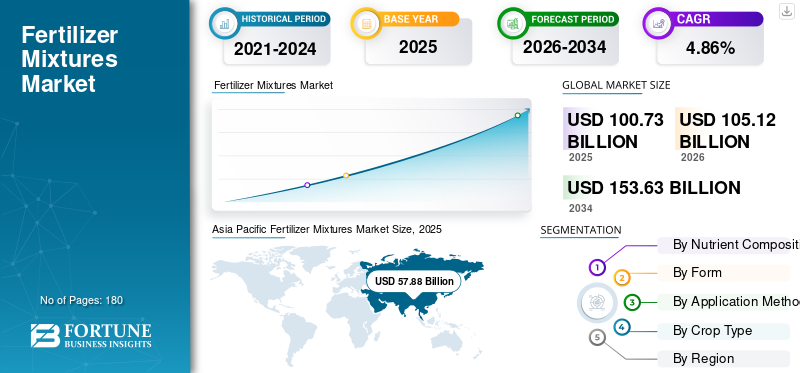
The global fertilizer mixtures market size was valued at USD 100.73 billion in 2025. The market is projected to grow from USD 105.12 billion in 2026 to USD 153.63 billion by 2034, exhibiting a CAGR of 4.86% during the forecast period. Asia Pacific dominated the fertilizer mixtures market with a market share of 57.46% in 2025.
Fertilizer mixtures are created by combining two or more main nutrients: Nitrogen (N), Phosphorus (P₂O₅), and Potassium (K₂O). They may also contain secondary nutrients and micronutrients. These mixtures provide crops with balanced nutrition that suits different plants, soils, and farming methods. As a result, plants use nutrients more efficiently, and farmers can achieve higher yields.
Companies such as Nutrien, Yara International, Mosaic, ICL Group, OCP, EuroChem, and PhosAgro are among the key players operating in this market. New product launches, mergers and acquisitions are key strategies that are boosting product sales and supporting market growth.
Download Free sample to learn more about this report.
Fertilizer Mixtures Market Key Takeaways
 Global Market Size & Forecast
- 2025 Market Size: USD 100.73 billion
- 2026 Market Size: USD 105.12 billion
- 2034 Forecast Market Size: USD 153.63 billion
- CAGR: 4.86% from 2026–2034
 Market Share
- Asia Pacific dominated the market with a 57.46% share in 2025.
- NPK Compound/Blends segment held the largest market share in 2025, driven by demand for balanced crop nutrition.
- Cereals & Grains segment accounted for the largest market share due to extensive cultivation and high fertilizer consumption.
 Key Regional Highlights
North America
The market reached USD 13.09 billion in 2025, driven by precision farming and widespread use of granular fertilizer blends.
Asia Pacific
The market reached USD 57.88 billion in 2025, supported by strong agricultural production and balanced fertilization programs.
Europe
The market reached USD 9.96 billion in 2025, driven by sustainable farming practices and efficient fertilizer use.
U.S.
The market reached USD 9.19 billion in 2025, supported by precision agriculture and customized fertilizer applications.
Japan
The market reached USD 2.56 billion in 2025, driven by precision farming and demand for high-value crop nutrition.
Read More

FERTILIZER MIXTURES MARKET TRENDS
Growing Focus on Precision Agriculture and Balanced Nutrient Management is a Key Market Trend
Several factors are changing the fertilizer mixtures market, including new farming practices, regulations, technology, and supply chain developments. A key change is the increased focus on balanced fertilization and using nutrients more efficiently. Government initiatives are encouraging better NPK ratios to protect soil and limit runoff, which is boosting demand for compound and custom fertilizer blends. Another important trend is the rise of precision agriculture. Tools such as GPS-guided equipment, variable-rate technology, and soil testing help create nutrient mixes tailored to each farm. As a result, more farmers are seeking fertilizer mixtures tailored to their specific needs rather than standard products.
MARKET DYNAMICS
MARKET DRIVERS
Rising Food Demand and Organized Fertilization Practices to Drive Market Growth
Rising demand for food and the push to increase crop yields per hectare are the main drivers of fertilizer mixtures market growth. As populations grow and diets change, staple crops face more pressure. Farmers are responding by using nutrients more carefully to get better yields. They are planting more cereals, oilseeds, and plantation crops, which keeps the demand for compound and blended fertilizers steady. Governments are supporting food security by offering subsidies and promoting modern farming methods. These efforts are leading to more fertilizer use, especially in emerging economies. Large, mechanized farms often use bulk blending and compound fertilizers. This helps keep demand steady in developed markets. Awareness is growing about the importance of efficient nutrient use and soil health. As a result, fertilization programs are becoming more organized.
MARKET RESTRAINTS
Raw Material Price Volatility Restrains Market Growth
A major challenge for the market is the unpredictable supply and pricing of key raw materials, such as nitrogen, phosphate, and potash. Blended and compound fertilizers rely on these materials, so changes in natural gas prices, political issues affecting potash exports, and trade limits on phosphate rock can all raise production costs and retail prices. Stricter environmental rules, especially in Europe, are also limiting the amount of nitrogen that can be used to reduce nitrate runoff and greenhouse gas emissions. These regulations can slow the growth of fertilizer use and raise compliance costs for producers.
MARKET OPPORTUNITIES
Rising Demand for Specialized Nutrition and Digital Wellness Channels Creates Growth Opportunities
The market offers strong opportunities driven by trends such as premium products, personalized options, and expansion into new regions. People seek clean-label, plant-based, vegan, and halal-certified enzymes, which help brands stand out, especially in developed and Middle Eastern markets. There is growing potential for products designed for specific needs, such as those for seniors, athletes, or people with lactose intolerance. Digital health platforms, subscription services, and expert-led online sites help companies connect more with customers and increase their long-term value. Emerging markets in the Asia Pacific, South America, and Africa offer new opportunities, as few people use these products now, and cities are growing. Working with pharmacies, nutritionists, and wellness platforms can help companies reach more customers and build trust.
Download Free sample to learn more about this report.
Segmentation Analysis
By Nutrient Composition
Balanced Nutrient Demand Drives NPK Compound /Blends Segment Growth
By nutrient composition, the market is segmented into NPK compound/blends, NP blends
NK blends, PK blends, and customized / micronutrient blends.
The NPK compound/blends segment held the largest fertilizer mixtures market share in 2025. These are the top nutrient choices in the market, as they deliver balanced macronutrients that meet today’s farming needs. Most major crops, such as corn, wheat, rice, soybeans, and oilseeds, need nitrogen, phosphorus, and potassium applied together to achieve the best yields and use nutrients efficiently. Compound NPK products provide even nutrient distribution within each granule, reducing the risk of separation and helping ensure steady results in the field.
The NP blends segment holds the second-largest market share, and is expected to grow at a CAGR of 4.80% during the forecast period. They are well-suited to cereal-based farming systems, where potassium requirements are often lower or already met by soil. NP blends, therefore, offer a cost-effective alternative where balanced NPK application is not agronomically necessary. In some markets, subsidies favor fertilizers that combine phosphorus and nitrogen, which helps keep demand for NP blends steady. NP blends are simpler to make and cost less than full NPK fertilizers. They are appealing to farmers in markets where price is a major concern.
By Form
Large-Scale Mechanization Drives Granular Dry Blends Segment Dominance
The market is segmented, by form into granular dry blends, powdered blends, liquid mixtures, and suspension fertilizers.
The granular dry blends segment led the global market in 2025. They work well with large-scale, mechanized farming. Granular fertilizer mixtures are the top product worldwide as they fit well with broad acre farming, offer cost-effective logistics, and use existing distribution networks. Granular blends and compound NPK products are easier to store, move, and handle in bulk. They are also less expensive to distribute per ton compared to liquid fertilizers. They last longer on the shelf, work with large spreaders, and are suitable for pre-plant or base fertilizer use.
Liquid mixtures segment accounted for the second largest market share in 2025 and are expected to register a CAGR of 5.69% during the forecast period. They are well-suited for precise application and work well with irrigation systems. Liquid fertilizers are especially useful for high-value crops such as fruits, vegetables, and plantation crops. They help farmers manage nutrients more precisely, which improves both crop quality and profits. Liquid fertilizers are also easier to mix with micronutrients and special additives, making it simpler to tailor them to the needs of different crops.
By Application Method
Large-Scale Mechanized Farming Drives Soil Broadcasting Segment Dominance
By application method, the market is segmented into soil broadcasting, band placement, fertigation, and foliar application.
The soil broadcasting segment led the global market in 2025. It is the most common method for applying fertilizer mixtures. This method works well with the large, mechanized farms that produce most of the world’s cereals and oilseeds. Farmers in North America, South America, Europe, China, India, and Australia use high-capacity spreaders to quickly and efficiently apply granular fertilizers over large fields. Broadcasting allows farmers to cover fields quickly, reduces the need for manual labor, and works well with both pre-plant and base nutrient programs. It is cost-effective, easy to use, and well-suited for growing staple crops. Broadcasting remains the leading method in the market.
Fertigation segment is expected to grow at a CAGR of 4.61% during the forecast period. It holds the second-largest market share as more farmers are using it in irrigated and high-value crops. Fertigation delivers nutrients directly through irrigation systems, helping plants use them more efficiently and allowing farmers to apply them at the right time.
While fertigation requires irrigation systems and careful management, its benefits for controlled and specialty farming help it continue to gain market share.
To know how our report can help streamline your business, Speak to Analyst
By Crop Type
Extensive Cultivation and High Nutrient Requirements of Staple Crops Drives Cereals & Grains Segment Growth
Based on crop type, the market is segmented into cereals & grains, oilseeds, fruits & vegetables,
plantation & specialty crops, and turf & ornamentals.
Cereals & grains segment accounted for the largest market share in 2025. Cereals and grains use the most fertilizer mixtures since they cover the most farmland worldwide and are essential for food security. Crops such as rice, wheat, and maize require regular, large amounts of nitrogen, phosphorus, and potassium to maintain high yields in intensive farming. In regions such as Asia Pacific, North America, and Europe, large-scale machine-based cereal farming leads to frequent, high-volume fertilizer use, resulting in better crop productivity, especially for base and top-dress applications.
Oilseeds segment held the second-largest share of the market and is expected to grow at a CAGR of 4.45% during the forecast period. They are widely grown in countries that focus on exports and need more nutrients, especially potassium. Crops such as soybean, rapeseed, sunflower, and groundnut require balanced fertilization to support oil production, seed growth, and good yields.
Fertilizer Mixtures Market Regional Outlook
By geography, the market is categorized into Europe, North America, Asia Pacific, South America, and the Middle East & Africa.
Asia Pacific
Asia Pacific Fertilizer Mixtures Market Size, 2025 (USD Billion)
To get more information on the regional analysis of this market, Download Free sample
The Asia Pacific region dominated the market with a valuation of USD 57.88 billion in 2025. In this region, India and China are leading the way. Demand is driven by high cereal production, strong local NPK manufacturing, and government programs that support balanced fertilization. Southeast Asia also plays a major role, especially in plantation crops such as oil palm. Fertilizer use in China is growing at a slower pace, while India and developing Southeast Asian countries continue to experience growth. The region uses a variety of fertilizer types. Liquid fertilizers are becoming more common in horticulture-focused areas, helping support steady market growth.
India Fertilizer Mixtures Market
The Indian market in 2025 was valued at USD 12.92 billion, accounting for roughly 12.82% of global revenues. India’s market is growing due to strong government subsidies and the wide use of NPK complex fertilizers. Straight urea is still the main source of nitrogen, but balanced fertilization programs are slowly making compound fertilizers more common.
China Fertilizer Mixtures Market
China’s market in 2025 was valued at USD 25.73 billion, representing roughly 25.55% of the global market share. China is the world’s largest market for fertilizer mixtures, driven by its large capacity for making compound NPK fertilizers. Government policies that encourage balanced fertilization and improved nutrient use help sustain strong demand for compound fertilizers.
Japan Fertilizer Mixtures Market
The Japanese market in 2025 reached a valuation of USD 2.56 billion, accounting for roughly 2.54% of global market revenues. Japan’s market is small but focuses on high-value crops, especially in horticulture and specialty farming. Due to limited arable land, agricultural production cannot grow significantly. Farmers spend more per hectare by using precision methods, liquid fertilizers, and blends with extra micronutrients. Demand remains steady and is slowly increasing, primarily driven by premium agricultural products.
North America
The market in North America reached a valuation of USD 13.09 billion in 2025. The North American market is well-established and employs advanced machinery. Most products are granular bulk blends made for corn, soybean, and wheat crops. A robust retail blending network and precision agriculture help create custom fertilizer mixes. Market growth remains steady primarily due to improvements in crop yields and nutrient efficiency, rather than an increase in the amount of land being farmed. The U.S. constitutes the majority of the market's value, but Mexico's horticulture sector is expanding rapidly. The market remains stable due to strong supply chains and companies that manage production from start to finish.
U.S. Fertilizer Mixtures Market
In 2025, the U.S. market reached USD 9.19 billion. Granular bulk blends are the main products used in the U.S. market, especially for corn and soybean farming. A well-developed retail blending network and precision agriculture support the creation of custom fertilizer mixes. Market growth is consistent, primarily due to efforts to enhance crop yields rather than expand agricultural land. There is also a slow rise in the use of liquid and specialty nutrients.
Europe
The European market reached a valuation of USD 9.96 billion in 2025. The region has a well-established market, shaped mainly by regulations and a strong use of compound NPK products. Strict environmental rules, such as nitrate directives and sustainability requirements, affect fertilizer use and promote balanced fertilization. The majority of fertilizer demand originates from cereal crops, particularly in France and Germany. In Southern Europe, liquid fertilizers are more commonly used in irrigated horticulture. Market growth is slow and is mainly driven by value-added products, micronutrient-enriched options, and more efficient formulations, instead of higher sales volumes.
Germany Fertilizer Mixtures Market
The market in Germany reached around USD 1.27 billion in 2025, representing roughly 1.26% of global revenues. Demand for fertilizer mixtures in Germany is influenced by the country’s intensive cereal farming and strict environmental rules. Nitrate rules limit the amount of nitrogen that can be used, so producers focus on balanced, efficient fertilizer blends.
U.K. Fertilizer Mixtures Market
The U.K. market reached approximately USD 0.68 billion in 2025, equivalent to around 0.68% of global market sales. The U.K. market mainly focuses on cereals and is well established, with consistent fertilizer use in wheat and barley farming.
South America and Middle East & Africa
Over the forecast period, South America is expected to experience significant growth in this market. The South America market in 2025 reached USD 14.72 billion. The region’s market is growing rapidly, mainly due to Brazil’s large soybean and corn production. Farmers in the region use a lot of blended fertilizers and need high amounts of potassium to meet their crops’ nutrient needs. Large-scale, mechanized farms prefer granular bulk blends, and plantation or export-focused agriculture keeps nutrient use steady. Growth rates in the region are higher than the global average due to expanding farmland and better productivity. Middle East & Africa region reached a valuation of USD 5.07 billion in 2025. The Middle East and Africa market is smaller but is growing steadily from a low base. North Africa leads in value due to its irrigated cereal and horticulture systems. Sub-Saharan Africa has significant long-term growth potential as more farmers adopt fertilizers. Broadcasting remains dominant, though fertigation is increasing in irrigated agriculture across the Middle East. Market growth is driven by food security programs, modern farming methods, and a slow rise in fertilizer use per hectare. However, overall fertilizer use is still lower than the global average.
Saudi Arabia Fertilizer Mixtures Market
Saudi Arabia market is set to grow at a CAGR of 3.15% during the forecast period. The Saudi Arabia market is relatively small, with a heavy reliance on irrigation and greenhouses. Fertigation and liquid fertilizer mixtures account for a significant share of the market, reflecting the focus on controlled-environment farming.
COMPETITIVE LANDSCAPE
Key Industry Players
Market Players Focus on Integrated Supply Chains and Regional Blending Networks to Gain Market Advantage
The global fertilizer mixtures is semi consolidated in nature with a few multinational companies operating at the global level. Major companies such as Nutrien, Yara International, Mosaic, ICL Group, OCP, EuroChem, and PhosAgro lead the production of compound NPK fertilizers as they control key resources, including nitrogen, phosphate, and potash. Some companies use a closed formula fertilizer mixture designed for quick nutrient uptake. These companies have an edge as they manage the entire supply chain, have strong global logistics, and offer advice to farmers. On the other hand, in places such as North America, Brazil, and Australia, many local distributors and cooperatives blend fertilizers and create custom mixes close to where farmers need them. In emerging markets, government-backed organizations and subsidy programs, especially in India and parts of Africa, play a big role in setting prices and deciding which products are available.
LIST OF KEY FERTILIZER MIXTURES COMPANIES PROFILED
- Nutrien Ltd. (Canada)
- Yara International ASA (Norway)
- The Mosaic Company (U.S.)
- ICL Group Ltd. (Israel)
- OCP Group (Morocco)
- EuroChem Group (Switzerland))
- PhosAgro (Russia)
- CF Industries Holdings (U.S.)
- OCI N.V. (Netherlands)
- Grupa Azoty S.A. (Poland)
KEY INDUSTRY DEVELOPMENTS
- December 2025: Adecoagro S.A., a major sustainable producer in South America, announced that YPF S.A. acquired the remaining 50% stake in Profertil S.A., the region’s largest granular urea producer.
- December 2025: IFFCO introduced DharAmrut, a natural seaweed extract that contains amino acids and alginic acids. This product launch is part of IFFCO’s efforts to promote sustainable, technology-based, and farmer-focused agriculture.
- November 2025: Rwanda Fertilizer Company Ltd. (RFC) introduced three new fertilizer blends to boost farm productivity and reduce the country's reliance on imported fertilizers. The products, named Twihaze, Ongera, and Ongera+, were launched at an event.
- March 2025: Agromate introduced a new line of premium imported compounds, including EDTA micronutrients and a TE Booster. These products are ideal for all crop types and at all stages of crop development. It provides the most complete and balanced nutrients for healthier crops and better agricultural productivity.
- July 2024: FertiStream agreed to acquire all shares of Nutrisource PTE, which includes a new fertilizer blending facility in Togo with a capacity of up to 200,000 tons per year. This acquisition expands FertiStream’s presence in emerging fertilizer markets and demonstrates its ongoing commitment to African agriculture.
REPORT COVERAGE
The fertilizer mixtures market forecast provides an in-depth study of market size and forecast by all the market segments included in the report. The market analysis includes details on the market dynamics and trends expected to drive the market during the forecast period. It offers information on the technological advancements, new product launches, key industry developments, and details on partnerships, mergers, and acquisitions. The industry also encompasses detailed competitive landscape with information on the market segmentation, market share and profiles of key operating players.
Request for Customization to gain extensive market insights.
Report Scope & Segmentation
| ATTRIBUTE | DETAILS |
| Study Period | 2021-2034 |
| Base Year | 2025 |
| Estimated Year | 2026 |
| Forecast Period | 2026-2034 |
| Historical Period | 2021-2024 |
| Growth Rate | CAGR of 4.86% from 2026-2034 |
| Unit | Value (USD Billion) |
| Segmentation | By Nutrient Composition, By Form, By Application Method, By Crop Type , and Region |
| By Nutrient Composition |
|
| By Form |
|
| By Application Method |
|
| By Crop Type |
|
| By Region |
|
Frequently Asked Questions
Fortune Business Insights says that the global market value stood at USD 100.73 billion in 2025 and is projected to reach USD 153.63 billion by 2034.
In 2025, the Asia Pacifics market value stood at USD 57.88 billion.
The market is expected to exhibit a CAGR of 4.86% during the forecast period.
By nutrient composition, NPK compound / blends segment led the global market in 2025.
Rising food demand and organized fertilization practices are the key factors driving the market.
Nutrien, Yara International, Mosaic, ICL Group, OCP, EuroChem, and PhosAgro are a few of the players in the market.
Asia Pacific held the largest market share in 2025.
Growing focus on precision agriculture and balanced nutrient management is a key market trend.


- 2021-2034
- 2025
- 2021-2024
- 180
-
(Offer valid till 15th Oct 2026)
Get 30-60 hrs Free Customization
Expand Regional and Country Coverage, Segments Analysis, Company Profiles, Competitive Benchmarking, and End-user Insights.














Related Reports
-
US +1 833 909 2966 ( Toll Free )
-
Get In Touch With Us