Flow Battery Energy Storage Market Size, Share & Industry Analysis, By Battery Type (Redox and Hybrid), By Material (Vanadium, Zinc Bromine, and Others), By Storage (Large Scale and Small Scale), By Application (Utilities, Commercial and Industrial, EV Charging Station, and Others), and Regional Forecast, 2026-2034
 Download Free Sample
KEY MARKET INSIGHTS
 Listen to Audio Version
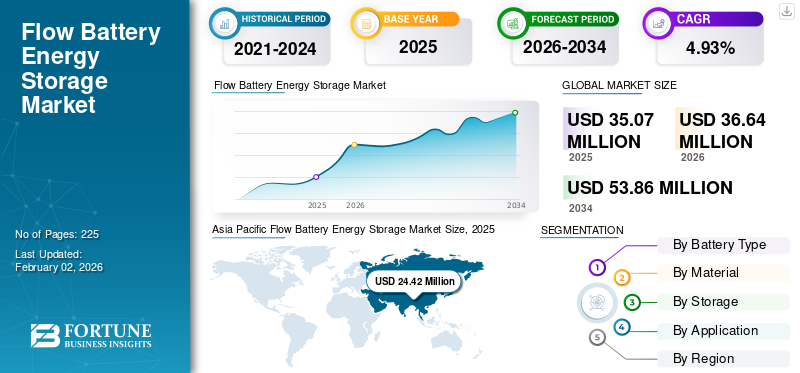
The global flow battery energy storage market size was valued at USD 35.07 million in 2025 and is projected to grow from USD 36.64 million in 2026 to USD 53.86 million by 2034, exhibiting a CAGR of 4.93% during the forecast period. Asia Pacific dominated the global market with a share of 69.64% in 2025.
Flow batteries can store energy for 4 to 12+ hours, making them ideal for balancing intermittent solar and wind power. Unlike lithium-ion batteries (1-4 hours), flow batteries are well suited for grid-level and industrial applications requiring extended backup.
The market for flow battery energy storage is growing because of its long-duration storage capability, scalability, low degradation rate, and enhanced safety features, which make it increasingly preferred for utility-scale renewable energy integration and grid stability applications.
Hybrid Flow batteries have a very long cycle life (10,000+ cycles) with minimal performance degradation. This ensures lower total ownership costs over 15-20 years, especially for frequent cycling applications. Vanadium redox flow batteries are growing due to their long lifespan, recyclability, and scalability.
Invinity Energy Systems a key market player in Vanadium redox flow battery (VRFB), with over 75 MWh deployed or contracted across 70+ projects in 14 countries. In 2023 alone, they sold or secured ~ 136.7 MWh of VRFB systems and won North America’s largest VRFB at Chappice Lake Solar+ Storage contract.
Sumitomo and VRB Energy are major players in the market because of their extensive technological expertise, proven large-scale project deployments, strong patent portfolios, and long-standing presence in developing and commercializing advanced vanadium redox flow battery systems for utility and renewable energy integration.
Download Free sample to learn more about this report.
Flow Battery Energy Storage Market Takeaways
 Global Market Size & Forecast
- 2025 Market Size: USD 35.07 million
- 2026 Market Size: USD 36.64 million
- 2034 Forecast Market Size: USD 53.86 million
- CAGR: 4.93% from 2026–2034
 Market Share
- Asia Pacific dominated the flow battery energy storage market with a 69.64% share in 2025.
- The Redox segment accounted for the largest market share, driven by its proven scalability and long-duration energy storage capabilities.
- The Vanadium segment dominated the market owing to its long cycle life and suitability for large-scale energy storage applications.
 Key Regional Highlights
North America
The regional market generated USD 2.59 million in 2025 and is projected to reach USD 2.69 million in 2026, supported by growing demand for resilient grid infrastructure.
Europe
The market was valued at USD 5.29 million in 2025 and is expected to reach USD 5.50 million in 2026, driven by investments in long-duration energy storage technologies.
Asia Pacific
The market reached USD 24.42 million in 2025 and is projected to grow to USD 25.59 million in 2026, supported by strong renewable energy deployment and grid modernization initiatives.
U.S.
The market is expanding steadily due to increasing demand for long-duration energy storage, renewable energy integration, and enhanced grid reliability.
Japan
The country continues to support the adoption of flow battery energy storage systems through investments in renewable energy integration and advanced grid infrastructure.
Read More

MARKET DYNAMICS
MARKET DRIVERS
Global Renewable Energy Expansion to Drive Market Growth
Massive investments in integrating renewable energy sources such as solar and wind drive the need for stable, dispatchable backup storage. Flow batteries store excess renewable energy and release it when needed, enabling a 24/7 green energy supply. Flow batteries offer about 10,000+ long-duration energy storage with minimal degradation. It is ideal for applications requiring frequent or continuous cycling, such as microgrids, EV charging stations, and off-grid systems. Lithium ion batteries and flow batteries both are used to store electrical energy and release it when needed, these factors drive the flow battery energy storage market growth.
In April 2025, Invinity Energy Systems was given the green light to install a 20.7MWh vanadium redox flow battery system in the U.K, the highest in the nation.
The UK Department for Energy Security and Net Zero (DESNZ) has given the London Stock Exchange-listed technology contributor and producer the go-ahead on the project, which is the highest to be installed by the company globally.
MARKET RESTRAINTS
High Initial Capital Cost to Hinder Market Growth
Flow batteries require large tanks, pumps, and external components, which increase upfront costs compared to compact lithium-ion systems. Despite lower long-term costs, this makes them less attractive for small-scale or budget-sensitive projects. Flow batteries involve moving parts (such as pumps and fluid circulation systems) that increase engineering complexity and maintenance.
This leads to higher installation and operational challenges, especially in remote or decentralized locations, further hindering the adoption of flow batteries.
MARKET OPPORTUNITIES
Growing Usage of Flow Battery Energy in Commercial and Industrial Applications to Drive Market Growth
The commercial and industrial sector is emerging as a major driver for the market's growth due to its unique energy demands and growing need for resilience, sustainability, and cost control.
Flow battery technology offers stable performance over years of intensive use, unlike lithium-ion systems that degrade faster with deep-cycle use. Businesses can use flow batteries to store cheap, off-peak power and use it during expensive peak hours. This reduces demand charges and lowers electricity bills significantly and drives the market growth. In May 2025, Aramco commendably assigned a megawatt-scale renewable energy storage system to reinforce gas production projects, marking a major turning point in industrial energy storage invention. The recently positioned Iron-Vanadium (Fe/V) flow battery is groundbreaking and will be a solar backup power source for global gas well operations.
Flow Battery Energy Storage Market Trends
Partnership and Demonstration Projects to Drive Flow Energy Storage Market Growth
Strategic partnerships and large-scale demonstration projects are critical in accelerating the adoption of flow battery energy storage systems. Collaborations amongst battery developers, utilities, government agencies, and research institutions are helping validate flow batteries' performance, safety, and long-duration capabilities in real-world settings. These demonstration projects help build investor and customer confidence, reduce perceived technological risks, and highlight the suitability of flow batteries for grid-scale renewable integration and long-duration storage needs.
Download Free sample to learn more about this report.
SEGMENTATION ANALYSIS
By Battery Type
Independent Scaling of Power and Energy to Drive Redox Battery Type Growth
The market, by battery type covers redox and hybrid.
Redox is the dominant segment in the market. Redox flow batteries, especially vanadium-based systems, have been tested and deployed at scale for decades. Major companies such as Sumitomo, Invinity Energy Systems, and VRB Energy use redox technology in grid-scale and commercial projects. In Redox flow batteries, power (cell stack) and energy capacity (electrolyte tank) can be scaled independently. This makes them highly flexible and modular, perfect for custom solutions across microgrids, utilities, and industries.
Hybrid flow battery is the second dominant segment in the market. These batteries are ideal for storing energy for over 4 hours to several days, addressing the growing need for long-duration storage in solar and wind projects.
By Material
Long Cycle Life and Low Degradation to Drive Vanadium-based Flow Battery Demand
By material, the market is segmented into vanadium, zinc bromine, and others.
Vanadium is the dominant segment in the market and is growing significantly across several key regions due to its unique advantages in long-duration, safe, and sustainable energy storage. Vanadium can handle 10,000-20,000 cycles with negligible capacity loss, even under deep charge-discharge cycles. This results in a lower total cost of ownership over a 15 to 20-year lifespan, especially for frequent-use applications.
Zinc bromine is the fastest-growing segment in the market. Zinc bromine flow batteries offer higher energy density than vanadium redox batteries, making them suitable for space-constrained installations in commercial and industrial settings.
By Storage
Requirement for Long-Duration and High-Capacity Battery to Escalate Large-Scale Segment Demand
By storage, the market is segmented into large scale and small scale.
Large-scale is the dominating segment in the market. In flow batteries, power cell stacks and energy (electrolyte) tanks are scalable independently. Adding more tanks or stacks makes it easier to build modular systems that can reach 100+ MWh.
Small-scale is the second leading segment in the market. Small-scale flow batteries are well suited for microgrids, rural areas, commercial buildings, and off-grid systems, where localized storage is essential for reliability.
By Application
Non-Inflammable Properties of Flow Batteries Aids in Utilities Application
By application, the market is segmented into utilities, commercial and industrial, EV charging station, and others.
Utilities are anticipated to drive the segment growth. Flow batteries use non-inflammable, water-based electrolytes, unlike lithium-ion, which pose a fire risk. This makes them safer for deployment at substations, power plants, and near populated areas. Utilities can scale power (MW) and energy (MWh) separately based on need.
Commercial and industrial segment also hold a notable position in the market. This segment often requires energy storage for over 4 hours to manage peak demand, support operations during outages, and store excess solar or wind energy. This factor is expected to drive segment growth.
Flow Battery Energy Storage Market Regional Outlook
The market has been analyzed geographically into North America, Europe, Asia Pacific, and rest of the world. Asia Pacific has been the dominating region during the historical years and is expected to continue in the forecast period as well.
North America
The North America market generated USD 2.59 million in 2025, representing 7.39% of the global market landscape, and is expected to reach USD 2.69 million in 2026. U.S. Inflation Reduction Act provides a 30% investment tax credit for flow batteries, with additional bonuses for domestic manufacturing and union labor. Federal and State programs such as California’s SGIP (Self Generation Incentive Program) have funded over 50 MWh of flow batteries for commercial and industrial (C&I) applications. Utilities are deploying 100 MWh+ systems to support grid stability and renewable integration. FERC (Federal Energy Regulatory Commission) Order 2222 allows flow batteries to participate in wholesale markets, including PJM. Thus, driving the North America flow energy battery market growth.
U.S.
The U.S. flow battery energy storage market is growing steadily due to the increasing need for long-duration storage, grid reliability, renewable integration, and favorable policies. Frequent power outages caused by wildfires, storms, and aging infrastructure have created demand for reliable, safe, and long-lasting storage, which flow batteries can provide.
Europe
Europe contributed 15.09% to the global market in 2025, with a valuation of USD 5.29 million, and is projected to reach USD 5.5 million in 2026. European countries such as Germany, the U.K, and France are expanding wind and solar capacity, leading to higher variability in power supply. Flow batteries help store excess renewable energy and deliver it during peak demand, supporting grid stability.
The EU’s Clean Energy Package and Electricity Market Design reform enhance storage integration and grid access. National mandates such as the UK’s Fit-for-55, Italy’s capacity auctions, and Germany’s grid-scale tenders are creating bankable markets for flow batteries, thus driving the Europe’s market growth.
Asia Pacific
Asia Pacific Flow Battery Energy Storage Market Size, 2025 (USD Million)
To get more information on the regional analysis of this market, Download Free sample
Asia Pacific is the dominating region and has largest flow battery energy storage market share. Asia Pacific accounted for USD 24.42 million in 2025, representing 69.64% of the global market share, and is projected to reach USD 25.59 million in 2026. Rapid solar and wind deployment across China, Japan, Australia, and Southeast Asia is creating significant demand for long-duration storage to balance grid supply and demand. China's five-year plan mandates energy storage for solar and wind projects, driving large-scale deployments such as the 400 MWh Dalian Vanadium flow battery.
Rest of the World
In rest of the world, Latin America is deploying vast amounts of solar and wind, nearly 319 GW of utility-scale projects by 2030, to diversify energy sources. This renewable surge is creating high demand for long-duration energy storage sources for smooth intermittent supply. Moreover, Gulf nations such as Saudi Arabia and the UAE are aggressively rolling out solar and wind projects as part of national clean energy targets (Saudi 50 % by 2030, UAE 44% by 2050). Battery energy storage, including flow batteries, is essential to integrate intermittent renewables into the grid by storing excess energy and dispatching it when needed.
COMPETITIVE LANDSCAPE
Key Industry Players
Vendors Partnering with Local Utilities and Government To Drive Flow Market Growth
In a strategic shift aimed at adapting to global market dynamics. In May 2025, Netherlands-based Elestor declared it would move from hydrogen-bromine to hydrogen-iron flow batteries due to the increasing geopolitical situation. Declaring the change on its website, Elestor CEO Hylke van Bennekom revealed that the move, which has been under wraps for months, has been made after years of research and development. It was done in argumentation with the company’s commercial partners and its committee of engineers and scientists.
List of Key Flow Battery Storage Companies Profiled
- Invinity Energy Systems (U.K.)
- Sumitomo Electric Industries Ltd. (Japan)
- VRB Energy (Canada)
- Enerox GmbH (Austria)
- Elestor (Netherlands)
- ESS Tech, Inc. (U.S.)
- Largo Inc (Canada)
- Lockheed Martin Corporation (U.S.)
- Primus Power (U.S.)
- EverFlow (Germany)
- Stryten Energy (U.S.)
- ViZn Energy Systems (U.S.)
- H2, Inc. (South Korea)
- KEMIWATT (France)
KEY INDUSTRY DEVELOPMENTS
- In May 2025, Sumitomo Electric started a vanadium redox flow battery (VRFB) system at a community solar microgrid in southern Japan. A ceremony was held on 22 April to complete the energy storage system at Kurokiyama Solar Power Plant in Minamikyushu City, Kagoshima prefecture, on the island of Kyushu.
- In May 2025, VFlowTech, a technical leader in justifiable long-duration energy storage, raised USD 20.5 million in planned funding, headed by Granite Asia. The round also witnessed involvement from Antares Ventures, EDBI, MOL PLUS, PSA Ventures, and returning investors such as İnci Holding, UntroD Capital, Pappas Capital, Wavemaker Partners, SEEDS Capital, and Entrepreneurs First.
- In February 2025, Stryten Energy LLC, a U.S.-based energy storage solutions provider, declared the registering of a partnership by one of its allies, Stryten Critical E-Storage LLC, with a subordinate of Largo Inc., Largo Clean Energy Corp. (LCE), to form the Storion Energy, LLC joint venture. Through this collaboration, the companies aim to bring exceptional homely fabricated vanadium electrolytes at a competitive price through a leasing model to increase quick commercialization and adoption of vanadium redox flow batteries.
- In October 2024, VRB Energy New Energy Company introduced an innovative function for its 3GWh Vanadium Flow Battery Energy Storage Industrial Base in Changzhi, Shanxi. Following their collaboration partnership, this circumstance marks the first combining project between Lubao Group and Ivanhoe Group.
- In June 2022, Lockheed Martin was granted an agreement to strengthen the first megawatt-scale, long-duration energy storage system for the U.S. Department of Defense (DoD). GridStar Flow will be deployed at Fort Carson, Colorado, for the U.S. Army under the supervision of the U.S. Army Engineer Research and Development Center’s (ERDC) Construction Engineering Research Laboratory (CERL).
REPORT COVERAGE
The report provides a detailed analysis of the market and focuses on key aspects such as leading companies, product processes, competitive landscape, and leading sources. Besides, the report offers insights into the market trends and highlights key industry developments. In addition to the factors above, the report encompasses several factors that contributed to the market's growth in recent years.
Request for Customization to gain extensive market insights.
Report Scope & Segmentation
|
ATTRIBUTE |
DETAILS |
|
Study Period |
2021-2034 |
|
Base Year |
2025 |
|
Estimated Year |
2026 |
|
Forecast Period |
2026-2034 |
|
Historical Period |
2021-2024 |
|
Growth Rate |
CAGR of 4.93% from 2026 to 2034 |
|
Unit |
Value (USD Million), Volume (MW) |
|
Segmentation
|
By Battery Type
|
|
By Material
|
|
|
By Storage
|
|
|
By Application
|
|
|
By Region
|
Frequently Asked Questions
As per the Fortune Business Insights study, the market size was USD 35.07 million in 2025.
In 2025, the Asia Pacific market value stood at USD 24.42 million.
The market is expected to exhibit a CAGR of 4.93% during the forecast period.
The utility segment led the market by application.
Global renewable energy expansion is anticipated to drive the market growth.
Some of the major players in the market are Elestor, ESS Tech, Inc., Largo Inc., and Lockheed Martin Corporation.
Asia Pacific dominated the market in 2025.


- 2021-2034
- 2025
- 2021-2024
- 225
Get 30-60 hrs Free Customization
Expand Regional and Country Coverage, Segments Analysis, Company Profiles, Competitive Benchmarking, and End-user Insights.













Related Reports
-
US +1 833 909 2966 ( Toll Free )
-
Get In Touch With Us