Food Container Market Size, Share & Industry Analysis, By Material (Plastic, Paper & Paperboard, Glass, Metal, and Others), By Product Type (Bottles & Jars, Cups & Tubs, Boxes & Cartons, Trays, and Others), By Application (Fruits & Vegetables, Dairy Products, Spices & Condiments, Frozen Food, Bakery, Snacks & Confectionery, Ready-to-eat Meals, and Others), and Regional Forecast, 2026-2034
 Download Free Sample
(Offer valid till 30th Sep 2026)

Food Container Market Size and Future Outlook
 Listen to Audio Version
The global food container market was valued at USD 245.53 billion in 2025 and is projected to grow from USD 258.71 billion in 2026 to USD 407.76 billion by 2034, exhibiting a CAGR of 5.85% during the forecast period. North America dominated the food container market with a market share of 33.25% in 2025.
A food container is a packaging solution specifically designed for storing, handling, and transporting food. The rapidly growing demand for effective packaging solutions for perishable and packaged food products, such as dairy and meat, drives market growth. The rapidly growing global food industry also contributes to the market's share.
Furthermore, many key industry players, such as Amcor, Sabert, and Ardagh Group, operating in the market, are focusing on developing innovative products and conducting R&D, and contributing to the global market share.
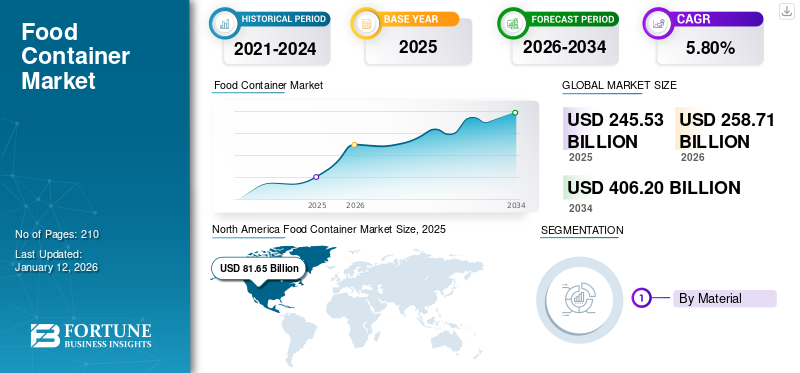
Download Free sample to learn more about this report.
FOOD CONTAINER MARKET KEY TAKEAWAYS
 Global Market Size & Forecast
- 2025 Market Size: USD 245.53 billion
- 2026 Market Size: USD 258.71 billion
- 2034 Forecast Market Size: USD 407.76 billion
- CAGR: 5.85% from 2026–2034
 Market Share
- North America dominated the food container market with a 33.25% share in 2025.
- Plastic led the material segment with a 41.05% share in 2026.
- Cups & tubs dominated the product type segment with a 35.10% share in 2026.
 Key Regional Highlights
North America
North America reached USD 81.65 billion in 2025, representing a 33.25% share of the global market.
Asia Pacific
Asia Pacific recorded USD 67.97 billion in 2025, making it the second-largest regional market.
Europe
Europe reached USD 44.27 billion in 2025 and is projected to grow at a 4.88% rate over the coming years.
U.S.
The food container market reached approximately USD 60.81 billion in 2025, accounting for 24.77% of global sales.
Japan
The food container market reached approximately USD 11.90 billion in 2025, representing 4.85% of global revenue.
Read More

FOOD CONTAINER MARKET TRENDS
Rising Utilization of Eco-friendly Containers for Food Packaging Emerges as a Market Trend
The growing consumer awareness of the harmful effects of plastic on the environment and human health has spurred the use of sustainable containers for food storage and packaging. On the other hand, as eco-friendly packaging solutions are manufactured from biodegradable and compostable materials that break down easily and do not harm the environment, consumers primarily use it. Eco-friendly containers reduce carbon emissions and are thus used by food manufacturers and consumers. The growing use of eco-friendly food packaging containers not only reduces food waste but also boosts market growth.
MARKET DYNAMICS
MARKET DRIVERS
Download Free sample to learn more about this report.
Augmenting Demand for Ready-to-Eat Meals and Convenience Foods Drives Market Growth
The increasing demand for food, ready-to-eat (RTE) meals and convenience foods is a significant driver of the market, as contemporary consumers are placing greater value on speed, ease of preparation, and portability in their food choices. Rapid urbanization, extended working hours, and the emergence of dual-income households have reduced the time available for home cooking, leading to increased consumption of packaged, pre-prepared, and on-the-go meals. As reported by the Food and Agriculture Organization (FAO), global consumption of processed and convenience foods increased in 2022, especially in urban areas, where time constraints and lifestyle shifts favor ready-to-eat meal options. Furthermore, the FAO has highlighted the significant role of packaging in preserving food quality and safety during prolonged distribution and storage, which is vital for ready-to-eat (RTE) foods. As convenience foods transition from occasional dietary choices to regular options, the need for efficient, reliable, and functional food containers continues to grow, directly driving market expansion across both retail and foodservice sectors.
Significant Benefits Offered by Containers to Food Sector to Propel Market Growth
A major factor contributing to the food container market growth is the significant benefits these containers offer to the food industry, especially in improving food safety, minimizing food waste, prolonging shelf life, and advancing sustainability objectives, which are vital for producers, retailers, and consumers alike. As reported by the United Nations Environment Programme's Food Waste Index Report 2021, approximately 17% of total global food production is wasted, underscoring the magnitude of the food waste issue that effective packaging can alleviate. Such containers for food play a crucial role in maintaining food quality by safeguarding against microbial contamination, oxidation, moisture, and physical damage throughout the supply chain, thereby enhancing safety and freshness. Well-designed packaging solutions often offer environmental benefits that significantly outweigh their material costs. Thus, the substantial benefits provided by the containers to the food sector boost market growth.
MARKET RESTRAINTS
Shifting Consumer Preferences and Fluctuations of Raw Material Costs Hampers Market Growth
The shifting preferences of consumers and variations in raw material prices are considerable constraints that hinder the expansion of the market. This is particularly evident as consumers increasingly seek sustainable and eco-friendly packaging, while manufacturers face challenges due to unpredictable input costs. The evolving behavior of consumers is exerting pressure on the industry to embrace greener materials and transparent labeling, which often entail higher costs and complicate production decisions. According to Global Sustainable Packaging Usage Trends, 54% of shoppers worldwide now prefer packaging that is recyclable, compostable, or reusable. Additionally, over 50% of consumers favor products that utilize less plastic, indicating a significant shift toward sustainable materials that may be costlier or technically difficult to implement. Collectively, these factors, where consumers increasingly seek sustainable and high-quality packaging while raw material prices remain volatile, contribute to a challenging market landscape that limits growth and hinders innovation in food container solutions.
MARKET OPPORTUNITIES
Technological Advancements in the Sector is Generating Significant Growth Opportunities
Technological progress is fostering significant growth opportunities in the sector by enabling smarter, safer, and more sustainable packaging solutions that meet the evolving demands of the food industry. Advances in materials science have led to the creation of high-barrier containers that enhance resistance to oxygen, moisture, and light, thereby greatly improving shelf life and food safety, particularly for ready-to-eat, fresh, and perishable food items. These innovations enable food manufacturers to broaden their distribution capabilities while reducing spoilage and waste.
Moreover, smart packaging technologies are gaining traction, offering new value propositions for food containers. Features such as QR codes, freshness indicators, temperature sensors, and traceability labels improve transparency and build consumer trust, while also aiding in regulatory compliance and supply chain oversight. These technologies are especially advantageous for cold-chain products, food delivery services, and premium food categories, where maintaining quality is essential.
MARKET CHALLENGES
Regulatory and Environmental Compliance Pressures are a Major Challenge to Market Growth
A significant challenge confronting the global industry is the growing regulatory and environmental compliance burden imposed by governments and environmental organizations worldwide. Regulations that restrict single use plastics, strict waste disposal requirements, and obligatory sustainability goals compel manufacturers to redesign their product lines, which can be both expensive and time-consuming. Adhering to these regulations frequently necessitates investment in new materials, production methods, and certification processes, thereby exerting pressure on both large multinational corporations and smaller producers to adapt swiftly.
Segmentation Analysis
By Material
Durable and Non-Hazardous Benefits of Plastic Material Thrives Segmental Growth
Based on the material, the market is divided into plastic, paper & paperboard, glass, metal, and others.
Plastic is the dominant material segment and is expected to grow rapidly during the forecast period. Unlike other materials, plastic containers are extremely durable, non-hazardous, and do not break during storage or transportation. The material can withstand a broader range of temperatures and is suitable for transporting both hot and cold foodstuffs. The material also offers optimal product visibility and excellent protection against dirt and spills, thereby driving the segment's growth. The Plastic segment is expected to lead the market, contributing 41.05% globally in 2026.
By Product Type
Augmenting Demand for Cups & Tubs for Food Packaging Boosts Segmental Growth
Based on the product type, the market is segmented into bottles & jars, cups & tubs, boxes & cartons, trays, and others.
Cups & tubs are the dominant segment and are expected to grow rapidly over the projected period. The cups & tubs are durable, lightweight, and leak-proof, and are essential in preserving the taste, color, quality, and texture of any food product. The rising demand for cups & tubs for storing ready-to-eat meals, frozen food, fruits, and dairy products drives the segmental growth. The tamper-evident design of cups & tubs enhances their use in the food industry, further driving the segment's growth.
The Cups & Tubs segment is expected to account for 35.1% of the market in 2026.
To know how our report can help streamline your business, Speak to Analyst
By Application
Growing Consumption of Fruits & Vegetables Enhances Segmental Growth
Based on the application, the market is segmented into fruits & vegetables, dairy products, spices & condiments, frozen food, bakery, snacks & confectionery, ready-to-eat meals, and others.
Fruits & vegetables are the leading segment of this market. The segment will experience noteworthy growth due to the rapidly growing food and beverage sector. Fruits and vegetables are the leading products in the global market, primarily due to the high demand for fresh produce and the need for protective, breathable packaging that extends shelf life. Containers play a crucial role in minimizing spoilage, facilitating long-distance transportation, and ensuring hygienic handling in both retail and foodservice sectors.
The Fruits & Vegetables segment is anticipated to hold a dominant market share of 35.78% in 2026.
Food Container Market Regional Outlook
By region, the market is categorized into Europe, North America, Asia Pacific, Latin America, and the Middle East & Africa.
North America
North America Food Container Market Size, 2025 (USD Billion)
To get more information on the regional analysis of this market, Download Free sample
North America held the dominating share in 2024, valued at USD 77.34 billion, and maintained its dominating position in 2025, valued at USD 81.65 billion. Key factors driving the North American market include increasing demand for convenient foods and ready-to-eat meals, driven by hectic work schedules, urban living conditions, and the prevalence of dual-income households. The swift growth of food delivery services, online grocery platforms, and meal kit providers has further underscored the need for durable, leakproof, and temperature-stable containers for food.
U.S. Food Container Market
Based on North America's strong contribution and the U.S. dominance within the region, the U.S. market value was approximated at around USD 60.81 billion in 2025, accounting for roughly 24.77% of global sales. The U.S. is the dominant player in North America's market and is expected to continue to flourish over the projected timeframe. The U.S. leads the North American market, attributed to its extensive and varied food and beverage sector, significant consumption of packaged and convenience foods, and a robust retail and foodservice framework.
Asia Pacific
Asia Pacific reached USD 67.97 billion in 2025 and secured the position of the second-largest region in the market. In the region, India and China are both estimated to reach USD 19.38 billion and USD 23.71 billion, respectively, in 2025. The swift growth of food delivery services and cloud kitchens has greatly heightened the need for robust, leakproof, and heat-resistant containers for food that ensure food safety during transportation. Moreover, the strengthening of food safety regulations and government efforts to improve hygiene standards are compelling food manufacturers to adopt higher-quality, compliant packaging solutions.
Japan Food Container Market
The Japanese market in 2025 was recorded to be around USD 11.90 billion, accounting for roughly 4.85% of global revenues. In Japan, the market is propelled by significant consumer demand for premium, convenience-focused packaging, especially for ready-to-eat meals and freshly prepared foods available at widespread convenience stores and retail establishments.
China Food Container Market
China's market is projected to be one of the largest worldwide, with 2025 revenues recorded at around USD 23.71 billion, representing roughly 9.66% of global sales.
India Food Container Market
The Indian market in 2025 was valued at around USD 19.38 billion, accounting for roughly 7.89% of global markets.
Europe
Europe market is third-dominating in the market and is projected to grow at 4.88% over the coming years, and further recorded a valuation of USD 44.27 billion by 2025. The expansion of food delivery services, take-away options, and private-label packaged foods in supermarkets has further heightened the necessity for durable, hygienic, and functional containers for food. Moreover, Europe's rigorous food safety regulations and quality standards require food manufacturers to implement high-performance packaging that reduces contamination risks and maintains product integrity throughout the supply chain.
U.K. Food Container Market
The U.K. market size in 2025 was recorded at USD 7.74 billion, representing approximately 3.15% of global revenues.
Germany Food Container Market
Germany's market reached approximately USD 10.22 billion in 2025, equivalent to around 4.16% of global sales.
Latin America
The Latin America region is expected to witness moderate growth in this market space during the forecast period and reached a valuation of USD 31.68 billion in 2025. Significant factors driving growth in Latin America include changing consumer lifestyles, higher participation rates among working populations, and an increasing preference for convenient, affordable food options. The growth of supermarkets, convenience stores, and rapidly expanding food delivery and takeaway services has heightened the demand for durable, leak-resistant, and cost-effective containers for food.
Middle East & Africa
In the Middle East & Africa, South Africa reached USD 5.60 billion in 2025. The market in the region is witnessing gradual yet consistent growth, bolstered by population growth, urbanization, and an increasing demand for packaged and processed foods across both developed and emerging economies in the region.
Saudi Arabia Food Container Market
The Saudi Arabian market reached approximately USD 7.64 billion by 2025, accounting for roughly 3.11% of global revenues.
COMPETITIVE LANDSCAPE
Key Industry Players
Focus on Expanding Product Launch and Acquisitions by Key Players to Propel Market Progress
The global market has a semi-consolidated structure, with major players including Amcor, Sabert, and Ardagh Group. The significant food container market share of these packaging companies are due to numerous strategic initiatives, including collaborations among operating entities to advance research.
- For instance, in November 2023, Sabert Corporation Europe aims to deliver a completely recyclable packaging solution for chilled food-to-go, confectionery, and bakery items through its innovative Tray2Go. Offered in four standard sizes, the double-wall tray with a recessed base is engineered for strength, efficient nesting, and secure stacking while maintaining product visibility.
Other notable players in the global market include Graphic Packaging International, LLC, Tetra Pak, and International Paper. These companies are expected to prioritize new product launches, strategic partnerships, and collaborations to increase their global market shares during the forecast period.
LIST OF KEY FOOD CONTAINER COMPANIES PROFILED
- Amcor (Switzerland)
- Sabert (Switzerland)
- Ardagh Group (Luxembourg)
- Graphic Packaging International, LLC (U.S.)
- Tetra Pak (Switzerland)
- International Paper (U.S.)
- Silgan Holdings Inc. (U.S.)
- Dart Corporation (Switzerland)
- Crown Holdings Inc. (U.S.)
- Sonoco Products Company (U.S.)
- Stölzle Glass Group (Austria)
- Gerresheimer AG (Germany)
- Huhtamaki (Finland)
- Genpak LLC (U.S.)
- PRINTPACK (U.S.)
KEY INDUSTRY DEVELOPMENTS
- July 2025: Huhtamaki, a global leader in sustainable food packaging solutions, announced the launch of its new ice cream cups, blending product innovation with strong consumer appeal. These cups are designed to be both home- and industrial-compostable and recyclable, providing a novel, sustainable packaging option for the ice cream sector. Constructed from responsibly sourced, certified paperboard with a bio-based coating, these cups represent a transition from fossil-based to bio-based plastics while maintaining plastic content below 10%.
- June 2025: A leading European packaging manufacturer Coveris introduced a new board-based MAP tray solution aimed at the meat, fish, and poultry sectors, achieving a 90% reduction in plastic while ensuring recyclability and shelf-life. By providing a plastic reduction of as much as 90%, Coveris' innovative BarrierFresh MAP trays integrate sustainably sourced board with a specially designed EVOH barrier film, resulting in a fully printable, hermetically sealed, single-SKU pack that preserves product integrity and recyclability for the chilled meat, fish, and poultry (MFP) category.
- March 2025: Mars, a provider of snacks, food, and pet care products, announced the launch of pantry jars constructed from 100% recycled plastic for its M&Ms, Skittles, and Starburst snacks, as part of the company's shift toward more sustainable packaging. The new jars, produced by packaging solutions company Berry Global, are currently being distributed throughout the U.S. and will replace the previous jars that contained 15% recycled plastic, according to Mars.
- February 2025: Klöckner Pentaplast (kp) initiated a pioneering venture in the U.K. market, in collaboration with Tesco and Hilton Foods, to test the first-ever food trays made entirely from 100% rPET derived from recovered tray material through its kp Tray2Tray initiative. This marks a significant advancement in the pursuit of complete circularity in food packaging.
- February 2025: Huhtamaki, a global leader in sustainable food packaging solutions, launched the ProDairy line of recyclable single-coated paper cups, specifically tailored for yogurt and dairy products. Yogurt is a product that necessitates stringent food safety standards. This highly effective and innovative packaging solution meets all necessary criteria and offers a lower polymer content than conventional alternatives.
REPORT COVERAGE
The market analysis includes a comprehensive study of market size & forecast across all market segmentations included in the report. It contains details on the market dynamics and market trends expected to drive the market over the forecast period. It provides information on key aspects, including technological advancements, pipeline candidates, the regulatory environment, and product launches. Additionally, it details partnerships, mergers & acquisitions, and key industry developments, along with their regional prevalence. The global market research report also provides a detailed competitive landscape, including market share and profiles of key operating players.
Request for Customization to gain extensive market insights.
Report Scope & Segmentation
| ATTRIBUTE | DETAILS |
| Study Period | 2021-2034 |
| Base Year | 2025 |
| Estimated Year | 2026 |
| Forecast Period | 2026-2034 |
| Historical Period | 2021-2024 |
| Growth Rate | CAGR of 5.85% from 2026-2034 |
| Unit | Value (USD Billion) |
| Segmentation | By Material, Product Type, Application, and Region |
| By Material |
|
| By Product Type |
|
| By Application |
|
| By Region |
|
Frequently Asked Questions
According to Fortune Business Insights, the global market value stood at USD 245.53 billion in 2025 and is projected to reach USD 407.76 billion by 2034.
In 2025, the market value stood at USD 81.65 billion in 2025.
The market is expected to grow at a CAGR of 5.85% over the forecast period.
By material, the plastic segment is expected to lead the market.
Augmenting demand for ready-to-eat meals and convenience foods drives market growth.
Amcor, Sabert, and Ardagh Group are key companies in the market growth.
North America dominated the market in 2025.



- 2021-2034
- 2025
- 2021-2024
- 200
-
(Offer valid till 30th Sep 2026)
Get 30-60 hrs Free Customization
Expand Regional and Country Coverage, Segments Analysis, Company Profiles, Competitive Benchmarking, and End-user Insights.








Related Reports
-
US +1 833 909 2966 ( Toll Free )
-
Get In Touch With Us