Food Emulsifiers Market Size, Share & Industry Analysis, By Product Type (Mono-Di-Glycerides & Derivatives, Lecithin, Stearoyl Lactylates, Sorbitan Esters, and Others), By Source (Plant-based and Animal-based), By Form (Liquid/Gel and Powder), By Functionality (Emulsification, Dough Strengthening, Texture Improvement, Fat Replacement, Shelf-life Extension, and Others), By Application (Bakery & Confectionery, Dairy & Frozen Desserts, Prepared Foods, Beverages, Meat & Poultry Products, and Others), and Regional Forecast, 2026–2034
 Download Free Sample
(Offer valid till 31st Oct 2026)

Food Emulsifiers Market Size and Future Outlook
 Listen to Audio Version
The global food emulsifiers market size was valued at USD 3.79 billion in 2025. The market is projected to grow from USD 3.96 billion in 2026 to USD 5.89 billion by 2034, exhibiting a CAGR of 5.08% during the forecast period. Europe dominated the food emulsifiers market with a market share of 32.98% in 2025. Growth is driven by the rapid expansion of processed and convenience food consumption across developed and emerging economies, as emulsifiers stabilize oil-water mixtures and improve texture stability and shelf life.
Food emulsifiers are food additives that enable normally immiscible ingredients, such as oil and water, to blend and remain mixed, preventing separation. They improve the texture, stability, and consistency of food products, including bakery products, meat, prepared foods, sauces, mayonnaise, and ice cream, while extending shelf life. The market is primarily driven by the surging demand for processed/convenience foods, rising consumer preference for clean-label/natural ingredients, and the need for improved texture and extended shelf life in bakery, dairy, and confectionery products. Growth is also fueled by rising disposable incomes, urbanization, and demand for low-fat, high-quality, healthy, functional, or plant-based alternatives.
The market is dominated by Kerry Group Plc., Ingredion Inc., Cargil Inc., International Flavors & Fragrances, ADM and others.
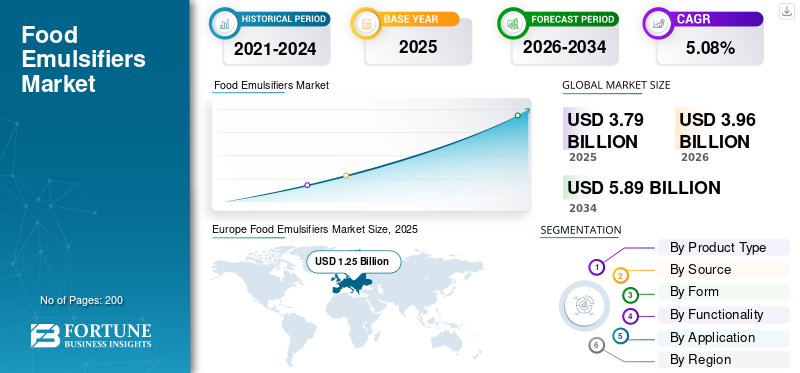
Download Free sample to learn more about this report.
FOOD EMULSIFIERS MARKET KEY TAKEAWAYS
 Market Size & Forecast
- 2025 Market Size: USD 3.79 billion
- 2026 Market Size: USD 3.96 billion
- 2034 Forecast Market Size: USD 5.89 billion
- CAGR: 5.08% from 2026–2034
 Market Share
- Europe dominated the food emulsifiers market with a 32.98% share in 2025.
- The lecithin segment is projected to register the fastest CAGR of 5.78% during the forecast period.
- The animal-based segment is expected to grow at the fastest CAGR of 4.56% from 2026–2034.
 Key Regional Highlights
North America
North America accounted for USD 1.17 billion in 2025 and is projected to expand at a CAGR of 4.82%, driven by demand from industrial bakeries, frozen desserts, sauces, and ready meals.
Europe
Europe generated USD 1.25 billion in 2025 and remains the leading regional market, supported by its strong confectionery, chocolate, and bakery industries.
Asia Pacific
Asia Pacific reached USD 0.99 billion in 2025 and is the fastest-growing region with a CAGR of 6.19%, supported by rising consumption of instant foods and soy lecithin-based products.
U.S.
The market was valued at USD 0.96 billion in 2025 and is expected to grow at a CAGR of 4.69%, driven by extensive processed food and industrial bakery production.
Japan
The market reached USD 0.12 billion in 2025, with demand supported by advanced food processing technologies and stringent quality standards.
Read More

Food Emulsifiers Market Trends
Increasing Adoption of Clean-Label and Plant-Based Emulsifiers is a Key Market Trend
A major trend shaping the market is the growing demand for clean-label ingredients and plant-based food additives. Consumers are increasingly seeking food products with recognizable, natural ingredients, prompting food manufacturers to replace synthetic emulsifiers with naturally derived alternatives such as lecithin, enzymatic emulsifiers, and plant-based mono-di-glycerides.
Food manufacturers are also reformulating products to reduce artificial additives while maintaining functionality, leading to the development of new emulsifier blends and multifunctional ingredient systems. These innovations allow manufacturers to maintain product stability and texture while aligning with consumer demand for simpler ingredient lists.
- According to the CBI.EU: nearly 52% of food & beverage products in the European market are clean-labeled, and this is anticipated to reach 70% by the end of 2026. Nearly 99% of European manufacturers consider clean-label products essential to their business strategy, with 87% already bringing them to market.
MARKET DYNAMICS
Market Drivers
Growing Demand for Processed and Convenience Foods Driving Emulsifier Consumption and Market Growth
The global market is primarily driven by the rapid growth of processed and convenience food consumption across both developed and emerging economies. Food emulsifiers play a critical role in stabilizing oil-water mixtures, improving texture stability, and shelf life in products such as bakery items, dairy products, confectionery, and ready-to-eat meals. As urbanization and busy lifestyles increase globally, consumers are increasingly relying on packaged and convenience foods, which require functional ingredients such as emulsifiers to maintain product stability and quality. Furthermore, the expansion of modern retail channels and foodservice sectors is increasing the availability of packaged food products in emerging markets. Countries such as China, India, Brazil, and South Africa are witnessing rising consumption of baked goods, dairy desserts, and ready meals, which directly contributes to the food emulsifiers market growth.
- According to the India Brand Equity Foundation, the Indian food processing industry grew by 50.92% from 2024 to 2026, reaching USD 535 billion by the end of 2026.
Market Restraints
Regulatory Scrutiny and Reformulation Pressure on Food Additives Restricting Market Expansion
Despite their functional importance, food emulsifiers face increasing regulatory scrutiny and consumer concerns regarding food additives. Regulatory authorities in several regions are tightening safety assessments and labeling requirements for food ingredients, which may affect the approval and usage levels of certain emulsifiers in food products.
Additionally, consumer perceptions of food additives have shifted in recent years, with many associating emulsifiers with processed or artificial foods. This perception has prompted food manufacturers to reformulate products using alternative ingredient systems or reduce the number of additives used in formulations.
Market Opportunities
Expansion of Plant-Based Foods and Functional Ingredient Innovation to Change the Industry Landscape
The rapid expansion of plant-based and alternative food products presents significant opportunities for the food emulsifiers market. Plant-based dairy alternatives, meat substitutes, and functional beverages require advanced emulsification systems to stabilize oil and water phases and maintain desirable texture and mouthfeel. As the plant-based food industry continues to expand, demand for specialized emulsifiers is expected to increase.
Companies are developing multifunctional emulsifier systems that combine emulsification, texture improvement, and shelf-life extension in a single ingredient. These innovations help food manufacturers simplify ingredient formulations while improving product performance.
Emerging markets such as China, India, Brazil, and Southeast Asia are also creating strong growth opportunities driven by rising demand for packaged food and expanding food processing industries. As food manufacturers in these regions continue to scale production and adopt modern processing technologies, the demand for emulsifiers as functional ingredients is expected to rise steadily.
- According to the People's Network Report on Development Statistics, the prepared food industry has been expanding at a 20% growth rate in recent years. It is expected to exceed one trillion yuan by 2026. Additionally, there are 68,000 players operating in the country, and nearly 11,000 new enterprises have been registered in 2024.
Download Free sample to learn more about this report.
SEGMENTATION ANALYSIS
By Product Type
Wide Usage in Bakery and Processed Food Applications Drives Mono-Di-glycerides & Derivatives Segments Growth
On the basis of product type, the market is segmented into mono-di-glycerides & derivatives, lecithin, stearoyl lactylates, sorbitan esters, and others.
The mono-di-glycerides & derivatives segment dominated the market in 2025, valued at USD 1.55 billion. The growth of this segment is driven by its extensive use in industrial bakery applications, which account for the largest share of emulsifier consumption worldwide. These emulsifiers are widely used in bread, cake, pastry, biscuit, and margarine formulations to improve dough stability, extend shelf life, enhance crumb softness, and maintain fat dispersion. The growing bakery industry and widespread product usage are likely to hold a prominent share of the market.
The lecithin segment is projected to grow at the fastest CAGR of 5.78% during the forecast period. It functions as a natural emulsifier, improving viscosity control, fat dispersion, and product stability. Emerging natural ingredients and plant-based emulsifiers to drive the segment's growth.
To know how our report can help streamline your business, Speak to Analyst
By Source
Availability of Plant-Based Ingredients to Drive Plant-Based Segment Growth
Based on source, the market is segmented into plant-based and animal-based.
The plant-based segment led the market in 2025, reaching USD 2.98 billion. Plant-based emulsifiers are primarily derived from vegetable oils such as soybean, sunflower, rapeseed, and palm oil, which are widely available and cost-effective raw materials for large-scale emulsifier production. Most commonly used emulsifiers, including mono-di-glycerides, lecithin, sorbitan esters, and stearoyl lactylates, are derived from vegetable oils, making plant-based ingredients the preferred source across the food industry.
The animal-based segment is expected to grow at the fastest CAGR of 4.56% during the forecast period.
By Form
High Shelf Life and Easy to Store Led the Powder Form Segment Growth
By form, the market is categorized into liquid/gel and powder.
The powder segment held the largest share of the market in 2025, valued at USD 2.27 billion. Powder emulsifiers are extensively used in commercial bakery formulations, including bread, cakes, biscuits, and bakery premixes. The powder form also offers longer shelf life, improved storage stability, and better compatibility with automated food processing systems, which are essential for large-scale industrial food production.
The liquid/gel segment is projected to grow at the fastest CAGR of 5.63% during the forecast period. Liquid forms are primarily used in applications such as chocolate and confectionery processing, sauces and dressings, dairy beverages, and beverage emulsions, where rapid dispersion in liquid systems is required. Lecithin, for example, is widely supplied in liquid form and is commonly used in chocolate manufacturing to control viscosity and improve flow properties during processing.
By Functionality
Food Formulaiton and Stability to Drive Emulsification Segment Growth
By functionality, the market is categorized into emulsification, dough strengthening, texture improvement, fat replacement, shelf-life extension, and others.
The emulsification segment held the largest food emulsifiers market share in 2025, valued at USD 1.33 billion. Emulsification accounts for the largest share, as the primary purpose of emulsifiers in food formulations is to stabilize oil-water mixtures that would otherwise separate. This functionality is essential across a wide range of food applications, including bakery products, confectionery, sauces and dressings, dairy desserts, beverages, and margarine. Emulsifiers are widely used to reduce interfacial tension between fat and water phases, ensuring stable emulsions and consistent product texture. The large-scale production of processed foods and ready-to-eat products globally continues to drive strong demand for emulsifiers performing this function.
The shelf-life extension segment is projected to grow at the fastest CAGR of 6.25% over the forecast period. Shelf-life extension is the fastest-growing functionality segment, driven by increasing demand for longer-lasting packaged food products and expanding global distribution networks.
By Application
High Adoption Rate of the Product in Bakery Industry Led the Bakery & Confectionery Segment Growth
Based on application, the market is segmented into bakery & confectionery, dairy & frozen desserts, prepared foods, beverages, meat & poultry products, and others.
Bakery & confectionery segment accounted for the largest share in 2025, valued at USD 1.76 billion. The segment accounts for the largest share due to the extensive use of emulsifiers in bread, cakes, pastries, biscuits, and chocolate products. Emulsifiers play a crucial role in improving dough stability, enhancing crumb softness, increasing aeration, and extending shelf life in baked goods. In confectionery applications, emulsifiers such as lecithin and PGPR help control viscosity and improve the flow properties of chocolate, allowing manufacturers to optimize processing efficiency and reduce cocoa butter usage.
Prepared foods segment is projected to witness the fastest CAGR of 6.14% over the forecast period. The segment is expected to be the fastest-growing due to rising consumption of convenience foods and ready-to-eat meals. Rapid urbanization, changing lifestyles, and the increasing demand for time-saving food options are prompting consumers to rely more on packaged and ready-made products.
Food Emulsifiers Market Regional Outlook
Regionally, the report covers the global market analysis across North America, Europe, Asia Pacific, South America, and the Middle East & Africa.
Europe
Europe Food Emulsifiers Market Size, 2025 (USD Billion)
To get more information on the regional analysis of this market, Download Free sample
Europe dominates the market in both value and volume consumption of the product, accounting for USD 1.25 billion in 2025 and expanding at a CAGR of 4.49% over the forecast period. Europe has a large confectionery and chocolate manufacturing industry, particularly in Belgium, Switzerland, and Germany. Emulsifiers such as lecithin and PGPR are essential ingredients in chocolate production as they improve flow properties and reduce cocoa butter requirements during processing. Furthermore, regulatory standards and consumer awareness regarding food ingredients are encouraging manufacturers to adopt natural emulsifier alternatives and improve ingredient transparency.
Germany Food Emulsifiers Market
Germany accounted for approximately USD 0.29 billion in 2025, driven by high bread consumption and strong industrial baking infrastructure. Bread improvers and bakery emulsifiers such as DATEM, mono-di-glycerides, and lactylates are widely used in the country. Germany also has large confectionery and chocolate manufacturing industries, which require lecithin and PGPR. Therefore, the country is anticipated to hold the dominating share of the market in the region.
North America
North America accounted for USD 1.17 billion in 2025 and is projected to grow at a CAGR of 4.82% during the forecast period. The industry is emerging in the region due to strong demand from industrial baker's, frozen desserts, sauces, and ready meals. Major ingredient producers, including ADM, Cargill, Ingredion, and IFF, are headquartered here, resulting in higher average selling prices for specialty emulsifiers. Although the market is mature, stable demand from packaged foods and innovation in clean-label emulsifiers maintain steady growth.
U.S. Food Emulsifiers Market
The U.S. market was valued at approximately USD 0.96 billion in 2025 and is expected to expand at a CAGR of 4.69% during the forecast period. The U.S. market dominates emulsifier consumption due to its massive processed food industry and extensive industrial bakery production. Applications such as bread, cakes, frozen desserts, margarine, sauces, and confectionery rely heavily on emulsifiers, including DATEM, mono-di-glycerides, lactylates, and PGPR. Large-scale bakery chains, frozen dessert manufacturing, and packaged food production drive demand for the product in the country.
Asia Pacific
Asia Pacific market reached USD 0.99 billion in 2025 and is the fastest-growing region, with a CAGR of 6.19% over the forecast period. Asia Pacific is one of the largest producers and consumers of instant foods such as noodles, which require emulsifiers to improve dough processing and product texture. Furthermore, the region has a strong soybean processing industry, particularly in China and India, which supports the production and consumption of soy lecithin used in confectionery, dairy beverages, and processed foods. As consumer lifestyles shift toward convenience foods and modern retail channels expand, demand for food emulsifiers is expected to continue to grow in the region.
China Food Emulsifiers Market
China was valued at USD 0.48 billion in 2025. It is the largest food manufacturing hub in the Asia Pacific, with strong demand for bakery products, instant noodles, confectionery, and dairy beverages. Large industrial bakeries and instant food producers consume high volumes of emulsifiers such as mono-di-glycerides and lecithin. Additionally, the expansion of packaged foods and rapid urbanization drives strong demand growth.
Japan Food Emulsifiers Market
Japan reached USD 0.12 billion in 2025. The country uses higher-value emulsifiers due to advanced food processing technologies and strict quality standards, thereby accelerating product demand.
South America and the Middle East & Africa
South America accounted for USD 0.24 billion in 2025, growing at a CAGR of 5.53% over the forecast period. Demand for food emulsifiers is primarily driven by the growth of the bakery, confectionery, and processed food industries. Countries such as Brazil and Argentina have large agricultural sectors and are among the world's leading producers of soybeans, which are a major raw material for lecithin production. Stable raw material availability will positively impact the manufacturing of the products. It is also contributing to the industry's growth.
The Middle East & Africa market was valued at USD 0.13 billion in 2025, and is expected to expand at a CAGR of 3.04% during the forecast period. The product demand in the Middle East & Africa is increasing due to rising urbanization, population growth, and expanding food processing industries. Bread and bakery products are staple foods across many countries in the region, driving strong demand for emulsifiers used for dough conditioning and shelf-life extension.
South Africa Food Emulsifiers Market
The South Africa market was valued at approximately USD 0.05 billion in 2025 and is projected to grow at a CAGR of 2.69% from 2026 to 2034. The growing availability of packaged foods and modern retail channels is likely to increase consumption of processed foods, thereby driving industry growth.
COMPETITIVE LANDSCAPE
Key Industry Players
Key Players Are Focused on Innovation, Portfolio Expansion, and Strategic Partnerships to Gain Market Advantage
The global food emulsifiers market is mederatley consolidated, dominated by a limited number of large global food ingredients manufacturers and several regional players. Key players such as Kerry Group Plc., Ingredion Inc., Cargil Inc., International Flavors & Fragrances, and ADM are dominating the market. The key players are investing in developing an innovative product portfolio using advanced technologies to meet the rising market demand for clean-label, natural, organic, and plant-based ingredients.
Key Players in the Food Emulsifiers Market
|
Rank |
Company Name |
|
1 |
ADM |
|
2 |
Cargill Incorporated |
|
3 |
International Flavors & Fragrances |
|
4 |
Ingredion Inc. |
|
5 |
Kerry Group Plc. |
List of Key Food Emulsifiers Companies Profiled
- ADM (U.S.)
- ABF Ingredients (U.K.)
- American Lecithin Company (U.S.)
- Cargill Incorporated (U.S.)
- Corbion (Netherlands)
- DuPont (U.S.)
- International Flavors & Fragrances (U.S.)
- Ingredion Inc. (U.S.)
- Kerry Group Plc. (Ireland)
- Tate & Lyle Ltd. (U.K.)
KEY INDUSTRY DEVELOPMENTS
- January 2026: Elchemy International, one of India’s emerging food ingredient manufacturers, launched Polysorbate 80 to enhance food texture. The newly launched emulsifier is designed for 2,300 food products, including salad dressings, baked goods, and sauces.
- June 2025: Indovinya, the specialty chemicals division of Indorama Ventures, launched a line of Sorbitan esters: Alkest Sp 80 K and Alkest Sp 60 K for bread, confectionery, oils, dairy, and beverage applications.
- June 2025: MaGie Creations, a Dutch food-tech company, developed a new emulsifier made from brewer's grain, a key byproduct of the beer industry. The company developed this product to address clean-label and sustainability concerns among food industry players.
- April 2025: Cultivated Biosciences, a Swiss biotech company, developed a yeast-based emulsifier using fermentation technology. The new product is designed for a variety of applications, including ready-to-drink protein shakes, coffee creamers, non-dairy milks, and more.
- January 2025: Louis Dreyfus Company, a Dutch multinational, acquired BASF SE's emulsifiers, aeration agents, omega-3 oils, and other ingredients business unit. The company acquired all food and health performance ingredient business product portfolios and a production site and R&D center in Germany.
REPORT COVERAGE
The market industry report analyzes the market in depth and highlights crucial aspects such as global food emulsifiers market trends, supply chain, market dynamics, prominent companies, investment in research and development, and end-use. Besides this, the research report also provides insights into the global market analysis and highlights significant industry developments.
Request for Customization to gain extensive market insights.
Report Scope & Segmentation
| ATTRIBUTE | DETAILS |
| Study Period | 2021-2034 |
| Base Year | 2025 |
| Estimated Year | 2026 |
| Forecast Period | 2026-2034 |
| Historical Period | 2021-2024 |
| Growth Rate | CAGR of 5.08% from 2026 to 2034 |
| Unit | Value (USD Billion) |
|
Segmentation |
By Product Type
|
|
By Source
|
|
|
By Form
|
|
|
By Functionality
|
|
|
By Application
|
|
|
By Region
|
Frequently Asked Questions
Fortune Business Insights says that the global market was USD 3.79 billion in 2025 and is anticipated to reach USD 5.89 billion by 2034.
At a CAGR of 5.08%, the global market will exhibit steady growth over the forecast period.
By product type, the mono-di-glycerides & derivatives segment led the market in 2025.
Europe held the largest market share in 2025.
The growing demand for processed and convenience foods is the crucial factor driving the global market.
Kerry Group Plc., Ingredion Inc., Cargil Inc., International Flavors & Fragrances, and ADM are the leading companies in the market.
Expansion of plant-based foods and innovation in functional ingredients is the key market trend.



- 2021-2034
- 2025
- 2021-2024
- 200
-
(Offer valid till 31st Oct 2026)
Get 30-60 hrs Free Customization
Expand Regional and Country Coverage, Segments Analysis, Company Profiles, Competitive Benchmarking, and End-user Insights.




















Related Reports
-
US +1 833 909 2966 ( Toll Free )
-
Get In Touch With Us