Tuberculosis (TB) Diagnostics Market Size, Share & Industry Analysis, By Type (Culture-based Diagnostics, Sputum Smear Microscopy, Rapid Molecular Diagnostics, and Others), By Disease Site (Pulmonary Tuberculosis and Extrapulmonary Tuberculosis), By End-user (Diagnostic & Reference Laboratories, Hospitals, Academic & Research Institutes, and Others), and Regional Forecast, 2026-2034
 Download Free Sample
KEY MARKET INSIGHTS
 Listen to Audio Version
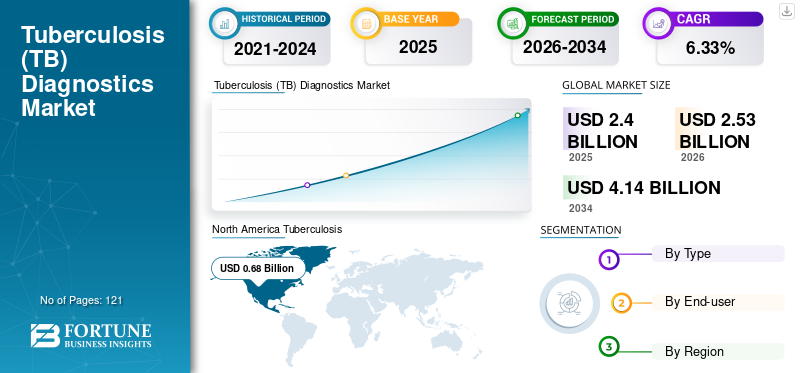
The global tuberculosis (TB) diagnostics market size was valued at USD 2.40 billion in 2025 and is projected to grow from USD 2.53 billion in 2026 to USD 4.14 billion by 2034, exhibiting a CAGR of 6.3% during the forecast period. North America dominated the tuberculosis diagnostics market with a market share of 28.33% in 2025.
Tuberculosis is a contagious disorder caused by a type of bacteria called Mycobacterium tuberculosis. The infection usually attacks the patient’s lungs. The infection can also attack other body parts such as the brain and spine. Tuberculosis diagnosis can be performed through skin tests and blood tests. The increasing prevalence of this disorder has increased the need for accurate and efficient diagnostic tests to control its spread. This factor is expected to significantly boost the demand for tuberculosis diagnostics in the coming years.
BIOMÉRIEUX, F. Hoffmann-La Roche Ltd., and Abbott held the largest market share due to strong brand reputation and established presence of the products from these companies.
Download Free sample to learn more about this report.
Tuberculosis (TB) Diagnostics Market Trends
Growing Adoption of Non-Sputum and Biomarker-Based Diagnostic Approaches to Emerge as a Key Trend
Currently, there has been a shift toward non-sputum-based and biomarker-driven testing methods. Although sputum microscopy and molecular tests remain central to TB diagnosis, obtaining adequate sputum samples can be difficult in children, older adults, immunocompromised patients, and individuals with extrapulmonary TB. Consequently, researchers and diagnostic companies are developing blood, urine, oral swab, and breath-based tests that enable less invasive and more accessible detection.
Emerging approaches include host gene-expression signatures, antigen assays, and oral swab molecular tests designed to identify active TB earlier and improve diagnosis in hard-to-test populations. These technologies could support point-of-care screening, reduce diagnostic delays, and expand testing in underserved settings. Continued clinical validation and regulatory approvals are expected to accelerate their adoption within active TB diagnostic pathways.
Market Dynamics
Market Drivers
Download Free sample to learn more about this report.
Rising Incidence of Tuberculosis in High-Burden Countries to Boost Market Growth
One of the most critical drivers that is positively impacting the market growth is the significant increase in the incidence of this disease across emerging countries. For instance, over the past few decades, there has been a surge in the patient population suffering from tuberculosis. This factor led to increased demand for research into effective diagnostic technologies for improved patient outcomes and greater accuracy in the diagnosis of these conditions.
- For instance, as per the Global Tuberculosis Report 2025 by the World Health Organization (WHO), a global total of 10.7 million people fell ill with TB in 2024.
Moreover, the high prevalence of tuberculosis encourages the key players to increase their focus on developing new diagnostics, such as nucleic acid amplification tests (NAATs) and rapid molecular assays, which can offer faster and more accurate results, even in challenging cases. As these diagnostics have become vastly available and demonstrate their effectiveness, a significant number of healthcare systems in the high-burden countries are increasingly adopting them, considering the accuracy and quick results. As a result, healthcare agencies and government organizations are concentrating on updating their tuberculosis (TB) diagnosis guidelines and recommending the best available tests.
- For instance, in March 2023, according to the NCBI, the World Health Organization (WHO) updated the TB diagnosis guidelines in February 2021. It reported on commercially available nucleic acid amplification test (NAAT) platforms and developed an algorithm for disease identification.
Such strong incidence rates, increasing demand for TB diagnoses, and increased focus on research and development are expected to propel global tuberculosis (TB) diagnostics market growth in the coming years.
Market Restraints
High Cost of Advanced Diagnostic Technologies May Hamper Market Expansion
Rapid molecular testing platforms require significant expenditure on instruments, test cartridges, calibration, maintenance, biosafety measures, and trained laboratory personnel. These costs can limit the decentralization of testing to primary healthcare and community settings, leading resource-constrained programs to continue relying on less expensive microscopy-based methods.
Moreover, recurring expenditure on consumables also places sustained pressure on public health budgets and restricts testing volumes, which is anticipated to hinder market growth over the forecast period.
Market Opportunities
Favorable Government Policies and Free Testing Programs to Create Lucrative Opportunities
Supportive government policies and publicly funded tuberculosis screening programs are expected to create significant growth opportunities for the market. Governments in high-burden countries are increasingly prioritizing early case detection, rapid molecular testing, and expanded access to diagnostic services as part of national TB control and elimination strategies. These initiatives are strengthening testing infrastructure, increasing public awareness, and encouraging the adoption of advanced diagnostic technologies across hospitals, laboratories, and community health centers.
The growing emphasis on active case finding and universal access to testing is also expected to increase diagnostic volumes, particularly among underserved and high-risk populations. Government procurement programs and investments in decentralized testing can further support the deployment of nucleic acid amplification tests, digital chest X-ray systems, and other rapid diagnostic tools.
- For instance, in February 2026, India’s Ministry of Health & Family Welfare stated that the government provides free TB diagnostic services under the National Tuberculosis Elimination Programme (NTEP), including upfront rapid molecular testing, X-ray imaging, and sputum-based examinations.
Market Challenges
Persistent Diagnostic Gaps and Delayed Case Detection to Challenge Market Growth
Tuberculosis symptoms often resemble those of other respiratory diseases, while children, immunocompromised individuals, and patients with extrapulmonary TB may be unable to produce adequate sputum samples. Moreover, limited laboratory infrastructure, shortages of trained personnel, weak sample-transport networks, and low awareness among patients and healthcare providers are expected to further delay diagnosis. These factors reduce the effective utilization of advanced diagnostic systems, particularly in rural and resource-constrained areas. Such a scenario is anticipated to challenge market expansion.
- For instance, according to the data published by the Centers for Disease Control and Prevention (CDC) in June 2026, nearly 2.4 million cases of active TB were either undiagnosed or unreported.
SEGMENTATION ANALYSIS
By Type
To know how our report can help streamline your business, Speak to Analyst
On the basis of type, the market is segmented into culture-based diagnostics, sputum smear microscopy, rapid molecular diagnostics, and others.
The rapid molecular diagnostics segment dominated the market in 2025 and is estimated to hold a significant market share throughout the forecast period. The segment's growth is attributed to the efficiency and accuracy associated with rapid molecular diagnostics for TB diagnosis. New product launches in the rapid molecular diagnostics segment are also anticipated to further drive the segment's growth during the forecast period.
- For instance, in March 2023, Illumina Inc. and GenoScreen collaboratively introduced a comprehensive solution that combines Illumina products with the GenoScreen Deeplex Myc-TB assay. This package utilizes targeted Next-Generation Sequencing (NGS) technology to enable rapid and thorough detection of drug resistance in tuberculosis cases. Such new product launches are expected to drive segmental growth over the forecast period.
Furthermore, the culture-based diagnostics segment is expected to grow substantially at 6.0% CAGR during the forecast period.
By Disease Site
Higher Cases of Pulmonary Tuberculosis Fueled Segment’s Growth
Based on disease site, the market is segmented into pulmonary tuberculosis and extrapulmonary tuberculosis.
The pulmonary tuberculosis segment dominated the market in 2025. Pulmonary tuberculosis accounts for the majority of diagnosed active TB cases and is supported by high-volume sputum-based testing, including smear microscopy, culture, and rapid molecular diagnostics. This is expected to drive the segment’s growth.
- For instance, according to the data from the Centers for Disease Control and Prevention (CDC) in December 2025, pulmonary-only tuberculosis accounted for 71.0% of reported TB cases in the U.S. in 2024, while 17.0% were classified as extrapulmonary-only cases and the remaining 12.0% involved both pulmonary and extrapulmonary disease.
The extrapulmonary tuberculosis segment is expected to grow at a CAGR of 7.1% over the forecast period.
By End-user
Strong Presence of Diagnostic & Reference Laboratories Boosted Segment’s Growth
Based on end-user, the market is classified into diagnostic & reference laboratories, hospitals, academic & research institutes, and others.
The diagnostic & reference laboratories segment accounted for a significant share of the market. The segment's growth is due to the strong presence of diagnostic laboratories globally. Moreover, an increasing trend of TB diagnosis being conducted in these diagnostic laboratories is responsible for the segment’s growth.
- For instance, as of July 2026, the data from Laboratory of Florida LLC stated that more than 200,000 clinical laboratories provide testing services in the U.S.
The hospitals segment is estimated to grow at a significant CAGR of 5.4% during the forecast period.
Tuberculosis (TB) Diagnostics Market Regional Outlook
By geography, the market is segmented into North America, Asia Pacific, Europe, Latin America, and the Middle East & Africa.
North America
North America Tuberculosis (TB) Diagnostics Market Size, 2025 (USD Billion)
To get more information on the regional analysis of this market, Download Free sample
North America accounted for the largest share of revenues in 2024, valued at USD 0.65 billion, and also reached USD 0.68 billion in 2025. The robust tuberculosis (TB) diagnostics market share of the region is due to the increasing prevalence of TB, which has been boosting the number of TB diagnoses being conducted in North America. Moreover, the strong presence of market players in this region is expected to contribute to the market growth during the forecast period.
U.S. Tuberculosis (TB) Diagnostics Market
In 2026, the U.S. is anticipated to reach USD 0.67 billion, accounting for approximately 26.3% of the global sales.
Asia Pacific
The Asia Pacific market is projected to be the second-largest market with a valuation of USD 0.83 billion in 2026. The improvement in healthcare infrastructure in Asian countries, the high burden of TB disease in this region, and the increasing demand among individuals for better treatment outcomes are driving the market growth in Asia Pacific.
- For instance, according to the TUBERCULOSIS SURVEILLANCE CENTER report in 2022, during 2021, there were a total of 11,519 newly reported cases of tuberculosis in Japan, resulting in a notification rate of 9.2 per 100,000 population.
Japan Tuberculosis (TB) Diagnostics Market
Japan is projected to reach approximately USD 0.09 billion in revenue in 2026, representing nearly 3.5% of the global sales.
China Tuberculosis (TB) Diagnostics Market
China’s market is anticipated to reach around USD 0.44 billion in 2026, accounting for nearly 17.5% of global revenues.
India Tuberculosis (TB) Diagnostics Market
India’s market is expected to reach approximately USD 0.12 billion in 2026, accounting for around 4.8% of global revenues.
Europe
Europe is projected to be the third-largest region in the market with a valuation of USD 0.45 billion in 2026 and is estimated to hold a CAGR of 5.1% during the forecast period. The segment's growth is attributable to the increasing demand for TB diagnostics such as rapid molecular diagnostics in Europe and initiatives undertaken by the European government agencies to increase the number of diagnostic laboratories in key countries such as the U.K.
U.K. Tuberculosis (TB) Diagnostics Market
The U.K. market is projected to reach USD 0.09 billion in 2026, representing approximately 3.4% of global revenues.
Germany Tuberculosis (TB) Diagnostics Market
Germany's market is expected to reach USD 0.11 billion in 2026, accounting for approximately 4.4% of global revenues.
Latin America and Middle East & Africa
Both Latin America and the Middle East & Africa are anticipated to witness moderate growth, with Latin America’s market estimated to reach approximately USD 0.25 billion by 2026. Their growth is attributed to an increasing number of companies penetrating these regions to expand their geographic presence.
GCC Tuberculosis (TB) Diagnostics Market
By 2026, the GCC market is estimated to reach approximately USD 0.13 billion, representing around 5.7% of global revenues.
COMPETITIVE LANDSCAPE
Key Industry Players
Market Players with Strong Focus on Expansion of Tuberculosis (TB) Diagnostics Portfolio to Hold Major Market Share
BIOMÉRIEUX, F. Hoffmann-La Roche Ltd., and Abbott are the prominent players in the market and accounted for significant share in 2025. The dominance of these companies is due to their strong product portfolio and continuous novel product launches in the market.
Other significant players, including Thermo Fisher Scientific Inc. and QIAGEN are increasing their emphasis on research & development activities for the development of innovative diagnostics and to strengthen their presence in the global market.
LIST OF KEY TUBERCULOSIS (TB) DIAGNOSTICS COMPANIES PROFILED
- Hoffmann-La Roche Ltd (Switzerland)
- BIOMÉRIEUX (France)
- QIAGEN (Netherlands)
- BD (U.S.)
- Cepheid (Danaher) (U.S.)
- Thermo Fisher Scientific Inc. (U.S.)
- Abbott (U.S.)
- Hologic, Inc. (U.S.)
- Hain Lifescience GmbH (Germany)
- Revvity (U.S.)
KEY INDUSTRY DEVELOPMENTS
- April 2026: Co-Diagnostics presented its Co-Dx PCR tuberculosis test at the Stop TB Partnership Summit in Washington, D.C., as the company prepared for further clinical development.
- November 2025: Co-Diagnostics presented its molecular TB test development and implementation strategy at The Union World Conference on Lung Health.
- November 2025: Oxford Nanopore and BIOMÉRIEUX launched AmPORE-TB, a research-use-only sequencing solution for rapid characterization of drug-resistance mutations in the M. tuberculosis complex.
- July 2024: Sherlock Biosciences joined the SMART4TB diagnostic partnership to develop an oral-swab-based, point-of-care molecular test for active tuberculosis.
- April 2024: QIAGEN launched the research-use-only QIAseq xHYB Mycobacterium tuberculosis Panel, enabling culture-free whole-genome sequencing and TB resistance surveillance.
- September 2023: QIAGEN donated 3,000 QuantiFERON-TB Gold Plus tests to the Ministry of Health (MOH) Malaysia. It served as a diagnostic tool for latent tuberculosis infection (LTBI) screening, focused on assisting the check-ups of immunocompromised individuals.
- February 2023: QIAGEN announced that it received the certification of QuantiFERON-TB Gold Plus (QFT-Plus) under the European Union’s 2017/746 In Vitro Diagnostic Medical Devices Regulation (IVDR). Moreover, QFT-Plus is validated by the WHO, which helps indirectly detect the bacteria that cause tuberculosis (TB).
- September 2022: BD India announced the launch of the BD MAX molecular diagnostic system and the BD MAX MDR-TB panel at a scientific session to enable clinicians to rapidly test for tuberculosis and multidrug resistance as a first-line test.
- May 2022: Hoffmann-La Roche Ltd entered into a partnership with the Global Fund to support low- and middle-income countries in strengthening critical diagnosis infrastructure against infectious diseases.
- March 2022: Thermo Fisher Scientific Inc. launched the SeqStudio Flex Series Genetic Analyzer for research & development of infectious disease detection, which is expected to expand the company's product portfolio in the market.
- February 2022: QIAGEN announced that its QuantiFERON tuberculosis testing solution received approval as the fourth generation of a modern gold standard test in China.
- July 2021: Hoffmann-La Roche Ltd. announced that WHO included the company’s products cobas MTB and cobas MTB-RIF/INH tests as Nucleic Acid Amplification Tests (NAATs). These products are nucleic acid testing products used to detect tuberculosis and drug-resistant tuberculosis (TB).
- March 2021: Hologic, Inc. announced the CE marking of its tuberculosis IGRA test on VIDAS. VIDAS TB-IGRA is an automated assay that helps in the diagnosis of infection with Mycobacterium tuberculosis.
REPORT COVERAGE
The tuberculosis (TB) diagnostics market research report provides a detailed competitive landscape. It focuses on key points such as new product launches in the market. Additionally, it includes the incidence of tuberculosis and key industry developments such as partnerships, mergers, and acquisitions. Furthermore, the report covers regional analysis of different segments and company profiles of key market players. The report consists of qualitative and quantitative insights contributing to the market growth.
Request for Customization to gain extensive market insights.
Report Scope & Segmentation
| ATTRIBUTE | DETAILS |
| Study Period | 2021-2034 |
| Base Year | 2025 |
| Estimated Year | 2026 |
| Forecast Period | 2026-2034 |
| Historical Period | 2021-2024 |
| Growth Rate | CAGR of 6.3% from 2026-2034 |
| Unit | Value (USD Billion) |
| Segmentation | By Type, Disease Site, End-user, and Region |
| By Type |
|
| By Disease Site |
|
| By End-user |
|
| By Region |
|
Frequently Asked Questions
Fortune Business Insights says that the global market stood at USD 2.40 billion in 2025 and is projected to reach USD 4.14 billion by 2034.
The market is expected to exhibit a CAGR of 6.3% during the forecast period.
The rapid molecular diagnostics segment is set to lead the market by type.
The key factors driving the market are the rising incidence of tuberculosis in high-burden countries.
BIOMÉRIEUX, F. Hoffmann-La Roche Ltd., and Abbott are the top players in the market.



- 2021-2034
- 2025
- 2021-2024
- 121
Get 30-60 hrs Free Customization
Expand Regional and Country Coverage, Segments Analysis, Company Profiles, Competitive Benchmarking, and End-user Insights.













.webp)






Related Reports
-
US +1 833 909 2966 ( Toll Free )
-
Get In Touch With Us