Fortified Dairy Products Market Size, Share & Industry Analysis, By Product Type (Fortified Milk, Fortified Yogurt and Fermented Dairy Products, Milk Powder and Dairy-Based Nutrition Powders, Fortified Cheese, and Others), By Nutrition Type (Vitamins, Minerals, Protein, Dietary Fibers, Probiotics, and Others), By End-User (Infants, Children, Adults, and Geriatric), By Distribution Channel (Supermarkets/Hypermarkets, Convenience/Grocery Stores, Online Retailers, and Others), and Regional Forecast, 2026-2034
 Download Free Sample
(Offer valid till 15th Oct 2026)

Fortified Dairy Products Market Size and Future Outlook
 Listen to Audio Version
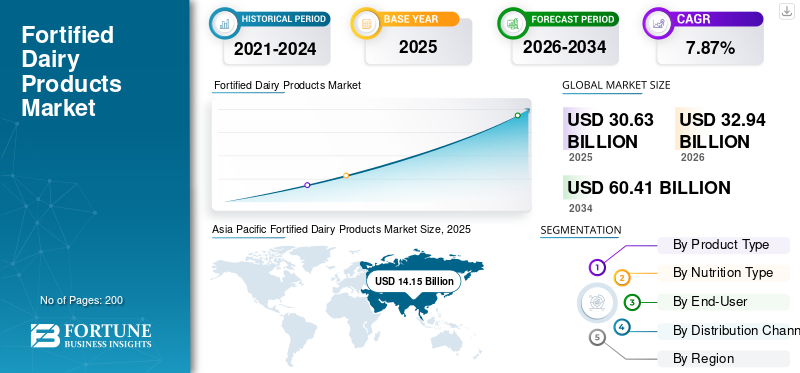
The global fortified dairy products market size was valued at USD 30.63 billion in 2025 and is projected to grow from USD 32.94 billion in 2026 to USD 60.41 billion by 2034, exhibiting a CAGR of 7.87% during the forecast period. Asia Pacific dominated the fortified dairy products market with a market share of 46.2% in 2025.
Fortified dairy products refer to milk, yogurt, fermented dairy products, cheese, milk powder, dairy beverages, and dairy-based nutritional formulations enriched with nutrients beyond their naturally occurring levels. Common additions include vitamins A, B-complex, C, D and E, calcium, iron, zinc and magnesium, milk and whey proteins, dietary fibers, probiotics, omega fatty acids, and other functional ingredients. Fortification may restore nutrients lost during processing or raise nutrient concentrations to address specific dietary requirements. The global market growth is evolving from conventional vitamin A- and vitamin D-fortified milk into a broader functional-nutrition category. Manufacturers are introducing high-protein yogurt, calcium-enriched milk, probiotic fermented beverages, fiber-containing dairy products, fortified cheese, lactose-free nutritional milk, children’s growth formulations, and dairy products designed for healthy aging. Shifting consumer preferences for personalized nutrition and nutrient-enriched foods are supporting the demand for fortified dairy products across global markets.
Commercial development is being led by multinational dairy manufacturers, nutritional-product companies, cooperatives and regional processors, including Nestlé S.A., Danone S.A., Fonterra Co-operative Group Limited, Royal FrieslandCampina N.V., Arla Foods amba, and Groupe Lactalis S.A. Their product portfolios cover fortified milk powders, children’s milk, high-protein products, probiotic yogurt, adult nutritional beverages, medical nutrition ingredients, and micronutrient-enriched dairy products.
Download Free sample to learn more about this report.
Fortified Dairy Products Market KEY Takeaways
 Global Market Size & Forecast
- 2025 Market Size: USD 30.63 Billion
- 2026 Market Size: USD 32.94 Billion
- 2034 Forecast Market Size: USD 60.41 Billion
- CAGR: 7.87% from 2026-2034
 Market Share
- Asia Pacific dominated with a revenue share of 46.2% in 2025.
- Fortified milk dominated the market in 2025, supported by widespread household consumption and established enrichment practices.
- Fortified yogurt and fermented dairy products are projected to grow at the fastest CAGR of 10.87% from 2026-2034.
 Key Regional Highlights
Asia Pacific
Asia Pacific led the market with USD 14.15 billion in 2025, driven by population growth and strong demand for fortified dairy nutrition.
Europe
Europe was valued at USD 7.18 billion in 2025, supported by established dairy infrastructure and rising demand for high-protein and probiotic products.
North America
Valued at USD 6.15 billion in 2025, driven by demand for fortified milk, yogurt, and high-protein dairy products.
U.S
The U.S. dominated North America with USD 5.13 billion in 2025, supported by fortified milk, high-protein yogurt, and probiotic products.
Japan
Demand is supported by growing consumer interest in fortified dairy products, protein nutrition, and wellness-oriented foods.
Read More

Fortified Dairy Products Market Trends
Increasing Development of High-Protein and Healthy-Aging Dairy Products to Shape Industry Trends
Protein fortification is moving beyond sports nutrition and becoming a mainstream feature of yogurt, milk beverages, dairy snacks, nutrition powders, and products designed for older consumers. Increasing consumer preference for fortified dairy products with added nutritional benefits is encouraging manufacturers to expand their product portfolios. Manufacturers are developing dairy formulations with elevated milk protein, whey protein, casein, calcium, vitamin D and omega-3s to address muscle maintenance, satiety, mobility and healthy aging.
The trend is particularly relevant for geriatric consumers, as aging is commonly associated with reduced muscle mass, lower appetite, declining bone density and difficulty obtaining sufficient nutrients from regular meals. Fortified dairy products offer a familiar and convenient vehicle for delivering protein, calcium and vitamins in drinkable, spoonable or powdered formats.
- According to Danone S.A., muscle mass declines by approximately 3–8% per decade after the age of 30, increasing the risk of sarcopenia. As a result, nutrition experts recommend greater intake of high-quality proteins, particularly dairy proteins, to preserve muscle function in older adults.
MARKET DYNAMICS
Market Drivers
Download Free sample to learn more about this report.
Increasing Micronutrient Deficiency Concerns to Strengthen Demand for Fortified Dairy Products
Micronutrient deficiencies remain a significant nutrition concern across both developing and developed economies. Inadequate intake of vitamin D, calcium, iron, zinc, vitamin A, and B vitamins can affect bone development, immunity, cognitive performance, growth, and general health. Dairy products provide an effective fortification platform, as milk, yogurt, and dairy powders are widely consumed, can be portion controlled, and are already associated with protein and calcium. The World Health Organization (WHO) defines food fortification as the deliberate addition of one or more micronutrients to improve the nutritional quality of the food supply and provide a public-health benefit with minimal health risk. The organization also recognizes fortification as a means of restoring nutrients lost during processing. This is expected to boost the fortified dairy products market growth in the coming years.
- The Seventy-sixth World Health Assembly reported that approximately 372 million preschool children and 1.2 billion women of reproductive age were at risk of at least one micronutrient deficiency. It also noted that vitamin D deficiency increases the risk of rickets and osteomalacia among children and osteoporosis among adults. These conditions support the continued development of vitamin- and mineral-fortified dairy products.
|
Rank |
Market Drivers |
Expected Impact on Market Growth |
Estimated Gross Market Growth Contribution (USD Billion) |
Impact: 2026-2028 |
Impact: 2029-2031 |
Impact: 2032-2034 |
|
1 |
Growing prevalence of nutritional deficiencies and increasing adoption of dairy products fortified with vitamins, calcium, iron, zinc, and other minerals |
High |
9.59 |
High |
High |
High |
|
2 |
Expanding consumption of high-protein milk, yogurt, fermented dairy products, nutritional beverages, and healthy-aging formulations |
High |
7.62 |
High |
High |
High |
|
3 |
Rising consumer demand for nutrient-enriched dairy products supporting protein intake, bone health, immunity, digestive wellness, and overall nutrition |
Medium-High |
6.30 |
High |
High |
Medium |
|
4 |
Product innovation involving probiotics, prebiotic fibers, lactose-free formulations, reduced-sugar products, specialized proteins, and life-stage nutrition |
Medium |
5.08 |
Medium |
High |
High |
|
5 |
Expansion of organised retail, cold-chain infrastructure, online grocery platforms, dairy-processing capacity, and distribution in emerging economies |
Medium-Low |
4.23 |
Medium |
Medium |
High |
|
6 |
Others, including school milk programmes, infant and child nutrition, sports nutrition, organic dairy products, premiumisation, and institutional demand |
Low |
3.51 |
Low |
Medium |
Medium |
|
Total Gross Growth Contribution |
36.33 |
Market Restraints
High Product Costs and Price Sensitivity Limit Adoption in Emerging Markets
Fortified dairy products generally require additional ingredients, formulation work, nutrient-stability testing, quality control and specialized packaging. Premium proteins, probiotic cultures, dietary fibers, vitamin premixes and mineral compounds increase manufacturing costs compared with conventional dairy products. These expenses are reflected in retail pricing and can constrain adoption among low-income households. Price sensitivity is particularly significant in markets where unpackaged milk, conventional milk powder or locally produced yogurt remain substantially cheaper than branded fortified alternatives.
The effect is likely to be strongest in South America, Africa and parts of Asia, where inflation, exchange-rate movements and imported premix costs can make fortified foods less affordable.
- The affordability constraint is intensified by persistent food inflation. World Bank data for June–September 2024 showed food inflation above 5% in 76.2% of low-income countries, 51.1% of lower-middle-income countries, and 38.0% of upper-middle-income countries. Under these conditions, households tend to prioritize essential staple dairy products and reduce purchases of premium fortified variants.
|
Rank |
Market Restraints |
Expected Impact on Market Growth |
Estimated Reduction in Market Size (USD Billion) |
Impact: 2026-2028 |
Impact: 2029-2031 |
Impact: 2032-2034 |
|
1 |
Higher production and retail costs associated with protein ingredients, vitamin and mineral premixes, probiotics, specialized processing, and protective packaging |
High |
3.00 |
High |
High |
Medium |
|
2 |
Competition from fortified plant-based beverages, non-dairy yogurt alternatives, dietary supplements, and other functional nutrition products |
Medium-High |
2.35 |
High |
Medium |
Medium |
|
3 |
Price sensitivity in emerging markets, limited cold-chain infrastructure, and volatility in milk, energy, packaging, and imported fortification-ingredient costs |
Medium |
2.05 |
Medium |
Medium |
Medium |
|
4 |
Others, including lactose intolerance, milk-protein allergies, concerns regarding added sugar and highly processed products, regulatory compliance, and nutrient-stability challenges |
Low |
1.46 |
Low |
Low |
Low |
|
Total Market Reduction |
8.86 |
Market Opportunities
Growing Demand for Protein, Digestive Health Benefits and Functional Nutrition to Expand Product Applications
Consumers are increasingly selecting foods that provide benefits beyond basic energy and nutrition. This is encouraging dairy companies to combine proteins, probiotics, prebiotic fibers, vitamins and minerals within yogurt, fermented drinks, milk beverages and dairy-based nutritional formulations. Yogurt and fermented dairy products are particularly suitable for functional positioning, as manufacturers can incorporate probiotic cultures, fiber, protein and micronutrients while retaining a familiar food format. The products are used across breakfast, snacking, digestive wellness, immunity-support and active-lifestyle occasions.
Protein fortification is also expanding into dairy drinks, cheese, yogurt cups, powdered nutritional products and meal-support beverages. This enables manufacturers to target athletes, working adults, weight-management health-conscious consumers, recovering patients and older people through differentiated concentrations and serving formats.
- For instance, in April 2025, Nestlé S.A. introduced Boost Advanced, containing 35 grams of protein per serving, together with nutrients intended to support digestive health and energy metabolism. The product was developed for consumers using GLP-1 weight-management therapies, illustrating the expansion of fortified dairy-based nutrition into specialized clinical and lifestyle applications.
SEGMENTATION ANALYSIS
By Product Type
Fortified Milk Dominated Market Due to High Household Consumption and Established Fortification Practices
Based on product type, the market is segmented into fortified milk, fortified yogurt and fermented dairy products, milk powder and dairy-based nutrition powders, fortified cheese, and others.
The fortified milk segment dominated the global market in 2025. Its leadership is supported by regular household consumption, established vitamin A and D enrichment practices, school milk programmes, and broad availability in refrigerated, UHT, flavored, and lactose-free formats. Milk also provides a familiar base for adding calcium, iron, zinc, protein, and omega fatty acids.
Fortified yogurt and fermented dairy products are projected to record the fastest CAGR of 10.87% from 2026 to 2034 due to the combined positioning of probiotics, protein, convenience, and digestive wellness.
To know how our report can help streamline your business, Speak to Analyst
By Nutrition Type
Vitamins Held Largest Share Due to Their Extensive Use in Milk and Dairy Nutrition Products
Based on nutrition type, the market is segmented into vitamins, minerals, protein, dietary fibers, probiotics, and others.
The vitamins segment dominated the global fortified dairy products market share in 2025. Vitamin A and vitamin D are widely added to fluid milk, powdered milk, and children’s dairy products, while vitamins B12, C, and E are used in family nutrition and functional beverages.
The protein segment is projected to record the fastest CAGR of 10.36% over the forecast period.
By End-User
Adults Dominated Due to Broad Consumption across Everyday Nutrition and Active-lifestyle Products
Based on end-user, the market is segmented into infants, children, adults, and geriatric.
Adults dominated the global market in 2025. The segment benefits from broad consumption of fortified milk, yogurt, cheese, protein beverages, and probiotic products for breakfast, snacking, digestive health, weight management, and active nutrition.
The geriatric segment is projected to register the fastest CAGR of 10.31% from 2026 to 2034, supported by an aging population and increasing demand for protein- and calcium-rich products.
By Distribution Channel
Supermarkets/Hypermarkets Held Largest Share Due to Broad Product Availability and Refrigerated Infrastructure
Based on distribution channel, the market is segmented into supermarkets/hypermarkets, convenience/grocery stores, online retailers, and others.
Supermarkets and hypermarkets dominated the global market in 2025. Their leadership is supported by refrigerated storage, high consumer traffic, extensive brand selection, and the ability to merchandise milk, yogurt, cheese, nutritional beverages, and dairy powders within dedicated categories.
Online retailers are projected to grow at the fastest CAGR of 14.28% from 2026 to 2034, supported by subscription purchasing, home delivery, and easier comparison of nutrition claims.
Fortified Dairy Products Market Regional Outlook
Regionally, the market is studied across North America, Europe, Asia Pacific, South America, and the Middle East & Africa.
Asia Pacific
Asia Pacific Fortified Dairy Products Market Size, 2025 (USD Billion)
To get more information on the regional analysis of this market, Download Free sample
Asia Pacific dominated the global market and was valued at USD 14.15 billion in 2025. The region is projected to reach USD 28.26 billion by 2034, growing at a CAGR of 8.03% during the forecast period. Its leading position is supported by a large population base, expanding milk production, established consumption of milk powders and yogurt, and strong demand for children’s nutrition in China, India, and Southeast Asia.
China Fortified Dairy Products Market
China was valued at approximately USD 2.61 billion in 2025. Demand is supported by children’s milk powders, calcium-fortified milk, yogurt, probiotic drinks, and products positioned for immunity and digestive wellness.
India Fortified Dairy Products Market
India was valued at approximately USD 9.30 billion in 2025. The market benefits from high household familiarity with milk, a large dairy-production base, and growing demand for vitamin-fortified milk, protein products, and children’s nutrition.
North America
North America was valued at USD 6.15 billion in 2025 and is projected to reach USD 11.01 billion by 2034, growing at a CAGR of 6.69% during the forecast period. Growth is supported by established vitamin A and vitamin D milk fortification, broad consumption of yogurt and cheese, increasing high-protein product launches, and strong demand for sports and adult nutrition.
U.S. Fortified Dairy Products Market
The U.S. dominated North America and was valued at approximately USD 5.13 billion in 2025. Demand is supported by vitamin-fortified fluid milk, high-protein yogurt, probiotic products, sports nutrition, lactose-free milk, and adult nutritional beverages.
Europe
Europe was valued at USD 7.18 billion in 2025 and is projected to reach USD 13.36 billion by 2034, growing at a CAGR of 7.18% during the forecast period. Growth is supported by strong yogurt and cheese consumption, established dairy-processing infrastructure, and increasing awareness of fortified dairy products, high-protein, probiotic, reduced-sugar, and lactose-free products.
Germany Fortified Dairy Products Market
Germany was valued at approximately USD 1.61 billion in 2025. Demand is supported by a mature yogurt and dairy-drink market, widespread supermarket availability, and consumer interest in protein, digestive wellness, and organic nutrition.
U.K. Fortified Dairy Products Market
The U.K. market was valued at approximately USD 1.25 billion in 2025. Growth is supported by high-protein yogurt, fortified children’s milk, probiotic beverages and dairy products positioned for bone health and active nutrition.
South America and Middle East & Africa
South America was valued at USD 2.10 billion in 2025 and is projected to reach USD 5.10 billion by 2034, growing at a CAGR of 10.42% during the forecast period. Growth is supported by increasing demand for powdered milk, fortified children’s products, protein-enriched dairy beverages, yogurt, and affordable family nutrition.
The Middle East & Africa market was valued at USD 1.05 billion in 2025 and is projected to reach USD 2.68 billion by 2034, growing at the fastest CAGR of 11.01% during the forecast period. Growth will be supported by population expansion, increasing urbanization, imported milk powders, school nutrition, children’s products, and rising demand for family and adult nutrition.
Brazil Fortified Dairy Products Market
Brazil dominated South America and was valued at approximately USD 1.44 billion in 2025. Its position is supported by a large dairy industry, extensive supermarket networks, and growing demand for yogurt, dairy beverages, children’s nutrition, and sports-nutrition products.
COMPETITIVE LANDSCAPE
Key Industry Players
Major Companies Focus on Nutrient-specific Formulations, Life-stage Nutrition, and Functional Dairy Innovation
The global fortified dairy products market includes multinational food manufacturers, dairy cooperatives, infant and adult nutrition companies, probiotic specialists and regional dairy processors. Competition is based on nutrient composition, scientific substantiation, protein concentration, probiotic viability, taste, sugar content, shelf life, affordability, brand trust and distribution reach.
Key players benefit from extensive milk-sourcing networks, formulation expertise and the ability to distribute products through supermarkets, pharmacies, institutional channels and e-commerce. They are also able to develop separate formulations for infants, children, adults, athletes and older consumers.
List of Key Fortified Dairy Product Companies Profiled
- Nestlé S.A. (Switzerland)
- Danone S.A. (France)
- Fonterra Co-operative Group Limited (New Zealand)
- Royal FrieslandCampina N.V. (Netherlands)
- Arla Foods amba (Denmark)
- Groupe Lactalis S.A. (France)
- Abbott Laboratories (U.S.)
- General Mills, Inc. (U.S.)
- Yakult Honsha Co., Ltd. (Japan)
- Meiji Holdings Co., Ltd. (Japan)
KEY INDUSTRY DEVELOPMENTS
- June 2026: Danone announced an agreement to acquire MADE Group in Australia. MADE’s portfolio includes high-protein ready-to-drink products and gut-health yogurts. Danone also agreed to acquire the remaining 49% interest in its existing fresh-dairy joint venture with Saputo Dairy Australia.
- June 2026: Lactalis announced the acquisition of The Protein Works, a sports- and active-nutrition company offering protein powders, functional foods and nutritional products.
- June 2025: Lactalis completed the acquisition of General Mills’ U.S. yogurt business after receiving regulatory clearance. The transaction transferred General Mills’ U.S. yogurt operations to Lactalis.
- January 2024: General Mills launched Yoplait Protein, a high-protein dairy snack made with ultra-filtered milk. The product contains 15 grams of protein per serving and was launched in several flavors in the U.S.
REPORT COVERAGE
The global fortified dairy products market report analyses the market in depth and highlights crucial aspects such as global market trends, market dynamics, supply chains, prominent companies, investment in research and development, and end-use. Besides this, the report also provides insights into the global market analysis and highlights significant industry developments.
Request for Customization to gain extensive market insights.
Report Scope and Segmentation
| ATTRIBUTE | DETAILS |
| Study Period | 2021-2034 |
| Base Year | 2025 |
| Estimated Year | 2026 |
| Forecast Period | 2026-2034 |
| Historical Period | 2021-2024 |
| Growth Rate | CAGR of 7.87% from 2026 to 2034 |
| Unit | Value (USD Billion) |
|
Segmentation |
By Product Type
|
|
By Nutrition Type
|
|
|
By End-User
|
|
|
By Distribution Channel
|
|
|
By Region
|
Frequently Asked Questions
Fortune Business Insights says that the global market was valued at USD 30.63 billion in 2025 and is anticipated to reach USD 60.41 billion by 2034.
At a CAGR of 7.87%, the global market will exhibit steady growth over the forecast period.
By product type, the fortified milk segment led the market.
Asia Pacific held the largest market share in 2025.
Increasing micronutrient deficiency concerns are driving market growth.
Nestlé S.A., Danone S.A., Fonterra Co-operative Group Limited, Royal FrieslandCampina N.V., Arla Foods amba, and Groupe Lactalis S.A. are the leading players in the market.
Increasing development of high-protein and healthy-aging dairy products is a key market trend.



- 2021-2034
- 2025
- 2021-2024
- 200
-
(Offer valid till 15th Oct 2026)
Get 30-60 hrs Free Customization
Expand Regional and Country Coverage, Segments Analysis, Company Profiles, Competitive Benchmarking, and End-user Insights.




















Related Reports
-
US +1 833 909 2966 ( Toll Free )
-
Get In Touch With Us