Frozen Fruits Market Size, Share & Industry Analysis, By Fruit Type (Tropical Fruits, Citrus Fruits, Berries, Melons, and Others), By Form (Whole, Sliced, Pulp, and Others), By Technology (IQF, Cryogenic Freezing, and Others), By Nature (Organic and Conventional), By Application (Bakery & Confectionery, Dairy, Frozen Desserts, Beverages, Snacks & Cereals, and Others), and Regional Forecast, 2026-2034
 Download Free Sample
(Offer valid till 31st Oct 2026)

Frozen Fruits Market Size and Future Outlook
 Listen to Audio Version
The global frozen fruits market size was valued at USD 5.98 billion in 2025. The market is projected to grow from USD 6.31 billion in 2026 to USD 10.03 billion by 2034, exhibiting a CAGR of 5.98% during the forecast period. Europe dominated the frozen fruits market with a market share of 36.62% in 2025.
Frozen fruits include fruits preserved through freezing technologies such as individual quick freezing, cryogenic freezing, blast freezing, and other cold preservation methods to maintain taste, texture, color, nutritional value, and shelf life. The market covers frozen berries, tropical fruits, citrus fruits, melons, fruit pulps, sliced fruits, whole fruits, and fruit blends used across bakery & confectionery, dairy, frozen desserts, beverages, snacks, cereals, foodservice, retail, and industrial food processing.
The global market size is expanding due to rising consumption of smoothies, frozen desserts, bakery toppings, yogurt inclusions, fruit-based beverages, ready-to-blend products, clean-label snacks, and convenience foods. Growth is also supported by expanding cold-chain logistics, rising year-round demand for seasonal fruits, increasing use of IQF technology, and growing consumer preference for minimally processed fruit ingredients with longer storage life.
The global product demand is supported by leading companies such as Dole plc, Ardo Group, Greenyard NV, Crop’s NV, and SunOpta Inc. These companies maintain strong positions across frozen berries, tropical fruits, fruit blends, frozen fruit ingredients, smoothie fruit packs, organic frozen fruits, private-label retail packs, and foodservice fruit solutions.
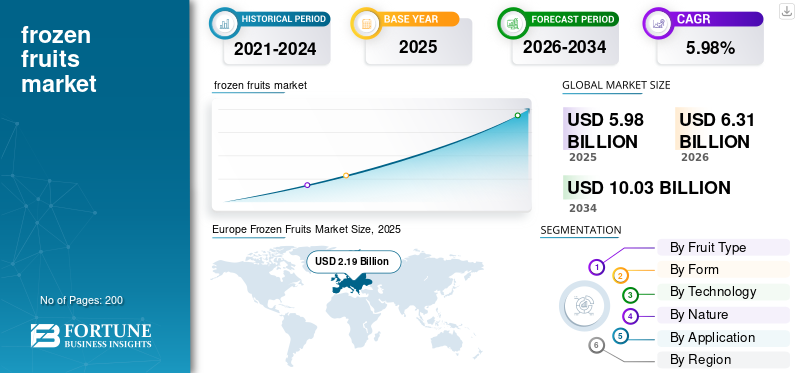
Download Free sample to learn more about this report.
Frozen Fruits Market Takeaways
 Global Market Size & Forecast
- 2025 Market Size: USD 5.98 billion
- 2026 Market Size: USD 6.31 billion
- 2034 Forecast Market Size: USD 10.03 billion
- CAGR: 5.98% from 2026–2034
 Market Share
- Europe dominated the frozen fruits market with a 36.62% share in 2025.
- The berries segment dominated the market, valued at USD 2.75 billion in 2025.
- The pulp segment led the market, valued at USD 2.13 billion in 2025.
 Key Regional Highlights
North America
North America was valued at USD 1.88 billion in 2025. The region is projected to reach USD 3.05 billion by 2034, growing at a CAGR of 5.59%.
Europe
Europe dominated the global market and was valued at USD 2.19 billion in 2025. The region is projected to reach USD 3.43 billion by 2034, growing at a CAGR of 5.14%.
Asia Pacific
Asia Pacific was valued at USD 1.36 billion in 2025. The region is projected to reach USD 2.66 billion by 2034, growing at the fastest CAGR of 7.78%.
U.S.
The U.S. dominated the North American market with an estimated value of USD 1.47 billion in 2025, driven by strong demand for frozen berries, smoothie mixes, and fruit blends.
Japan
Japan is witnessing rising demand for premium frozen fruits, supported by increasing consumption of convenient, healthy, and ready-to-use fruit products across retail and foodservice sectors.
Read More

Frozen Fruits Market Trends
Expansion of Snackable Frozen Fruits, Smoothie Blends, and Tropical IQF Fruit Formats is a Key Market Trend
A major trend shaping the global market is the rapid expansion of snackable frozen fruit products, ready-to-blend smoothie packs, and tropical IQF fruit formats. Frozen fruits are no longer used only as ingredients for smoothies, bakery fillings, yogurts, and desserts; they are increasingly being positioned as convenient, healthy, and indulgent frozen snacks. Products such as chocolate-coated frozen fruit, frozen fruit bites, smoothie cubes, mixed berry packs, mango chunks, pineapple pieces, dragon fruit cubes, and tropical fruit blends are gaining strong traction among households, cafés, foodservice operators, and beverage manufacturers.
The trend is strongly supported by rising consumer preference for better-for-you snacking, convenient breakfast options, and low-waste fruit consumption. Frozen fruits offer year-round availability, longer shelf life, portion control, and reduced preparation time compared with fresh fruits. IQF technology also helps preserve individual fruit pieces separately, making them easier to use in smoothies, bowls, desserts, dairy products, bakery toppings, and ready-to-blend beverages.
The popularity of frozen fruits is also increasing as consumers seek convenient, fruit-based snacks that support healthier eating patterns without requiring washing, peeling, cutting, or immediate consumption.
- The U.S. Department of Agriculture cold storage data showed total U.S. frozen fruit stocks at around 950.6 million pounds as of May 31, 2024, compared with 856.3 million pounds a year earlier. Frozen strawberries accounted for approximately 212.8 million pounds, while frozen blueberries accounted for nearly 170.0 million pounds, reflecting strong demand from smoothie, dairy, bakery, dessert, and retail applications.
MARKET DYNAMICS
Market Drivers
Download Free sample to learn more about this report.
Rising Demand for Convenient, Long Shelf-life, and Ready-to-use Fruit Ingredients to Strengthen Market Growth
Rising demand for convenient and long shelf-life fruit ingredients is one of the strongest drivers of the global market. Consumers are increasingly shifting toward easy-to-use fruit formats that reduce preparation time, minimize waste, and provide year-round access to seasonal fruits. Frozen fruits are widely used in smoothies, desserts, bakery products, breakfast bowls, dairy products, fruit beverages, and snacks as they are pre-cleaned, portionable, and suitable for both home and commercial kitchens.
This driver is particularly strong in North America and Europe, where frozen fruit is widely used in retail smoothie packs, yogurt toppings, bakery mixes, and frozen dessert applications. It is also gaining momentum in Asia Pacific as urban households, cafés, quick-service restaurants, and beverage chains increase the use of frozen fruit purees, sliced fruits, and IQF fruit pieces.
The demand for frozen fruits is further supported by the long shelf life of frozen formats, which helps consumers reduce food waste while enabling foodservice operators and manufacturers to maintain a consistent fruit supply across seasons.
- The National Agricultural Statistics Service stated that the Cold Storage survey covers more than 800 commercial and public warehouses in the 48 U.S. states that store refrigerated products for 30 days or more. This supports the role of mature warehousing infrastructure in frozen fruit availability.
Market Restraints
Seasonal Raw Material Availability, Cold-chain Dependence, and Quality Variation to Restrict Market Expansion
The global frozen fruits market growth is restrained by seasonal raw material availability, cold-chain dependence, energy costs, and quality variation across fruit types. Since fruits are highly perishable and harvested seasonally, processors must manage procurement, washing, cutting, freezing, storage, and transport within strict time and temperature conditions. Any delay in harvesting, processing, or freezing can affect color, flavor, texture, drip loss, and overall product quality.
Cold-chain dependence is another major restraint. Frozen fruits require uninterrupted refrigerated warehousing, frozen transport, and temperature-controlled retail or foodservice storage. In emerging markets, insufficient cold-chain infrastructure can limit distribution reach and raise logistics costs. Power reliability, freezer capacity, and high energy costs can also affect profitability for processors and distributors.
Quality consistency is especially challenging for berries, tropical fruits, and fruit pulps, as fruit size, ripeness, sugar content, acidity, and moisture level vary by region and season. These factors can restrict adoption in premium bakery, dairy, and beverage applications where consistent color, taste, and texture are important.
In some markets, limited awareness of the health benefits of frozen fruits compared with fresh alternatives can also restrict consumer adoption, especially where frozen foods are still associated mainly with highly processed products.
- According to joint reports from the UN Environment Programme (UNEP) and the Food and Agriculture Organization (FAO), the lack of sustainable food cold chains results in 526 million tons of food loss annually.
Market Opportunities
Expansion of Snackable Frozen Fruit, Private-label Packs, and Asia Pacific Frozen Fruit Trade to Unlock New Growth Potential
The expansion of snackable frozen fruit products, private-label frozen fruit packs, and the Asia Pacific frozen fruit trade is expected to create strong growth opportunities for the global market. Frozen fruit is no longer limited to smoothies and bakery use; it is increasingly being positioned as a convenient snack, affordable household ingredient, and tradeable year-round fruit format. One major opportunity is the rise of snackable frozen fruit, including chocolate-coated frozen berries, frozen fruit bites, yogurt-covered fruit pieces, and portion-controlled dessert-style products.
Busy lifestyles further support the opportunity, as consumers increasingly prefer quick-to-use fruit formats for breakfast bowls, smoothies, school snacks, desserts, and café-style beverages. Retailers are also expanding private-label frozen fruit packs to offer affordable options across supermarkets, hypermarkets, and online grocery platforms.
- For instance, in May 2025, Pitaya Foods launched its new Swirl Smoothie Bowl line at Target stores nationwide, introducing three ready-to-eat frozen varieties that bring boutique smoothie-shop quality to the frozen snack aisle.
SEGMENTATION ANALYSIS
By Fruit Type
Berries Dominated Market Due to Their High Usage in Smoothies, Bakery, Dairy, Frozen Desserts, and Retail Frozen Packs
Based on fruit type, the market is segmented into tropical fruits, citrus fruits, berries, melons, and others.
Berries dominated the global market, valued at USD 2.75 billion in 2025, owing to their strong demand for frozen strawberries, blueberries, raspberries, blackberries, and mixed berry blends across smoothies, yogurt, bakery toppings, breakfast bowls, ice creams, desserts, and retail frozen fruit packs. Berries are highly suitable for freezing due to their strong flavor, vibrant color, and broad use in health-oriented food and beverage products. The segment also benefits from rising demand for antioxidant-rich fruits, clean-label snacking, and ready-to-blend smoothie ingredients.
The tropical fruits segment is projected to grow at the fastest CAGR of 7.42% during 2026-2034, driven by beverage chain expansion, smoothie consumption, and rising demand for exotic fruit flavors.
By Form
Pulp Segment Dominated Market as It Reduces Preparation Time and Assists Year-round Use of Seasonal Fruits
Based on form, the market is segmented into whole, sliced, pulp, and others.
The pulp segment dominated the global market, valued at USD 2.13 billion in 2025, owing to high demand from beverage manufacturers, dairy companies, ice cream producers, dessert processors, cafés, hotels, and foodservice operators. Frozen fruit pulp is widely used in smoothies, juices, milkshakes, fruit preparations, yogurt, sorbets, sauces, fillings, and frozen desserts as it offers consistent texture, flavor, and processing convenience. It also reduces preparation time and supports year-round use of seasonal fruits.
The sliced segment is projected to grow at the fastest CAGR of 6.81% during 2026-2034, supported by convenience-oriented retail packs, frozen dessert toppings, bakery applications, and ready-to-use fruit preparations.
To know how our report can help streamline your business, Speak to Analyst
By Technology
IQF Segment Dominated Market Due to Superior Product Separation, Texture Retention, and Industrial Processing Suitability
Based on technology, the market is segmented into IQF, cryogenic freezing, and others.
The IQF segment dominated the global frozen fruits market share, valued at USD 3.89 billion in 2025, owing to its ability to freeze individual fruit pieces quickly while preserving shape, color, texture, and nutritional quality. IQF technology is widely used for berries, mango cubes, pineapple pieces, cherries, sliced fruits, and fruit blends as it prevents clumping and allows portion-controlled usage. This makes IQF fruit highly suitable for retail packs, smoothies, bakery toppings, dairy inclusions, desserts, and foodservice applications.
The cryogenic freezing segment was valued at USD 0.68 billion in 2025 and is projected to grow at the fastest CAGR of 7.05% during 2026-2034, supported by demand for premium frozen fruit products, faster freezing cycles, and better texture retention in delicate fruits.
By Nature
Conventional Segment Dominated Market Due to Large-scale Availability, Cost Competitiveness, and Strong Industrial Use
Based on nature, the market is segmented into organic and conventional.
The conventional segment dominated the global market, valued at USD 4.91 billion in 2025, owing to its large-scale availability, lower price point, broad sourcing base, and strong use across retail, foodservice, beverage, dairy, bakery, and frozen dessert applications. Conventional frozen fruits remain the preferred format for mass-market food processing as manufacturers require consistent supply, competitive pricing, and dependable volumes.
The organic segment was valued at USD 1.07 billion in 2025 and is projected to grow at the fastest CAGR of 7.52% during 2026-2034.
By Application
Increased Usage of Frozen Fruits in Smoothies, Juices, and Ready-to-blend Products Boosted Beverages Segment Growth
Based on application, the market is segmented into bakery & confectionery, dairy, frozen desserts, beverages, snacks & cereals, and others.
The beverages segment dominated the global market, valued at USD 1.29 billion in 2025, owing to strong use of frozen fruits in smoothies, juices, milkshakes, fruit teas, mocktails, functional beverages, and ready-to-blend drink formats. Frozen berries, mango, pineapple, citrus fruits, and fruit pulps are widely used by beverage chains, cafés, quick-service restaurants, hotels, and packaged beverage manufacturers as they provide year-round flavor consistency and easy handling.
The dairy segment is expected to register a CAGR of 6.47% over the forecast period, driven by increasing consumer demand for fruit-based dairy products such as flavored yogurts, smoothie bowls, frozen desserts, milkshakes, and functional probiotic beverages.
Frozen Fruits Market Regional Outlook
Regionally, the market is studied across North America, Europe, Asia Pacific, South America, and the Middle East & Africa.
Europe
Europe Frozen Fruits Market Size, 2025 (USD Billion)
To get more information on the regional analysis of this market, Download Free sample
Europe dominated the global market and was valued at USD 2.19 billion in 2025. The region is projected to reach USD 3.43 billion by 2034, growing at a CAGR of 5.14%. Growth is supported by strong demand for frozen berries, bakery fillings, fruit preparations, dairy inclusions, smoothies, desserts, and private-label frozen fruit packs. Europe is also witnessing stronger demand for fruit-based options aligned with plant-based diets, especially across smoothies, dairy alternatives, frozen desserts, and clean-label snack formats.
Germany Frozen Fruits Market
The market in Germany was valued at approximately USD 0.66 billion in 2025, supported by strong demand for frozen berries, organic frozen fruits, smoothie ingredients, bakery fillings, dairy preparations, and frozen dessert applications.
France Frozen Fruits Market
The market in France was valued at approximately USD 0.35 billion in 2025, driven by demand for frozen berries, fruit pulps, bakery toppings, pastries, desserts, yogurt inclusions, and foodservice fruit preparations.
North America
North America was valued at USD 1.88 billion in 2025. The region is projected to reach USD 3.05 billion by 2034, growing at a CAGR of 5.59%. Growth is driven by high consumption of smoothies, frozen berries, bakery products, yogurt inclusions, frozen desserts, and retail frozen fruit packs.
U.S. Frozen Fruits Market
The U.S. dominates the North American market, valued at approximately USD 1.47 billion in 2025, supported by high consumption of frozen berries, smoothie mixes, frozen fruit blends, and ready-to-use fruit ingredients. Demand is strong across retail, foodservice, dairy, bakery, frozen desserts, and beverage chains.
Asia Pacific
Asia Pacific was valued at USD 1.36 billion in 2025. The region is projected to reach USD 2.66 billion by 2034, growing at the fastest CAGR of 7.78%. Growth is driven by urbanization, rising disposable income, expanding beverage chains, café culture, bakery growth, modern retail expansion, and increasing use of frozen fruit pulps in foodservice and industrial applications. The region is also supported by rising health consciousness, particularly among urban consumers seeking fruit-based beverages, smoothie bowls, frozen desserts, and convenient nutrition-oriented snacks.
China Frozen Fruits Market
China dominated the regional market, valued at approximately USD 0.52 billion in 2025, supported by demand from beverage chains, bakery outlets, frozen dessert manufacturers, retail platforms, and foodservice operators.
India Frozen Fruits Market
India was valued at approximately USD 0.15 billion in 2025, supported by rising demand for frozen mango pulp, berries, tropical fruit pulps, ice cream ingredients, smoothies, fruit beverages, and bakery fillings.
South America and Middle East & Africa
South America was valued at USD 0.31 billion in 2025 and is projected to reach USD 0.54 billion by 2034, growing at a CAGR of 6.50%. Growth is driven by tropical fruit production, frozen pulp exports, smoothie applications, bakery and dessert consumption, and rising domestic demand for convenient fruit ingredients. The region has strong potential in mango, pineapple, passion fruit, berries, and fruit pulp processing.
The Middle East & Africa market was valued at USD 0.24 billion in 2025 and is projected to reach USD 0.35 billion by 2034, growing at a CAGR of 4.48%. Growth is supported by demand for imported frozen fruits, hotel and restaurant applications, desserts, beverages, premium retail products, and temperature-controlled food distribution in Gulf countries.
Brazil Frozen Fruits Market
Brazil dominated the South American market, valued at approximately USD 0.15 billion in 2025, supported by large tropical fruit availability, fruit pulp processing, beverage applications, frozen dessert demand, and export-oriented fruit processing.
COMPETITIVE LANDSCAPE
Key Industry Players
Expansion of IQF Capacity, Organic Frozen Fruits, Private-label Retail Packs, and Foodservice Supply to Strengthen Market Position
Key players in the global frozen fruits market are focusing on IQF processing capacity, organic frozen fruits, private-label retail packs, fruit blends, foodservice formats, and industrial fruit ingredient supply to strengthen their market position. Companies are investing in freezing technology, sourcing networks, cold-chain logistics, quality control systems, and sustainable fruit procurement to meet demand from retailers, food manufacturers, beverage chains, dairy processors, bakeries, and frozen dessert companies.
The competitive landscape is shaped by fruit sourcing capability, freezing technology, product quality, certification, organic offerings, and supply reliability. Large companies compete through broad portfolios of frozen berries, tropical fruits, sliced fruits, fruit pulps, smoothie blends, and private-label frozen fruit products. Regional processors are also important as frozen fruit production depends heavily on proximity to fruit-growing areas, harvest timing, and rapid freezing after picking.
Leading companies in the market are increasingly expanding value-added product lines, organic frozen fruit offerings, smoothie blends, and foodservice supply formats to strengthen their presence across mature and emerging markets.
Key Players in the Frozen Fruits Market
|
Rank |
Company Name |
|
1 |
Dole plc |
|
2 |
Ardo Group |
|
3 |
Greenyard NV |
|
4 |
Crop’s NV |
|
5 |
SunOpta Inc. |
List of Key Frozen Fruit Companies Profiled
- Dole plc (Ireland)
- Ardo Group (Belgium)
- Greenyard NV (Belgium)
- Crop’s NV (Belgium)
- SunOpta Inc. (U.S.)
- R. Simplot Company (U.S.)
- Nature’s Touch Frozen Foods Inc. (Canada)
- Wawona Frozen Foods (U.S.)
- Dirafrost Frozen Fruit Industry NV (Belgium)
- Capricorn Food Products India Ltd. (India)
KEY INDUSTRY DEVELOPMENTS
- February 2026: WYLFOODS Company launched its new IQF Frozen Banana Slices, a high-quality industrial frozen fruit product made from ripe, naturally sweet bananas that are carefully selected, peeled, and sliced before being frozen using Individual Quick Freezing (IQF) technology to preserve natural flavor, color, and texture.
- January 2026: PACK'D expanded its organic frozen fruit range with the launch of Organic Frozen Pomegranate, a 300g pack of frozen pomegranate arils. The product is made from 100% organic pomegranate that is handpicked, deseeded, and frozen on the day of harvest to capture all the fruit's natural goodness, flavor, and nutritional benefits.
- September 2024: Tropical Fruit World introduced a new frozen fruit selection featuring exotic flavors available year-round, with frozen fruit bags that let customers enjoy their favorite tropical fruits anytime. The exotic fruits are picked at peak ripeness directly from the farm and frozen immediately to lock in flavor, nutrients, and natural sweetness, ensuring authentic tropical taste regardless of season.
- March 2024: Mars-owned viral frozen snack brand Trü Frü officially launched in the U.K. PSA: trüfrü has officially launched in the U.K., shaking up the frozen aisle with its award-winning range of 100% real fruit double-immersed in premium chocolate.
- May 2023: iD Fresh Food, India's largest fresh food brand, launched its iD Frozen Fruit Blend in the UAE market, marking an international expansion for the Bengaluru-based company. The product line is made from fresh fruit extracts without any preservatives or artificial agents, reinforcing iD's legacy of offering healthy, convenient, and smartly packaged food that remains accessible and affordable.
REPORT COVERAGE
The global frozen fruits market report analyzes the market in depth and highlights crucial aspects such as global market trends, market dynamics, supply chains, prominent companies, investment in research and development, and crop type. Besides this, the report also provides insights into the global market analysis and highlights significant industry developments.
Request for Customization to gain extensive market insights.
Report Scope & Segmentation
| ATTRIBUTE | DETAILS |
| Study Period | 2021-2034 |
| Base Year | 2025 |
| Estimated Year | 2026 |
| Forecast Period | 2026-2034 |
| Historical Period | 2021-2024 |
| Growth Rate | CAGR of 5.98% from 2026 to 2034 |
| Unit | Value (USD Billion) |
|
Segmentation |
By Fruit Type
|
|
By Form
|
|
|
By Technology
|
|
|
By Nature
|
|
|
By Application
|
|
|
By Region
|
Frequently Asked Questions
Fortune Business Insights says that the global market was valued at USD 5.98 billion in 2025 and is anticipated to reach USD 10.03 billion by 2034.
At a CAGR of 5.98%, the global market will exhibit steady growth over the forecast period.
By form, the pulp segment led the market.
Europe held the largest market share in 2025.
Rising demand for convenient, long shelf-life, and ready-to-use fruit ingredients to strengthen market growth.
Dole plc, Ardo Group, Greenyard NV, Crop’s NV, and SunOpta Inc. are the leading players in the market.
Expansion of snackable frozen fruit, smoothie blends, and tropical IQF fruit formats is a key market trend.



- 2021-2034
- 2025
- 2021-2024
- 200
-
(Offer valid till 31st Oct 2026)
Get 30-60 hrs Free Customization
Expand Regional and Country Coverage, Segments Analysis, Company Profiles, Competitive Benchmarking, and End-user Insights.




















Related Reports
-
US +1 833 909 2966 ( Toll Free )
-
Get In Touch With Us