Garlic Oleoresin Market Size, Share & Industry Analysis, By Form (Solid, Semi-Solid, and Liquid), By Extraction Method (Solvent Extraction, Supercritical CO2 Extraction, and Others), By Application (Food & Beverages, Nutraceuticals, Animal Feed & Nutrition, Cosmetics & Personal Care, and Others), and Regional Forecast, 2026-2034
 Download Free Sample
(Offer valid till 30th Sep 2026)

Garlic Oleoresin Market Size and Future Outlook
 Listen to Audio Version
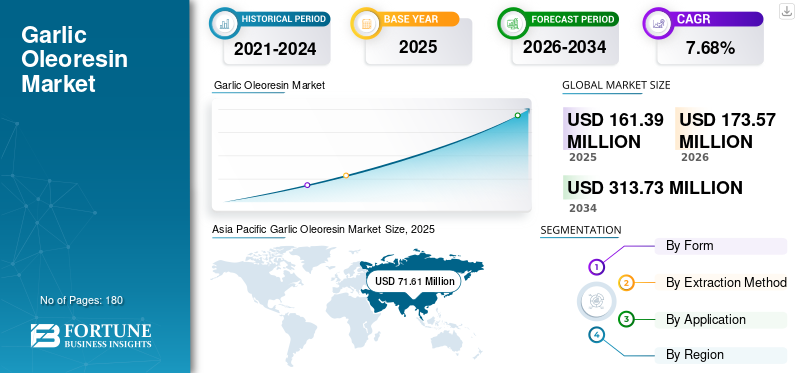
The global garlic oleoresin market size was valued at USD 161.39 million in 2025. The market is projected to grow from USD 173.57 million in 2026 to USD 313.73 million by 2034, exhibiting a CAGR of 7.68% during the forecast period. Asia Pacific dominated the garlic oleoresin market with a market share of 44.37% in 2025.
Garlic oleoresin is a semi-solid to liquid, highly concentrated extract produced from dehydrated or fresh garlic utilizing extraction techniques or organic solvents. This component has a dark-brown to reddish-brown color and a pungent taste. Moreover, it is oil-soluble and provides a characteristic garlic odor. With respect to usage, it's widely adopted across food processing, nutraceuticals, personal care products, and pharmaceuticals. In terms of consumption trends, this component is highly consumed in the Asia Pacific and North America.
Companies such as Synthite Industries Pvt. Ltd., Mane Kancor, and Kalsec Inc. are prominent players in the global market. Base expansion is a pivotal strategy adopted by key players to improve their position.
Download Free sample to learn more about this report.
Garlic Oleoresin Market Key Takeways
 Global Market Size & Forecast
- 2025 Market Size: USD 161.39 million
- 2026 Market Size: USD 173.57 million
- 2034 Forecast Market Size: USD 313.73 million
- CAGR: 7.68% from 2026–2034
 Market Share
- Asia Pacific dominated the garlic oleoresin market with a 44.37% share in 2025.
- The liquid segment accounted for the largest market share in 2025.
- The supercritical CO₂ extraction segment is projected to grow at the highest CAGR of 10.06% during the forecast period.
 Key Regional Highlights
Asia Pacific
Asia Pacific led the global market with a valuation of USD 71.61 million in 2025, supported by strong demand from the food processing industry.
Europe
Europe was valued at USD 36.82 million in 2025 and is expected to grow at a CAGR of 7.36% during the forecast period.
North America
North America reached a market value of USD 27.94 million in 2025, securing the third-largest regional position.
U.S.
U.S. The market was valued at USD 20.94 million in 2025, representing approximately 12.97% of global market sales.
Japan
Japan The market was valued at USD 8.18 million in 2025, accounting for approximately 5.07% of global market revenue.
Read More

GARLIC OLEORESIN MARKET TRENDS
Rising Use of Garlic Oleoresin in the Personal Care Sector is a Current Market Trend
The global market is witnessing an emerging trend towards oleoresin-based skincare products. In the cosmetics industry, oleoresin is gaining popularity for its antimicrobial, anti-inflammatory, and antioxidant properties, making it useful for applications such as scalp treatments and acne skincare. Moreover, it is widely utilized in minimizing aging signs and treating eczema. Additionally, this ingredient helps improve skin firmness and promotes new cell growth. Besides this, it is also used in body washes, lotions, and creams. Seeing these advantages, global producers are aiming to launch new oleoresin-infused personal care products for consumers.
MARKET DYNAMICS
MARKET DRIVERS
Download Free sample to learn more about this report.
Expanding Convenience Food Industry Drives the Adoption of Oleoresin
The flourishing convenience food sector is a key driver fueling the demand for oleoresin, as producers need components that offer ease of handling and consistent flavor. In the ultra-processed food industry, which comprises instant noodles, sauces, snack coatings, and frozen food products, manufacturers cannot depend on fresh garlic owing to its time-consuming preparation and shorter shelf life. This factor fuels the adoption of oleoresins, as they can be directly added during food preparation and allow formulators to maintain taste and aroma. Moreover, its utilization supports minimal food waste and faster manufacturing, which are necessary for the production of ready-to-cook/eat food. As a result, such factors bolster the acceptance rate of garlic oleoresin in the processed food market.
MARKET RESTRAINTS
Shelf Life/Stability Challenges and Competition from Alternative Hinder Industry's Potential
One of the main hurdles in the global market is stability and shelf life concerns. Garlic oleoresins comprise volatile sulfur compounds, which are highly prone to environmental factors such as oxygen, light, and heat. Over a period of time, these components can easily degrade, resulting in a loss of functional potency and aroma strength. Assuring the end product's stability mostly requires specialized encapsulation technologies and packaging, which increase the overall cost of the item. Moreover, inadequate transportation or storage conditions can further trigger degradation, fueling risks for distributors and producers. As a result, such aforementioned factors hinder the global market share. Another obstacle in the industry is tough competition from various garlic forms. The oleoresin sector faces intense competition from garlic oil, garlic powder, and dehydrated garlic flakes, further inhibiting the garlic oleoresin market growth.
MARKET OPPORTUNITIES
Technological Advancements in the Oleoresin Industry Open Growth Opportunities
The utilization of advanced technology in the garlic sector creates various growth opportunities. To achieve premium-quality oleoresin, companies are adopting supercritical extraction technology. In addition to improved quality, this technique also enhances aroma profiles. Technological upgradation in microencapsulation techniques is also gaining traction as these are used to protect components from light and oxidation. Moreover, spectrometry and chromatography methods are being utilized by manufacturers to ensure batch-to-batch consistency along with standardization of active components. Besides this, to minimize environmental impact, businesses are adopting energy-efficient equipment and greener solvents. Such advancements not only align with sustainability goals but also captivate the attention of environmentally conscious individuals.
Segmentation Analysis
By Form
Liquid Segment Dominated the Market Owing to its High Usage in Convenience Food Items
Based on the form, the market is segmented into solid, semi-solid, and liquid.
The liquid segment led the largest garlic oleoresin market share in 2025. Liquid oleoresin is highly used in convenience food items such as seasoning blends, dressings, and sauces, as it ensures uniform dispersion. Moreover, it is easy to dose, especially in automated systems, and minimizes labor costs and processing time. Additionally, it is ideal for semi-solid and oil-based food matrices and maintains flavor during thermal processing.
The solid segment is projected to grow at a CAGR of 9.07% over the forecast period.
To know how our report can help streamline your business, Speak to Analyst
By Extraction Method
Solvent Extraction Leads the Segment Due to its Cost-Effectiveness and Less Complex Equipment for Extraction
Depending on the extraction method, the market is divided into solvent extraction, supercritical CO2 extraction, and others.
In 2025, the solvent extraction category led the global industry. Compared with other extraction techniques, solvent extraction typically offers higher yields and has the ability to extract both non-volatile and volatile compounds. Moreover, it's economical, as it requires less complex equipment for extraction. Additionally, solvent extraction has a lower processing time than supercritical extraction, which bolsters the segment's potential.
The supercritical CO2 extraction segment is projected to grow at a high CAGR of 10.06% over the forecast period.
By Application
Food & Beverages Segment Led the Market Owing to High Use of Oleoresin in Culinary Applications
Based on application, the market is distributed into food & beverages, nutraceuticals, animal feed & nutrition, cosmetics & personal care, and others.
Food & beverages lead in the global industry in 2025. Compared to other applications, this component is widely used in processed items such as meat products, sauces, ready meals, and snacks, where ease of handling and flavor are critical. Moreover, its prolonged shelf life and strong thermal treatment tolerance fuel its usage in large-scale food production. Additionally, low logistics and storage costs and compatibility with industrial formulations can further augment the segment's potential.
The cosmetics & personal care category is projected to grow at a high CAGR of 13.50% over the forecast period.
Garlic Oleoresin Market Regional Outlook
By region, the market is categorized into Europe, North America, Asia Pacific, South America, and the Middle East & Africa.
Asia Pacific
Asia Pacific Garlic Oleoresin Market Size, 2025 (USD Million)
To get more information on the regional analysis of this market, Download Free sample
Asia Pacific dominated the market, accounting for USD 71.61 million in 2025. The growing demand for ethnic foods and health & wellness trends are key factors escalating the sales of oleoresins. In the region, India and China reached USD 17.36 million and USD 30.15 million, respectively, in 2025.
India Garlic Oleoresin Market
The Indian market in 2025 accounted for USD 17.36 million, accounting for roughly 10.75% of the global market revenues. The improved awareness of long shelf life natural ingredients/raw materials and functional cosmetics is boosting the market's growth.
China Garlic Oleoresin Market
China's market is projected to be one of the largest worldwide, with revenues at USD 30.15 million in 2025, accounting for roughly 18.68% of global market sales.
Japan Garlic Oleoresin Market
The Japanese market in 2025 was valued at USD 8.18 million, accounting for approximately 5.07% of the global market revenues.
Europe
European market is valued at USD 36.82 million in 2025, recording a growth rate of 7.36% in the coming years, and secured the second position. The expanding nutraceuticals sector and increasing consumer demand for natural raw ingredients are improving the region's potential.
Germany Garlic Oleoresin Market
The German market in 2025 had a market value of USD 8.94 million, representing roughly 5.54% of global market revenues.
U.K. Garlic Oleoresin Market
The U.K. market reached approximately USD 7.15 million in 2025, equivalent to around 4.43% of the global market sales.
North America
The North America region reached a valuation of USD 27.94 million in 2025 and hold the third position. The market in North America is expected to grow due to increasing demand for natural extract/clean label ingredients and awareness of health benefits associated with garlic. Moreover, the advanced technological infrastructure and new product innovation are driving regional growth.
U.S. Garlic Oleoresin Market
Based on North America's strong contribution and the U.S. dominance within the region, the U.S. market was analytically approximated at around USD 20.94 million in 2025, accounting for roughly 12.97% of global sales.
South America, the Middle East, and Africa
The South America and Middle East & Africa regions are expected to witness moderate growth in this market space during the forecast period. The South America market reached a valuation of USD 13.80 million in 2025. The increasing number of prominent oleoresin producers and growing health consciousness are expected to drive demand. The Middle East and Africa market gained a value of USD 11.22 million in 2025.
South Africa Garlic Oleoresin Market
The South African market valued at around USD 5.22 million in 2025, representing roughly 3.23% of global revenues.
COMPETITIVE LANDSCAPE
Key Industry Players
Capacity Expansion Helps the Companies to Fulfill the Rising Consumer Demands
The garlic oleoresin market is moderately fragmented, with both local and renowned producers. All companies operating in the space are focusing on purity levels and product standardization to cater to the personal care, food processing, and other sectors. Additionally, the producers are expanding their operations by opening new plants in various countries.
LIST OF KEY GARLIC OLEORESIN COMPANIES PROFILED
- Synthite Industries Pvt. Ltd. (India)
- Trilogy Essential Ingredients Inc. (U.S.)
- Mane Kancor (India)
- Kalsec Inc. (U.S.)
- Universal Oleoresins (India)
- Indesso Group (Indonesia)
- CSV Pharmaceuticals India Pvt. Ltd. (India)
- S.A.S. Jean Gazignaire (France)
- Silverline Chemicals (India)
- Plant Lipids Pvt. Ltd. (India)
KEY INDUSTRY DEVELOPMENTS
- May 2023: Mane Kancor, an Indian spices company, revealed the news of opening its biggest production facility in Karnataka, India.
- December 2022: Mane Kancor, an ingredient company based in India, expanded its base by opening manufacturing plants in Kerala and Karnataka.
REPORT COVERAGE
The global garlic oleoresin market provides an in-depth study of the market size & forecast by all the market segments included in the oleoresin market reports. The global market forecast analysis includes details on the market dynamics and trends expected to drive the market during the forecast period. The market analysis provides information on technological advancements, new product launches, key industry developments, and partnerships, mergers & acquisitions. The industry forecast also includes a detailed competitive landscape, including market segmentation, market share, and profiles of key operating players.
Request for Customization to gain extensive market insights.
Report Scope & Segmentation
| ATTRIBUTE | DETAILS |
| Study Period | 2021-2034 |
| Base Year | 2025 |
| Estimated Year | 2026 |
| Forecast Period | 2026-2034 |
| Historical Period | 2021-2024 |
| Growth Rate | CAGR of 7.68% from 2026-2034 |
| Unit | Value (USD Million) |
| Segmentation | By Form, Extraction Method, Application, Region |
| By Form |
|
| By Extraction Method |
|
| By Application |
|
| By Region |
|
Frequently Asked Questions
Fortune Business Insights says that the global market value stood at USD 161.39 million in 2025 and is projected to reach USD 313.73 million by 2034.
In 2025, the market value stood at USD 71.61 million.
The market is expected to exhibit a CAGR of 7.68% during the forecast period.
By form, the liquid segment led the global market in 2025.
Expanding convenience food industry drives oleoresin adoption.
Synthite Industries Pvt. Ltd., Mane Kancor, and Kalsec Inc. are among the key players in the market.
Asia Pacific held the largest market share in 2025.
Rising use of garlic oleoresin in the personal care sector is a current trend.



- 2021-2034
- 2025
- 2021-2024
- 180
-
(Offer valid till 30th Sep 2026)
Get 30-60 hrs Free Customization
Expand Regional and Country Coverage, Segments Analysis, Company Profiles, Competitive Benchmarking, and End-user Insights.




















Related Reports
-
US +1 833 909 2966 ( Toll Free )
-
Get In Touch With Us