Gateway Cloning Market Size, Share & Industry Analysis, By Product (Consumables, Instruments, Software & Services, Clone Libraries), By Application (Protein Expression, Functional Genomics, Drug Discovery & Target Validation, Synthetic Biology & Pathway Engineering, Gene Editing & CRISPR Workflow Support), By Cloning Format (Single-fragment Gateway Cloning, MultiSite Gateway Cloning, Gateway-Compatible Hybrid Cloning, and High-throughput Gateway Cloning), By End User (Pharmaceutical, Biotechnology, CROs, CDMOs & Cloning Service, Academic & Research), and Regional Forecast, 2026-2034
 Download Free Sample
Gateway Cloning Market Size and Future Outlook
 Listen to Audio Version
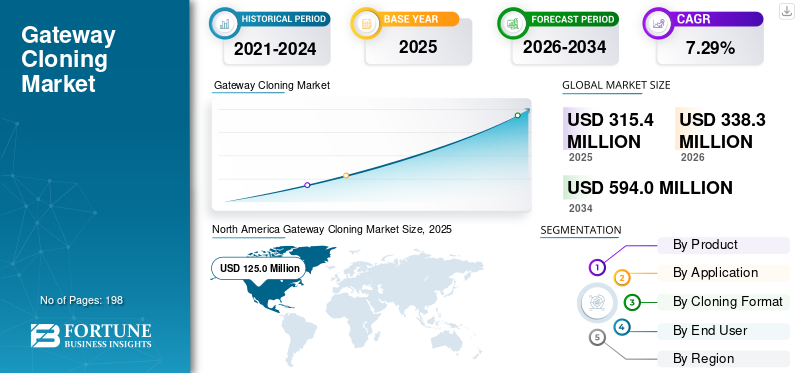
The global gateway cloning market size was valued at USD 315.4 million in 2025. The market is projected to grow from USD 338.3 million in 2026 to USD 594.0 million by 2034, exhibiting a CAGR of 7.29% during the forecast period. North America dominated the gateway cloning market with a market share of 39.63% in 2025.
Gateway cloning is a proprietary, recombination-based method that moves DNA fragments between plasmids without using restriction enzymes or ligase. By utilizing bacteriophage site-specific recombination (via att sites), it efficiently transfers genes from an initial Entry clone to various destination vectors. These systems are mainly used in protein expression and purification, functional genomics, target validation, synthetic biology, CRISPR workflow support, and high-throughput construct generation. The market is gaining traction as gateway cloning reduces dependence on restriction enzyme sites, maintains insert orientation and reading frame, and allows researchers to move the same gene into several expression vectors with fewer repeated cloning steps.
Key players operating in the global market include Thermo Fisher Scientific Inc. and Danaher Corporation (Integrated DNA Technologies, Inc.). These companies are focusing on ready-to-use vectors, synthetic DNA inputs, clone repositories, software-enabled construct design, and custom cloning services to support faster and more reliable cloning workflows.
Download Free sample to learn more about this report.
Gateway Cloning Market KEY TAKEAWAYS
 Global Market Size & Forecast
- 2025 Market Size: USD 315.4 million
- 2026 Market Size: USD 338.3 million
- 2034 Forecast Market Size: USD 594.0 million
- CAGR: 7.29% during 2026–2034
 Market Share
- North America dominated the global market with a 39.63% share in 2025.
- Protein Expression & Purification held the dominant application share in 2025 and is expected to account for 29.3% in 2026.
- Single-fragment Gateway Cloning led the market in 2025 and is expected to hold a 48.2% share in 2026.
 Key Regional Highlights
North America
The market was valued at USD 125.0 million in 2025, supported by strong life science research funding.
Europe
The market is projected to grow at a 5.88% CAGR during the forecast period, supported by academic research infrastructure.
Asia Pacific
The market is expected to reach USD 85.4 million in 2026, supported by biotechnology research expansion.
U.S.
The market is projected to reach approximately USD 123.8 million in 2026.
Japan
The market is estimated to reach approximately USD 20.1 million in 2026.
Read More

GATEWAY CLONING MARKET TRENDS
Increasing Application of Synthetic Biology Processes is a Major Trend Observed in the Global Market
The global market is benefiting from the increasing application of synthetic biology processes, as scientists require the assembly, evaluation, and transfer of genes, promoters, tags, and pathway components across various expression systems. As projects in synthetic biology grow more modular and high-throughput, conventional restriction enzyme cloning becomes less effective due to its slower pace and increased reliance on compatible restriction sites. Gateway cloning addresses this problem by enabling the transfer of standardized DNA components into various destination vectors in a consistent orientation and reading frame. This makes it beneficial for pathway design, multi-gene expression, functional screening, and cell engineering research. The trend is further backed by the presence of MultiSite Gateway systems, which enable the assembly of several DNA fragments into a single vector without the need for restriction enzymes or ligases. Consequently, academic laboratories, biotechnology firms, and synthetic biology service providers are employing gateway-compatible methods to shorten construct-development duration and enhance experiment reproducibility. Thermo Fisher claims that its MultiSite Gateway Pro technology facilitates the engineering of proteins, pathways, and cells, which is directly relevant to synthetic biology applications.
- For instance, in November 2025, a study published in Development introduced MultiSite Assembly of Gateway Induced Clones (MAGIC), a Gateway-based modular plasmid assembly system designed to support transgenesis in cells and vertebrate models. The toolkit used gateway recombinatorial cloning for rapid modular assembly and included tools for inducible gene expression, fluorescent reporters, and recombinase-dependent expression, showing how Gateway-based systems continue to support modern synthetic biology and cell-engineering workflows.
MARKET DYNAMICS
MARKET DRIVERS
Download Free sample to learn more about this report.
Rising Demand for High-throughput Cloning to Boost Market Growth
The global market is expanding as research labs and biotech firms require the rapid and consistent production of numerous expression constructs. In functional genomics, protein expression, synthetic biology, and target validation, scientists frequently require the transfer of the same gene into various expression vectors for different hosts, tags, reporters, or assay modalities. Conventional restriction enzyme cloning can hinder this process as it relies on compatible restriction sites and multiple subcloning stages. Gateway cloning resolves this problem by employing recombination-based transfer, enabling DNA inserts to be transferred into various destination vectors while preserving orientation and reading frame. This makes it ideal for high-throughput processes where numerous constructs need to be produced concurrently for assessment and verification. With the growing utilization of expression libraries, ORF clones, and multi-vector testing in pharma, biotech, and academic labs, there is an ongoing increase in the demand for gateway-compatible vectors, clonase enzyme mixes, clone libraries, and cloning services.
- For instance, in March 2025, Plant Cell Reports published a study introducing a GATEWAY-compatible vector toolbox for rapid functional gene analysis in soybean composite plants. The toolbox enabled researchers to quickly generate multiple gene-expression constructs for subcellular localization, protein–protein interaction analysis, and root-pathogen interaction studies using Gateway cloning.
MARKET RESTRAINTS
High Dependence on Proprietary Reagents and Branded Systems to Limit Market Growth
The global gateway cloning market growth is restrained by its strong dependence on proprietary reagents, branded vectors, and specific BP/LR Clonase enzyme mixes. Although these components make gateway cloning reliable and reproducible, they also increase recurring consumable costs for laboratories that run frequent cloning experiments. Cost-sensitive academic institutes, small biotechnology firms, and early-stage research groups may shift toward lower-cost or more open-format cloning methods when budgets are limited. The product also requires compatible att sites, entry vectors, donor vectors, and destination vectors, which can restrict flexibility compared with scarless or modular assembly systems. This becomes more important in synthetic biology and high-throughput workflows, where researchers often need to build many constructs at scale. As a result, alternative methods such as Golden Gate cloning, Gibson Assembly, and other modular cloning systems can reduce product adoption in some applications.
- For instance, Thermo Fisher’s Gateway protocols show that the workflow relies on BP and LR reactions and dedicated Gateway vectors.
MARKET OPPORTUNITIES
Expansion of Functional Genomics and Target Validation Studies to Offer Lucrative Opportunities
The expansion of functional genomics and target validation studies is creating a strong opportunity for the global market, as researchers need faster methods to study gene function across different model systems. In drug discovery and academic research, a single gene often needs to be transferred into multiple expression vectors to test protein localization, pathway activity, protein-protein interaction, and disease relevance. Gateway cloning addresses this need by allowing genes to move between donor, entry, and destination vectors without repeated restriction enzyme cloning. This reduces turnaround time and makes it easier to generate expression-ready constructs for cell-based assays, screening models, and validation experiments. As pharma and biotech companies increase early-stage target discovery work, demand is expected to rise for gateway-compatible vectors, entry clone collections, ORF libraries, software tools, and custom cloning services. This opportunity is also supported by wider use of gene-function studies in plants, mammalian cells, and disease models, where scalable and reproducible cloning workflows are essential.
- For instance, in November 2025, a research article titled, ‘MultiSite Assembly of Gateway Induced Clones (MAGIC): a flexible cloning toolbox for use in vertebrate model systems’ was published in the journal Development. The MAGIC system components are compatible with existing MultiSite Gateway Tol2 systems, along with mammalian lentiviral and adenoviral Destination vectors, leading to greater adoption of the product.
MARKET CHALLENGES
Competition from Alternative Cloning Technologies Poses a Prominent Challenge to Market Growth
Competition from alternative cloning technologies is a key challenge for the global market, as researchers have several flexible options for DNA assembly. Methods such as Gibson Assembly, Golden Gate cloning, In-Fusion cloning, TOPO cloning, and ligation-independent cloning can support scarless, sequence-independent, or multi-fragment assembly workflows. This directly affects product adoption as the gateway leaves recombination-site sequences in the final construct and requires compatible donor, entry, and destination vectors. In synthetic biology and complex construct design, users often prefer methods that allow higher flexibility in assembling multiple DNA parts, promoters, tags, and regulatory elements. These alternatives are also attractive for laboratories that want lower dependence on proprietary gateway reagents and fixed vector systems. As a result, gateway cloning remains strong in standardized and repeatable workflows, but its growth can be challenged in advanced modular cloning, pathway engineering, and custom vector construction applications.
- For instance, in October 2024, a Scientific Reports study introduced Golden EGG, a simplified Golden Gate cloning system. The study noted that many alternatives to gateway cloning have developed over time, including Gibson Assembly, In-Fusion, TOPO cloning, GoldenBraid, SLiCE, TEDA, and Cas9-based auto-cloning, showing how continuous innovation in competing cloning technologies can limit a product’s adoption in some workflows.
Segmentation Analysis
By Product
Recurring Use of Consumables Supported Segment Expansion
In terms of product, the market is divided into software and services, consumables, instruments, clone libraries, and others.
The consumables segment held the dominant global gateway cloning market share in 2025. This is due to the frequent purchases of various consumables, including entry vectors, destination vectors, competent cells, and others. These products are consumed in every cloning cycle, unlike instruments and software, which are purchased less frequently. The repeated use of gateway cloning in protein expression, functional genomics, target validation, CRISPR support workflows, and synthetic biology increases the demand for ready-to-use consumables across academic, biotechnology, and pharmaceutical laboratories.
- For instance, in 2025, a study published in Horticulture Research used Gateway BP Clonase II Enzyme Mix to insert the CDS of CsTCP13 into the pDONR221 vector and then used Gateway LR Clonase II Enzyme Mix to transfer the recombinant plasmid into the pK7WG2D destination vector for stable genetic transformation work. This shows the continued use of gateway-specific consumables in recent gene-function and plant molecular biology research.
The software and services segment is anticipated to rise with a CAGR of 10.53% over the forecast period.
To know how our report can help streamline your business, Speak to Analyst
By Application
High Use of Gateway-Based Expression in Recombinant Protein Production Supported Protein Expression & Purification Segment Growth
Based on application, the market is classified into protein expression & purification, functional genomics, drug discovery & target validation, synthetic biology & pathway engineering, gene editing & CRISPR workflow support, and others.
The protein expression & purification segment accounted for the dominant market share in 2025. This can be attributed to the fact that gateway cloning is widely used to transfer genes of interest into bacterial, yeast, insect, mammalian, and plant expression vectors. The segment also benefits from the availability of gateway destination vectors designed for native, N-terminal-tagged, and C-terminal-tagged recombinant protein production. This makes the workflow suitable for protein characterization, antibody research, enzyme studies, structural biology, and assay-development work. Furthermore, the segment is set to hold a 29.3% share in 2026.
- For instance, in July 2025, a study published in Agronomy used gateway cloning with pDONR221 entry vector and Gateway destination vectors including pEarleyGate101, pEarleyGate104, pADT7, and pGBKT7 to construct plasmids for subcellular localization and yeast two-hybrid analysis of tomato yellow leaf curl virus V2 proteins. The study further used transient expression and protein extraction/Western blot analysis to validate protein expression, showing continued use of gateway-based expression constructs in recent functional protein
The drug discovery & target validation segment is anticipated to rise with a CAGR of 8.34% over the forecast period.
By Cloning Format
Single-Fragment Gateway Cloning Segment Dominated due to its Benefits
On the basis of cloning format, the market is divided into single-fragment gateway cloning, multisite gateway cloning, gateway-compatible hybrid cloning, and high-throughput gateway cloning.
In 2025, the single-fragment gateway cloning segment led the market. This format is easier to design, validate, and troubleshoot compared with MultiSite or hybrid cloning formats, making it highly preferred across academic and research laboratories. Additionally, single-fragment gateway cloning is widely used for protein expression, subcellular localization, yeast two-hybrid studies, CRISPR support constructs, and gene-function analysis. Furthermore, the segment is set to hold a 48.2% share in 2026.
- For instance, in February 2024, a study published in Frontiers in Pharmacology used pDONR221-SLCO2A1 mutant entry vectors and a pJTI-R4-DEST-CMV destination vector with Gateway LR Clonase II enzyme to generate single-gene mammalian expression constructs for prostaglandin transporter variant analysis. This shows the continued use of single-fragment Gateway cloning in recent cell-line generation and functional protein activity research.
The multisite gateway cloning segment is anticipated to rise with a CAGR of 8.26% over the forecast period.
By End User
Strong Use of Gateway Cloning in Academic Research Supported Academic & Research Institutes Segment Growth
Based on end user, the market is segmented into pharmaceutical & biotechnology companies, CROs, CDMOs & cloning service providers, academic & research institutes, and others.
The academic & research institutes segment dominated the market in 2025. Gateway cloning is preferred in academic settings as it reduces restriction-enzyme dependency and allows the same entry clone to be transferred into several expression vectors for different experiments. The segment also benefits from plasmid-sharing platforms such as Addgene and standardized protocols that make gateway-compatible vectors easier to access across research labs. Furthermore, the segment is set to hold a 45.3% share in 2026.
- For instance, in March 2026, a study published in Vaccines used the gateway cloning approach to clone modified HPV-16 and HPV-18 L1 genes into pDONR221 through BP recombination and then create final binary expression vectors for plant-based vaccine research. The work showed gateway cloning being applied in university-style translational research involving recombinant antigen expression, plant transformation, and vaccine candidate development.
CROs, CDMOs & cloning service providers are projected to witness 8.79% growth rate during the forecast period.
Gateway Cloning Market Regional Outlook
Based on region, the global market is divided into Asia Pacific, Latin America, Europe, North America, and the Middle East & Africa.
North America
North America Gateway Cloning Market Size, 2025 (USD Million)
To get more information on the regional analysis of this market, Download Free sample
The North American market was valued at USD 118.1 million in 2024 and dominated the global market. In 2025, the region maintained its leading position, with USD 125.0 million. The region is expected to maintain its leading position during the forecast period due to strong life science research funding, high adoption of recombinant DNA technologies, and the presence of major molecular biology product suppliers.
U.S. Gateway Cloning Market
The U.S. market led the North American region and is projected to reach approximately USD 123.8 million in 2026, representing about 36.6% of the global sales.
Europe
Europe market is growing at a CAGR of 5.88% during the forecast period. The region’s market growth is supported by strong academic research infrastructure, public funding for genomics and biotechnology, and increasing use of recombinant protein and cell biology workflows.
U.K. Gateway Cloning Market
The U.K. market in 2026 is estimated to reach around USD 18.2 million, representing roughly 5.4% of global revenues.
Germany Gateway Cloning Market
Germany’s market is projected to reach approximately USD 21.3 million in 2026, equivalent to around 6.3% of global sales.
Asia Pacific
The Asia Pacific market is expected to reach a valuation of USD 85.4 million in 2026. Asia Pacific is expected to witness strong growth due to the rapid expansion of biotechnology research, increasing government investment in genomics, and rising pharmaceutical R&D activity in Asian countries. Additionally, the growing number of academic laboratories, CROs, CDMOs, and gene synthesis service providers is increasing the use of cloning workflows, thereby driving market growth.
Japan Gateway Cloning Market
The Japanese market is estimated to reach around USD 20.1 million in 2026, accounting for roughly 5.9% of global revenues.
China Gateway Cloning Market
China’s market is projected to reach around USD 25.0 million in 2026, representing roughly 7.4% of global sales.
India Gateway Cloning Market
The Indian market in 2026 is poised to reach around USD 10.6 million, accounting for roughly 3.1% of global revenues.
Latin America and the Middle East & Africa
The growth in the Middle East & Africa and Latin America regions is anticipated to be moderate in the coming years. Key factors include increasing biotechnology research activity, expanding academic molecular biology programs, and rising use of recombinant DNA tools in agriculture, infectious disease research, and biomedical studies. are expected to boost market growth in these regions. The Latin American market is likely to reach around USD 19.3 million in 2026.
In the Middle East Africa region, the GCC market is projected to reach approximately USD 6.5 million in 2026, representing about 1.9% of worldwide revenues.
COMPETITIVE LANDSCAPE
Key Industry Players
Thermo Fisher Scientific Singularly Leads the Market Due to the Presence of Proprietary Products in Its Portfolio
The competitive landscape of the global market is moderately consolidated, with Thermo Fisher Scientific Inc. holding the strongest position due to its proprietary gateway cloning technology, BP/LR Clonase enzyme mixes, donor vectors, entry vectors, and destination vector portfolio. Thermo Fisher, along with other companies, is competing by improving vector availability, reducing cloning design errors, and supporting faster construct development for protein expression, functional genomics, synthetic biology, and CRISPR workflows.
- For instance, Thermo Fisher’s Gateway LR Clonase II enzyme mix is positioned for recombination between entry clones and destination vectors to generate expression clones.
Other significant participants include Takara Bio Inc., Twist Biosciences, and Addgene. These firms are strengthening their presence through synthetic gene inputs, outsourced cloning services, clone libraries, and software-enabled workflow support.
LIST OF KEY GATEWAY CLONING COMPANIES PROFILED
- Thermo Fisher Scientific Inc. (U.S.)
- Twist Bioscience (U.S.)
- Takara Bio Inc. (Japan)
- Danaher Corporation (Integrated DNA Technologies, Inc.) (U.S.)
- Addgene (U.S.)
- SnapGene (U.S.)
- GenScript (U.S.)
- OriGene Technologies, Inc. (U.S.)
- Creative Biogene (U.S.)
KEY INDUSTRY DEVELOPMENTS
- October 2025: VectorBuilder announced the publication of its MiniVec plasmid system, a next-generation plasmid design approach engineered for safer, more efficient, and scalable development of genetic medicines.
- July 2025: Addgene announced a strategic partnership with Promega to launch the Promega Plasmid Collection, expanding Addgene’s plasmid repository for academic and industry researchers.
- May 2025: SnapGene released SnapGene 8.1.0, adding improvements in file navigation, data management, multi-file operations, and enhanced visualization. These upgrades support gateway cloning users by improving plasmid map handling, construct documentation, and in silico cloning workflow management.
- November 2024: VectorBuilder and Sartorius signed a strategic cooperation agreement focused on gene vector and mRNA bioprocess solutions and services. The partnership also covered optimization of development platforms and commercial production of GMP-compliant mRNA, plasmid, and viral vectors, supporting broader demand for vector construction and cloning services.
- June 2024: GenScript launched FLASH Gene, an ultra-fast sequence-to-plasmid service with delivery from sequence to plasmid construct in four business days. The service includes gene synthesis, cloning, and plasmid preparation, directly supporting outsourced cloning demand across antibody, vaccine, gene therapy, and cell therapy research.
REPORT COVERAGE
The global gateway cloning market analysis includes a thorough evaluation of the market size and forecasts for every segment highlighted in the report. It offers insights into the market dynamics and trends expected to drive the market throughout the forecast period. The global market report provides an understanding of essential factors, including technological progress, product innovations, the regulatory environment, and the launch of new products. Additionally, it details partnerships, mergers & acquisitions, as well as key developments in the industry within the market. The global market forecast report also provides an in-depth competitive landscape, including information on market share and profiles of key active players.
Request for Customization to gain extensive market insights.
Report Scope & Segmentation
| ATTRIBUTE | DETAILS |
| Study Period | 2021-2034 |
| Base Year | 2025 |
| Estimated Year | 2026 |
| Forecast Period | 2026-2034 |
| Historical Period | 2021-2024 |
| Growth Rate | CAGR of 7.29% from 2026-2034 |
| Unit | Value (USD Million) |
| Segmentation | By Product, Application, Cloning Format, End User, and Region |
| By Product |
|
| By Application |
|
| By Cloning Format |
|
| By End User |
|
| By Region |
|
Frequently Asked Questions
According to Fortune Business Insights, the global market value stood at USD 315.4 million in 2025 and is projected to reach USD 594.0 million by 2034.
In 2025, the market value stood at USD 125.0 million.
The market is expected to exhibit a CAGR of 7.29% during the forecast period.
By product, the consumables segment led the market.
Growing use of recombinant proteins, cell-based assays, gene function studies, pathway engineering, and academic plasmid-sharing workflows are the key factors driving market expansion.
Thermo Fisher Scientific Inc., Twist Bioscience, Takara Bio Inc., and Danaher Corporation (Integrated DNA Technologies, Inc.) are some of the top players in the global market.
North America dominated the market in 2025.



- 2021-2034
- 2025
- 2021-2024
- 198
Get 30-60 hrs Free Customization
Expand Regional and Country Coverage, Segments Analysis, Company Profiles, Competitive Benchmarking, and End-user Insights.













.webp)






Related Reports
-
US +1 833 909 2966 ( Toll Free )
-
Get In Touch With Us