Gender-Neutral Fashion Market Size, Share & Industry Analysis, By Product Type (Apparel, Footwear, Accessories, and Others), By Price Range (Economy/Budget, Mid-Range, and Premium/Luxury), By Age Group (Gen Z (18–27 Years), Millennials (28–43 Years), Gen X (44–59 Years), and Baby Boomers (60+ Years)) By Distribution Channel (Online/E-Commerce, Specialty Stores, Supermarkets/Hypermarkets, and Others), and Regional Forecast, 2026-2034
 Download Free Sample
(Offer valid till 30th Sep 2026)

Gender-Neutral Fashion Market Size and Future Outlook
 Listen to Audio Version
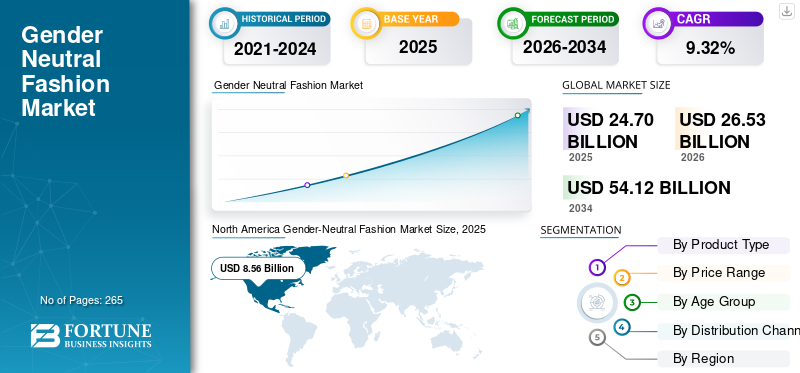
The gender-neutral fashion market size was valued at USD 24.70 billion in 2025. The market is projected to grow from USD 26.53 billion in 2026 to USD 54.12 billion by 2034, exhibiting a CAGR of 9.32% during the forecast period. North America dominated the gender neutral fashion market with a market share of 34.66% in 2025.
The global market is experiencing steady growth, driven by shifts in perceptions of inclusiveness, individualism, and customer deviation from gender norms. Some of the leading fashion companies, including Zara, H&M, and Levi Strauss & Co., have begun producing garments that both men and women can wear in loose-fitting styles and neutral colors. This trend is caused by Generation Gender-Neutral, whose priorities include self-expression and sustainability. According to the UN report, gender-neutral consumers constitute an important customer base with a prominent online presence, helping shape diversity in fashion industry through social networking sites. Celebrity culture and the growing visibility of the LGBTQ+ community have helped accept gender-neutral fashion brands.
Leading brands, including Zara, H&M, Gucci, Telfar, and Phluid Project, are at the forefront of the market. Launching exclusive unisex apparel collections, adopting sustainable manufacturing practices, and expanding direct-to-consumer channels are among the prominent growth strategies adopted by these companies to stay ahead in the competitive industry.
Download Free sample to learn more about this report.
Gender Neutral Fashion Market Key Takeaways
 Global Market Size & Forecast
- 2025 Market Size: USD 24.70 billion
- 2026 Market Size: USD 26.53 billion
- 2034 Forecast Market Size: USD 54.12 billion
- CAGR: 9.32% (2026–2034)
 Market Share
- North America dominated the market with a 34.66% share in 2025.
- The other segment is projected to witness the fastest growth, expanding at a 11.65% CAGR during the forecast period.
- The premium/luxury segment is expected to register the highest growth at a 11.11% CAGR during the forecast period.
 Key Regional Highlights
Asia Pacific
Asia Pacific generated USD 6.01 billion in 2025 and is projected to grow at a 10.42% CAGR during the forecast period.
North America
North America generated USD 8.56 billion in 2025 and is projected to grow at a 9.43% CAGR during the forecast period.
Europe
Europe accounted for USD 7.01 billion in 2025, making it the second-largest regional market.
U.S.
U.S. market reached USD 6.55 billion in 2025.
Japan
Japan market reached USD 1.00 billion in 2025.
Read More

GENDER-NEUTRAL FASHION MARKET TRENDS
Rising Influence of Gen Z and Social Media is Prominent Market Trend
The increasing popularity of social media platforms, especially among Gen-Z buyers, is a major factor behind the growth of the gender-neutral fashion sector. Current buyers tend to be very expressive and resist the conventional gender identity imposed upon them, leading fashion companies to provide unisex clothing ranges. Adaptive fashion trends that are inclusive of both genders have been popularized on social media platforms such as TikTok and Instagram through fashion influencers, celebrities, and fashion consumer behavior. The rise of this trend has led fashion companies to introduce oversized clothing items and a more neutral palette to appeal to younger generations.
Download Free sample to learn more about this report.
MARKET DYNAMICS
MARKET DRIVERS
Growing Consumer Preference for Inclusivity and Self-Expression Accelerates Market Growth
A significant factor driving gender-neutral fashion industry is consumer’s inclination toward inclusivity, individuality, and freedom of self-expression. Present-day consumers, particularly young consumers, Millennials, and Gen Zs, are increasingly adopting a more liberal attitude toward the conventional way of dressing for each gender. As a result, there has been an increase in the manufacturing and sale of gender-neutral fashion clothing lines by fashion companies, characterized by looser styles and neutral colors. Fashion marketers have leveraged consumer trends by offering flexible sizing options and designing retail stores aligned with their gender-neutral marketing campaigns.
MARKET RESTRAINTS
Limited Consumer Acceptance in Traditional Markets Restricts Industry Expansion
The limited and slow adoption of gender-neutral clothing in conservative and traditional markets is a major restraint on market growth. There are some countries with strong cultural traditions and a preference for traditional gender-specific men's and women's clothing. This plays a very important role in decision-making. This reluctance has posed problems for companies trying to promote their gender fluid fashion through mainstream sales channels. Consequently, firms struggle to achieve faster adoption rates, manage stock control, and allocate limited store space to the unisex clothes collection. Moreover, issues related to fit uniformity and consumer attitudes toward gender-neutral garments could hinder repeat orders, thus limiting market reach and financial gains.
MARKET OPPORTUNITIES
Expansion of E-commerce and Direct-to-Consumer Platforms Creates New Growth Opportunities
The rapid rise in the number of e-commerce sites and D2C retail models is creating significant growth opportunities in the gender-neutral clothing industry. The internet allows fashion brands to market their products to a wide range of customers without any physical restrictions on separating them by gender in a store setting. These market players focus on a personalized marketing approach to lure young audiences who favor gender-neutral clothing brands through influencers and social media. Consequently, new gender-neutral fashion brands have gained worldwide recognition and popularity while incurring lower operational expenses.
MARKET CHALLENGES
Difficulty in Standardizing Sizing and Fit Creates Operational Challenges
One of the main obstacles for the market is the lack of standardization in sizing and fit. Despite standard sizing for both genders, designing a product line that suits both groups of consumers pose additional challenges. It becomes more difficult and expensive to create products that fit diverse body shapes and requirements, thereby affecting fit. This leads to an unsatisfactory customer experience, which may cause high rates of return and even stock problems, particularly when buying online.
Segmentation Analysis
By Product Type
Rising Demand for Versatile Everyday Fashion to Drive Growth of Apparel Segment
By product type, the market is segmented into apparel, footwear, accessories, and others.
The apparel category dominated the segment in 2025, as most customers preferred unisex clothes that individuals could easily adapt. Apparel products including sweatshirts, hoodies, baggy tees, casual pants, and jeans are quite popular among people looking for a gender-inclusive fashion industry. Besides, the apparel category has greatly expanded due to the availability of various products through fast-fashion stores and online sites. As a result, the need to introduce new lines of unisex clothing has been encouraged by market fashion trends. In addition, increased affordability and purchase frequency make this segment dominant over others.
The other segment is anticipated to rise at the fastest CAGR of 11.65% over the forecast period.
To know how our report can help streamline your business, Speak to Analyst
By Price Range
Strong Mass-market Consumer Demand to Lead Growth of Economy/Budget Segment
Based on price range, the market is divided into economy/budget, mid-range, and premium/luxury.
The economy/budget segment lead the market in 2025, since there is plenty of inexpensive unisex clothing in fast-fashion retail stores and online. Trend-conscious customers, including young people from Generation Z and early millennials, have shown a stronger preference for affordable gender-neutral garments. Thus, high-end fashion brands began creating inexpensive collections, sustaining the segment’s growth.
The premium/luxury segment is anticipated to rise at the fastest CAGR of 11.11% over the forecast period.
By Age Group
Strong Preference for Expressive and Inclusive Fashion Industry to Boost Gen Z Segment Dominance
Based on age group, the market is segmented into Gen Z (18–27 Years), millennials (28–43 Years), Gen X (44–59 Years), and baby boomers (60+ Years).
The Gen Z (ages 18 to 27) category dominated the segment, owing to their preference for self-expression and their rebellion against fashion trends. Fashion trends largely influence members of Gen Z, propagated through social media by influencers and celebrities who endorse clothing that transcends gender lines. It is very typical of members of this age group to dress in clothes that are not confined by gender lines but rather reflect their personalities. This has led fashion brands to target this demographic through influencer marketing.
The millennials (28–43 years) segment is projected to grow at the second-fastest CAGR of 9.18% during the forecast period.
By Distribution Channel
Growing Digital Fashion Consumption to Boost Growth of Online/E-Commerce Segment
Based on distribution channel, the market is segmented into online/e-commerce, specialty stores, supermarkets/hypermarkets, and others.
The online/e-commerce category held the largest revenue share, driven by growing consumer preference for digital convenience. The online shopping platform is far more convenient than regular retail outlets with separate men's and women's sections, due to the broader availability of gender-neutral clothing. Social media marketing, influencer marketing campaigns, and other digital marketing initiatives have added momentum to the growth of online purchases, thereby helping this segment capture a larger market share. Fashion companies have also started making significant investments in their direct-to-consumer websites and mobile app stores to engage customers effectively on digital platforms.
The specialty stores segment is projected to grow at the second-fastest CAGR of 9.04% during the forecast period.
Gender-Neutral Fashion Market Regional Outlook
By geography, the market is categorized into Europe, North America, Asia Pacific, South America, and Middle East & Africa.
North America
North America Gender-Neutral Fashion Market Size, 2025 (USD Billion)
To get more information on the regional analysis of this market, Download Free sample
North America dominated the global market. It is projected to grow at a CAGR of 9.43% in the coming years, and reached a valuation of USD 8.56 billion in 2025. The regional market's growth is highly influenced by strong consumer acceptance of fashion that embraces inclusivity and non-binary trends, especially among younger generations, including Gen Z and millennials. Factors such as social media influence, celebrity endorsement, and increased representation of the LGBTQ community in popular culture have been shown to boost the adoption of gender-fluid fashion trends in the region. The existence of well-established fashion houses and direct-to-customer companies producing unisex clothing has also improved product availability in the market.
U.S. Gender-Neutral Fashion Market
With North America’s strong contribution, the U.S. market reached USD 6.55 billion in 2025, accounting for roughly 26.53% of global market sales. Strong consumer acceptance of modern, gender-inclusive fashion, high Gen Z purchasing power, and the rapid expansion of digitally driven unisex apparel brands and celebrity-backed gender-fluid apparel trends drive the country's market growth.
Europe
Europe held the second-largest share in 2025, valued at USD 7.01 billion and accounting for 28.39% of the global market. Europe’s market growth is bolstered by increasing inclination of consumers toward ethical, sustainable unisex fashion, along with the growing popularity of gender-neutral fashion trends in nations including the U.K., Germany, and France. The widespread presence of luxury and fast-fashion brands releasing gender-neutral lines has further boosted growth in this regional market.
U.K. Gender-Neutral Fashion Market
The U.K. market in 2025 reached USD 1.49 billion, representing roughly 6.04% of global market revenues.
Germany Gender-Neutral Fashion Market
Germany market reached USD 1.38 billion in 2025, equivalent to around 5.59% of global market sales.
Asia Pacific
The Asia Pacific stood at third-rank in the global market, reaching USD 6.01 billion in 2025 and growing at a CAGR of 10.42%. Rapid urbanization, the rising influence of Korean and Japanese street fashion, and increasing social media engagement among Gen Z consumers drive Asia Pacific market growth. Expanding e-commerce penetration and growing acceptance of modern inclusive fashion trends across countries such as India, South Korea, China, and Japan are further supporting regional market growth.
Japan Gender-Neutral Fashion Market
The Japanese market in 2025 was valued at USD 1.00 billion, accounting for roughly 4.06% of global market revenues. The market is driven by the country’s vibrant streetwear and minimalist fashion scene, especially in cities such as Tokyo, where oversized, gender-neutral items are popular among the fashion-conscious populace. The growing popularity of young-generation fashion trends, anime-inspired fashion, and revolutionary retailing ideas introduced by brands such as Uniqlo is driving demand for gender-neutral garments.
China Gender-Neutral Fashion Market
China’s market in 2025 was valued at USD 2.08 billion in revenues, representing roughly 8.44% of global market sales.
India Gender-Neutral Fashion Market
The Indian market in 2025 was valued at USD 1.10 billion, accounting for roughly 4.45% of global market revenues.
South America and Middle East & Africa
The South America and Middle East & Africa regions are expected to witness moderate growth in this market during the forecast period. The South America market reached USD 1.85 billion in 2025. The market for gender-neutral fashion in South America is influenced by expanding urban populations, the increasing presence of international fast-fashion retailers, rising social media influence, and rising youth fashion consciousness. In the Middle East & Africa, the UAE reached USD 0.36 billion in 2025.
South Africa Gender-Neutral Fashion Market
The South African market reached USD 0.30 billion in 2025, representing roughly 1.23% of global market revenues.
COMPETITIVE LANDSCAPE
Key Industry Players
Inclusive Product Innovation and Digital-first Strategies Strengthens Market Competition
In the highly competitive landscape of gender-fluid fashion, strong competitors include fashion retailers worldwide, luxury fashion houses, and individual fashion designers who aim to be unique and inclusive. The growing trend of androgynous fashion, the emphasis on adaptive fashion, and the growing preference for universal clothing design are currently playing an important role in shaping companies' retail trend forecasting strategies to anticipate future trends within the fashion industry and cater to diverse and inclusive markets. The key players in this industry include companies such as Zara, H&M, Gucci, Telfar, and Phluid Project, which have been employing effective strategies such as introducing unisex products, sourcing eco-friendly fabrics, collaborating with influencers, and adopting direct-to-consumer business models to strengthen their market positions.
LIST OF KEY GENDER-NEUTRAL FASHION COMPANIES PROFILED
- Zara (Spain)
- H&M (Sweden)
- Gucci (Italy)
- Telfar (U.S.)
- Phluid Project (U.S.)
- ASOS (U.K.)
- Uniqlo (Japan)
- Levi Strauss & Co. (U.S.)
- Adidas (Germany)
- Nike (U.S.)
KEY INDUSTRY DEVELOPMENTS
- May 2026: H&M partnered with Stella McCartney to release a sustainable fashion line for men and women that uses eco-friendly materials and a gender-neutral clothing style. This has greatly improved H&M's luxury partnership strategy.
- March 2025: GU established the second collaboration with the London-based label rokh to launch gender-neutral menswear lines and improve the fashion industry.
- February 2025: Gap collaborated with Harlem's Fashion Row to create an exclusive capsule collection, which focuses on fashion design that embraces inclusiveness and cultural diversity.
- February 2025: Nike formed a long-term strategic alliance with SKIMS to launch the NikeSKIMS brand, integrating performance-clothing technology with fashion designed for the entire body to expand globally.
- January 2025: Zara collaborated with designer Samuel Ross to launch the “SR_A Engineered by Zara” line at Paris Fashion Week Men’s to add to its range of high-end gender-neutral streetwear and unisex apparel
REPORT COVERAGE
The global gender-neutral fashion market analysis includes a comprehensive study of the market & forecast by all the market segments included in the report. This qualitative and quantitative report includes details on the market dynamics and trends that are expected to drive the market over the forecast period. It provides information on key aspects, including technological advancements, the regulatory environment, and product launches. Additionally, it details partnerships, mergers & acquisitions, and key industry developments. The global market research report also provides a detailed competitive landscape, including market share and profiles of key players.
Request for Customization to gain extensive market insights.
Report Scope & Segmentation
| ATTRIBUTE | DETAILS |
| Study Period | 2021-2034 |
| Base Year | 2025 |
| Estimated Year | 2026 |
| Forecast Period | 2026-2034 |
| Historical Period | 2021-2024 |
| Growth Rate | CAGR of 9.32% from 2026 to 2034 |
| Unit | Value (USD Billion) |
| Segmentation | By Product Type, Price Range, Age Group, Distribution Channel, and Region |
| By Product Type |
|
| By Price Range |
|
| By Age Group |
|
| By Distribution Channel |
|
| By Region |
|
Frequently Asked Questions
According to Fortune Business Insights, the global market value stood at USD 24.70 billion in 2025 and is projected to reach USD 54.12 billion by 2034.
In 2025, the North America market value stood at USD 8.56 billion.
The market is expected to grow at a CAGR of 9.32% over the forecast period.
By product type, the apparel segment leads the market.
Increasing consumer preference for inclusivity, individuality, and gender-fluid self-expression, particularly among Gen Z and millennial demographics, is driving market growth.
Zara, H&M, Gucci, Telfar, and Phluid Project are the major players in the global market.
North America dominated the market in 2025.



- 2021-2034
- 2025
- 2021-2024
- 265
-
(Offer valid till 30th Sep 2026)
Get 30-60 hrs Free Customization
Expand Regional and Country Coverage, Segments Analysis, Company Profiles, Competitive Benchmarking, and End-user Insights.










Related Reports
-
US +1 833 909 2966 ( Toll Free )
-
Get In Touch With Us