Generative AI for Clinical Documentation Market Size, Share & Industry Analysis, By Product Type (Ambient Clinical Documentation Tools, AI Medical Scribes, AI Dictation & Voice Documentation Tools, Clinical Summarization Tools), By Deployment (Cloud-Based, On-Premise, & Hybrid), By Technology (Large Language Models, Natural Language Processing), By Application (Clinical Note Generation, Chart Summarization, Coding & Clinical Documentation Improvement, Workflow Automation), By End User (Hospitals & ASCs, Specialty Clinics, & Others), and Regional Forecast, 2026-2034
 Download Free Sample
 Generative AI for Clinical Documentation Market Size and Future Outlook
 Listen to Audio Version
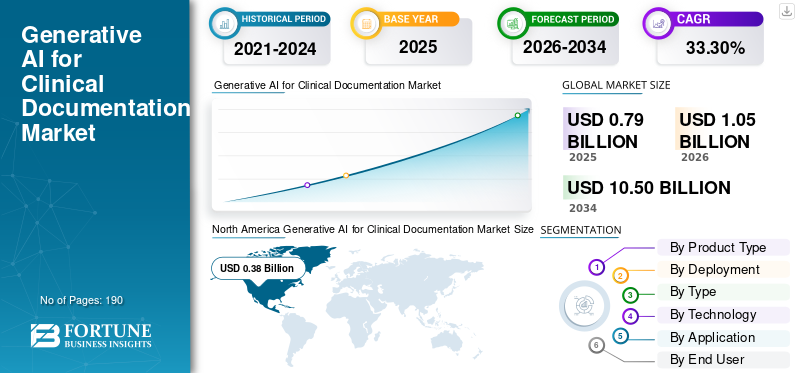
The global generative AI for clinical documentation market size was valued at USD 0.79 billion in 2025. The market is projected to grow from USD 1.05 billion in 2026 to USD 10.50 billion by 2034, exhibiting a CAGR of 33.30% during the forecast period. North America dominated the generative AI for clinical documentation market with a market share of 48.1% in 2025.
The global generative AI for clinical documentation market is projected to grow significantly over the coming years, driven by the rising administrative burden on clinicians and the increasing need to reduce time spent on manual note creation. These solutions generate clinical notes, summaries, and structured documentation. As healthcare providers focus more on workflow efficiency and faster documentation turnaround, demand for generative AI documentation tools is expected to increase. Additionally, deeper EHR integration and wider enterprise adoption across healthcare systems are supporting market expansion. Overall, the growing adoption of AI-powered documentation platforms is expected to drive the market growth.
Strategic collaborations among key market players to incorporate AI capabilities into their generative clinical documentation solutions reinforce the market's growth potential.
- For instance, in January 2025, Mayo Clinic expanded its use of the Abridge AI platform through an enterprise-wide agreement that initially covered about 2,000 clinicians across multiple specialties and care settings. The platform is being implemented to improve clinical documentation and support patient care at scale. Such enterprise-wide adoption of generative AI documentation platforms is anticipated to accelerate the overall market growth.
Furthermore, leading players in the generative AI industry, such as Abridge AI, Inc., Suki AI, Inc., DeepScribe, Inc., and Nabla Technologies, are focusing on expanding their offerings and strengthening their market positions.
Download Free sample to learn more about this report.
Generative AI for Clinical Documentation Market Key Takeaways
 Global Market Size & Forecast
- 2025 Market Size: USD 0.79 billion
- 2026 Market Size: USD 1.05 billion
- 2034 Forecast Market Size: USD 10.50 billion
- CAGR: 33.30% from 2026–2034
 Market Share
- North America dominated the generative AI for clinical documentation market with a 48.1% share in 2025.
- The Large Language Models (LLMs) segment accounted for the largest market share during the forecast period.
- The workflow automation segment is projected to register the fastest growth with a CAGR of 35.44% over the forecast period.
 Key Regional Highlights
North America
North America maintained its market leadership, reaching a valuation of USD 0.38 billion in 2025.
Europe
Europe is projected to reach USD 0.27 billion by 2026, supported by a CAGR of 32.94%.
Asia Pacific
Asia Pacific is estimated to reach USD 0.22 billion in 2026, making it the third-largest regional market.
U.S.
U.S. The market is estimated to reach approximately USD 0.46 billion in 2026.
Japan
Japan The market is estimated to reach approximately USD 0.04 billion in 2026.
Read More

GENERATIVE AI FOR CLINICAL DOCUMENTATION MARKET TRENDS
Growing Integration of Generative AI Documentation Tools with EHR Platforms is a Significant Market Trend Observed
The market is increasingly moving toward tighter integration with EHR platforms, as healthcare providers require documentation tools that fit directly into existing clinical workflows. When AI documentation solutions integrate with the EHR, clinicians can review, edit, and finalize notes without switching between systems, improving workflow efficiency and saving time. These features also support faster adoption across hospitals and health systems as integrated tools are easier to deploy at scale. As a result, vendors with strong EHR connectivity are attracting more attention in the market. Therefore, the rising integration of generative AI documentation tools with EHR platforms is emerging as a key market trend.
- For instance, in January 2025, Abridge announced Abridge Inside for Emergency Medicine as part of Epic’s Workshop program. The solution seamlessly integrated with Epic’s ASAP module in Haiku and Hyperspace, transforming emergency care conversations into structured notes within the clinical workflow. Such developments highlight how stronger EHR integration is shaping product innovation and supporting market expansion.
MARKET DYNAMICS
MARKET DRIVERS
Download Free sample to learn more about this report.
Rising Administrative Burden on Clinicians is Accelerating Adoption of AI Documentation Tools
A key factor driving the market growth is the high administrative burden from manual note creation, chart updates, and documentation review. As this workload increases, providers seek tools that reduce time spent on non-clinical tasks and help clinicians focus more on patient care. This is increasing the market demand, which can automatically capture conversations and create structured notes. As a result, healthcare organizations are adopting these tools to improve workflow efficiency, reduce burnout, and support faster documentation turnaround. Therefore, to reduce administrative burdens on clinicians, the market is anticipated to grow.
- For instance, in October 2025, UPMC announced that it was scaling the Abridge AI platform enterprise-wide to 12,000 clinicians. The platform transforms medical conversations into clinically useful, billable documentation at the point of care, helping reduce administrative burden and clinician burnout while improving the patient experience. Such large-scale deployments by health systems demonstrate that documentation pressure is accelerating the adoption, thereby supporting market growth.
MARKET RESTRAINTS
Risk of Clinical Errors and Hallucinated Outputs to Restrain Market Growth
The market faces a key restraint as AI-generated notes may sometimes include hallucinated, incomplete, or inaccurate clinical information. When healthcare providers are not fully confident in the reliability of generated documentation, they become more cautious about adopting these tools widely in routine care. This increases the need for manual review, clinician oversight, and governance controls, potentially reducing the time-saving benefits these solutions are expected to provide. As a result, concerns around patient safety, documentation accuracy, and medico-legal accountability can slow purchasing decisions and broader enterprise deployment. Therefore, the risk of clinical errors and hallucinated outputs is restraining the generative AI for clinical documentation market growth.
- For instance, in October 2025, Frontiers in Artificial Intelligence published a study titled ‘Assessing the quality of AI-generated clinical notes: validated evaluation of a large language model ambient scribe’ that reported the notes were more prone to hallucination than physician-authored notes. Such published findings highlight why providers may hesitate to scale these tools aggressively, thereby limiting market growth.
MARKET OPPORTUNITIES
Expansion of Specialty-Specific Clinical Documentation Solutions to Create Market Growth Opportunities
The market is expected to witness strong growth as healthcare providers increasingly demand documentation tools tailored to the needs of different specialties. Clinical workflows, terminology, and note structures vary widely across areas such as cardiology, behavioral health, emergency medicine, and inpatient care. Underscoring such varied applications, vendors expand their solutions into specialty-specific use cases to address a wider provider base and improve product relevance in real-world settings. These developments are encouraging healthcare organizations to adopt generative AI tools across specialized departments where documentation is more complex. Therefore, the expansion of specialty-specific clinical documentation solutions is creating a major growth opportunity for the market.
- For instance, in March 2025, Oracle launched its Oracle Health Clinical AI Agent across more than 30 medical specialties, including urgent care, sports medicine, nephrology, pulmonology, urology, gastroenterology, hepatology, cardiology, otolaryngology, internal medicine, and behavioral health.
MARKET CHALLENGES
High Implementation, Customization, and Training Costs to Challenge Market Growth
The market faces a major challenge of high implementation and customization costs. Healthcare providers usually need workflow redesign, EHR integration work, specialty-level customization, governance controls, user onboarding, and continuous staff training before the tools can be used effectively. This increases the overall cost and time required for deployment, especially for large hospitals and multi-site health systems. As a result, some providers may delay adoption or limit deployment to selected departments until the business case becomes clearer. Therefore, high implementation, customization, and training costs are creating a significant challenge to the market's growth.
- For instance, a 2025 npj Digital Medicine systematic review noted that evidence on the cost-effectiveness and budgetary impact of clinical AI interventions remains limited and mixed across settings, making investment decisions more difficult for healthcare organizations. In addition, the review also highlighted that deployment across diverse care settings raises important clinical, technical, and operational challenges.
Segmentation Analysis
By Product Type
Reduced Manual Notetaking Due to Ambient Clinical Documentation Tools Drives Segmental Growth
Based on the product type, the market is categorized into ambient clinical documentation tools, AI medical scribes, AI dictation & voice documentation tools, clinical summarization tools, and others.
The ambient clinical documentation tools segment accounted for the largest generative AI for clinical documentation market share. Ambient clinical documentation tools reduce manual note-taking during patient visits. These tools automatically capture clinician-patient conversations and convert them into structured notes, which helps reduce administrative burden and improve physician productivity. As documentation time remains a major pain point across healthcare settings, providers are adopting ambient tools faster than narrower point solutions such as standalone summarization-only products. In addition, ambient documentation tools fit directly into real-time care delivery, making their value more visible in daily clinical practice. New product launches for the product type further reinforce segmental growth.
- For instance, in October 2025, Northwell Health announced plans to deploy the Abridge ambient AI platform across its 28 hospitals to improve clinical documentation of patient conversations as part of its system-wide digital transformation. Such large-scale adoption of ambient documentation solutions indicates why this segment is likely to lead the market.
The clinical summarization tools segment is expected to grow at a CAGR of 34.08% over the forecast period.
To know how our report can help streamline your business, Speak to Analyst
By Deployment
Increasing Application of Cloud-Based to Boost Segmental Growth
Based on deployment, the market is segmented into cloud-based, on-premise, and hybrid.
In 2025, the cloud-based segment accounted for the largest revenue share. Cloud-based solutions dominated the market as healthcare organizations prefer solutions that can be implemented faster, scaled across multiple sites, and updated continuously without heavy on-premise infrastructure requirements. It also supports easier integration of AI upgrades, model improvements, and multi-location access, which is important in a rapidly evolving market. As a result, vendors offering cloud-based generative AI documentation platforms are better positioned to scale adoption across large provider networks. Key companies are focusing on technologically advanced new product offerings and strategic partnerships to strengthen their market position.
- For instance, in May 2025, Oracle and the Cleveland Clinic, in collaboration with G42, launched an AI-based global healthcare delivery platform designed to be secure, scalable, and accessible. Such emphasis on scalable AI-enabled healthcare infrastructure supports the view that cloud-based models are creating the strongest commercial momentum in the market.
The hybrid segment is projected to grow at a CAGR of 31.00% over the forecast period.
By Type
Embedded EHR Interoperability of the Integrated Segment to Lead Growth in the Segment
Based on type, the market is segmented into standalone and integrated.
In 2025, the integrated segment dominated the market based on type. Healthcare providers increasingly prefer integrated solutions, as AI documentation tools that work directly within existing EHR and clinical workflows are becoming more prevalent. When documentation tools are embedded into clinician workflows, providers can review, edit, and finalize notes more efficiently, thereby improving usability and reducing workflow disruption. These features make enterprise adoption easier. As a result, integrated products are gaining stronger market acceptance than standalone tools.
- For instance, in August 2025, Ambiance Healthcare joined Epic’s Toolbox program, expanding the availability of its AI-powered documentation capabilities and enabling deeper functionality directly inside Epic Haiku and Epic’s ambient workflows. Such product developments indicate why integrated solutions are likely to lead the market.
In addition, the standalone segment is projected to grow at a CAGR of 28.80% during the forecast period.
By Technology
Key Applications in Generative AI to Use Large Language Models (LLMs), Fueling Segmental Growth
Based on technology, the market is segmented into Large Language Models (LLMs), Natural Language Processing (NLP), and others.
The Large Language Models (LLMs) accounted for the largest share of the market during the forecast period, as they are the core engines behind AI-generated clinical notes, structured summaries, and documentation drafting. LLMs can better understand conversational context and generate more complete, clinically relevant documentation. This improves note quality, supports specialty-specific customization, and makes generative AI documentation platforms more useful in real clinical environments. As vendors continue to compete on documentation accuracy and workflow value, LLM-driven systems are becoming the foundation of most product innovation in this market. Innovative product launches by key companies to further boost the segment’s dominance.
- For instance, in March 2025, Microsoft launched Dragon Copilot, which helped to produce accurate documentation efficiently and consistently, including ambient capture of multilingual patient-clinician conversations into specialty-specific notes. Such product positioning indicates that LLM-led capabilities are central to market leadership.
In addition, the Natural Language Processing (NLP) segment is projected to grow at a CAGR of 30.26% during the forecast period.
By Application
Core Applications of Clinical Note Generation to Lead Segmental Growth
Based on application, the market is segmented into clinical note generation, chart summarization, referral letter & documentation drafting, coding & Clinical Documentation Improvement (CDI), workflow automation, and others.
In 2025, clinical note generation accounted for the largest market share. Clinical note generation addresses the most immediate problem faced by clinicians: the time spent inefficiently creating visit documentation. Providers are more willing to invest in tools that directly reduce charting burden and improve documentation speed than in narrower use cases such as referral drafting or workflow support alone. Since note creation is a daily and high-volume task across specialties and care settings, solutions focused on this application have broader adoption potential.
- For instance, in March 2025, Oracle announced that physicians using Oracle Health Clinical AI Agent were seeing a nearly 30% reduction in daily documentation time. Such measurable gains in note creation efficiency highlight why clinical note generation is likely the leading application area in the market.
The workflow automation segment is projected to grow at a CAGR of 35.44% over the forecast period.
By End User
Demand in Hospitals & ASCs Due to Large Patient Volumes to Lead Growth in the Segment
Based on end user, the market is segmented into hospitals & ASCs, specialty clinics, and others.
By end user, the hospitals & ASCs segment dominated the market, accounting for the largest share. These settings manage high patient volumes, complex documentation requirements, and large numbers of clinicians, which creates a stronger need for automation. Large provider organizations also have more resources to invest in enterprise AI platforms and can generate clearer return on investment through productivity gains, reduced burnout, and workflow standardization. Strategic partnerships among key operating entities further propel the segmental growth.
- For instance, in March 2025, Rush University System for Health expanded its partnership with Suki to roll out its ambient AI assistant enterprise-wide following a successful deployment, enabling clinicians across 28 specialties to reduce administrative time and focus more on patient care. Such enterprise-scale deployment in a major health system supports the view that hospitals and ASCs are leading adoption in the market.
The specialty clinics segment is projected to grow at a CAGR of 36.52% over the forecast period.
Generative AI for Clinical Documentation Market Regional Outlook
By geography, the market is categorized into Europe, North America, Asia Pacific, Latin America, and the Middle East & Africa.
North America
North America Generative AI for Clinical Documentation Market Size, 2025 (USD Billion)
To get more information on the regional analysis of this market, Download Free sample
North America held the dominant share in 2024 at USD 0.29 billion and maintained its leading position in 2025 at USD 0.38 billion. The market is growing strongly in North America as health systems are increasingly adopting generative AI documentation tools to reduce clinician burnout, improve workflow efficiency, and scale ambient documentation across large provider networks.
U.S. Generative AI for Clinical Documentation Market
Given North America's substantial contribution and the U.S. dominance in the region, the U.S. market is estimated at around USD 0.46 billion in 2026, accounting for roughly 43.91% of global sales.
Europe
Europe is projected to grow at 32.94% over the coming years, the second-highest among all regions, and reach a valuation of USD 0.27 billion by 2026. The European market is witnessing growth as health systems increasingly evaluate ambient scribing and generative AI tools to improve productivity, documentation quality, and clinical efficiency.
U.K. Generative AI for Clinical Documentation Market
The U.K. market is estimated at around USD 0.05 billion in 2026, representing roughly 4.75% of the global market.
Germany Generative AI for Clinical Documentation Market
Germany's market is projected to reach approximately USD 0.06 billion in 2026, equivalent to around 5.41% of the global market.
Asia Pacific
Asia Pacific is estimated to reach USD 0.22 billion in 2026 and secure the position of the third-largest region in the market. The market is growing in the Asia Pacific as healthcare providers are focusing more on digital healthcare infrastructure, scalable AI platforms, and workflow automation to support the expanding demand for care.
Japan Generative AI for Clinical Documentation Market
The Japanese market in 2026 is estimated at around USD 0.04 billion, accounting for approximately 3.50% of the global market.
China Generative AI for Clinical Documentation Market
China's market is projected to be one of the largest worldwide, with 2026 revenues estimated at around USD 0.08 billion, representing approximately 7.62% of global sales.
India Generative AI for Clinical Documentation Market
The Indian market in 2026 is estimated at around USD 0.03 billion, accounting for roughly 2.92% of global revenue.
Latin America and the Middle East & Africa
The Latin America and the Middle East & Africa regions are expected to witness moderate growth in this market during the forecast period. The Latin America market is set to reach a valuation of USD 0.03 billion in 2026. The market is expected to grow in Latin America due to rising on-premises investment. In the Middle East & Africa, the GCC is set to reach USD 0.01 billion in 2026.
South Africa Generative AI for Clinical Documentation Market
The South African market is projected to reach approximately USD 0.01 billion by 2026, accounting for roughly 0.52% of global revenue.
COMPETITIVE LANDSCAPE
Key Industry Players
Strategic Collaborations by Key Players to Propel Market Progress
The global generative AI for clinical documentation market is highly consolidated, with companies such as Abridge AI, Inc, Suki AI, Inc., DeepScribe, Inc., Nabla Technologies, Ambiance Healthcare, and Solventum Corporation holding significant market share. Strategic partnerships, new product launches, technological advancements, and increased investments in the sector drive these companies' market share gains.
- For instance, in March 2024, Nabla Technologies, the leading AI assistant for practitioners, launched Nabla Copilot's new Magic Edit feature, introducing a new level of personalization in automated clinical documentation.
Other notable players in the global market include Microsoft Corporation, Oracle Corporation, and Commure, Inc. These companies are expected to prioritize technological advancements, strategic collaborations, and new product launches to strengthen their positions in the global market.
LIST OF KEY GENERATIVE AI FOR CLINICAL DOCUMENTATION COMPANIES PROFILED
- Abridge AI, Inc. (U.S.)
- Suki AI, Inc. (U.S.)
- DeepScribe (U.S.)
- Nabla Technologies (France)
- Ambiance Healthcare (U.S.)
- Solventum Corporation (U.S.)
- Microsoft Corporation (U.S.)
- Oracle Corporation (U.S.)
- Commure, Inc. (U.S.)
- Corti (Denmark)
KEY INDUSTRY DEVELOPMENTS
- February 2026: Oracle Health launched its Clinical AI Agent, Clinical Note, in the U.K. The new AI solution enables caregivers at NHS and private practices to use an ambient voice- and screen-driven assistant to draft patient notes, reducing administrative tasks and allowing them to devote more time to patient care.
- August 2025: Ambiance Healthcare launched Chart Chat, a first-of-its-kind AI copilot designed to integrate directly within Epic’s Electronic Health Record (EHR) system to give healthcare providers context-aware clinical insights.
- October 2025: UPMC expanded Abridge enterprise-wide, cementing a longstanding partnership forged in Pittsburgh that has scaled from a small pilot to thousands of clinicians using Abridge to document the care they deliver to millions of patients each year.
- September 2025: Onvida Health and Ambiance Healthcare launched frontier ambient AI capabilities directly within Epic’s Hyperspace and Haiku applications. This enterprise-wide deployment gives Onvida clinicians seamless access to Ambiance’s chart summarization, ambient scribing, coding, and patient summary technology.
- May 2025: Suki announced the general availability of its ambient technology to all health systems on athenahealth’s network via athenahealth’s integrated Ambient Notes solution. This milestone expanded the company’s nationwide partnership with athenahealth.
REPORT COVERAGE
The report provides a detailed global generative AI for clinical documentation market analysis of the industry across key segments, including product type, deployment, type, technology, application, and end user. It examines the growing adoption of ambient documentation tools, AI medical scribes, voice-based documentation tools, and clinical summarization solutions across healthcare settings. The study also covers key market dynamics, including drivers, restraints, challenges, and growth opportunities, that influence industry expansion. In addition, it offers regional analysis across major geographies and evaluates the competitive landscape through company profiling, product offerings, and recent strategic developments. The report is designed to provide a clear view of current market trends, future growth potential, and the factors shaping the adoption of these solutions.
Request for Customization to gain extensive market insights.
Report Scope & Segmentation
| ATTRIBUTE | DETAILS |
| Study Period | 2021-2034 |
| Base Year | 2025 |
| Estimated Year | 2026 |
| Forecast Period | 2026-2034 |
| Historical Period | 2021-2024 |
| Growth Rate | CAGR of 33.30% from 2026 to 2034 |
| Unit | Value (USD Billion) |
| Segmentation | By Product Type, Deployment, Type, Technology, Application, End User, and Region |
| By Product Type |
|
| By Deployment |
|
| By Type |
|
| By Technology |
|
| By Application |
|
| By End User |
|
| By Region |
|
Frequently Asked Questions
According to Fortune Business Insights, the global market value stood at USD 0.79 billion in 2025 and is projected to reach USD 10.50 billion by 2034.
In 2025, the North Americas market value stood at USD 0.38 billion.
The market is expected to grow at a CAGR of 33.30% over the forecast period.
By product type, the ambient clinical documentation tools segment led the market.
The rising administrative burden on clinicians is the key factor driving the market.
Abridge AI, Inc., Suki AI, Inc., DeepScribe, Nabla Technologies, and Ambiance Healthcare are the major market players in the global market.
North America dominated the market in 2025 with the largest share.



- 2021-2034
- 2025
- 2021-2024
- 190
Get 30-60 hrs Free Customization
Expand Regional and Country Coverage, Segments Analysis, Company Profiles, Competitive Benchmarking, and End-user Insights.













.webp)






Related Reports
-
US +1 833 909 2966 ( Toll Free )
-
Get In Touch With Us