Geospatial Intelligence Market Size, Share & Industry Analysis, By Component, By Data Source (Satellite Imagery, Aerial & UAV Imagery, LiDAR & 3D Mapping Data, SAR Data, and Others), By Technology (GIS & Mapping Analytics, Remote Sensing, AI / ML-Based Geospatial Analytics, Data Fusion & Big Data Analytics, and Others), By Application (Defense, Intelligence & Surveillance, Disaster Management & Emergency Response, and Others), By End User (Defense & Intelligence Agencies, Energy, Mining & Utility Companies, Agriculture & Environmental Agencies, and Others), and Regional Forecast, 2026-2034
 Download Free Sample
Geospatial Intelligence Market Size and Future Outlook
 Listen to Audio Version
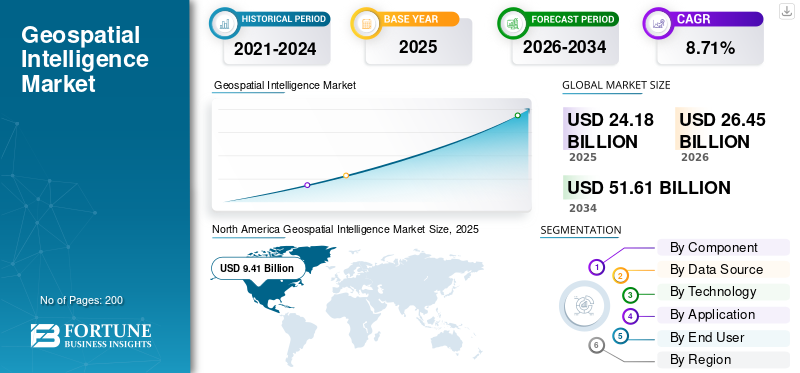
The global geospatial intelligence market size was valued at USD 24.18 billion in 2025 and is projected to grow from USD 26.45 billion in 2026 to USD 51.61 billion by 2034, exhibiting a CAGR of 8.71% during the forecast period. North America dominated the geospatial intelligence market with a market share of 38.92% in 2025.
Geospatial Intelligence (GEOINT) involves analyzing imagery and location-based data to understand physical features and activities on Earth. It uses sources such as satellite imagery, remote sensing technology, LiDAR, SAR, GNSS, and ground sensors, supported by platforms such as ArcGIS, QGIS, and Google Earth Engine. GEOINT is widely used in defense, national security, disaster management, agriculture, public health, and urban planning. Market adoption is rising due to geopolitical tensions, smart city investments, and artificial intelligence and machine learning driven spatial data analytics. Key players include Esri, Maxar Technologies, Hexagon AB, Planet Labs, Palantir Technologies, and Trimble, each supporting mapping, environmental monitoring, intelligence, and decision-making applications.
Download Free sample to learn more about this report.
GEOSPATIAL INTELLIGENCE MARKET KEY TAKEAWAYS
 Global Market Size & Forecast
- 2025 Market Size: USD 24.18 billion
- 2026 Market Size: USD 26.45 billion
- 2034 Forecast Market Size: USD 51.61 billion
- CAGR: 8.71% from 2026–2034
 Market Share
- North America dominated the market with a 38.92% share in 2025.
- The Software / Platforms segment held the largest market share in 2025.
- The Satellite Imagery segment held the largest market share in 2025.
 Key Regional Highlights
North America
Reached USD 9.41 billion in 2025, driven by mature defense GEOINT infrastructure and strong adoption across military and commercial applications.
Europe
Projected to reach USD 6.37 billion by 2026, growing at an 8.76% CAGR, supported by investments in sovereign satellite constellations and intelligence infrastructure.
Asia Pacific
Projected to reach USD 5.84 billion by 2026, emerging as the fastest-growing region due to defense modernization and expanding space-based surveillance programs.
U.S.
The market is projected to reach USD 6.43 billion by 2026, supported by significant investments in AI-powered GEOINT and advanced satellite intelligence capabilities.
Japan
Growth is supported by increasing investments in satellite observation, geospatial analytics, disaster management, and defense intelligence capabilities.
Read More

GEOSPATIAL INTELLIGENCE MARKET TRENDS
AI-Driven Automation and Real-Time Spatial Analytics are Key Market Trends
AI-driven automation is becoming a major GEOINT market trend as agencies and enterprises shift from manual image interpretation to faster, automated detection, change monitoring, and decision-support capabilities. NGA notes that GEOINT AI improves the processing of large volumes of geospatial data efficiently, while ESA’s Φ-sat mission demonstrates how onboard AI can filter unusable Earth-observation imagery before downlink. Real-time platforms such as ArcGIS Velocity also support live sensor ingestion, alerts, and spatial workflows. This trend is accelerating demand for AI-enabled GEOINT across defense, disaster response, infrastructure monitoring, climate analytics, and smart-city operations.
MARKET DYNAMICS
MARKET DRIVERS
Download Free sample to learn more about this report.
Integration of Satellite Imagery and AI Analytics Strengthens GEOINT Market Demand
Governments are increasingly integrating satellite imagery, real-time mapping, and AI-based spatial analytics into defense operations for surveillance, threat detection, and precision targeting. The NGA provides GEOINT that enables the Department of Defense to plan missions, achieve battlefield superiority, precisely target adversaries, and protect military forces while also contributing to counterterrorism, counternarcotics, and border security efforts. NATO's adoption of AI-enhanced surveillance tools reflects a strategic push to harmonize capabilities across member states, while the European Defense Fund emphasizes investments in dual-use technologies that serve both civilian and military applications. These dynamics are anchoring sustained, government-led procurement across allied nations, further supporting geospatial intelligence market growth.
MARKET RESTRAINTS
High Deployment Costs and Integration Complexity Limiting Wider Adoption Across Sectors
Ensuring data privacy and security is a major concern, as the growth of data collection and sharing increases the risk of sensitive information being compromised. Additionally, there is a shortage of skilled personnel in the field, which can make it difficult for organizations to find and train the right staff. Standardization of data and AI models is needed to ensure interoperability, but governance discussions must also encompass ethical deployment and workforce impacts. High infrastructure investment requirements, complex multi-source data integration, and evolving regulatory frameworks around data sovereignty collectively slow adoption, particularly among smaller public agencies and commercial organizations operating with constrained budgets and limited technical capacity.
MARKET OPPORTUNITIES
Expansion of Commercial and Civil GEOINT Applications Creates New Opportunities
Governments, utilities, insurers, logistics firms, agricultural companies, and infrastructure operators are increasingly using location-based data to monitor assets, assess risk, plan investments, and respond faster to disruptions. AI-enabled satellite imagery, drone mapping, SAR data, and cloud-based Geographic Information Systems (GIS) platforms are making GEOINT more affordable and scalable for non-defense users. This creates strong opportunities for vendors offering automated change detection, climate-risk analytics, infrastructure monitoring, precision agriculture insights, and real-time decision-support platforms across both public and commercial sectors.
MARKET CHALLENGES
Data Interoperability Gaps and Cybersecurity Vulnerabilities Posing Persistent Operational Risks
Geospatial intelligence systems are vulnerable to cyber threats, including data breaches, system intrusions, and denial-of-service attacks. Protecting sensitive information, ensuring data integrity, and safeguarding communication networks are critical challenges for the geospatial intelligence community. Geospatial data often originates from diverse sources, formats, and standards. Real-time processing of high-dimensional geospatial data, including satellite imagery, LiDAR point clouds, and sensor telemetry, involves massive data volumes and demands significant computational resources, particularly at the edge within autonomous platforms given size, weight, and power limitations. Bridging interoperability gaps across legacy systems while defending increasingly networked geospatial infrastructure remains one of the field's most pressing unsolved challenges.
Segmentation Analysis
By Component
Accelerating Demand for AI-Embedded Analytics and Cloud Deployment to Propel Software / Platforms Segment Growth
Based on the component, the market is segmented into software / platforms, data & imagery, services, and hardware.
The software / platform segment is anticipated to account for the largest market share in 2025. The segment is growing as defense agencies, intelligence organizations, and commercial enterprises are shifting from hardware-dependent workflows toward cloud-native software platforms that automate geospatial data processing, imagery interpretation, and spatial analytics at scale.
The data & imagery segment is anticipated to rise with a CAGR of 8.93% over the forecast period.
To know how our report can help streamline your business, Speak to Analyst
By Data Source
Rapid Expansion of LEO Satellite Constellations to Strengthen Satellite Imagery Segment Dominance
Based on data source, the market is segmented into satellite imagery, aerial & UAV imagery, LiDAR & 3D mapping data, SAR data, GNSS / GPS & location data, and others.
In 2025, the satellite imagery segment dominated the global market. The segment is growing as the rapid proliferation of commercial low-Earth orbit satellite constellations has dramatically increased revisit frequencies. Therefore, making continuous, high-resolution Earth observation available to a far broader range of defense, government, and commercial users than ever before.
The SAR data is projected to grow at a high CAGR of 9.48% over the forecast period.
By Technology
Growing Need for Unified Spatial Decision-Making Across Multi-Source Data Environments to Advance GIS and Mapping Analytics Segment Growth
Based on the technology, the market is segmented into GIS & mapping analytics, remote sensing, AI / ML-based geospatial analytics, data fusion & big data analytics, cloud-based geospatial platforms, and others.
The GIS & mapping analytics segment is anticipated to witness a dominating geospatial intelligence market share over the forecast period. The segment is growing as governments, defense establishments, and urban planners are increasingly demanding integrated spatial frameworks that consolidate satellite imagery, IoT sensor feeds, drone data, and field surveys into a single, interoperable analytical environment.
The AI / ML-based geospatial analytics segment is projected to grow at a high CAGR of 9.42% over the forecast period.
By Application
Growing Dependence on AI-Assisted Situational Awareness to Accelerate Defense, Intelligence & Surveillance Segment Growth
Based on application, the market is segmented into defense, intelligence & surveillance, homeland security & border monitoring, disaster management & emergency response, urban planning & infrastructure monitoring, environmental & climate monitoring, agriculture, forestry & natural resources, energy, mining & utilities, transportation, logistics & maritime monitoring, and others.
The defense, intelligence & surveillance segment dominated the market share in 2025. The segment is growing as modern warfare and intelligence operations increasingly depend on continuous, AI-assisted geospatial surveillance that delivers fused, multi-source situational awareness directly into command-and-control systems with minimal latency.
In addition, the disaster management & emergency response segment is projected to grow at a high CAGR of 9.37% during the forecast period.
By End User
Rising GEOINT Budget Allocation by National Security Agencies to Consolidate Defense & Intelligence Agencies as Dominant End Users
Based on end user, the market is segmented into defense & intelligence agencies, homeland security & law enforcement agencies, government & public sector agencies, commercial enterprises, energy, mining & utility companies, agriculture & environmental agencies, transportation & logistics companies, and others.
The defense & intelligence agencies segment dominated the market share in 2025. The segment is growing as national defense establishments and intelligence communities worldwide are directing substantial budget allocations toward integrated GEOINT platforms. These platforms help to combine satellite surveillance, AI-driven analytics, and real-time data fusion into mission-ready operational architectures.
In addition, the commercial enterprises segment is projected to grow at a CAGR of 9.50% during the forecast period.
Geospatial Intelligence Market Regional Outlook
By region, the market is categorized into Europe, North America, Asia Pacific, and the rest of the world.
North America
North America Geospatial Intelligence Market Size, 2025 (USD Billion)
To get more information on the regional analysis of this market, Download Free sample
North America held the dominant share in 2024, valuing at USD 8.64 billion, and also maintained the leading share in 2025, with USD 9.41 billion. North America maintains market leadership driven by mature defense GEOINT infrastructure, continuous operational requirements from ongoing conflicts, and deep integration of geospatial data into commercial and military workflows.
U.S. Geospatial Intelligence Market
Based on North America’s strong contribution and the U.S. dominance within the region, the U.S. market can be analytically approximated at around USD 6.43 billion in 2026. Further, the country is accounting for roughly 8.96% of CAGR during the forecast period. The U.S. dominates the market through the National Geospatial-Intelligence Agency's (NGA) substantial investments in AI-powered computer vision systems and automated data processing for real-time intelligence.
Europe
Europe is projected to record a steady growth rate of 8.76% during the forecast period, the second-highest among all regions, and reach a market value of USD 6.37 billion by 2026. European countries are accelerating sovereign GEOINT capabilities to reduce dependence on U.S. assets through significant investments in multi-sensor satellite constellations and domestic intelligence infrastructure.
U.K. Geospatial Intelligence Market
The U.K. market in 2026 is estimated to reach approximately USD 2.02 billion, representing a CAGR of roughly 9.19% during the forecast period. The U.K. is developing the ISTARI multi-satellite intelligence system to enhance sovereign surveillance capabilities while modernizing optical and reconnaissance assets across its defense and intelligence agencies.
Germany Geospatial Intelligence Market
Germany’s market is projected to reach approximately USD 1.76 billion in 2026. Germany announced USD 35 billion in space-defense investments through 2030, representing the largest national commitment to sovereign space-based intelligence in Europe. The partnership between Norway's Kongsberg and Germany's Helsing to develop a multi-sensor SAR/EO satellite constellation by 2029 positions Germany as a leading GEOINT hub in Europe.
Asia Pacific
Asia Pacific is estimated to reach USD 5.84 billion by 2026, securing its position as the third-largest regional market and the fastest-growing region during the forecast period. The growth is driven by geopolitical tensions, rapid modernization of defense forces, and massive investments in space-based surveillance infrastructure.
China Geospatial Intelligence Market
China’s market is projected to be one of the largest in Asia Pacific, with 2026 revenues estimated at around USD 1.85 billion. China is rapidly expanding its multi-sensor satellite constellations, including Jilin SAR and Kuanfu intelligence satellites, creating one of the world's largest space-based surveillance networks.
India Geospatial Intelligence Market
The Indian market value in 2026 is estimated at around USD 1.62 billion. India's market is growing rapidly due to the government's liberalization of geospatial data guidelines, which removed restrictions for private companies and enabled domestic startups to develop GIS and satellite-based analytics solutions.
Rest of the World
The rest of the world region, including the Middle East & Africa and Latin America, is experiencing growing demand driven by border security needs, smart city initiatives, and increasing defense modernization across emerging economies. The Middle East & Africa and Latin America market is set to reach a valuation of USD 2.40 billion and USD 1.56 billion in 2026, respectively.
COMPETITIVE LANDSCAPE
Key Industry Players
Focus on Innovation and Partnerships by Leading Companies to Shape Market Positioning
The geospatial intelligence market is moderately consolidated, anchored by key players including Maxar Technologies, Lockheed Martin, BAE Systems, Esri, Airbus, Thales Alenia Space, OHB, Kongsberg, and Helsing. The market also includes NASA-aligned industrial primes, ESA-drawn aerospace groups, national-scale intelligence agencies (NGA, ISRO), and emerging private-space firms such as Pixxel, SatSure, iQPS, Startup Enabled Intelligence, and Terran Orbital. These organizations are active in Earth observation, small-satellite constellations, SAR satellites, and AI-driven geospatial analytics across the U.S., Europe, China, and India.
Leading companies invest in AI-powered computer vision systems, advanced satellite platforms (including SAR and hyperspectral payloads), automated data processing pipelines, and cloud based SaaS delivery models. They also form strategic alliances with national intelligence agencies (such as NGA, ESA, ISRO), commercial satellite operators, and technology providers. These partnerships underpin large-scale infrastructure, including sovereign GEOINT constellations, real-time intelligence data layers, and secure defense communications networks. They help secure long-term government contracts, co-develop technical standards for automated image and spatial analysis, and support the sharing of critical space-based surveillance infrastructure.
LIST OF KEY GEOSPATIAL INTELLIGENCE COMPANIES PROFILED
- Esri (U.S.)
- Maxar Intelligence (U.S.)
- Planet Labs PBC (U.S.)
- BlackSky Technology Inc. (U.S.)
- Palantir Technologies (U.S.)
- Hexagon AB (Sweden)
- Trimble Inc. (U.S.)
- Airbus Defense and Space (Netherlands)
- BAE Systems (U.K.)
- NV5 Geospatial (U.S.)
- Bentley Systems (U.S.)
KEY INDUSTRY DEVELOPMENTS
- March 2026: Under the NGA Luno A Facility Monitoring Delivery Order, BlackSky Technology Inc. received a grant. Customer satisfaction and the consistent performance of the company's high-cadence, AI-enabled change detection analytics led NGA to extend financing for the four-year award.
- February 2026: The National Geospatial-Intelligence Agency (NGA) awarded Vantor a USD 5.3 million Luno B contract to identify and provide automated insights on real-time changes to the Earth's landscape, bolstering NGA's international mapping and intelligence activities.
- October 2025: The NGA awarded a contract to its subsidiary Planet Labs Federal under the Luno B indefinite delivery, indefinite quantity (IDIQ) contract. Planet Labs PBC is a major source of daily data and insights about Earth.
- June 2025: BlackSky Technology Inc. secured a four-year delivery order worth over USD 24 million from the National Geospatial-Intelligence Agency (NGA) under the Luno A Facility Operational Monitoring (FOMO) program. The contract supports global monitoring of military and economic facilities.
- January 2025: NGA selected 13 vendors for the USD 200.00 million Luno B commercial data IDIQ, including Airbus U.S. Space & Defense, BAE Systems, BlackSky, Maxar Mission Solutions, NV5 Geospatial, Planet Labs Federal, and Ursa Space Systems. The contract supports commercial GEOINT data and AI-enabled analytics for monitoring economic, environmental, geopolitical, and illegal activities.
REPORT COVERAGE
The global geospatial intelligence industry analysis includes a comprehensive study of the market size & forecast by all the market segments included in the report. It includes details on the market dynamics and market trends expected to drive the market over the forecast period. It provides information on key aspects, including an overview of technological advancements the regulatory environment, porter’s five forces analysis, company profiles and retrofitting program. Additionally, it details partnerships, mergers & acquisitions, as well as key aviation industry developments and prevalence by key regions. The global market report also provides a depth competitive landscape with information on the market share and profiles of key operating players.
Request for Customization to gain extensive market insights.
Report Scope & Segmentation
| ATTRIBUTE | DETAILS |
| Study Period | 2021-2034 |
| Base Year | 2025 |
| Estimated Year | 2026 |
| Forecast Period | 2026-2034 |
| Historical Period | 2021-2024 |
| Growth Rate | CAGR of 8.71% from 2026-2034 |
| Unit | Value (USD Billion) |
| Segmentation | By Component, Data Source, Technology, Application, End User, and Region |
| By Component |
|
| By Data Source |
|
| By Technology |
|
| By Application |
|
| By End User |
|
| By Region |
|
Frequently Asked Questions
According to Fortune Business Insights, the global market value stood at USD 24.18 billion in 2025 and is projected to reach USD 51.61 billion by 2034.
In 2025, the market value stood at USD 9.41 billion.
The market is expected to grow at a CAGR of 8.71% during the forecast period.
By component, the software / platforms segment is expected to dominate the market.
Escalating defense digitalization and rising cross-border threats is fueling sustained market demand.
Maxar Technologies, Lockheed Martin, BAE Systems, Esri, Airbus, and Thales Alenia Space are few key players in the global market.
North America dominated the market in 2025



- 2021-2034
- 2025
- 2021-2024
- 200
Get 30-60 hrs Free Customization
Expand Regional and Country Coverage, Segments Analysis, Company Profiles, Competitive Benchmarking, and End-user Insights.




















Related Reports
-
US +1 833 909 2966 ( Toll Free )
-
Get In Touch With Us