Glass Cosmetic Packaging Market Size, Share & Industry Analysis, By Product Type (Jars & Containers, Bottles, Vials & Ampoules, and Others), By Capacity (Less than 50 ml, 50-100 ml, 101-200 ml, 201-500 ml, and Above 500 ml), By Application (Skincare, Haircare, and Makeup), and Regional Forecast, 2026-2034
 Download Free Sample
(Offer valid till 15th Oct 2026)

KEY MARKET INSIGHTS
 Listen to Audio Version
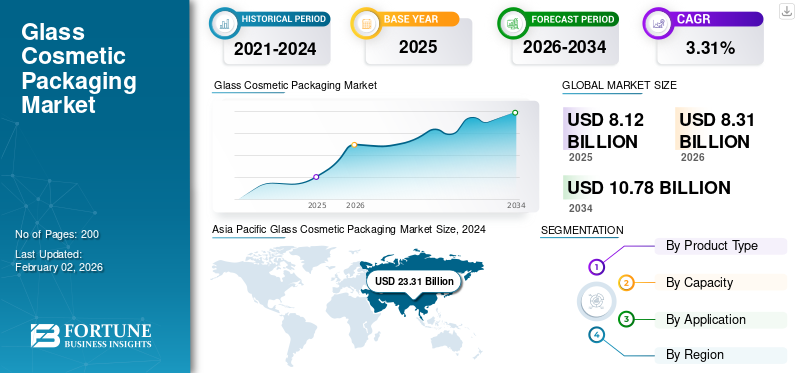
The global glass cosmetic packaging market size was valued at USD 8.12 billion in 2025. The market is projected to grow from USD 8.31 billion in 2026 to USD 10.78 billion by 2034, exhibiting a CAGR of 3.31% during the forecast period. Asia Pacific dominated the glass cosmetic packaging market with a market share of 33.14% in 2025.
Glass cosmetic packaging pertains to containers used to store and safeguard cosmetic items. These containers are preferred for their visual attractiveness, luxurious sensation, and ability to maintain product quality, due to their inert and non-reactive characteristics. Glass is highly recyclable and can be recycled repeatedly without losing its quality, making it an environmentally friendly option. Manufacturers are integrating recycled glass and exploring refillable options to support sustainability goals and align with growing eco-consciousness among buyers. The growing recycling initiatives by the government bodies, organizations, and manufacturers worldwide drive glass cosmetic packaging market growth.
- For instance, in July 2025, Cosmetics Europe and Close the Glass Loop announced that Cosmetics Europe has now become the 15th European partner to join the Close the Glass Loop initiative. This collaboration strengthens the dedication of the entire glass packaging value chain to reach a 90% glass collection rate for recycling in the EU by 2030.
Stoelzle Glass Group and Vitro Glass Containers are the leading manufacturers, accounting for the largest market share.
Download Free sample to learn more about this report.
GLASS COSMETIC PACKAGING MARKET Key Takeaways
 Global Market Size & Forecast
- 2025 Market Size: USD 8.12 billion
- 2026 Market Size: USD 8.31 billion
- 2034 Forecast Market Size: USD 10.78 billion
- CAGR: 3.31% from 2026–2034
 Market Share
- Asia Pacific dominated the glass cosmetic packaging market with a market share of 33.14% in 2025.
- Bottles were the leading product type segment, supported by strong demand for premium and sustainable cosmetic packaging.
- The 50–100 ml capacity segment held the largest share, driven by rising skincare adoption among Gen Z and millennials.
 Key Regional Highlights
Asia Pacific
The region led the global market with USD 2.69 billion in 2025, supported by rapid urbanization, rising premium beauty demand, and strong cosmetics manufacturing across China, India, and South Korea.
North America
The region remained the second-largest market, driven by high cosmetic imports, strong social media influence on beauty trends, and the presence of leading cosmetic manufacturers.
Europe
Growing recycling initiatives and sustainability regulations are accelerating the adoption of glass cosmetic packaging across the region.
U.S.
Beauty cosmetics and skincare imports reached USD 7.8 billion in 2024, reflecting robust consumer demand and supporting continued market growth.
Japan
According to the Observatory of Economic Complexity, Japan supplied USD 2.55 billion worth of beauty products imported by China in 2024.
Read More

MARKET DYNAMICS
MARKET DRIVERS
Growing Emphasis on Sustainable and Eco-friendly Packaging Drives Market Growth
In light of the sustainability trend, the popularity of glass cosmetic packaging as an environmentally friendly choice has surged. Incorporating recycled glass and advancements in manufacturing methods has paved the way for lightweight yet durable glass packaging options, reducing the carbon emissions associated with production and transit. Growing up amidst heightened environmental awareness, Gen Z and millennials have directly observed the impacts of plastic waste, climate change, and the depletion of natural resources. Consequently, they place high value on environmental protection and seek sustainable alternatives. Glass, being recyclable and eco-friendly, aligns perfectly with the waste reduction and environmental conservation principles valued by Gen Z and millennials. Henceforth, the increasing emphasis on eco-friendly solutions and demand for sustainable packaging drives market growth.
MARKET RESTRAINTS
Transportation Challenges and Design Limitations to Hamper Market Growth
One significant issue faced by many manufacturers is the fragility of glass and the challenges associated with transportation. Glass bottles are delicate and prone to breakage during transportation, leading to financial losses and additional costs for manufacturers. This fragility complicates the situation for logistics and supply chain management. To mitigate this risk, special precautions must be taken to guarantee the secure delivery of glass bottles, impacting the total cost and driving up the product's price. Recycling systems for glass are inconsistent globally, and supply chain disruptions can impact the availability and profitability of sustainable glass packaging options.
Another challenge encountered by manufacturers concerns the restricted design capabilities. While glass provides numerous options for creating distinctive packaging designs to draw in customers, it also comes with constraints. Compared to alternative packaging options, such as plastic, glass bottles offer less flexibility, which complicates the processes of customization, shaping, and sizing, limiting the ability to achieve specific designs or functionalities.
MARKET OPPORTUNITIES
Growing Consumer Demand for Miniature Packaging Offers Significant Growth Opportunities
The popularity of miniature cosmetic items is on the rise, fueled by factors such as cost-effectiveness, ease of travel, and a preference for experimenting with new products. This shift allows brands to draw in new consumers, increase brand visibility on social media platforms, and experiment with new formulations at reduced production costs. Miniature glass cosmetic containers provide an elegant and practical option for holding and displaying various beauty items. Typically available in sizes from 10g to 50g, these compact glass jars are perfect for creams, balms, serums, and even smaller products such as lip scrubs and eye creams. They are preferred for their premium appearance, ability to preserve product freshness, and environmentally friendly characteristics. As consumers embrace miniature cosmetic products, the glass cosmetic packaging market offers potential growth opportunities.
GLASS COSMETIC PACKAGING MARKET TRENDS
Augmenting Demand for Luxury Products Emerges as a Key Trend
The realm of cosmetics goes beyond just the product quality; it also involves how it is showcased. Luxurious cosmetic jars made with glass material are essential for the presentation, preservation, and overall attractiveness of cosmetic items. Consumers and beauty brands are increasingly drawn to glass packaging for its high-end appearance and recyclable nature, especially in skincare and fragrance lines. These containers are crafted to safeguard the contents and reflect a brand's identity and luxury segments. Luxury cosmetic jars transcend mere functionality; they symbolize brand identity and principles.
- Asia Pacific witnessed a growth from USD 23.31 billion in 2024 to USD 24.50 billion in 2025.
The jars' design, packaging materials, and practical use can greatly influence how consumers perceive them. This underscores the significance of cosmetics packaging, allowing brands to set themselves apart in a saturated market. The rising demand for luxury cosmetic products thus emerges as a key market trend.
Download Free sample to learn more about this report.
Segmentation Analysis
By Product Type
Significant Benefits Offered by the Glass Bottles Boost the Bottles Segment Growth
Based on product type, the market is divided into jars & containers, bottles, vials & ampoules, and others. Bottles are the dominating product type segment of the market. Cosmetic glass bottles offer several key benefits for both brands and consumers. They are visually appealing, convey a sense of luxury and quality, and are chemically inert, ensuring product stability and safety by preventing interactions with ingredients. Glass bottles, especially those with frosted or colored finishes, exude a premium look and feel, enhancing the perceived value of cosmetic products, further boosting the segment’s growth.
Jars & containers are the second-dominating segment of the market. Glass jars offer a premium, high-end look and feel, enhancing the perceived value of the cosmetic product. Their tactile appeal and visual elegance contributed to an elevated customer experience, which continues to propel the segment’s growth.
By Capacity
Increasing Focus of Younger Population on Skincare Fosters 50-100 ml Segment Growth
Based on capacity, the market is divided into less than 50 ml, 50-100 ml, 101-200 ml, 201-500 ml, and above 500 ml. The 50-100 ml is the leading capacity segment of the global glass cosmetic packaging market, driven largely by the younger demographic’s strong emphasis on skincare. For many in this age group, skincare is viewed as a necessity rather than a luxury. This trend is particularly evident among Gen Z and millennials, who are more informed about skincare ingredients and actively seeking long-term skin health. This shift has led to an increase in the development of specialized products designed to meet their specific needs and preferences, with capacities that are neither too large nor too small, fostering the segment’s growth.
Less than 50 ml is the second-dominating segment in the market. Less than 50 ml of cosmetic products usually involves miniature cosmetic products. The segment is experiencing growing demand, driven by affordability, convenience, and the desire to experiment with new products. This trend particularly appeals to Gen Z and consumers looking for travel-friendly options.
By Application
Rising Social Media Influence on Skincare Industry Boosted the Segment’s Growth
Based on application, the market is segmented into skincare, haircare, and makeup.
The skincare segment dominated the market in 2024. Social media platforms have played a crucial role in shaping young consumers' awareness and interest in skincare, with influencers and celebrities showcasing routines and product recommendations. Younger generations prioritize skincare routines focusing on overall skin health and preventing future issues rather than solely addressing immediate cosmetic concerns. Beauty brands utilize social media to connect with consumers, promote products, and build brand loyalty through engaging content and influencer collaborations further contributes to the segment’s growth.
The makeup segment is expected to witness steady growth during the forecast period. A growing emphasis on personal grooming and appearance drives demand for makeup products. Beauty influencers and celebrity endorsements on social media platforms significantly impact consumer choices, thus enhancing demand for makeup products.
Glass Cosmetic Packaging Market Regional Outlook
By geography, the market is categorized into North America, Europe, Asia Pacific, Latin America, and the Middle East & Africa.
Asia Pacific
Asia Pacific Glass Cosmetic Packaging Market Size, 2025 (USD Billion)
To get more information on the regional analysis of this market, Download Free sample
The Asia Pacific region dominates the global market, propelled by a growing middle class, heightened urbanization, and an expanding interest in premium beauty items. Rapidly growing demand for personal care and cosmetic products is surging in countries such as China, India, and South Korea. The cosmetics sector in the region has experienced notable expansion, especially within the natural and organic product categories, leading to a heightened demand for high-quality cosmetic glass bottle solutions. China plays a major role in the region’s growth as a major importer and a significant player in global cosmetics manufacturing and consumption, enhancing the region's growth.
- The Observatory of Economic Complexity states that in 2024, China brought in USD 13 billion worth of beauty products. The primary sources for China's beauty product imports were France (USD 3.6 billion), Japan (USD 2.55 billion), South Korea (USD 1.94 billion), the U.S. (USD 1.51 billion), and the U.K. (USD 1.23 billion).
North America
North America captures the second-largest glass cosmetic packaging market share. Platforms such as Instagram and YouTube have democratized access to skincare information and trends, impacting purchasing decisions and the perception of beauty standards in the U.S. The presence of key cosmetic manufacturers in the region also contributes to market growth. The region is a major importer of cosmetic products, fostering market development.
- According to World Top Exports Data 2024, America's total imports of beauty cosmetics and skincare items amounted to USD 7.8 billion. The fastest-growing suppliers of beauty and skincare products to the U.S. since 2023 were South Korea (increased by 55%), India (increased by 51.1%), Japan (increased by 24%), and Taiwan (increased by 21.8%).
Europe
Europe is a significant market for glass cosmetic packaging. Government bodies and organizations' growing emphasis on decreasing the environmental impact and boosting packaging recycling drives market growth. Rising recycling initiatives within the glass packaging sector have further encouraged the usage of glass material for cosmetic packaging, boosting market expansion.
- In the latest data released by Close the Glass Loop, the European Container Glass Federation stated that in 2020, the EU average collection of glass packaging for recycling was 80.1%. The multi-stakeholder collaboration ‘Close the Glass Loop’ aims to reach a post-consumer glass container collection target of 90% by 2030.
Latin America
The Latin America region is expected to observe considerable growth. Easier access to information and a broader selection of skincare items, such as specialized products like serums, toners, and sunscreens, has simplified the process for young individuals to create and uphold skincare routines. The growing demand for serums, toners, and other skincare products among the region’s youth is a key factor propelling market growth.
Middle East & Africa
The Middle East and Africa region is expected to grow moderately in the coming years. The expansion of online retail is making cosmetic products more accessible to a wider audience, contributing to market growth. Moreover, there’s a growing demand for products that cater to the diverse population's specific hair and skin needs, particularly those of African descent, thus boosting market expansion.
COMPETITIVE LANDSCAPE
Key Industry Players
Key Companies Focus on the Introduction of New Products to Boost their Market Share
The global glass cosmetic packaging market is concentrated with companies such as Stoelzle Glass Group, Vitro Glass Containers, SGD Pharma, Origin Pharma Packaging, Ardagh Group, and APackaging Group, accounting for a significant share.
Stoelzle Glass Group is a leading, family-run manufacturer of high-quality glass packaging with a history spanning over 200 years. They operate seven production plants across Europe and the U.S., alongside four decoration sites. The company is known for its diverse glass packaging solutions, serving sectors such as spirits, pharmaceuticals, perfumery & cosmetics, and food & beverage.
Vitro Glass Containers, a division of Vitro, S.A.B. de C.V., is a leading glass packaging manufacturer specializing in bottles for the perfumery, cosmetics, toiletry, pharmaceutical, and premium liquor industries. Founded in 1909, Vitro is a global company with a long history in glass manufacturing, focusing on innovation and quality.
Additionally, Gerresheimer AG and Eurovetrocap are among the other prominent players in the market. Focus on significant investments in the research & development of innovative products has supported the cosmetic companies' share in the market and boosted the market expansion of glass cosmetics packaging.
- In February 2024, Gerresheimer, an innovative systems and solutions provider and a worldwide collaborator for the pharmaceutical, biotech, and cosmetics sectors, announced that its eco-friendly packaging solution featuring the Gx Amsterdam glass jar paired with the bio-based forewood closure has been chosen for the launch of an innovative cosmetic item by the German start-up 4peoplewhocare. The blend of glass containers with 100% bio-based closures made from forewood material aligns perfectly with the sustainability principles underpinning this new cosmetic product.
LIST OF KEY GLASS COSMETIC PACKAGING COMPANIES PROFILED
- Stoelzle Glass Group (Austria)
- Origin Pharma Packaging (U.K.)
- Gerresheimer AG (Germany)
- Ardagh Group (Luxembourg)
- Vitro Glass Containers (Mexico)
- APackaging Group (U.S.)
- Eurovetrocap (Italy)
- TYH Container Enterprise Co., Ltd. (Taiwan)
- Jarsking (China)
- Chaudhary Glasspack (India)
- SGD Pharma (France)
- Arcade Beauty (U.S.)
- Lomei Cosmetics Ent. Co., Ltd. (Taiwan)
- RAFESA (Spain)
- Virospack (Spain)
KEY INDUSTRY DEVELOPMENTS
- November 2024: Stratasys Ltd. revealed its partnership with Baralan, a prominent supplier of primary packaging for the cosmetics sector, aiming to enhance creative options in cosmetic packaging by leveraging Stratasys’ PolyJet technology. Baralan employs Stratasys’ 3D printing to create final parts on glass and plastic containers, providing premium brands with bespoke, fully decorated packaging that caters to personalization and low-volume production needs.
- October 2024: Ardagh Glass Packaging declared the launch of new Cream Jars, the perfect packaging solution for protecting cosmetic and health products. The new cream jars are planned to keep products fresh & protected, while preserving their quality over time, and are available in sizes ranging from 15 to 500 ml.
- September 2024: Austrian glass packaging company Stoelzle Glass Group launched Elixir, a novel 30ml standard dropper bottle tailored for cosmetics, particularly serums and foundations. Weighing only 53g, Elixir is 32% lighter than its former version (78g), which the glass manufacturer claims leads to a 32% reduction in CO2 emissions compared to a typical 30ml serum bottle.
- December 2023: The worldwide provider of hybrid packaging, which markets glass, plastic, and metal containers along with various closures for the high-end beverage and cosmetics sectors, Berlin Packaging disclosed its acquisition of South Korea's Nest-Filler PKG Co., Ltd. This acquisition allows Berlin Packaging to enhance its presence in the Asia Pacific region and reinforces its beauty and cosmetic packaging offerings. The company presents an extensive range of plastic and glass packaging products, strongly emphasizing sustainable solutions.
- November 2021: An Italian company that provides primary packaging solutions for the cosmetics and beauty sectors, Baralan, launched Olivia Slim, a new line of glass bottles featuring cylindrical shapes and rounded shoulders reminiscent of the Boston Round design. The new collection includes three sizes and three colors of glass bottles (15 ml, 30 ml, 50 ml): clear, amber, and cobalt blue. New makeup, skincare, and fragrance products were created alongside this collection.
REPORT COVERAGE
The global glass cosmetic packaging industry analysis provides market size and forecasts by all segments included in the report. It details the market dynamics and trends expected to drive the industry during the forecast period. It offers information on the utilization of the product in key regions, company profiles, industry developments, new product launches, and details on partnerships, mergers & acquisitions in key countries. It covers a detailed competitive landscape with information on the market share and profiles of key players.
Request for Customization to gain extensive market insights.
Report Scope & Segmentation
|
ATTRIBUTE |
DETAILS |
|
Study Period |
2021-2034 |
|
Base Year |
2025 |
|
Estimated Year |
2026 |
|
Forecast Period |
2026-2034 |
|
Historical Period |
2021-2024 |
|
Growth Rate |
CAGR of 3.31% from 2026-2034 |
|
Unit |
Value (USD Billion) |
|
Segmentation |
By Product Type
|
|
By Capacity
|
|
|
By Application
|
|
|
By Geography
|
Frequently Asked Questions
Fortune Business Insights says that the global market value stood at USD 8.12 billion in 2025 and is projected to record a valuation of USD 10.78 billion by 2034.
In 2024, the market value stood at USD 23.31 billion.
The market is expected to grow at a CAGR of 3.31% during the forecast period.
The skincare segment led the market by application.
The key factor driving the market is the growing emphasis on sustainable and eco-friendly packaging.
Stoelzle Glass Group, Vitro Glass Containers, SGD Pharma, Origin Pharma Packaging, Ardagh Group, and APackaging Group are the top players in the market.
Asia Pacific dominates the market.
Increased demand for the skincare products is one of the factors that is expected to favor product adoption.



- 2021-2034
- 2025
- 2021-2024
- 200
-
(Offer valid till 15th Oct 2026)
Get 30-60 hrs Free Customization
Expand Regional and Country Coverage, Segments Analysis, Company Profiles, Competitive Benchmarking, and End-user Insights.









Related Reports
-
US +1 833 909 2966 ( Toll Free )
-
Get In Touch With Us