Gluten-free Oats Market Size, Share & Industry Analysis, By Product Type (Gluten-Free Rolled Oats, Gluten-Free Instant Oats, Whole Gluten-Free Oats, Gluten-Free Steel-Cut Oats, and Others), By Nature (Conventional and Organic), By Distribution Channel (Supermarkets/Hypermarkets, Convenience Stores, Specialty Stores, and Online Retail), and Regional Forecast, 2026-2034
 Download Free Sample
(Offer valid till 30th Sep 2026)

Gluten-free Oats Market Size and Future Outlook
 Listen to Audio Version
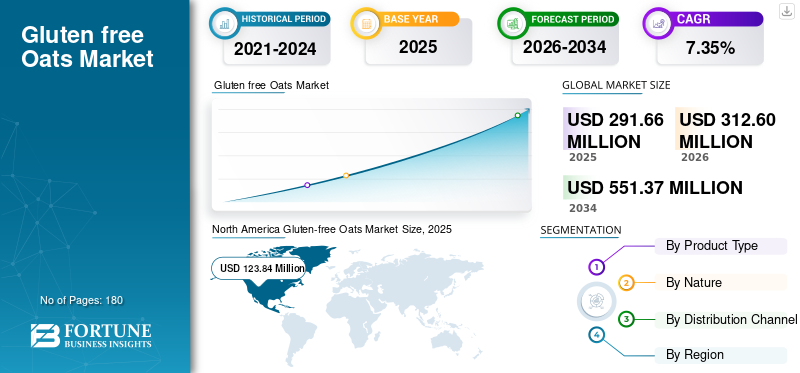
The global gluten-free oats market size was valued at USD 291.66 million in 2025. The market is projected to grow from USD 312.60 million in 2026 to USD 551.37 million by 2034, exhibiting a CAGR of 7.35% during the forecast period. North America dominated the gluten free oats market with a market share of 42.39% in 2025.
Gluten-free oats are specialty controlled oat products produced through segregation, testing, and verified sourcing to assure they adhere to gluten-free standards. The manufacturing process of gluten-free oats commences with controlled fields and approved oat seeds that are not contaminated with gluten-rich grains such as rye, barley, or wheat. Some popular types of gluten-free oats include steel-cut, quick, and rolled oats. The key end-users of gluten free oats include cereal producers, foodservice operators, kid’s nutrition brands, and household consumers. Geographically, Europe and North America are the major regional consumers in the global market.
Companies such as PepsiCo, Glebe Farm Foods, and Bob’s Red Mill Natural Foods are prominent players in the market. New product launches are a pivotal strategy adopted by key players to improve their position.
Download Free sample to learn more about this report.
Gluten Free Oats Market Key Takeaways
 Global Market Size & Forecast
- 2025 Market Size: USD 291.66 million
- 2026 Market Size: USD 312.60 million
- 2034 Forecast Market Size: USD 551.37 million
- CAGR: 7.35% from 2026–2034
 Market Share
- North America dominated the gluten-free oats market with a 42.39% share in 2025.
- Gluten-free instant oats are projected to grow at a CAGR of 9.25% over the forecast period.
- The organic segment is projected to grow at a CAGR of 8.89% over the forecast period.
 Key Regional Highlights
North America
North America led the market with a valuation of USD 123.84 million in 2025.
Europe
Europe ranked second, valued at USD 85.83 million in 2025, with a projected CAGR of 6.52%.
Asia Pacific
Asia Pacific ranked third at USD 47.41 million in 2025, supported by new product launches and rising gluten-free awareness.
U.S.
The market was estimated at USD 95.49 million in 2025, accounting for approximately 32.74% of global sales.
Japan
The market was valued at approximately USD 7.01 million in 2025, representing around 2.41% of global revenues.
Read More

GLUTEN-FREE OATS MARKET TRENDS
Surging Inclination toward Kid-Friendly Gluten Free Oat Snacks is a Prominent Trend
Kid-friendly gluten-free oat snacks are recognized as a substantial trend in the gluten-free market. Today, most parents are seeking products for children that combine better-for-you components, safety, and portability. To fulfil this demand, companies are experimenting with oats, particularly gluten-free oats, to produce oatmeal cups, snack bars, and lunchbox-friendly items. Gluten free oats offer high fiber and whole grains, and they have a mild taste that appeals to kids. Moreover, the rising trend of better-for-you snacking further fuels the popularity of gluten free oats-enriched snacks. Additionally, it supports versatility in various formats (cookies and bites) and enhances the product’s structure.
MARKET DYNAMICS
MARKET DRIVERS
Download Free sample to learn more about this report.
Increasing Incidences of Gluten Sensitivity/Celiac Disease Drives Market’s Growth
The increasing prevalence of gluten sensitivity and celiac disease is a key driver of the gluten-free oats market growth. Today, nearly half of the population is struggling with gluten intolerance and is looking for items that provide both nutritional value and safety. Gluten-free oats fit well into this trend by offering a nutrient-rich grain and a versatile option when developed under verified, controlled conditions. They also provide better satiety and whole-grain nutrition than gluten-free foods composed of refined starches. As diagnosis and awareness improve, individuals are gravitating toward gluten-free items that can be consumed regularly while still fulfiling the expectations for nutritional quality, taste, and convenience. Thus, the above-mentioned factors fuel market expansion.
MARKET RESTRAINTS
High Risk of Gluten Cross Contamination Hinders Market Momentum
One of the major hurdles in the market is the high risk of gluten cross-contamination. In the production process of gluten-free oats, contamination can occur during storage, crop rotation, and transportation if the same facilities/equipment are used for different gluten-rich grains. To overcome this challenge, the producers should utilize strict cleaning systems, regular batch testing, and dedicated fields. These requirements drive up manufacturing costs and minimize the commercial availability of gluten-free oats. This concern is specifically relevant for individuals suffering from gluten intolerance or celiac disease. Even minimal contamination can hamper the end product’s safety, leading to loss of brand trust and recalls. As a result, the aforementioned factors can hinder the global market growth.
MARKET OPPORTUNITIES
Integration of Modern Technologies in the Oats Industry Creates Growth Opportunities
The adoption of advanced technologies in the oats sector builds various growth prospects. To identify foreign grains in gluten-free production, producers mostly rely on advanced optical sorting. These systems utilize sensors and image recognition tools that easily detect the presence of wheat, rye, or barley and help companies reduce cross-contamination. Digital traceability is another key advancement in the gluten-free market. Companies are adopting traceability systems to track oats from the field through processing and storage. Moreover, manufacturers are exploring AI-enabled systems to identify impurities with better precision. Additionally, specialized cleaning equipment is gaining traction in the industry, as it helps remove kernels and dust before milling.
Segmentation Analysis
By Product Type
Gluten-free Rolled Oats Led the Market Due to Consumer Familiarity
Depending on the product type, the market is segmented into gluten-free rolled oats, gluten-free instant oats, whole gluten-free oats, gluten-free steel-cut oats, and others.
The gluten-free rolled oats segment led the global market in 2025. Compared with whole and instant oats, gluten-free rolled oats cook faster and also preserve more texture. These oats are versatile and can be utilized in a range of muesli, bread mixes, cookies, snack bars, and muffins. Moreover, they are considered more nutritious than instant oats as they are less processed. Additionally, clean-label positioning and better value for daily consumption further boost the segment’s potential.
Gluten-free instant oats are projected to grow at a high CAGR of 9.25% over the forecast period.
By Nature
Conventional Segment Dominated Market Due to Affordability
On the basis of nature, the market is segmented into conventional and organic.
In 2025, the conventional segment led global gluten-free oats market share in 2025. Conventional gluten-free oats have stronger availability across online platforms and supermarkets than organic variants. This type of oats is more economical, which gives them a benefit in budget-sensitive markets. Moreover, it has a stable supply and is ideal for large-scale food production. Additionally, they are minimally dependent on premium consumer segments, further boosting the segment growth.
The organic segment is projected to grow at a high CAGR of 8.89% over the forecast period.
By Distribution Channel
To know how our report can help streamline your business, Speak to Analyst
Supermarkets/Hypermarkets Leads Market Owing to Strong Consumer Trust
Based on distribution channel, the market is segmented into supermarkets/hypermarkets, convenience stores, specialty stores, and online retail.
Supermarkets/hypermarkets lead the market, offering improved product visibility for oats compared with specialty stores and online retailers. These outlets place gluten-free products, specifically oats, in free-from and health food sections, which improves product visibility. Moreover, it provides the option of price comparison and has better promotional opportunities via bundled offers, discounts, and store displays. Additionally, impulse purchasing benefits and support for private labels further boost the segment’s growth.
The online retail segment is projected to grow at a high CAGR of 8.68% over the forecast period.
Gluten-Free Oats Market Regional Outlook
By geography, the market is categorized into Europe, North America, Asia Pacific, South America, and the Middle East & Africa.
North America
North America Gluten-free Oats Market Size, 2025 (USD Million)
To get more information on the regional analysis of this market, Download Free sample
North America dominated the market, reaching a valuation of USD 123.84 million in 2025. The market in North America is expected to grow due to increasing oat production and the high adoption of gluten free diets.
U.S. Gluten-free Oats Market
Given North America's strong contribution and the U.S. dominance in the region, the U.S. market can be estimated at around USD 95.49 million in 2025, accounting for roughly 32.74% of global sales.
Europe
The European market was valued at USD 85.83 million in 2025 and is expected to grow at a CAGR of 6.52% in the coming years, securing the second position. The increasing number of health-conscious consumers and the launch of gluten-free granola snacks are boosting the market’s potential.
Germany Gluten-free Oats Market
The German market in 2025 was valued at around USD 21.46 million, representing roughly 7.36% of the global revenues.
U.K. Gluten-free Oats Market
The U.K. market was valued at USD 16.07 million in 2025, equivalent to around 5.51% of the sales.
Asia Pacific
The Asia Pacific region was valued at USD 47.41 million by 2025 and ranked third. New product launches and rising awareness of gluten free sensitivities strengthen the region's potential.
India Gluten-free Oats Market
The Indian market in 2025 was valued at around USD 7.16 million, accounting for roughly 2.46% of the global revenues.
China Gluten-free Oats Market
China's market is projected to be one of the largest worldwide, valued at around USD 13.27 million in 2025, accounting for roughly 4.55% of global sales.
Japan Gluten-free Oats Market
The Japanese market in 2025 was valued at around USD 7.01 million, accounting for approximately 2.41% of global revenues.
South America and Middle East & Africa
The South America and Middle East & Africa regions are expected to witness moderate growth in this market space during the forecast period. The South America market was valued at USD 22.44 million in 2025. The surging demand for baked goods and gluten free food manufacturers is expected to drive demand. The Middle East & Africa market was valued at USD 12.14 million in 2025.
South Africa Gluten-free Oats Market
The South African market was valued at approximately USD 5.47 million in 2025, accounting for roughly 1.88% of global revenues.
COMPETITIVE LANDSCAPE
Key Industry Players
Innovative Product Launches Help in Gaining Competitive Advantage
The gluten-free oats industry is moderately fragmented, with strong competition between certified gluten-free specialists and prominent oat processors. All the players are competing through clean-label positioning and organic product offerings across instant oats, rolled oats, and other snack formats. Moreover, enterprises are gaining an advantage from new product launches, which boost market penetration rates. Additionally, the companies should consider entering into collaborations or acquisitions to strengthen their profitability.
LIST OF KEY GLUTEN-FREE OATS COMPANIES PROFILED
- Bob’s Red Mill Natural Foods (U.S.)
- Glebe Farm Foods (U.K.)
- Avena Foods (Canada)
- Gluten-Free Prairie (U.S.)
- Grain Millers, Inc. (U.S.)
- PepsiCo (U.S.)
- Nature’s Path Foods (Canada)
- GF Harvest (U.S.)
- Only Oats (Canada)
- Bakery On Main (U.S.)
KEY INDUSTRY DEVELOPMENTS
- May 2026: White’s Oats, a breakfast cereal producer in Ireland, marked its entry into the free-from category by introducing oat flakes, which are gluten-free. This product can be purchased from Tesco stores based in Northern Ireland.
- February 2025: Bay State Milling Company, a prominent, privately held U.S. enterprise, unveiled a line of PurelySown Purity Protocol Gluten-Free Oats for American consumers.
- March 2024: Tirlan, an Irish farmer-owned dairy cooperative, released a new range of gluten-free drinks across the U.S. market. This beverage is produced from gluten-free Irish oats and is available in the barista and original oat drink ranges.
- August 2023: Glebe Farm, a gluten-free oats producer in the U.K., launched its granola range, featuring upgraded recipes and new packaging.
- May 2023: Flahavan’s, an Ireland-based oat milling firm, introduced gluten free jumbo Irish pure oats, available in Supervalu stores, an Irish retail chain.
REPORT COVERAGE
The global gluten-free oats market provides an in-depth study of market size & forecast across all market segments included in the market reports. The global market forecast analysis includes details on the market dynamics and global market trends expected to drive the market during the forecast period. The global market analysis provides information on new product launches, key industry developments, partnerships, mergers & acquisitions. The gluten-free oats industry forecast also includes a detailed competitive landscape, with information on market segmentation, market share, and profiles of key operating players.
Request for Customization to gain extensive market insights.
Report Scope & Segmentation
| ATTRIBUTE | DETAILS |
| Study Period | 2021-2034 |
| Base Year | 2025 |
| Estimated Year | 2026 |
| Forecast Period | 2026-2034 |
| Historical Period | 2021-2024 |
| Growth Rate | CAGR of 7.35% from 2026 to 2034 |
| Unit | Value (USD Million) |
| Segmentation | By Product Type, Nature, Distribution Channel, Region |
| By Product Type |
|
| By Nature |
|
| By Distribution Channel |
|
| By Region |
|
Frequently Asked Questions
Fortune Business Insights says that the global market value stood at USD 291.66 million in 2025 and is projected to reach USD 551.37 million by 2034.
In 2025, the market value in North America stood at USD 123.84 million.
The market is expected to exhibit a CAGR of 7.35% during the forecast period of 2026-2034.
By nature, the conventional segment led the global market in 2025.
Increasing incidences of gluten sensitivity/celiac disease drive market growth.
PepsiCo, Glebe Farm Foods, and Bob’s Red Mill Natural Foods are among the key players in the market.
North America held the largest market share in 2025.
Surging inclination toward kid-friendly gluten-free oat snacks is a prominent trend.



- 2021-2034
- 2025
- 2021-2024
- 180
-
(Offer valid till 30th Sep 2026)
Get 30-60 hrs Free Customization
Expand Regional and Country Coverage, Segments Analysis, Company Profiles, Competitive Benchmarking, and End-user Insights.




















Related Reports
-
US +1 833 909 2966 ( Toll Free )
-
Get In Touch With Us