 Download Free Sample



Get a Quote
Receive a tailored pricing based on your needs.
- Choose license type
- Multiple user options
- Custom scope & coverage
- Fast turnaround
"Designing Growth Strategies is in our DNA"
 Listen to Audio Version
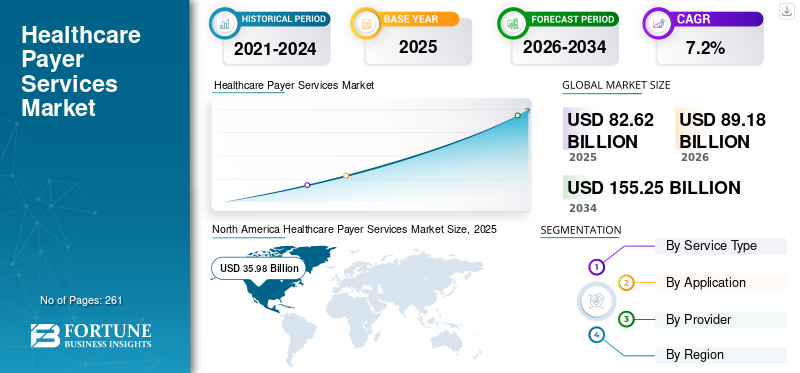
The global healthcare payer services market size was valued at USD 82.62 billion in 2025 and is projected to grow from USD 89.18 billion in 2026 to USD 155.25 billion by 2034, exhibiting a CAGR of 7.2% during the forecast period. North America dominated the healthcare payer services market with a market share of 43.55% in 2025.
Healthcare payer services refer to administrative, operational, and financial solutions utilized by government programs and health insurance companies. The increasing enrollment in health insurance, rising healthcare expenditure, and growing outsourcing of non-core payer operations are driving greater adoption of these services in the market. The rising demand for value-based care and outcome-linked reimbursement is further boosting the adoption of healthcare payer services in the market.
The growing focus by companies, including UNITEDHEALTH GROUP and Accenture, on offering innovative insurance policies is further driving demand for these services in the market.
Download Free sample to learn more about this report.
 Market Size & Forecast
 Market Share
 Key Regional Highlights
North America
The North America market held the dominant share in 2024, valued at USD 32.92 billion, and also took the leading share in 2025 with USD 35.98 billion.
Europe
Europe is projected to record a growth rate of 6.2% in the coming years, which is the second highest among all regions, and reach a valuation of USD 18.46 billion in 2026.
Asia Pacific
Asia Pacific is estimated to reach USD 23.97 billion in 2026 and secure the position of the third-largest region in the market.
U.S.
The U.S. market can be analytically approximated at around USD 35.35 billion in 2026, accounting for roughly 39.6% of global sales.
Japan
The Japan market in 2026 is estimated at around USD 4.24 billion, accounting for roughly 4.7% of global revenues.
Read More

Growing Adoption of Digital Tools and Artificial Intelligence is a Key Market Trend
There is an increasing adoption of digital platforms, automation, advanced analytics, and artificial intelligence to enhance operational efficiency across claims management, provider management, payment integrity, billing, and compliance workflows. In addition, integrating digital technology reduces administrative costs, improves accuracy, shortens turnaround times, and enhances the member and provider experiences. Artificial intelligence and automation also support auto-adjudication of claims, fraud detection, prior-authorization decision support, risk scoring, chatbot-based member engagement, provider network analytics, and predictive medical cost management.
Download Free sample to learn more about this report.
Increasing Number of Clinical Trials to Boost Market Growth
The growing enrollment in health insurance plans is increasing the operational workload for public and private payers. The increasing number of individuals covered under employer-sponsored plans, private insurance, Medicare, Medicaid, government-funded schemes, and other plans is resulting in higher volumes of claims processing, eligibility verification, premium billing, provider network management, member onboarding, payment reconciliation, and other activities.
This, along with rising demand for operational efficiency, the expansion of cloud-based payer platforms, and the adoption of automation technologies, is further boosting the adoption of these services in the market. Therefore, the factors above, along with the growing focus on offering novel insurance policies by payers, are likely to further contribute to the global healthcare payer services market growth.
Data Privacy and Cybersecurity Risks to Limit Market Growth
Data privacy and cybersecurity risks pose a major restraint on the global market. Service providers handle large volumes of highly sensitive and personal information, including individuals’ demographics, medical records, health insurance data, claims history, provider contracts, billing and payment information, and personally identifiable information. Cloud platforms, third-party outsourcing, offshore delivery centers, analytics vendors, and the adoption of digital tools increase the risk across multiple access points.
Payer databases contain both financial and clinical data, making them more valuable than various other types of enterprise data. Data breaches and operational inefficiencies in claims management result in regulatory penalties, operational disruption, litigation costs, loss of member trust, vendor scrutiny, and delays in payer outsourcing decisions, thereby hampering market growth.
Expansion in Healthcare Insurance Network to Create Lucrative Opportunities
The expansion of healthcare insurance coverage in emerging nations presents a lucrative opportunity in the global market. The companies are focusing on expanding social insurance programs, public health coverage, private health insurance penetration, and employer-sponsored insurance schemes. The increasing demand for a formal healthcare coverage framework is driving payers to expand their service offerings for claims processing, enrollment management, eligibility verification, provider network management, billing and payment management, compliance administration, and more. Additionally, the rapid development of healthcare infrastructure and healthcare expenditure is contributing to the establishment of a robust healthcare insurance network, especially in emerging countries such as China, Brazil, and others.
Inadequate Reimbursement Policies in Emerging Countries to Hamper Market Growth
Insufficient reimbursement policies in developing countries remain a key challenge for the global market. Insurance enrollment is increasing across many developing markets; however, reimbursement coverage often remains limited, fragmented, or uneven across private and public payer systems. Various insurance schemes cover only selected procedures, medicines, hospitals, or population groups, resulting in a lower reimbursement range than actual treatment costs. This limits the effectiveness of insurance coverage and minimizes the scale of formal payer-managed transactions, thereby limiting market growth.
Increasing Number of Insurance Claims Led to Business Process Outsourcing (BPO) Services Segment Dominance
Based on service type, the market is classified into business process outsourcing (BPO) services, information technology outsourcing (ITO) services, and knowledge process outsourcing (KPO) services.
The business process outsourcing (BPO) services segment held the largest revenue share in 2025. The growth is driven by the increasing number of insurance claims, resulting in rising demand for claims processing, eligibility verification, member enrollment, provider data management, billing support, and other services among payer service providers. This, along with the growing number of companies offering innovative services, is expected to further contribute to global market growth.
The information technology outsourcing (ITO) services segment is expected to grow at a CAGR of 7.1% over the forecast period.
To know how our report can help streamline your business, Speak to Analyst
Increasing Number of Processed Claims Led to Dominance of Claims Management Services Segment
Based on the application, the market is segmented into claims management services, member management services, provider management services, billing & accounts management services, payment management services, analytics & fraud management services, integrated front-office & back-office operations, audit & compliance management services, and others.
The claims management services segment dominated the global market in 2025. The segment held a 24.4% share in 2025. The growth is driven by increased utilization of healthcare services, rising claims processing volumes among payers, and other factors, thereby contributing to segmental growth.
The billing & accounts management services segment is set to flourish with a growth rate of 5.5% across the forecast period.
Increasing Private Healthcare Spending Boosted Segment Growth
Based on the provider, the market is bifurcated into private and public.
The private segment dominated the healthcare payer services market share in 2025. The benefits of private health insurance, including faster turnaround times and more efficient provider networks, are driving growing private healthcare spending among the patient population, further contributing to segmental market growth. Furthermore, the segment is set to hold a 55.1% share in 2026.
The public segment is projected to grow at a 7.0% CAGR during the forecast period.
Based on region, the market has been studied across North America, Europe, Asia Pacific, Latin America, and the Middle East & Africa.
North America Healthcare Payer Services Market Size, 2025 (USD Billion)
To get more information on the regional analysis of this market, Download Free sample
The North America market held the dominant share in 2024, valued at USD 32.92 billion, and also took the leading share in 2025 with USD 35.98 billion. Rising Medicare and Medicaid expenditures, the growing adoption of insurance policies, and the increasing number of insurance payers, among others, are among the factors contributing to market growth in the region.
Based on North America’s strong contribution and the U.S. dominance within the region, the U.S. market can be analytically approximated at around USD 35.35 billion in 2026, accounting for roughly 39.6% of global sales.
Europe is projected to record a growth rate of 6.2% in the coming years, which is the second highest among all regions, and reach a valuation of USD 18.46 billion in 2026. The growing demand for payer services, including analytics and fraud management, is likely to support market growth.
The U.K. market in 2026 is estimated at around USD 2.85 billion, representing roughly 3.2% of global revenues.
Germany’s market is projected to reach approximately USD 3.80 billion in 2026, equivalent to around 4.3% of global sales.
Asia Pacific is estimated to reach USD 23.97 billion in 2026 and secure the position of the third-largest region in the market. The growing healthcare delivery system and improved data analytics are among the private and public payers likely to support the market's growth.
The Japan market in 2026 is estimated at around USD 4.24 billion, accounting for roughly 4.7% of global revenues. Japan is expected to grow due to the expansion of healthcare payer service networks and the rising adoption of billing and accounts management services among key companies in the market.
China’s market is projected to be one of the largest globally, with 2026 revenues estimated at around USD 7.06 billion, representing roughly 7.9% of global sales.
The India market size in 2026 is estimated at around USD 3.97 billion, accounting for roughly 4.5% of global revenues.
The Latin America and Middle East & Africa regions are expected to witness moderate growth in this market space during the forecast period. The Latin America market is set to reach a valuation of USD 4.46 billion in 2026. The growth is driven by the increasing number of cost-effective insurance policies offered by health insurers and the rising demand for healthcare payer services in the region. The Middle East & Africa region is also anticipated to grow as more key companies expand their geographic presence in the market. In the Middle East & Africa, the GCC is set to reach a value of USD 1.79 billion in 2026.
The South Africa market is projected to reach around USD 0.62 billion in 2026, representing roughly 0.7% of global revenues.
Increasing Number of Acquisitions Among Other Companies to Support Their Dominance
A robust, diversified portfolio, along with a significant emphasis on strategic initiatives globally, is one of the key factors contributing to these companies' dominance in the market. UNITEDHEALTH GROUP and Accenture are major companies in the market in 2025. Furthermore, the growing focus of key companies on acquisitions and mergers among other companies is likely to strengthen their presence, further contributing to the global market share.
Other key players, including Cigna Healthcare, are also growing in the market, primarily due to their increasing focus on expanding services to strengthen their presence.
The report provides a detailed global healthcare payer services market analysis and focuses on key aspects such as leading companies and market segmentation, including service type, application, and provider. Besides this, the global report offers insights into the market growth trends and highlights key industry developments. In addition to the aforementioned factors, the report encompasses several factors that have contributed to the growth and advancement of the market over recent years.
Request for Customization to gain extensive market insights.
| ATTRIBUTE | DETAILS |
| Study Period | 2021-2034 |
| Base Year | 2025 |
| Estimated Year | 2026 |
| Forecast Period | 2026-2034 |
| Historical Period | 2021-2024 |
| Growth Rate | CAGR of 7.2% from 2026 to 2034 |
| Unit | Value (USD Billion) |
| Segmentation | By Service Type, Application, Provider, and Region |
| By Service Type |
|
| By Application |
|
| By Provider |
|
| By Region |
|
Fortune Business Insights says that the global market size was USD 82.62 billion in 2025 and is projected to reach USD 155.25 billion by 2034.
In 2025, North America’s market value stood at USD 35.98 billion.
Growing at a CAGR of 7.2%, the market will exhibit steady growth over the forecast period (2026-2034).
By service type, the business process outsourcing (BPO) services segment led the market in 2025.
An increasing number of clinical trials is driving market growth.
UNITEDHEALTH GROUP and Accenture are the major players in the global market.
North America dominated the market share in 2025.
The rising number of insurance claims, the expansion of health insurance networks, and the outsourcing of non-core payer services are among the crucial factors expected to boost the adoption of these services globally.

Get 30-60 hrs Free Customization
Expand Regional and Country Coverage, Segments Analysis, Company Profiles, Competitive Benchmarking, and End-user Insights.













.webp)






Related Reports
Get In Touch With Us
US +1 833 909 2966 ( Toll Free )
Receive a tailored pricing based on your needs.
Discuss your questions with our industry experts.
Have questions? Get quick answers before you purchase.

