Hemp Seed Oil Market Size, Share & Industry Analysis, By Nature (Organic and Conventional), By Type (Cold-Pressed and Refined), By Distribution Channel (B2B and B2C [Supermarkets/Hypermarkets, Convenience Stores, Pharmacies/Drugstores & Wellness Shops, Online Retail and Others]), By End-Use (Food & Beverage, Nutraceuticals/Dietary supplements, Personal Care & Cosmetics, and Others), and Regional Forecast, 2026-2034
 Download Free Sample
(Offer valid till 15th Oct 2026)

KEY MARKET INSIGHTS
 Listen to Audio Version
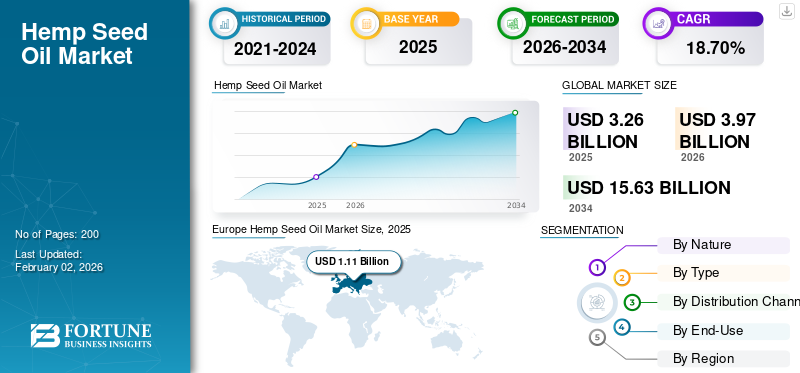
The global hemp seed oil market size was valued at USD 3.26 billion in 2025 and is projected to grow from USD 3.97 billion in 2026 to USD 15.63 billion by 2034, exhibiting a CAGR of 18.70% during the forecast period. Europe dominated the hemp seed oil market with a market share of 33.91% in 2025.
Hemp seed oil is a vegetable oil derived from hemp plant seeds (Cannabis sativa L.), a non-psychoactive form of cannabis. It is a significant source of essential fatty acids, particularly omega-6 and omega-3, and is widely utilized in food, nutritional supplements, and cosmetics. Growing demand for natural, organic, and plant-based products in the food and beverage, cosmetics, personal care, and nutraceutical segments is a strong growth driver. The growing use of hemp seed oil in nutritional supplements, skincare, and functional foods also drives market growth.
The market encompasses several major players with Manitoba Harvest, Hemp Oil Canada Inc., Canah International, Hempflax BV, and Green Source Organics Inc. at the forefront.
Download Free sample to learn more about this report.
Hemp Seed Oil Market KEY TAKEAWAYS
 Global Market Size & Forecast
- 2025 Market Size: USD 3.26 billion
- 2026 Market Size: USD 3.97 billion
- 2034 Forecast Market Size: USD 15.63 billion
- CAGR: 18.70% from 2026–2034
 Market Share
- Europe dominated the hemp seed oil market with a 33.91% share in 2025
- The conventional segment accounted for the largest market share in 2024
- The cold-pressed segment accounted for the largest market share in 2024
 Key Regional Highlights
Asia Pacific
Asia Pacific reached USD 0.68 billion in 2025, driven by rising demand for plant-based oils.
North America
North America reached USD 1.09 billion in 2025, supported by favorable hemp regulations.
Europe
Europe reached USD 1.11 billion in 2025, driven by expanding hemp cultivation and EU policies.
U.S.
U.S. is driven by legalized hemp cultivation and growing demand for hemp-based products.
Japan
Japan is driven by increasing demand for natural and plant-based personal care products.
Read More

MARKET DYNAMICS
MARKET DRIVERS
Growing Health and Nutrition Halo to Propel Market Growth
The increasing health and nutrition halo around hemp seed oil is an important driving factor for the global hemp seed oil market growth. It is endowed with a balanced proportion (3:1) of omega-6 (linoleic acid) and omega-3 (alpha-linolenic acid) fatty acids. These polyunsaturated fats play an important role in lowering inflammation, improving cardiovascular health, bad cholesterol (LDL), and possibly reducing blood pressure in hypertensive patients.
- According to the National Center for Biotechnology Information, Gamma-linolenic acid (GLA) in hemp seed oil helps reduce inflammation, which benefits conditions such as arthritis and skin ailments. Its antioxidant constituents fight oxidative stress, promoting cellular health as well as preventing diseases resulting from oxidative stress.
As a result of these complex nutritional and awareness of the health benefits, hemp seed oil is viewed as a superfood and functional food additive, driving consumer demand and market growth.
MARKET RESTRAINTS
Regulatory Complexity and Legal Ambiguity Restrict Market Expansion
The hemp seed oil market faces significant regulatory complexity and legal ambiguity, which impact its growth and commercialization. Constantly conflicting and changing regulations for cultivation, licensing, THC levels, distribution, and product approval restrict the market’s growth. Most nations and areas do not have standard hemp product regulations, particularly regarding acceptable THC levels and usage in foods, supplements, and cosmetics.
• For instance, in the European Union, hemp seed oil is covered under Novel Food Regulation (EU) 2015/2283). Certain hemp extracts (such as CBD oil) are considered "novel foods," and they are subjected to comprehensive safety dossiers and EFSA authorization before they can be sold.
MARKET OPPORTUNITIES
Focus on Developing Natural Skincare or Beauty Formulations Create Lucrative Opportunities
Hemp seed oil is becoming more well-known for its astounding benefits in skincare, backed by its distinctive composition that is high in omega-3 and omega-6 fatty acids, vitamins A, C, and E, and antioxidants. Its properties deliver hydration, anti-aging, calm inflammation, and enhance skin elasticity, which makes it extremely ideal for sensitive skin and dermatological issues such as eczema, acne, and psoriasis.
• In November 2020, Herbalife Nutrition, a leading global nutrition company, entered the Hemp-Cannabinoid skincare space with the introduction of Enrichual, a line of new topical skincare products infused with hemp-cannabinoids. The new offering features Hemp Relief Balm and Hemp Facial Serum to support consumers in caring for their body and mind.
HEMP SEED OIL MARKET TRENDS
Increasing Popularity of Premium & Cold-Pressed Oils is a Significant Market Trend
Cold-pressed and premium hemp seed oils are forming one of the most robust growth niches in the global market. Cold-pressed extraction is taking over due to its avoidance of heat or chemical solvents so that the oil does not lose any of its complete profile of omega-3, omega-6, vitamins, and antioxidants—making it more desirable for use in nutraceuticals, functional foods, and clean-label skincare. Concurrently, the premium category, generally coinciding with cold-pressed hemp seed oils, is experiencing a higher willingness to pay among consumers, especially in gourmet foods, luxury personal care, and holistic wellness products, further impacting market growth.
Download Free sample to learn more about this report.
Segmentation Analysis
By Nature
Lower Production and Retail Cost Contribute to Conventional Segment’s Growth
On the basis of the segmentation of nature, the market is classified into organic and conventional.
The conventional segment accounted for a significant global hemp seed oil market share in 2024. Conventional hemp farming involves the use of synthetic pesticides, fertilizers, and intensive agriculture, which enable more yield at a reduced cost per unit. This reduces the cost of conventional hemp seed oil to be affordable for mass consumers, particularly in price-sensitive markets such as Asia Pacific and South America. Food and beverages, cosmetics, and industrial use favor inexpensive inputs, with traditional hemp oil serving as the prime choice.
The organic segment is expected to be the fastest-growing in the forecast period, owing to increasing consumer preference for organic, pesticide-free, and non-GMO products that align with their health and wellness values.
By Type
Natural Appeal, Superior Flavor, and Sensory Qualities Boost Cold-Pressed Hemp Seed Oil
In terms of type, the market is categorized into cold-pressed and refined.
The cold-pressed segment captured the largest share of the market in 2024. Nowadays, there has been an increased demand for minimal processing, non-GMO, and natural products among consumers. Cold-pressed oils, perceived as less processed and genuine, fit into this trend and are highly promoted for "clean-label" benefits, particularly in the food, beverage, and personal care markets. Cold-pressed hemp seed oil has a light and nutty flavor, and adds depth to culinary uses such as salad dressing, smoothies, and health foods, which attracts consumers and chefs as a desired taste with nutritional benefits.
Refined hemp seed oil segment is expected to grow at a high CAGR over the forecast period and is gaining traction owing to its affordability and suitability for cost-sensitive and industrial applications.
By Distribution Channel
Rise of E-commerce and Convenient Channels Supplemented B2C Segment Growth
Based on distribution channel, the market is segmented into B2B and B2C.
The B2C segment held the dominating position in 2024. The B2C segment further consists of supermarkets/hypermarkets, convenience stores, pharmacies/drugstores & wellness shops, online retail, and others. With rising consumer interest in plant-based, natural, and organic beauty products, B2C sales through personal care brands, e-commerce websites, and retail stores continue to grow at a very high rate.
- In February 2023, Hemp Foods Australia secured nationwide deals with major supermarket chains. Its organic hemp seed oil is now stocked in all 948 Woolworths stores in Australia, and its Functional Seed Mix range is available in over 800 Coles stores.
The B2B segment is expected to experience significant growth in the forecast period.
By End Use
Clean Label and Organic Preference Propel Food & Beverage as Leading End-Use
Based on end-use, the market is segmented into food & beverage, nutraceuticals/dietary supplements, personal care & cosmetics, and others.
The food and beverage segment dominates the global hemp seed oil market as it aligns with health-oriented diets, plant-based food, clean-label, and has robust regulatory support and retail penetration among personal care or pharma applications. Increasing health awareness is rising demand for functional drinks, fortified foods, and nutritional supplements containing hemp oil. Players have been countering by bringing innovative products to the marketplace.
- For instance, in February 2022, PepsiCo Inc., an American multinational food, snack, and beverage corporation, launched an energy drink named Rockstar, infused with hemp seed oil, designed to help consumers relax.
In addition, the nutraceuticals/dietary supplements segment is projected to grow at a high CAGR during the study period.
Hemp Seed Oil Market Regional Outlook
By geography, the market is categorized into Europe, North America, Asia Pacific, Latin America, and Middle East & Africa.
Europe
Europe Hemp Seed Oil Market Size, 2025 (USD Billion)
To get more information on the regional analysis of this market, Download Free sample
Europe accounted for USD 1.11 billion in 2025, representing 33.91% of the global market share, and is projected to reach USD 1.35 billion in 2026. The hemp cultivation area in the European Union has significantly grown, with production volumes also rising sharply. This growth in supply supports market expansion. France, Germany, and the Netherlands are the leading producers of hemp in Europe. Supportive EU policies—particularly the Novel Food Regulation, CosIng cosmetic approvals, and harmonised THC limits—have established a secure, EU-wide framework for hemp seed oil. This has enabled growth in food, nutraceutical, pharmaceutical adjuncts, and personal care applications, driving strong market expansion.
- According to the European Commission, hemp cultivation in Europe for fibre has increased significantly in the EU from 20,540 hectares (ha) in 2015 to 33,020 ha in 2022 (a 60% increase), wherein France accounts for more than 60% of EU production.
North America and Asia Pacific
Other regions, such as North America and Asia Pacific, are expected to experience a significant increase in the future. The 2018 Farm Bill in the U.S. legalized hemp cultivation and the use of hemp-based products such as seed oil, opening up the market and removing legal barriers. Hemp farm production, as well as hemp oil production, is also supported by good regulations in Canada, which has contributed to growth in the sector. Additionally, an increasing middle-class population and urbanization in Asia Pacific are driving demand for natural and plant-based oils and influencing global hemp seed oil demand. North America contributed 33.40% to the global market in 2025, with a valuation of USD 1.09 billion, and is projected to reach USD 1.34 billion in 2026. The Asia Pacific market was valued at USD 0.68 billion in 2025, capturing 20.72% of global revenue, and is estimated to reach USD 0.81 billion in 2026.
Middle East & Africa
The Middle East & Africa market for hemp seed oil is aided by growing urbanization, government policy changes in favor of sustainable agriculture, rising disposable income, and booming e-commerce channels. With hemp seed oil marketed for its omega‑3/6 profile and emollient properties, the region’s premium beauty focus—enabled by the legality of hemp seed oil in topicals—creates pull in skincare and haircare. In addition, growing legalization and acceptance of the cultivation of hemp and hemp-derived products, particularly in Brazil and Argentina, further propel growth in South America. The market in Middle East & Africa reached USD 0.14 billion in 2025, representing 4.30% of total market revenue, and is projected to reach USD 0.17 billion in 2026.
Latin America
In 2025, the Latin America market stood at USD 0.25 billion, representing 7.67% of global demand, and is projected to grow to USD 0.3 billion in 2026.
COMPETITIVE LANDSCAPE
Key Industry Players
Wide Range of Product Offerings Coupled with Strong Distribution Network of Key Companies Support their Leading Position
The global hemp seed oil market showcases a highly fragmented structure characterized by a multitude of small and mid-sized producers, diverse product portfolios, regional segmentation, and niche applications. Industry players invest in developing new product formats, including capsules, various oils, skincare, and ready-to-eat (RTE) products. Emphasis is also placed on organic, vegan, bio-based, clean-label, and sustainability-oriented product attributes to meet consumer demand for health and environmentally conscious products.
Manitoba Harvest, Hemp Oil Canada Inc., Canah International, Hempflax BV, and Green Source Organics Inc. are some of the dominating players in the global market. They dominate through product innovation, sustainability practices, and expansive market reach. Though other companies are also significant, these stand out consistently across multiple sources.
Apart from this, other prominent players in the market include Nutiva, Inc., Canah International Srl, Sky Organics, and others. These companies focus on product innovation, sustainable sourcing, and geographic market expansion.
LIST OF KEY HEMP SEED OIL COMPANIES PROFILED
- Manitoba Harvest (Canada)
- Hemp Oil Canada Inc. (Canada)
- Canah International (Romania)
- Hempflax BV (Netherlands)
- Bombay Hemp Company (BOHECO) (India)
- Liaoning Qiaopai Biotech Co., Ltd. (China)
- North American Hemp & Grain Co. (Canada)ss
- Yunnan HuaFang Industrial Hemp Co., Ltd. (China)
- GFR Ingredients Inc. (Canada)
- Green Source Organics Inc. (U.S.)
KEY INDUSTRY DEVELOPMENTS
- December 2024: Koru Pharma launched a new brand called Mesohemp, which is a line of high-quality hemp-based skincare products. The initial product released under this brand is the Mesohemp Hemp Seed Oil Face Massssk. The new product is rich in nourishing hemp seed oil and is the first of eight planned products intended to form a complete cosmetic line.
- November 2023: Modicare launched the all-new Hemp Lab range, which is a holistic skincare solution focused on repair and balance. It includes a five-step skincare regimen composed of foaming face wash, face scrub, milk serum, and others.
- April 2023: hemperella, Europe's first hemp-based Superfood company, launched an innovative new line of hemp-based superfood products in Poland and the Netherlands. The new range includes products such as Protein Powder, Protein Bars, Hemp Seeds, Hemp Flour, Hemp Oil, Hemp Muesli, and Yoghurt Toppings.
- October 2023: Hempz launched a body moisturizer duo specifically for Eczema Awareness Month. These moisturizers are formulated with 100% pure hemp seed oil and aloe vera extracts.
- December 2021: The Amado Group launched a hemp seed oil capsule in Thailand as the country relaxed regulations on hemp and cannabis products. The product is called Amaprai Hemp Seed Oil Plus. It contains hemp seed oil along with nine other oils, offering omega fatty acids and vitamins that claim to support immunity, nerve, bone, and joint health, as well as providing antioxidant benefits.
REPORT COVERAGE
The global hemp seed oil market analysis provides an in-depth study of market size & forecast by all the market segments included in the report. It includes details on the market dynamics and trends expected to drive the market in the forecast period. It offers information on the technological advancements, new product launches, key industry developments, and details on partnerships, mergers & acquisitions. The report also encompasses a detailed competitive landscape with information on the market share and profiles of key operating players.
Request for Customization to gain extensive market insights.
Report Scope & Segmentation
|
ATTRIBUTE |
DETAILS |
|
Study Period |
2021-2034 |
|
Base Year |
2025 |
|
Estimated Year |
2026 |
|
Forecast Period |
2026-2034 |
|
Historical Period |
2021-2024 |
|
Growth Rate |
CAGR of 18.70%% from 2026-2034 |
|
Unit |
Value (USD Billion) |
|
Segmentation |
By Nature
|
|
By Type
|
|
|
By Distribution Channel
|
|
|
By End-Use
|
|
|
By Geography
|
Frequently Asked Questions
Fortune Business Insights says that the global market value stood at USD 3.97 Billion in 2026 and is projected to reach USD 15.63 Billion by 2034.
In 2025, the market value stood at USD 1.11 billion.
The market is expected to exhibit a CAGR of 18.70% during the forecast period of 2026-2034.
The cold-pressed segment led the market by type.
The key factor driving the market is the growing health & nutrition halo.
Manitoba Harvest, Hemp Oil Canada Inc., Canah International, Hempflax BV, and Green Source Organics Inc. are some of the prominent players in the market.
Europe dominated the hemp seed oil market with a market share of 33.91% in 2025.
Expanding applications in functional foods and dietary supplements is the key trend in the market.



- 2021-2034
- 2025
- 2021-2024
- 200
-
(Offer valid till 15th Oct 2026)
Get 30-60 hrs Free Customization
Expand Regional and Country Coverage, Segments Analysis, Company Profiles, Competitive Benchmarking, and End-user Insights.




















Related Reports
-
US +1 833 909 2966 ( Toll Free )
-
Get In Touch With Us