 Download Free Sample



Get a Quote
Receive a tailored pricing based on your needs.
- Choose license type
- Multiple user options
- Custom scope & coverage
- Fast turnaround
"Designing Growth Strategies is in our DNA"
 Listen to Audio Version
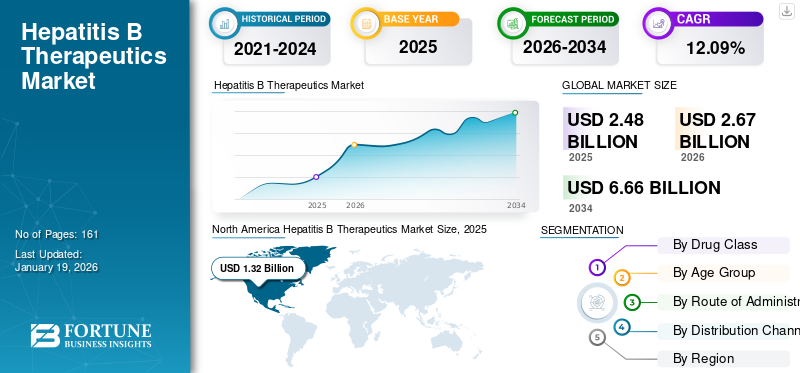
The global hepatitis B therapeutics market size was USD 2.48 billion in 2025. The market is projected to grow from USD 2.67 billion in 2026 to USD 6.65 billion in 2034 at a CAGR of 12.07% during the forecast period. North America dominated the hepatitis B therapeutics market with a market share of 52.31% in 2025.
Hepatitis B therapeutics are a group of medicines that are used to treat hepatitis B infections caused by the hepatitis B virus in humans. The hepatitis B virus is spread through sexual transmission, when in contact with blood or other fluids, and from the mother to the child during birth or delivery. The global market is witnessing significant growth due to the rising prevalence of hepatitis B globally, with increasing government initiatives to raise awareness, thus propelling the demand and adoption of therapeutics.
Moreover, the presence of key players such as Gilead Sciences, Inc. GSK plc, with robust product portfolio and advanced research and development facilities to launch novel treatments is expected to boost the growth of the market during the forecast period.
Download Free sample to learn more about this report.
 Global Market Size & Forecast
 Market Share
 Key Regional Highlights
North America
North America led the global market with USD 1.32 billion in revenue in 2025 and is projected to reach USD 1.40 billion in 2026.
Asia Pacific
Asia Pacific accounted for 26.85% of the global market and generated USD 0.64 billion in revenue in 2025.
Europe
Europe represented 12.35% of the worldwide market, generating USD 0.31 billion in revenue in 2025.
U.S.
The hepatitis B therapeutics market is projected to reach USD 1.36 billion by 2026.
Japan
The hepatitis B therapeutics market is projected to reach USD 0.06 billion by 2026.
Read More

Rising Prevalence of Hepatitis B Increases Demand for Effective Treatment
The increasing prevalence of hepatitis B across the globe is one of the major factors driving the market growth. Hepatitis B is a severe liver infection which can lead to both acute and chronic diseases. The disease is spread due to needle stick injuries, tattooing, body piercing, and exposure to infected blood or body fluids such as saliva, menstrual, vaginal, and seminal fluids.
Such a high patient population increases the demand for adequate diagnosis and treatment, thus leading toward the global hepatitis B therapeutics market growth.
Emergence of Drug Resistance in Hepatitis B Patients Restraining Market Growth
Anti-viral drug resistance in chronic hepatitis B patients is one of the prominent factors impeding market growth. The long-term treatment of chronic hepatitis B infection with antiviral drugs leads to the development of mutations in the virus, particularly for nucleoside and nucleotide analogs. This can lead to treatment failure, increased viral load, and potential liver disease progression. Moreover, many researchers are escalating their efforts to study the mechanisms of drug resistance and to identify biomarkers for early detection.
Such scenarios lead to lower product adoption by patients, restraining market growth.
Emerging Pipeline Products to Provide Lucrative Opportunities in the Market
The emergence of anti-viral drug resistance and the limited availability of effective therapeutic options offer significant growth opportunities in the treatment landscape. Currently, the anti-viral monotherapies have shown limitations, including the emergence of drug-resistant strains, inadequate viral eradication, and recurrence of disease after treatment discontinuation.
To fulfill the unmet needs, various key players are focusing on developing a combination treatment that offers promising growth prospects for the market.
High Treatment Cost Associated to Therapeutics May Hinder Adoption and Market Growth
The high cost associated with its diagnosis, long-term management, and therapeutic interventions remains a significant barrier to the market growth. As hepatitis B progresses, it can lead to severe complications such as liver cirrhosis and hepatocellular carcinoma, requiring intensive and costly medical care. Thus, intensifying financial strain on the lower-middle economic population.
Additionally, the high cost of antiviral therapy is also impeding its access in low-income and middle-income countries. Also, the long-term medication adherence remains a challenge, especially with daily oral regimens that lead to poor compliance. So, it increases the risk of resistance development, thus challenging the market growth.
Emergence of New Therapies for Hepatitis B Treatment is a Prominent Trend
The hepatitis B therapeutics landscape is evolving with a growing focus on targeting the root cause of chronic infection, i.e., cccDNA (covalently closed circular DNA) and integrated HBV DNA.
The rising prevalence of hepatitis B, along with the emergence of antiviral-resistant strains, has exposed the limitations of current therapies, which suppress viral replication but fail to eliminate cccDNA, which leads to viral persistence and recurrence.
This is driving the development of next-generation therapies aimed at eradicating cccDNA.
Such innovations signal a shift toward curative approaches and offer significant global hepatitis B therapeutic market trends.
Download Free sample to learn more about this report.
Increasing Prescriptions for Nucleoside Analogues Boost Segment's Growth
Based on drug class, the global market is segmented into nucleoside analogues, nucleotide analogues, interferons, and others.
In 2026, the nucleoside analogues segment is projected to lead the market with a 74.03% share. This was driven by the rising prevalence of hepatitis B and increasing demand for adequate treatment to decrease the disease progression in the patients.
Moreover, increasing the prescription of nucleoside analogues for hepatitis B therapeutics is one of the factors boosting the segment’s growth.
On the other hand, the nucleotide analogues held the second-largest share of the market and are expected to grow with a moderate CAGR during the forecast period. The slower growth of the segment is due to the increasing resistance for the drug in the hepatitis B patients.
The interferons segment held a considerable market share owing to increasing strategic activities by key players for developing new combination therapies products with interferons for addressing unmet medical needs in liver and viral disease.
The others segment is expected to grow with a significant CAGR during the forecast period. Increasing anti-viral drug resistance due to traditional treatment and the increasing shift of key companies toward research and development for launching novel medication for hepatitis B is expected to boost the growth of the segment during the forecast period.
To know how our report can help streamline your business, Speak to Analyst
Rising Prevalence of Hepatitis B Infection Amongst Adults Contribute to Segment’s Dominance
Based on age group, the segment is bifurcated into adults and pediatrics.
TThe adult segment is projected to dominate the market with a share of 77.87% in 2026. The higher share of the segment is due to the higher transmission rates among adults, particularly through sexual contact, especially among unvaccinated individuals with multiple partners, and exposure to infected body fluids such as saliva, menstrual, vaginal, and seminal fluids.
Moreover, the rising focus of healthcare authorities of the different countries to expand the screening program for adults is leading towards efficient diagnosis. It increases the requirement for adequate treatment to frther decrease the disease progression.
The pediatric segment held a comparatively lower share of the market and is expected to grow with a moderate CAGR during the forecast period. This lower share is primarily attributed to the declining prevalence of hepatitis B among children, driven by widespread vaccination initiatives.
However, many key companies are focusing on expanding indications of the already available drug for hepatitis B therapeutics in the pediatric population.
Convenience of Oral Route of Administration Supports its Dominance
Based on route of administration, the market is classified into oral and parenteral.
The oral segment segment is expected to lead the market, contributing 94.76% globally in 2026. The convenience and effectiveness of oral dosage forms make it a preferred choice for healthcare providers and patients. Also, increasing research and development of new hepatitis B therapeutics for oral route of administration is boosting the growth of the segment.
The parenteral segment is expected to grow with a significant CAGR during the forecast period. This growth can be attributed to the rapid absorption and enhanced bioavailability of the parenteral dosage form. Also, increasing regulatory approval for the commercialization of hepatitis B therapeutics with parenteral dosage forms is expected to boost the growth of the segment.
Online Pharmacies Segment to Exhibit High Growth in the Near Future
Based on distribution channel, the global market is segmented into hospital pharmacies, retail pharmacies, and online pharmacies.
The online pharmacy is expected to grow with the highest CAGR over the forecast period. Increasing e-commerce channels and convenience associated with the online channels due to doorstep delivery mode propel segment growth during the forecast timeframe.
In contrast, increasing collaborative activities amongst digital pharmacies and non-profit organizations to increase accessibility and affordability for such lifesaving medicine will boost the segment’s growth.
The retail pharmacies segment will account for 52.53% market share in 2026. This is primarily due to the accessibility of drugs to consumers through prescription. Moreover, retail pharmacies serve as vital points for dispensing drugs and provide crucial information to patients about proper usage, potential side effects, and adherence to prescribed regimens.
On the other hand, the hospital pharmacies segment is projected to witness growth during the forecast period, driven by a growing preference among patients for hospital-based hepatitis B therapeutics and the availability of favorable reimbursement policies that help reduce drug costs, encouraging greater adoption through this channel.
On the basis of region, the global market can be segmented into North America, Europe, Asia Pacific, Latin America, and the Middle East & Africa.
North America Hepatitis B Therapeutics Market Size, 2025 (USD Billion)
To get more information on the regional analysis of this market, Download Free sample
North America recorded a market size of USD 1.32 billion in 2025, capturing 52.31% of the global market share, and is projected to reach USD 1.4 billion in 2026. The rising prevalence of hepatitis B and the presence of advanced healthcare facilities for effective diagnosis and treatment of infectious diseases, helped to drive the region’s growth. Moreover, rising number of programs is anticipated to raise awareness for early diagnosis and treatment of this viral infection.
Furthermore, the presence of key players in the market with advanced research and development facilities to launch novel therapeutic products for hepatitis B is anticipated to propel the regional market growth.
The U.S. dominated the North America region, owing to the rising prevalence of the diseases and the presence of adequate reimbursement policies to offer low-cost treatment. Presence of key players with robust research and development initiatives to develop and commercialize novel drugs for hepatitis B therapeutics will propel the market’s growth in the U.S. The U.S. market is projected to reach USD 1.36 billion by 2026.
The Asia Pacific market generated USD 0.64 billion in 2025, representing 26.85% of the global market landscape, and is expected to reach USD 0.72 billion in 2026. Asia Pacific held the second largest share. Rising prevalence and presence of affordable and effective generic drugs collectively propel the market's growth in the region. Also, the region has a strong presence of global and regional players with strategic activities to launch new drugs for hepatitis B therapeutics. The Japan market is projected to reach USD 0.06 billion by 2026, the China market is projected to reach USD 0.56 billion by 2026, and the India market is projected to reach USD 0.06 billion by 2026.
In 2025, Europe represented USD 0.31 billion, accounting for 12.35% of the worldwide market, and is projected to grow to USD 0.33 billion in 2026. Europe held the third-largest share of the market owing to the rising prevalence of hepatitis B, advanced healthcare facilities, and increasing investment in R&D activities driving the demand for these drugs in Europe. The UK market is projected to reach USD 0.08 billion by 2026, while the Germany market is projected to reach USD 0.05 billion by 2026.
Middle East & Africa accounted for USD 0.12 billion in 2025, representing 4.86% of the global market share, and is projected to reach USD 0.13 billion in 2026.
In 2025, Latin America held 3.63% of the global market, reaching a valuation of USD 0.09 billion, and is projected to grow to USD 0.1 billion in 2026. Latin America and the Middle East & Africa holds a comparatively lower share but is expected to grow during the forecast period. The growth of the regional markets is augmented by the increasing prevalence of hepatitis B due to limited knowledge and management of HBV infection. However, rising initiatives to eliminate sexually transmitted infectious diseases by the government authorities will propel the market’s growth in the region.
Gilead Sciences, Inc. and Bristol-Myers Squibb Company to Hold Top Positions
This market holds a consolidated structure with players such as Gilead Sciences, Inc., and Bristol-Myers Squibb Company, accounting for a substantial share in 2024. The top market players are holding their position due to consistent sales of the key products in several key regions.
Other key players with an important presence in the global market include Aurobindo Pharma Limited and Lupin, whose product portfolio includes several generics of key hepatitis B drugs.
The report provides detailed industry analysis. It focuses on key aspects, such as the prevalence of hepatitis B, in key countries and regions. Additionally, it includes key industry developments such as partnerships, mergers & acquisitions, and pipeline analysis. Besides these, it offers insights into the market trends and highlights advancements in hepatitis B therapeutics.
Request for Customization to gain extensive market insights.
|
ATTRIBUTE |
DETAILS |
|
Study Period |
2021-2034 |
|
Base Year |
2025 |
|
Estimated Year |
2026 |
|
Forecast Period |
2026-2034 |
|
Historical Period |
2021-2024 |
|
Growth Rate |
CAGR of 12.07% from 2026-2034 |
|
Unit |
Value (USD Billion) |
|
Segmentation |
By Drug Class
|
|
By Age Group
|
|
|
By Route of Administration
|
|
|
By Distribution Channel
|
|
|
By Region
|
Fortune Business Insights says that the global market size was USD 2.67 billion in 2026 and is projected to reach USD 6.66 billion by 2034.
In 2025, market value in North America stood at USD 1.32 billion.
Registering a CAGR of 12.09% the market will exhibit steady growth over the forecast period.
Based on drug class, the nucleoside analogues segment leads the market.
Rising prevalence of hepatitis B is a major factor driving the growth of the market.
Gilead Sciences, Inc. and Bristol-Myers Squibb Company are major players in the global market.
Increasing government initiatives to combat hepatitis B in developing countries are expected to drive the growth and adoption of the products.

Get 30-60 hrs Free Customization
Expand Regional and Country Coverage, Segments Analysis, Company Profiles, Competitive Benchmarking, and End-user Insights.













.webp)






Related Reports
Get In Touch With Us
US +1 833 909 2966 ( Toll Free )
Receive a tailored pricing based on your needs.
Discuss your questions with our industry experts.
Have questions? Get quick answers before you purchase.

