Hormone-Friendly Skincare Market Size, Share & Industry Analysis, By Product Type (Cleansers, Serums & Treatments, Moisturizers & Creams, and Others), By Skin Type (Oily/Acne-Prone, Dry, Sensitive, and Others), By Skin Concern (Hormonal Acne & Blemishes, Dryness & Dehydration, Sensitivity & Barrier Repair, and Others), By Life Stages (Menstrual Cycle-linked, Pregnancy & Postpartum, Perimenopause & Menopause, and Others), By End User (Women, Men, and Others), By Distribution Channel (Specialty Beauty Stores, Pharmacies & Drugstores, Online Retail, and Others), and Regional Forecast, 2026-2034
 Download Free Sample
(Offer valid till 31st Oct 2026)

Hormone-Friendly Skincare Market Size and Future Outlook
 Listen to Audio Version
The global hormone-friendly skincare market size was valued at USD 7.83 billion in 2025. The market is projected to grow from USD 8.34 billion in 2026 to USD 15.80 billion by 2034, exhibiting a CAGR of 8.31% during the forecast period. North America dominated the hormone friendly skincare market with a market share of 36.91% in 2025.
There is an increasing awareness about the growth of the hormone-compatible skincare industry, with consumers looking for skincare products that help combat any changes in their skin due to hormones that may be caused by their menstrual cycle, pregnancy, menopause, stress, and hormonal acne. The demand is augmented by growing knowledge about the importance of cruelty-free, plant-based, organic ingredients, repairing one's natural skin barrier, maintaining the right microbiome health, non-comedogenic products, gentle active agents, and customized skin care for different types of skin, such as dry, oily, or skin prone to breakouts. Moreover, the growth is further led by social media trends & education, women’s wellness trends, and premiumization in functional and natural skincare.
Players dominating the market include Veracity, Womaness, Amareta, Stripes Beauty, and Bioelements. These companies are adapting to the evolving market by developing products that are science-based, hormone-friendly, clean, and stage-of-life-oriented for issues such as periods, perimenopause, menopause, dryness, acne, and barrier sensitivities. One of the strategies that these companies have been using in their expansion efforts is innovative clinical testing and personalized product development.
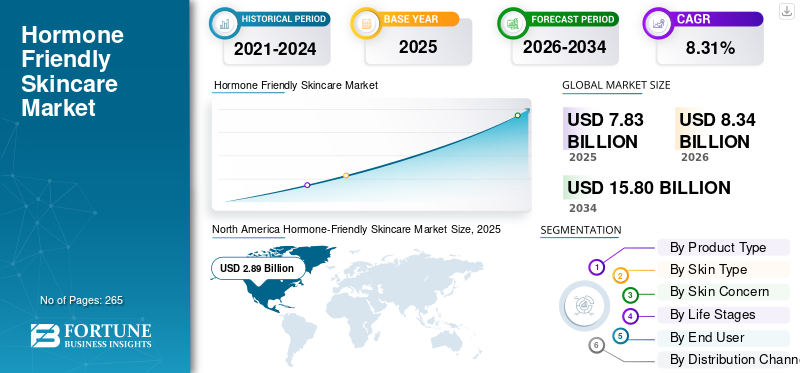
Download Free sample to learn more about this report.
HORMONE-FRIENDLY SKINCARE MARKET TRENDS
Personalized Hormonal Skin-Cycle Care is a Major Market Trend
The growing knowledge of consumers regarding the influence of acne, dryness, sensitivity, and barrier damage on a hormonal basis due to changes such as menstruation, pregnancy, stress, perimenopause, and menopause is encouraging brands to develop hormone-specific skin care products depending on life stages. Consequently, growing interest in natural beauty is pushing brands to include calming botanicals, essential oils, plant-based anti-aging ingredients, non-comedogenic, barrier repair, and personalized solutions through the use of quizzes and tests that have been communicated to consumers by dermatologists. At the same time, rising concerns over irritation and skin sensitivity are pushing companies to reduce synthetic fragrances and promote cleaner, dermatologist-tested, and hormone-conscious skincare solutions.
MARKET DYNAMICS
MARKET DRIVERS
Download Free sample to learn more about this report.
Rising Awareness of Hormonal Skin Changes to Boost Market Growth
As consumers are becoming increasingly aware of skin conditions such as acne, dry skin, sensitivity, and dullness, which occur due to hormonal issues, the demand for a hormone-specific skin health product range is growing. Individuals are becoming progressively inclined toward choosing clean beauty products that address these specific concerns rather than opting for ordinary beauty solutions. This trend is causing companies to develop more hormone-friendly skin care regimes, cleaner product formulations, dermatologically tested products, and more personalized advice. In turn, this has resulted in increased consumer confidence and loyalty toward the brand as well as room for niche brands to thrive, leading to global hormone-friendly skincare market growth.
MARKET RESTRAINTS
Limited Scientific Validation and Claim Sensitivity to Hamper Market Growth
Inadequate scientific validation and sensitivity to claims impede the growth of the market. Due to the challenges associated with proving the benefit of being hormone-friendly in various skin types and life phases with differing levels of hormones, brands experience consumer skepticism as well as stringent regulations. This places increased costs on manufacturers to perform proper testing, ingredient disclosure, and comply with regulations restricting market development.
MARKET OPPORTUNITIES
Life-Stage-Specific Skincare Expansion to Create Immense Growth Opportunities
The increased awareness surrounding issues related to perimenopause, menopause, and cycle-related skin conditions provides a significant business opportunity for skincare products that are suitable for hormonal imbalance. Further, the rising demand for pregnancy-safe skincare solutions creates a growth opportunity for market players. By providing customers with specialized, effective, and scientifically backed formulas to address dryness, acne, sensitivities, and barrier repair, brands can leverage their expansion through product ranges by age stage, custom diagnostics, subscriptions, and wellness collaborations to achieve a premium position and higher retention rates among customers.
MARKET CHALLENGES
Building Consumer Trust around Hormone-Friendly Claims to Present Major Challenges for Market Expansion
Credibility is one of the significant issues in selling organic skincare products, which can be hormone-friendly. Hormonal problems are associated with the age of the individual, their lifestyle, and some health conditions. Therefore, one particular formula might fail to give reliable results to all customers. To avoid disappointments, brands should provide evidence through clinical testing and proper labeling, among other things, which is quite challenging for brands.
Segmentation Analysis
By Product Type
Targeted Hormonal Skin Solutions to Drive Growth of Serums & Treatments Segment
By product type, the market is segmented into cleansers, serums & treatments, moisturizers & creams, and others.
The serums & treatments segment dominated the market in terms of share in 2025, as consumers suffering from hormonal acne, blemishes, pigmentation, oil imbalance, and barrier sensitivity favor the use of concentrated products that deliver the desired results. In case of issues related to hormones, consumers look forward to correcting their problems and not just maintaining them. Ingredients such as niacinamide, salicylic acid, peptides, ceramides, and botanicals help consumers in achieving this objective, sustaining the segment’s leading position.
To know how our report can help streamline your business, Speak to Analyst
The others segment, which comprises products such as toners & mists, sunscreens, masks & exfoliants, body care products, and skincare kits/routines, is anticipated to rise at the second-fastest CAGR of 8.41% over the forecast period.
By Skin Type
Strong Hormonal Breakout Linkage to Fuel Oily/Acne-Prone Segment Growth
Based on skin type, the market is divided into oily/acne-prone, dry, sensitive, and others.
The oily/acne-prone segment dominated the market in 2025 in terms of revenue since this particular skin type is susceptible to major hormonal fluctuations during puberty, menstrual cycles, stress, pregnancy, and perimenopause. These different stages of an individual can trigger sebum production and cause recurring breakouts, blemishes, and clogged pores. To treat these conditions, consumers invest in targeted cleansers, serums, spot treatments, and non-comedogenic moisturizers, driving the need for a hormone-friendly skincare routine.
The sensitive skin type segment is anticipated to rise at the fastest CAGR of 10.10% over the forecast period.
By Skin Concern
Recurring Breakout Concerns to Augment Hormonal Acne & Blemishes Segment Growth
Based on skin concern, the market is divided into hormonal acne & blemishes, dryness & dehydration, sensitivity & barrier repair, and others.
The hormonal acne & blemishes segment captured the dominant market share in 2025. As hormonal fluctuations are associated with different life stages, they often trigger excess oil production, recurring breakouts, clogged pores, and post-acne marks. Consequently, consumers are more likely to invest in targeted solutions that can help them get rid of these issues.
The sensitivity & barrier repair segment is anticipated to rise at the fastest CAGR of 9.90% over the forecast period.
By Life Stages
Demand for Customized Skincare Regimes to Drive Menstrual Cycle-Linked Segment Growth
Based on life stages, the market is divided into menstrual cycle-linked, pregnancy & postpartum, perimenopause & menopause, and others.
The menstrual cycle-linked segment captured the dominant hormone-friendly skincare market share in 2025, driven by the fact that monthly hormonal changes lead to consistent breakouts, oiliness, sensitivity, dullness, and irritation, which means there is a constant need for customized skincare regimes. Thus, customers belonging to this particular life stage buy cleansers, serums, treatments, and moisturizers more often than customers belonging to other life stages.
The perimenopause & menopause segment is anticipated to rise at the fastest CAGR of 9.85% over the forecast period.
By End User
Broader Hormonal Skin-Care Demands to Drive Growth of the Women Segment
By end user, the market is segmented into women, men, and others.
The women segment dominated the market in terms of share in 2025, as women undergo a number of skin concerns related to hormones during their menstrual cycle, pregnancy, postpartum period, perimenopause, and menopause. Therefore, there have been recurring skin issues such as acne, dry skin, sensitivity, dull skin, and barrier breakage. Due to this, women are more interested in using specific cleansers, serums, moisturizers, and treatment methods than men and other end-user segments.
The men segment is anticipated to rise at the fastest CAGR of 10.31% over the forecast period.
By Distribution Channel
Changing Consumer Preferences to Impel Online Retail Segment Growth
Based on distribution channel, the market is segmented into specialty beauty stores, pharmacies & drugstores, online retail, and others.
The online retail segment held the dominant market share in 2025, due to changing preferences of consumers who are turning more to brand websites, e-commerce platforms, subscription services, online skin quizzes, influencer education, and product reviews to identify the skincare best suited to cure their life-stage-specific needs. Consequently, online channels make it easier for niche and luxury brands to reach target consumers through other means than shelf space alone. Moreover, online brand presence benefits from broader product availability, personalized recommendations, repeat purchase, and stronger direct-to-consumer engagement.
The pharmacies & drugstores segment is projected to grow at the second-fastest CAGR of 8.24% during the forecast period.
Hormone-Friendly Skincare Market Regional Outlook
By geography, the market is categorized into Europe, North America, Asia Pacific, South America, and the Middle East and Africa.
North America
North America Hormone-Friendly Skincare Market Size, 2025 (USD Billion)
To get more information on the regional analysis of this market, Download Free sample
North America dominated the global market in 2025 with a valuation of USD 2.89 billion and is projected to grow at a CAGR of 7.56% over the analysis period. The regional market growth can be attributed to the high spending on cosmetics, dermatology awareness, and increased demand for treatments related to acne, menopause, pregnancy, and skin sensitivity. The growing need for serums, treatments, barrier repair creams, and non-comedogenic products drives regional market development. This has led to a rise in product supply through direct-to-consumer brands, ecommerce sites, pharmacy stores, and specialty beauty retailers in North America.
U.S. Hormone-Friendly Skincare Market
With North America’s strong contribution and the U.S. dominance in the region, the U.S. market reached USD 1.89 billion in 2025, accounting for roughly 24.10% of global market sales. As per the American Academy of Dermatology Association, with acne affecting around 50 million Americans each year and spending on beauty products increasing in the U.S.’s prestige and mass segments in 2025, consumers have moved toward efficacy-based skincare, which in turn drives the market growth in the country.
Europe
The Europe market held the second-largest share in 2025, valued at USD 2.21 billion, accounting for 28.21% of the global market. Rising knowledge about hormonal factors contributing to acne during periods, pigmentation during pregnancy, dry skin after giving birth, and the effects of perimenopause/menopause on skin condition has increased the demand for such products in Europe. With rising awareness about the impact of hormonal changes on sebum, hydration, sensitivity, and skin barrier, consumers are using specialized cleansers, serums, and moisturizers regularly. Cosmetics Europe reported Europe’s cosmetics and personal care retail sales at USD 125.44 billion in 2025, supporting the region’s strong beauty-consumption base.
U.K. Hormone-Friendly Skincare Market
The U.K. market reached USD 0.34 billion in 2025, representing roughly 4.32% of global market revenues.
Germany Hormone-Friendly Skincare Market
The Germany market reached USD 0.44 billion in 2025, equivalent to around 5.63% of global market sales.
Asia Pacific
The Asia Pacific ranked third in the global market, reaching USD 1.79 billion in 2025. The regional market is poised to surge at a CAGR of 10.70% over the forecast period. The soaring premium skincare trends, high digital beauty discovery rate, and the need for skincare products that can specifically address problems such as acne, sensitivity, hyperpigmentation, and others related to specific life stages drive market growth. In this respect, for instance, L’Oréal signed an agreement in June 2026 to take the majority ownership in Innovist, which is India’s first digitally-driven personal care products company.
Japan Hormone-Friendly Skincare Market
The Japanese market was valued at USD 0.15 billion in 2025, accounting for roughly 1.97% of global market revenues. In the country, the market is growing due to its aging population and an established skincare industry. The Japan Cosmetic Industry Association monitors cosmetic shipment and trade statistics from Japanese governmental agencies. In 2025, Japan’s Cabinet Office announced that population aging is one of the demographic trends in the country, which further fuels product demand.
China Hormone-Friendly Skincare Market
The China market was valued at USD 0.50 billion in revenues in 2025, representing roughly 6.35% of global market sales.
India Hormone-Friendly Skincare Market
The India market size was valued at USD 0.57 billion in 2025, accounting for roughly 7.30% of global market revenues.
South America and the Middle East & Africa
The South America and Middle East & Africa markets are expected to witness moderate growth during the forecast period. The South America market reached USD 0.41 billion in 2025. Brazil’s strong beauty and personal care culture, expanding digital beauty access, and rising demand for targeted acne, sensitivity, and wellness-led skincare solutions drive market development in the region. In the Middle East & Africa, the UAE market reached USD 0.07 billion in 2025.
South Africa Hormone-Friendly Skincare Market
The South Africa market reached USD 0.10 billion in 2025, representing roughly 1.25% of global market revenues.
COMPETITIVE LANDSCAPE
Key Industry Players
Pivotal Companies Emphasize Innovation-led Portfolio Expansion to Secure a Competitive Edge
The home-friendly skincare market is fragmented, with niche players such as Veracity, Womaness, Amareta, Stripes Beauty, and Bioelements competing on the basis of science-driven positioning and consumer education. The main differentiating factors for players in this market include hormone profiling services, product line-up depending on menstrual cycle phases, menopausal skincare range, clinically tested and clean formulas, and engaging with consumers directly. In addition, retailers, subscription models, online skin tests, and wellness communities are among the other ways in which firms are seeking to grow in this nascent category. Given the importance of consumer trust in this segment, firms are keen on differentiation based on transparency, scientific backing, ingredient safety, and life-stage-relevant messaging.
LIST OF KEY HORMONE-FRIENDLY SKINCARE COMPANIES PROFILED
- Veracity Wellness Inc. / Veracity Selfcare (U.S.)
- Womaness (U.S.)
- Amareta Lifestyle Group Ltd. (U.S.)
- Stripes Beauty LLC (U.S.)
- No7 Beauty Company Limited (U.K.)
- Bioelements (U.S.)
- Pai Skincare Ltd. (U.K.)
- Rael Inc. (U.S.)
- Knours (U.S.)
- Faace Ltd. (U.K.)
KEY INDUSTRY DEVELOPMENTS
- March 2026: Reale Actives launched an acne-focused skincare line developed with input from The brand introduced a simplified four-product routine for acne-prone and sensitive skin, targeting consumers dealing with recurring breakouts and barrier concerns.
- October 2025: No7 expanded its Menopause Skincare range in Australia. The initiative strengthened No7’s life-stage-specific skincare positioning by offering products designed for dryness, dullness, sensitivity, and loss of elasticity linked to menopause-related hormonal changes.
- August 2025: Stripes Beauty entered Credo Beauty as the retailer’s first dedicated menopause brand. The partnership expanded Stripes’ clean, science-backed menopause care products across online and physical retail channels, improving access for midlife consumers.
- June 2025: Womaness launched in 1,400 Walmart stores with nine SKUs across skincare, supplements, and sexual wellness. The expansion helped the brand reach mainstream consumers seeking perimenopause and menopause-focused personal care solutions.
- May 2025: Rael announced a major retail expansion across Walmart, Ulta Beauty, and Walgreens. The initiative broadened access to its hormone-conscious period care, self-care, and K-beauty-inspired skincare products across thousands of retail doors.
REPORT COVERAGE
The global hormone-friendly skincare market analysis includes a comprehensive study of the market & forecast by all the market segments included in the report. This qualitative and quantitative report includes details on the market dynamics and trends that are expected to drive the market over the forecast period. It provides information on key aspects, including technological advancements, the regulatory environment, and product launches. Additionally, it details partnerships, mergers & acquisitions, and key industry developments. The global market report is combined with a detailed competitive landscape, including market share and profiles of key players.
Request for Customization to gain extensive market insights.
Report Scope & Segmentation
| ATTRIBUTE | DETAILS |
| Study Period | 2021-2034 |
| Base Year | 2025 |
| Estimated Year | 2026 |
| Forecast Period | 2026-2034 |
| Historical Period | 2021-2024 |
| Growth Rate | CAGR of 8.31% from 2026 to 2034 |
| Unit | Value (USD Billion) |
| Segmentation | By Product Type, Skin Type, Skin Concern, Life Stages, End User, Distribution Channel, and Region |
| By Product Type |
|
| By Skin Type |
|
| By Skin Concern |
|
| By Life Stages |
|
| By End User |
|
| By Distribution Channel |
|
| By Region |
|
Frequently Asked Questions
According to Fortune Business Insights, the global market value stood at USD 7.83 billion in 2025 and is projected to reach USD 15.80 billion by 2034.
In 2025, the North America market value stood at USD 2.89 billion.
The market is expected to grow at a CAGR of 8.31% over the forecast period.
By product type, the serums & treatments led the market in 2025.
Rising consumer awareness regarding hormonal changes during menstruation, pregnancy, postpartum, perimenopause, and menopause, and increasing demand for targeted, gentle, and life-stage-specific skincare solutions are driving global market growth.
Veracity, Womaness, Amareta, Stripes Beauty, and Bioelements are major players in the global market.
North America dominated the market in 2025.



- 2021-2034
- 2025
- 2021-2024
- 265
-
(Offer valid till 31st Oct 2026)
Get 30-60 hrs Free Customization
Expand Regional and Country Coverage, Segments Analysis, Company Profiles, Competitive Benchmarking, and End-user Insights.



















-
US +1 833 909 2966 ( Toll Free )
-
Get In Touch With Us