Hydraulic Dosing Pump Market Size, Share & Industry Analysis, By Pump Type (Hydraulic Diaphragm Pumps, Hydraulic Plunger (Piston) Pumps, and Others), By Pressure (Up to 10 bar, 10–50 bar, 50–100 bar, 100–250 bar, and above 250 bar), By End-Use Industry (Water & Wastewater Treatment, Chemicals & Petrochemicals, Power Generation, Food & Beverage, and Others), and Regional Forecast, 2026-2034
 Download Free Sample
Hydraulic Dosing Pump Market Future Outlook
 Listen to Audio Version
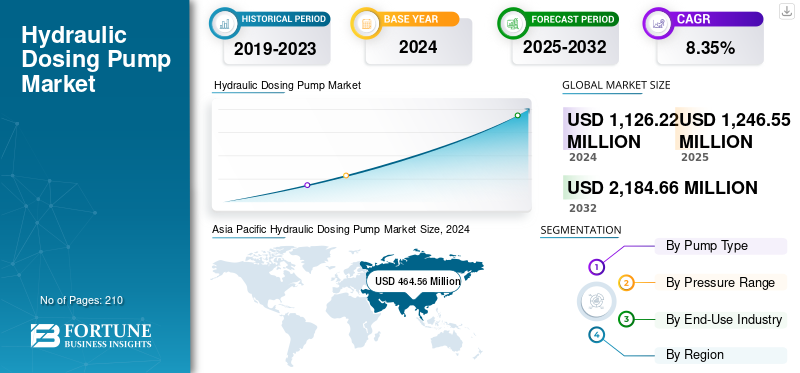
The global hydraulic dosing pump market size was valued at USD 1.25 billion in 2025. The market is projected to grow from USD 1.37 billion in 2026 to USD 2.52 billion by 2034, exhibiting a CAGR of 7.94% during the forecast period. Asia Pacific dominated the hydraulic dosing pump market with a market share of 41.49% in 2025.
Moreover, Asia Pacific accounts for the largest market revenue share owing to increasing investments by governments in water and wastewater treatment facilities and environmental protection, driving the need for precise dosing solutions for chemical treatment and fluid management in public infrastructure projects.
The hydraulic dosing pump market refers to the sector involving pumps designed for precise fluid dosing and chemical injection in various industries. These pumps utilize hydraulic pressure to deliver precise volumes of fluids such as chemicals or additives into various processes, including water and wastewater treatment, chemical processing, pharmaceuticals, food and beverage, and oil & gas. Market growth is driven by increasing industrial automation, infrastructure investments, and stringent environmental regulations that require precise chemical dosing to enhance process efficiency, safety, and sustainability.
- For instance, in July 2025, The Governments of the U.S. and Mexico formalized a memorandum of understanding to finance and accelerate wastewater treatment projects. The agreement pledges USD 93 million from Mexico for sanitation infrastructure upgrades and commits the U.S. to expand the South Bay International Wastewater Treatment Plant's capacity from 25 to 50 million gallons per day by 2027. Such investments are expected to drive demand for hydraulic dosing pumps in the years to come.
IDEX Corporation holds a prominent position in the hydraulic dosing pump market. The company's prominence is supported by its portfolio of well-known brands, including Milton Roy, which is specifically noted for its dosing pump solutions. IDEX leverages its established presence to serve various industries, driven by market trends such as increased demand for water/wastewater treatment, as well as chemical processing.
Download Free sample to learn more about this report.
Hydraulic Dosing Pump Market Key Takeaways
 Global Market Size & Forecast
- 2025 Market Size: USD 1.25 billion
- 2026 Market Size: USD 1.37 billion
- 2034 Forecast Market Size: USD 2.52 billion
- CAGR: 7.94% from 2026–2034
 Market Share
- Asia Pacific dominated the market with a 41.49% share in 2025.
- The hydraulic diaphragm pumps segment is expected to account for 64.23% of the market in 2026.
- The water & wastewater treatment segment is projected to hold a 39.42% share in 2026.
 Key Regional Highlights
Asia Pacific
Asia Pacific generated USD 0.52 billion in 2025, accounting for 41.49% of the global market.
Europe
Europe reached USD 0.29 billion in 2025, representing 23.44% of the global market.
North America
North America recorded USD 0.26 billion in 2025 with a 20.92% market share.
U.S.
The U.S. hydraulic dosing pump market is projected to reach USD 0.24 billion by 2026.
Japan
The Japan hydraulic dosing pump market is projected to reach USD 0.07 billion by 2026.
Read More

MARKET DYNAMICS
MARKET DRIVERS
Rising Wastewater Treatment & Reuse Investments to Boost the Market Growth
Rising investments in wastewater treatment and reuse are significantly boosting the hydraulic dosing pump market growth. Increasing urbanization and industrialization have led to stricter regulations on water quality and pollution control, driving the demand for efficient chemical dosing systems. The hydraulic dosing pump plays a crucial role in wastewater treatment for precise chemical injection to maintain pH balance, remove contaminants, and prevent corrosion.
- For instance, in April 2024, Washington’s King County, U.S., announced plans of USD 10 billion investment over the next decade to upgrade wastewater infrastructure, reduce pollution, and enhance resilience against climate change impacts. The initiative includes replacing pumps, seismic retrofits, and sewer pipe upgrades, supported by a USD 194 million loan from the EPA.
Large-scale projects such as sewage treatment plants and initiatives including Namami Ganga underscore the global emphasis on water management, fueling steady demand for advanced dosing technology, especially in emerging markets, including Asia-Pacific and Europe.
Growth in Chemical & Petrochemical Processing Capacity to Fuel the Market Growth
Growth in chemical and petrochemical processing capacity is a key driver for the hydraulic dosing pump market. Expanding production capacities, especially in emerging economies such as India, are boosting demand for precise chemical dosing systems which are essential for optimizing reactions, maintaining safety, and controlling environmental impact. Investments in new petrochemical projects and modernization of existing plants are increasing the need for reliable hydraulic dosing pumps to manage aggressive and corrosive chemicals. Additionally, growing end-use industries such as construction, automotive, and electronics amplify the market, as these sectors rely heavily on petrochemical-derived products. This capacity growth underpins sustainable industrial expansion worldwide.
MARKET RESTRAINTS
Competition from Smart Electronic Metering Pumps to Limit Market Growth
Competition from smart electronic metering pumps poses a significant challenge to the hydraulic dosing pump market growth. Smart electronic pumps offer higher precision, enhanced automation compatibility, and real time monitoring, appealing to industries seeking improved accuracy and process control. Their digital integration enables remote operation and diagnostics, reducing downtime and maintenance costs.
Despite hydraulic pumps’ robustness in handling high pressures and corrosive fluids, their relatively complex maintenance and lower automation levels limit their appeal. As industries increasingly adopt Industry 4.0 technologies, the convenience and efficiency of smart electronic metering pumps are expected to hinder the expansion of hydraulic dosing pump market.
MARKET OPPORTUNITIES
Smart Dosing & Remote Monitoring Systems (IoT Integration) to Create Opportunities
Smart dosing and remote monitoring systems integrated with IoT technology are creating significant opportunities in the hydraulic dosing pump market. IoT-enabled pumps provide real-time data on parameters including flow rate, pressure, and temperature, allowing operators to monitor and control dosing processes remotely. This remote accessibility enhances operational efficiency, reduces downtime, and enables predictive maintenance by identifying potential faults early.
- In March 2025, Grundfos released the DDA SMART Digital Dosing pump, featuring a powerful variable-speed stepper motor with a turndown ratio of up to 1:3000 for precise, continuous chemical dosing. It offers enhanced safety, ease of use, and remote management via the Grundfos GO app.
Additionally, IoT integration enables automation, resulting in optimized chemical use, reduced waste, and enhanced accuracy. These advances align with Industry 4.0 trends, making smart dosing technologies increasingly vital for industries focused on sustainability and cost-effectiveness.
MARKET CHALLENGES
Maintenance Complexity & Oil Hydraulics Dependency Creates Market Challenges
The hydraulic dosing pump market faces challenges due to the complexity of maintenance and reliance on oil hydraulics. These pumps require regular inspections, lubrication, and replacement of wear parts such as diaphragms and seals to ensure accurate dosing and prevent leaks. Oil hydraulics dependency adds to operational costs and environmental risks due to potential leaks and contamination.
Maintenance demands specialized skills and frequent servicing, increasing downtime and total cost of ownership. These factors can hinder market growth, especially in cost-sensitive and resource-limited regions. However, advancements in pump design aim to reduce maintenance needs and improve efficiency thereby mitigating these challenges.
HYDRAULIC DOSING PUMP MARKET TRENDS
Shift Toward Hydraulic Diaphragm Designs is Emerging as a Key Trend.
A shift toward hydraulic diaphragm pump designs is emerging as a key market trend due to their enhanced durability, precision, and capability to handle high pressures and corrosive fluids. These pumps offer leak-free operation and improved safety, making them ideal for demanding applications in chemical processing, water treatment, and oil & gas sectors. The global hydraulic diaphragm pump market is growing steadily, driven by technological advancements such as integrated leak detection and pulsation dampening.
Download Free sample to learn more about this report.
IMPACT OF TARIFFS ON THE GLOBAL HYDRAULIC DOSING PUMP MARKET
Tariffs have a notable impact on the global hydraulic dosing pump market by increasing import and export costs, thereby, affecting supply chains and product pricing. Trade restrictions, such as tariffs and quotas, can lead to higher manufacturing expenses, which are often passed to end-users, potentially reducing demand. This impact is particularly significant for countries relying heavily on imported raw materials or finished dosing pumps. Additionally, tariff-induced delays in supply chains may cause project postponements and increased operational costs. However, manufacturers are adapting by optimizing local production and diversifying their supply sources to mitigate tariff effects and supporting growth in the global hydraulic dosing pump market.
SEGMENTATION ANALYSIS
By Pump Type
Hydraulic Diaphragm Pumps Led the Segmental Growth Due to Their Low Maintenance Application
Based on pump type, the market is segmented into hydraulic diaphragm pumps, hydraulic plunger (piston) pumps, and others.
The Hydraulic diaphragm pumps segment will account for 64.23% market share in 2026. Hydraulic diaphragm pumps dominate the market due to their superior ability to handle corrosive and abrasive fluids with leak-free, pulsation-free operation. Their durability, safety features, low maintenance, and compatibility with automation make them ideal for water treatment, chemical processing, and pharmaceuticals, accounting for nearly half the hydraulic dosing pump market.
- In July 2024, AILIPU successfully delivered five high-efficiency process diaphragm pumps featuring high mechanical efficiency and energy-saving performance, significantly outperforming traditional centrifugal pumps.
Meanwhile, hydraulic plunger (piston) pumps are experiencing significant growth with a CAGR of 7.80% driven by their high-pressure capabilities, precise flow control, and suitability for heavy-duty industrial applications such as oil & gas and petrochemicals, where high efficiency and robustness are critical. Both pump types complement diverse industrial dosing needs.
By Pressure Range
50–100 Bar Segment Dominated the Market Due to Its Ability to Handle High Precision and Reliability
Based on pressure range, the market is segmented into up to 10 bar, 10–50 bar, 50–100 bar, 100–250 bar, and above 250 bar.
The 50–100 bar segment is expected to lead the market, contributing 32.85% globally in 2026, due to the suitability for mid- to high-pressure chemical dosing applications across industries, including water treatment, oil & gas, and chemical processing. Their ability to handle viscous, corrosive fluids with high precision and reliability makes them preferred for demanding environments.
Furthermore, conversely, pumps in the 10–50 bar range are witnessing significant growth driven by expanding water and wastewater treatment infrastructure and increasing industrial automation, especially in emerging economies. These wide range pumps offer cost-effective solutions for moderate-pressure dosing needs with enhanced operational efficiency, fueling their rising adoption globally.
By End-Use Industry
To know how our report can help streamline your business, Speak to Analyst
Water & Wastewater Treatment Segment Led the Market Owing to the Favorable Government Policies
Based on the end-use industry, the market is segmented into water & wastewater treatment, chemicals & petrochemicals, power generation, food & beverage, and others.
The Water & wastewater treatment segment is poised to account for 39.42% of the market share in 2026, due to stringent environmental regulations mandating precise chemical dosing for pollutant removal, pH control, and corrosion prevention. Investments in large-scale treatment infrastructure, especially in regions such as Asia-Pacific, Europe, and the USA, further drive market demand.
Chemicals and petrochemicals represent a significant growth segment, fueled by expanding processing capacities, growing end-use industries, and increasing reliance on accurate dosing for safety and process efficiency. The chemical sector's constant need for handling corrosive and hazardous fluids also enhances the demand for reliable hydraulic dosing pumps, supporting steady market expansion.
HYDRAULIC DOSING PUMP MARKET REGIONAL OUTLOOK
By region, the market is categorized into North America, Europe, Asia Pacific, Latin America, and the Middle East & Africa.
Asia Pacific
Asia Pacific Hydraulic Dosing Pump Market Size, 2025 (USD Billion) To get more information on the regional analysis of this market, Download Free sample
The Asia Pacific market accounted for USD 0.52 Billion in 2025, representing 41.49% of the global industry, and is expected to reach USD 0.57 Billion in 2026. Rapid industrialization and urbanization in countries including China, India, and Southeast Asia, leading to higher demand for dosing pumps across industries such as water treatment, chemical processing, and pharmaceuticals. The Japan market is projected to reach USD 0.07 billion by 2026, the China market is projected to reach USD 0.14 billion by 2026, and the India market is projected to reach USD 0.18 billion by 2026.
Europe
In 2025, Europe generated USD 0.29 Billion, contributing 23.44% to global market revenue, and is projected to grow to USD 0.32 Billion in 2026. Growing demand in the water and wastewater treatment sectors, driven by increasing focus on water quality, environmental regulations, and municipal infrastructure investments. The UK market is projected to reach USD 0.05 billion by 2026, and the Germany market is projected to reach USD 0.07 billion by 2026.
North America
North America maintained a strong presence in the global market, reaching USD 0.26 Billion in 2025, accounting for 20.92% share, and is expected to reach USD 0.29 Billion in 2026, driven by strong demand from water and wastewater treatment sectors, driven by stringent environmental regulations and the need for precise chemical dosing in disinfection, pH adjustment, and sludge dewatering processes. The U.S. market is projected to reach USD 0.24 billion by 2026.
Latin America
Latin America contributed 5.79% to the global market in 2025, with a valuation of USD 0.07 Billion, and is projected to reach USD 0.08 Billion in 2026. The market for hydraulic dosing pump in Latin America is driven by rising focus on water treatment and wastewater management due to severe water scarcity and pollution concerns in countries such as Brazil, Mexico, and Argentina.
Middle East & Africa
In 2025, Middle East & Africa represented USD 0.1 Billion, accounting for 8.37% of the worldwide market, and is projected to grow to USD 0.11 Billion in 2026. Increasing investments in water treatment infrastructure due to severe water scarcity issues in countries such as Saudi Arabia, the UAE, and South Africa, which boost demand for precise chemical dosing systems in desalination and wastewater plants.
COMPETITIVE LANDSCAPE
KEY INDUSTRY PLAYERS
Strategic Collaboration and Campaigns By the Major Key Players Fuel Market Share
The competitive landscape is fragmented, and the key competitive players include Grundfos Holding, ProMinent GmbH, Dover Corporation, IDEX Corporation, Nikkiso Co., Ltd., and others. For instance, in December 2025, AxFlow and Grundfos announced a strategic cooperation, making AxFlow the official distributor of Grundfos dosing pumps in Europe. This partnership leverages AxFlow’s industry expertise to enhance the availability and support of Grundfos’s high-performance dosing pump solutions. Such developments are expected to foster market growth during the forecast period.
List of the Key Hydraulic Dosing Pump Market Companies Profiled
- Grundfos Holding (Denmark)
- ProMinent GmbH (Germany)
- Dover Corporation (U.S.)
- IDEX Corporation (U.S.)
- Nikkiso Co., Ltd (Japan)
- Milton Roy (Ingersoll Rand) (U.S.)
- SPX Flow (U.S.)
- LEWA GmbH (Germany)
- Watson-Marlow Fluid Technology (U.K.)
- Verder International (Netherlands)
- IWAKI & Co., Ltd (Japan)
- Seko S.p.A. (Italy)
- ViscoTec Pumpen- und Dosiertechnik (Germany)
- Wilden (U.S.)
- Haosh Pumps (China)
KEY INDUSTRY DEVELOPMENTS
- In December 2024, IDEX China launched the PulsaMax 8480 Series, a hydraulically balanced, leak-free diaphragm metering pump meeting API675 standards. Designed for precise dosing and long-lasting reliability, it serves industries including Refinery, Oil & Gas, Petrochemical, Pharmaceuticals, and Water Treatment.
- In November 2024, Netzsch unveiled the PERIPRO peristaltic tube pump, which is designed for demanding dosing tasks, especially in wastewater treatment. It offers hermetically sealed operation to prevent leakage, features an early leakage sensor, requires low maintenance with only one wear part (the tube), and operates without electronics, reducing downtime and costs. It also suits the chemical and food industry as well as End-Use Industries.
- In September 2024, Pulsafeeder launched NextStep dosing pumps, which offer high-resolution, digitally controlled metering with a turndown ratio of 3,333:1, ensuring precise, near-constant chemical flow and reduced pulsation. These pumps feature multiple operating modes, remote communication options (Modbus/RS-485), and reliability for handling challenging fluids, backed by a five-year diaphragm warranty and inclusive installation accessories.
- In July 2024, Milton Roy introduced Primeroyal Q Series metering pumps. These pumps are designed to offer enhanced precision and reliability for various industrial end-use industries, representing a significant advancement in metering pump Pressure Range to meet evolving customer needs.
- In May 2024, Roto Pumps launched the Roto Aggressive Chemical (AC) Dosing Pumps designed for precise, steady, and non-pulsating chemical dosing. They offer high dosing accuracy (+/-1%), handle pressures up to 24 bar, manage entrained solids, are corrosion-resistant, and self-priming, optimizing operational efficiency across demanding industrial end-use industries.
REPORT COVERAGE
The global hydraulic dosing pump market report delivers a detailed insight into the market. It focuses on key aspects, such as leading companies in the hydraulic dosing pump market. Besides, the report offers regional insights and global market trends & Pressure Range, and highlights key industry developments. In addition to the factors above, the report encompasses several factors and challenges that contributed to the growth and downfall of the market in recent years.
Request for Customization to gain extensive market insights.
Report Scope & Segmentation
|
ATTRIBUTE |
DETAILS |
|
Study Period |
2021-2034 |
|
Base Year |
2025 |
|
Estimated Year |
2026 |
|
Forecast Period |
2026-2034 |
|
Historical Period |
2021-2024 |
|
Growth Rate |
CAGR of 7.94% from 2026 to 2034 |
|
Unit |
Value (USD Billion) |
|
Segmentation |
By Pump Type
|
|
By Pressure Range
|
|
|
By End-Use Industry
|
|
|
By Region
|
Frequently Asked Questions
As per the Fortune Business Insights study, the market size was USD 1.25 billion in 2025.
The market is likely to grow at a CAGR of 7.94% over the forecast period (2026-2034).
The industrial segment is expected to lead the market over the forecast period.
The market size of the Asia Pacific stood at USD 0.52 billion in 2025.
Rising wastewater treatment & reuse investments to boost the market growth.
Some of the top players in the market are Grundfos Holding, ProMinent GmbH, Dover Corporation, IDEX Corporation, Nikkiso Co., Ltd., and others.
The global market size is expected to reach USD 2.52 billion by 2034.



- 2021-2034
- 2025
- 2021-2024
- 210
Get 30-60 hrs Free Customization
Expand Regional and Country Coverage, Segments Analysis, Company Profiles, Competitive Benchmarking, and End-user Insights.



















Related Reports
-
US +1 833 909 2966 ( Toll Free )
-
Get In Touch With Us