Hydrogen Derivatives Market Size, Share & Industry Analysis, By Type (Ammonia, Methanol, and Others), By End-Use Industry (Fertilizers, Chemicals, Marine, Aviation, and Others), and Regional Forecast, 2026-2034
 Download Free Sample
Hydrogen Derivatives Market Size and Future Outlook
 Listen to Audio Version
The hydrogen derivatives market size was valued at USD 132.31 billion in 2025. The market is projected to grow from USD 146.87 billion in 2026 to USD 312.24 billion by 2034, growing at a CAGR of 9.9% during the forecast period. Asia Pacific dominated the hydrogen derivatives market with a market share of 57.09% in 2025.
The market includes a range of hydrogen-based products used across multiple industrial applications, including chemicals, refining, fertilizers, energy, transportation, and industrial manufacturing processes. This market covers key derivatives such as ammonia, methanol, synthetic fuels, and other hydrogen-based compounds that are valued for their role in renewable energy systems, chemical synthesis, and low-emission industrial use. The market is increasingly influenced by demand for cleaner fuels, decarbonization strategies, and high-performance feedstocks that support energy transition goals and process efficiency. Growing preference for low-carbon production pathways, wider industrial adoption, and rising investment in hydrogen value chains are driving the market growth.
Furthermore, the market is led by several key players, including Yara International, CF Industries Holdings, Inc., Fertiglobe, Methanex Corporation, and Proman. Their competitive position is supported by strong production capabilities, reliable feedstock access, established global supply networks, and close alignment with demand across fertilizers, chemicals, energy, and other industrial end-use sectors.
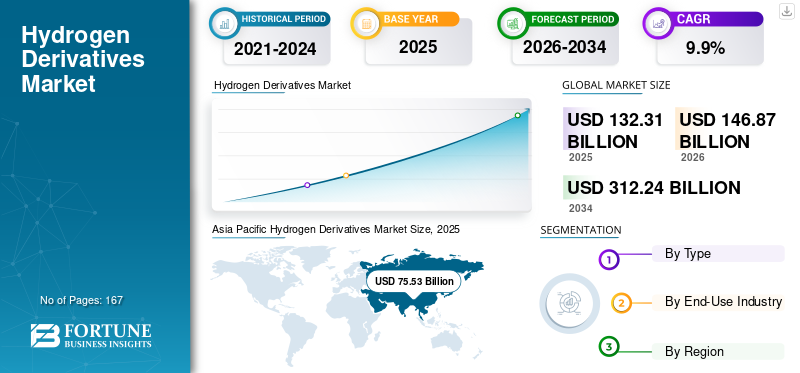
Download Free sample to learn more about this report.
HYDROGEN DERIVATIVES MARKET KEY TAKEAWAYS
 Global Market Size & Forecast
- 2025 Market Size: USD 132.31 billion
- 2026 Market Size: USD 146.87 billion
- 2034 Forecast Market Size: USD 312.24 billion
- CAGR: 9.90% from 2026–2034
 Market Share
- Asia Pacific dominated the market with a 57.09% share in 2025.
- The Ammonia segment held the largest market share in 2025.
- The Fertilizers segment held the largest market share in 2025.
 Key Regional Highlights
Asia Pacific
Reached USD 75.53 billion in 2025, driven by strong fertilizer production, chemical manufacturing, and industrial expansion.
Europe
The market is projected to reach USD 13.44 billion by 2026, supported by demand from fertilizers, chemicals, refining, and clean industrial processes.
North America
Growth is driven by strong demand from fertilizers, chemicals, refining, and advanced industrial infrastructure.
U.S.
The market is projected to reach USD 15.06 billion by 2026, accounting for 79.5% of North American sales.
Japan
The market is projected to reach USD 10.98 billion by 2026, accounting for 13.0% of Asia Pacific revenue.
Read More

HYDROGEN DERIVATIVES MARKET TRENDS
Rising Use of Hydrogen Derivatives in Low-Carbon Industrial and Energy Applications is Prominent Market Trend
One of the key trends in the market is the growing shift from conventional fossil-based feedstock toward hydrogen-based derivatives in industrial and energy-related applications. End users are increasingly looking for products that can support cleaner production, easier transport of hydrogen value, and better compatibility with existing storage and distribution systems. As a result, suppliers are expanding & developing hydrogen derivative offerings for chemicals, fertilizers, shipping, power-related uses, and other industrial applications where decarbonization is becoming more important. Similarly, the market is moving toward higher-value and transition-focused applications where carbon reduction, supply reliability, and process efficiency are becoming more important.
- According to the IEA, hydrogen trade remains limited and is mainly carried out through hydrogen-based products such as ammonia or methanol, reflecting the growing role of hydrogen-based derivatives in low-carbon industrial and energy applications.
MARKET DYNAMICS
MARKET DRIVERS
Download Free sample to learn more about this report.
Growing Demand from Fertilizer Applications Supports Market Growth
The primary driver of the hydrogen derivatives market growth is the rising demand from fertilizer applications, where hydrogen-based derivatives play an essential role in large-scale nutrient production. Materials such as ammonia are widely used in the fertilizer industry as they serve as key building blocks for nitrogen-based fertilizers and support efficient agricultural output. An additional layer of support comes from the continued need for large-volume fertilizer production and the growing importance of efficient feedstock that can support both agricultural demand and long-term supply stability.
- According to the IEA, about 70% of ammonia is used for fertilizers, reflecting the central role of hydrogen-based derivatives in fertilizer applications.
MARKET RESTRAINTS
High Production Costs and Infrastructure Requirements Restrict Broader Market Adoption
A key restraint in the market is the high cost and infrastructure complexity involved in producing, storing, and distributing these products at scale. Since hydrogen derivatives such as ammonia, methanol, and synthetic fuels are used across fertilizers, chemicals, energy, and transport applications, their commercial use often depends on access to efficient production systems, stable feedstock supply, and suitable transport and storage networks. In many cases, additional investment is needed in production facilities, export terminals, storage systems, and downstream handling infrastructure before hydrogen-based derivatives can be adopted widely in a specific application. These requirements can increase project costs, delay commercialization, and limit faster market expansion.
- According to the IEA, transport and storage infrastructure for hydrogen and hydrogen-based fuels remains very limited, reflecting the infrastructure-related restraint facing the market.
MARKET OPPORTUNITIES
Rising Demand from Chemical Applications Creates Market Opportunities
One of the key opportunities in the market is the rising demand from chemical applications. Hydrogen derivatives are increasingly valued as important feedstock in the production of ammonia, methanol, synthetic fuels, and other chemical intermediates used across industrial value chains. As chemical manufacturers continue to focus on cleaner production pathways, feedstock flexibility, and lower-emission processing systems, the use of hydrogen-based derivatives is becoming more important. Another area of opportunity comes from the growing need for scalable and efficient raw materials that can support both conventional chemical demand and emerging low-carbon production strategies.
- According to the U.S. Department of Energy Hydrogen Program, clean hydrogen can provide a low-carbon route to methanol, ammonia, hydrazine, and other compounds that serve as feedstock for chemicals and fuels, reflecting the opportunity for hydrogen-based derivatives in chemical applications.
MARKET CHALLENGES
Feedstock Supply Dependence and Price Volatility Challenges Market Growth
The market faces a key challenge due to dependence on stable feedstock availability and the difficulty of maintaining cost-effective supply and demand for hydrogen and its derivatives across large industrial applications. Since hydrogen derivatives are used in fertilizers, chemicals, energy, and transport-related sectors, changes in natural gas availability, electricity pricing, carbon costs, and hydrogen production economics can affect overall competitiveness and supply planning. The challenge becomes more significant when buyers require stable pricing, large commercial volumes, and dependable delivery across multiple downstream applications. In many cases, producers need stronger feedstock security, better cost control, and long-term infrastructure planning to meet market expectations.
- According to the IEA, low-emissions hydrogen production from natural gas with CCUS is affected by natural gas prices, reflecting how feedstock and energy cost volatility can challenge the market.
Segmentation Analysis
By Type
Broad Industrial Use and Established Demand Support the Dominance of Ammonia Segment
Based on type, the market is segmented into ammonia, methanol, and others.
The ammonia segment holds the largest hydrogen derivatives market share due to its broad industrial use, large-scale production base, and strong commercial importance across multiple sectors. Ammonia is widely preferred as it is used extensively in fertilizers, chemicals, industrial processing, and emerging energy-related applications where reliable supply and high-volume availability are important. Strong demand from agriculture and chemical manufacturing, along with its growing relevance in low-carbon energy discussions, continues to support the dominance of the ammonia segment.
- According to the IEA, hydrogen use in ammonia production accounted for nearly half of global hydrogen demand in 2024, reflecting the dominant position of the ammonia segment in the market.
The methanol segment is expected to grow at a CAGR of 9.0% over the forecast period.
By End-Use Industry
To know how our report can help streamline your business, Speak to Analyst
Increasing Demand for Ammonia and Related Hydrogen-Based Compounds Leads to Dominance of Fertilizers Segment
In terms of end-use industry, the market is categorized into fertilizers, chemicals, marine, aviation, and others.
The fertilizers segment held the largest share of the market in 2025, supported by its broad use of ammonia and related hydrogen-based compounds in large-scale nutrient production. Hydrogen derivatives are widely used in this segment as they serve as essential building blocks for nitrogen fertilizers that support crop yield, food production, and agricultural efficiency. Their role in enabling high-volume fertilizer manufacturing makes them especially important in applications where reliable nutrient supply and large-scale production are critical. Strong and continuing demand from global agriculture continues to support the dominance of the fertilizers segment.
- According to the U.S. Geological Survey (USGS), approximately 88% of U.S. ammonia production was used for fertilizer use, reflecting the dominant role of the fertilizers segment in hydrogen derivative consumption.
The chemicals segment is expected to grow at a CAGR of 9.4% over the forecast period.
Hydrogen Derivatives Market Regional Outlook
By geography, the market is categorized into North America, Europe, Asia Pacific, Latin America, and Middle East & Africa.
Asia Pacific
Asia Pacific Hydrogen Derivatives Market Size, 2025 (USD Billion)
To get more information on the regional analysis of this market, Download Free sample
In 2024, the Asia Pacific accounted for the largest share of the market, valued at USD 69.24 billion, and continued to lead in 2025, valued at USD 75.53 billion. The region benefits from its strong industrial base, large-scale fertilizer production, expanding chemicals demand, and well-established manufacturing and export activities across China, India, Japan, South Korea, and Southeast Asia. Hydrogen derivatives are widely used across fertilizers, chemicals, refining, energy, and industrial processing applications, all of which see high consumption across the region’s growing industrial sectors. Rising agricultural demand, strong chemical production, and continued expansion in downstream industrial activity continue to reinforce the Asia Pacific’s leading market position.
China Hydrogen Derivatives Market
By 2026, the Chinese market is projected to reach USD 32.95 billion. China remains the region’s largest demand center, supported by its large fertilizer industry, broad chemical manufacturing base, and extensive use of hydrogen-based derivatives in ammonia, methanol, refining, and other industrial applications. This growth is reinforced by large-scale production activity, rising demand from fertilizer and chemical sectors, and continued expansion in downstream industrial processing.
To know how our report can help streamline your business, Speak to Analyst
India Hydrogen Derivatives Market
The Indian market in 2026 is estimated at around USD 17.85 billion, accounting for roughly 21.2% of regional revenues.
Japan Hydrogen Derivatives Market
The Japanese market in 2026 is estimated to be around USD 10.98 billion, accounting for roughly 13.0% of the regional revenues.
Europe
Europe is expected to experience significant market growth over the coming years. Throughout the forecast period, the region is expected to expand at a steady rate, attaining a market valuation of USD 13.44 billion by 2026. Europe is projected to witness stable growth during this period, supported by strong demand from fertilizers, chemicals, refining, and energy-related applications. The region also benefits from its established industrial base, advanced manufacturing capabilities, and increasing focus on cleaner feedstock, low-emission production pathways, and efficient industrial processing.
U.K. Hydrogen Derivatives Market
The U.K. market in 2026 is estimated at around USD 1.60 billion, accounting for roughly 11.9% of regional revenues.
Germany Hydrogen Derivatives Market
Germany’s market in 2026 is estimated at around USD 4.21 billion, accounting for roughly 31.3% of regional revenues.
North America
North America continues to be a well-established and attractive market for hydrogen derivatives, supported by strong demand from fertilizers, chemicals, refining, and other industrial applications. The region benefits from its advanced production base, stable industrial demand, and widespread use of hydrogen-based derivatives in sectors that require reliable feedstock, large-scale processing, and consistent supply. Its mature industrial structure, strong energy infrastructure, and steady downstream consumption continue to support the importance of North America in the market.
U.S. Hydrogen Derivatives Market
Given North America’s significant contribution, the U.S. market is estimated at around USD 15.06 billion in 2026, accounting for roughly 79.5% of regional sales.
Latin America and Middle East & Africa
Latin America and Middle East & Africa are relatively smaller in size, yet continue to present meaningful growth prospects for the market. Growth in Latin America is supported by expanding fertilizer demand, rising chemical production, and increasing use of hydrogen derivatives in ammonia, methanol, and other industrial applications. The region is also benefiting from gradual industrial development, improving agricultural requirements, and a broader interest in efficient feedstock for downstream processing. The Middle East & Africa are also showing steady potential, supported by growing industrial diversification, expanding chemical and fertilizer capacity, and increasing use of hydrogen-based derivatives in energy-related and industrial applications. Rising investment in production infrastructure, improving export potential, and stronger downstream processing activity are further supporting market opportunities across both regions.
Brazil Hydrogen Derivatives Market
The Brazilian market in 2026 is estimated at USD 4.46 billion, accounting for approximately 51.5% of regional revenues.
COMPETITIVE LANDSCAPE
Key Industry Players
Production Scale, Feedstock Access, and Global Supply Reach Leads to Increased Market Competition
The market is moderately fragmented, with competition shaped by producers that can offer reliable output, stable feedstock access, efficient production systems, and strong distribution reach across end-use industries. Competitive advantage depends on the ability to maintain consistent product quality, support large-volume supply needs, and align production with demand from fertilizers, chemicals, refining, energy, and other industrial sectors.
Major participants such as Yara International, CF Industries Holdings, Inc., Fertiglobe, Methanex Corporation, and Proman benefit from strong production capabilities, broad hydrogen derivative portfolios, and established global supply networks serving fertilizers, chemicals, energy, and other industrial applications. As competition continues to evolve, the market is increasingly favoring suppliers that combine dependable raw material access, scale advantages, and application-focused supply strategies rather than competing only on volume.
LIST OF KEY HYDROGEN DERIVATIVES COMPANIES PROFILED
- Yara International (Norway)
- CF Industries Holdings, Inc. (U.S.)
- (UAE)
- ADNOC (UAE)
- NEOM Green Hydrogen Company (Saudi Arabia)
- AM Green (India)
- ACME Group (India)
- Methanex Corporation (Canada)
- Proman (Switzerland)
- MITSUBISHI GAS CHEMICAL COMPANY, INC. (Japan)
KEY INDUSTRY DEVELOPMENTS
- January 2026: AM Green signed a long-term binding offtake agreement with Uniper for up to 500,000 tons per year of renewable ammonia, marking a major green ammonia commercialization step for hydrogen derivatives.
- January 2026: CF Industries Holdings, Inc. signed an MOU with Trafigura and TFG Marine to advance low-carbon ammonia as a marine fuel, focused initially on the U.S. Gulf Coast and Northwest Europe.
REPORT COVERAGE
The global market analysis provides an in-depth study of market size & forecast by all the market segments included in the report. It includes details on market dynamics and trends expected to drive the market during the forecast period. It offers information on technological advancements, new product launches, key industry developments, and partnerships, mergers & acquisitions. The market research report also encompasses a detailed competitive landscape with information on the market shares and profiles of key players.
Request for Customization to gain extensive market insights.
Report Scope & Segmentation
| ATTRIBUTE | DETAILS |
| Study Period | 2021-2034 |
| Base Year | 2025 |
| Estimated Year | 2026 |
| Forecast Period | 2026-2034 |
| Historical Period | 2021-2024 |
| Growth Rate | CAGR of 9.9% from 2026-2034 |
| Unit | Value (USD Billion) Volume (Kiloton) |
| Segmentation | By Type, End-Use Industry, and Region |
| By Type |
|
| By End-Use Industry |
|
| By Geography |
|
Frequently Asked Questions
Fortune Business Insights says that the global market size was valued at USD 132.31 billion in 2025 and is projected to reach USD 312.24 billion by 2034.
Recording a CAGR of 9.9%, the market is slated to exhibit steady growth during the forecast period of 2026-2034.
The fertilizers end-use industry segment led the market.
Asia Pacific held the highest market share.
Rising demand from fertilizer applications is accelerating the adoption of hydrogen derivatives.



- 2021-2034
- 2025
- 2021-2024
- 167
Get 30-60 hrs Free Customization
Expand Regional and Country Coverage, Segments Analysis, Company Profiles, Competitive Benchmarking, and End-user Insights.


















Related Reports
-
US +1 833 909 2966 ( Toll Free )
-
Get In Touch With Us