Hydrogen Electrolyzer Market Size, Share & Industry Analysis, By Technology (Alkaline Electrolyzer (AEL), PEM Electrolyzer, Solid Oxide Electrolyzer (SOEC), AEM Electrolyzer, and Others), By Capacity Scale (Large-scale (>100 MW), Medium-scale (10 MW–100 MW), and Small-scale (<10 MW)), By End-Use Industry (Ammonia & Fertilizer, Refining, Steel & Metals, Energy Storage & Power, Mobility, Chemicals & Methanol, Synthetic Fuels (e-fuels), and Others), and Regional Forecast, 2026-2034
 Download Free Sample
Hydrogen Electrolyzer Market Size and Future Outlook
 Listen to Audio Version
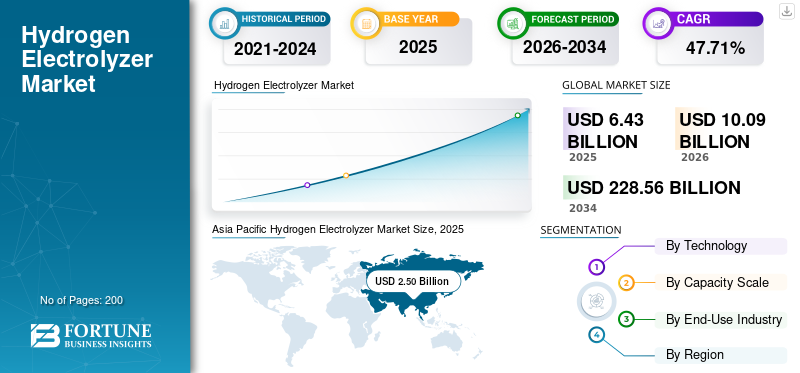
The global hydrogen electrolyzer market size was valued at USD 6.43 billion in 2025. The market is projected to grow from USD 10.09 billion in 2026 to USD 228.56 billion by 2034, exhibiting a CAGR of 47.71% during the forecast period. Asia Pacific dominated the hydrogen electrolyzer market with a market share of 38.88% in 2025.
Hydrogen electrolyzers are electrochemical systems designed to produce low-carbon hydrogen by splitting water into hydrogen and oxygen using electricity, primarily from renewable energy sources such as solar, wind, hydro, and nuclear power. Unlike conventional hydrogen production methods dependent on natural gas reforming, electrolyzers are increasingly being deployed as critical infrastructure for industrial decarbonization and renewable energy integration.
The hydrogen electrolyzer market share is being driven by the rapid expansion of green hydrogen projects across refining, ammonia, steel, chemicals, synthetic fuels, and heavy transport sectors, where industries are seeking alternatives to fossil fuel-based hydrogen feedstocks. Strong policy support mechanisms, including hydrogen subsidies, carbon reduction mandates, renewable fuel targets, and production tax incentives in regions such as Europe, the U.S., China, India, and the Middle East that are accelerating electrolyzer investments. Additionally, declining renewable electricity costs and large-scale manufacturing expansion are improving project economics and supporting commercial-scale deployment.
- For instance, in October 2024, Siemens Energy partnered with Air Liquide to supply an industrial-scale PEM electrolyzer system for large green hydrogen projects in Europe aimed at decarbonizing refining and chemical operations. The collaboration focused on accelerating renewable hydrogen production capacity through integrated electrolyzer deployment linked with offshore wind and industrial hydrogen infrastructure. The project highlighted the growing commercialization of large-scale electrolyzer systems across Europe and demonstrated increasing investments in hydrogen technologies to support industrial decarbonization, green ammonia production, and long-term renewable energy integration within the regional hydrogen economy.
Some of the leading companies operating in the global industry include Thyssenkrupp, Nel Hydrogen, Siemens Energy, and others. Thyssenkrupp Nucera is one of the world’s leading hydrogen electrolyzer companies specializing in large-scale alkaline water electrolysis systems for green hydrogen production. Headquartered in Germany, the company focuses on industrial-scale hydrogen solutions for ammonia, refining, steel, and chemical applications. Thyssenkrupp Nucera has a strong global project portfolio and is actively involved in giga-scale hydrogen developments across Europe, the Middle East, and Australia.
Download Free sample to learn more about this report.
Hydrogen Electrolyzer Market Key Takeways
 Global Market Size & Forecast
- 2025 Market Size: USD 23.86 billion
- 2026 Market Size: USD 25.14 billion
- 2034 Forecast Market Size: USD 44.72 billion
- CAGR: 6.6% from 2026–2034
 Market Share
- North America dominated the medical nutrition products market with a 34.87% share in 2025.
- The enteral nutrition segment is expected to account for the largest market share.
- The 1.1–1.5 kcal/ml segment dominated the global market in 2025.
 Key Regional Highlights
North America
North America maintained its market leadership, reaching an estimated value of USD 8.32 billion in 2026.
Europe
Europe is projected to grow at a 7.1% CAGR and reach USD 7.20 billion by 2026.
Asia Pacific
Asia Pacific is expected to reach USD 5.68 billion in 2026, making it the third-largest regional market.
U.S.
U.S. The market is estimated to reach approximately USD 7.98 billion in 2026, supported by strong demand for clinical nutrition products.
Japan
Japan The market is projected to reach approximately USD 0.97 billion in 2026, driven by an aging population and increasing healthcare needs.
Read More

HYDROGEN ELECTROLYZER MARKET TRENDS
Transition Toward Giga-Scale Green Hydrogen and Integrated Electrolyzer Ecosystems is a Key Market Trend
A major trend shaping the market is the rapid transition from pilot-scale hydrogen production to giga-scale integrated hydrogen ecosystems linked with renewable energy, green ammonia, and industrial decarbonization projects. Large electrolyzer deployments exceeding 100 MW are increasingly being announced across Europe, China, the Middle East, Australia, and North America, driven by demand from steel, refining, chemicals, and export-oriented green ammonia industries.
In addition, the shift toward proton exchange membrane PEM and SOEC technologies is expected for applications requiring higher operational flexibility, renewable energy integration, and improved energy efficiency. Electrolyzer manufacturers are also expanding gigafactory capacities to reduce system costs and localize supply chains, particularly in China, Europe, India, and the U.S. Additionally, governments are increasingly supporting domestic electrolyzer manufacturing through subsidies, hydrogen tax credits, and localization incentives to reduce dependence on imported technologies.
MARKET DYNAMICS
MARKET DRIVERS
Download Free sample to learn more about this report.
Expansion of Industrial Decarbonization and Green Hydrogen Projects Driving Electrolyzer Demand
The growing need to decarbonize hard-to-abate industries is one of the primary drivers accelerating demand for hydrogen electrolyzers globally. Industries such as steel, refining, ammonia, chemicals, shipping, and aviation are increasingly adopting green hydrogen as an alternative to fossil fuel-based hydrogen and carbon-intensive feedstocks to meet emission reduction targets and regulatory requirements. Large industrial companies are investing in electrolyzer-based hydrogen production to reduce dependence on natural gas-derived hydrogen and comply with carbon pricing mechanisms, renewable fuel mandates, and net-zero commitments.
Governments across Europe, North America, China, India, and the Middle East are also introducing hydrogen subsidies, production tax credits, and financial incentives to support commercial-scale electrolyzer deployment and domestic manufacturing expansion. In addition, declining renewable electricity costs are improving the economic viability of green hydrogen projects, particularly in regions with abundant solar and wind resources. The emergence of giga-scale green ammonia plants, hydrogen export hubs, and integrated renewable hydrogen ecosystems is further accelerating electrolyzer installations exceeding 100 MW capacity. These factors are anticipated to drive the hydrogen electrolyzer market growth during the forecast period.
MARKET RESTRAINTS
High Capital Costs and Renewable Power Infrastructure to Hamper Market Demand
High initial capital investment and renewable power infrastructure limitations remain major restraints for the large-scale commercialization of hydrogen electrolyzers globally. Electrolyzer systems, particularly PEM and SOEC technologies, require substantial upfront expenditure for equipment, balance-of-plant systems, renewable electricity integration, water treatment infrastructure, storage facilities, and hydrogen transport networks.
Although electrolyzer manufacturing costs are gradually declining, green hydrogen produced through electrolysis is still significantly more expensive than conventional grey hydrogen generated from natural gas in many regions. In addition, the economic feasibility of electrolyzer projects heavily depends on access to low-cost renewable electricity, which remains unevenly distributed across countries. Large-scale hydrogen production projects also require a stable renewable energy supply, grid connectivity, land availability, and water resources, creating additional infrastructure and permitting challenges.
MARKET OPPORTUNITIES
Growth of Green Hydrogen Export Hubs and Large-Scale Renewable Energy Integration Creating New Revenue Opportunities
The rapid development of green hydrogen export hubs and renewable energy-based industrial clusters is creating significant growth opportunities for the market globally. Countries with abundant low-cost solar and wind resources, including Australia, Saudi Arabia, the UAE, Oman, India, Chile, Morocco, and Namibia, are increasingly investing in giga-scale hydrogen and green ammonia projects aimed at supplying international markets such as Europe, Japan, and South Korea. This is driving demand for high-capacity electrolyzer systems integrated with dedicated renewable power plants and export infrastructure.
In addition, the expansion of offshore wind projects and hybrid renewable energy systems is creating opportunities for large-scale electrolysis applications capable of producing hydrogen for industrial use, synthetic fuels, and long-duration energy storage. Emerging applications in sustainable aviation fuel (SAF), green methanol, maritime fuels, and hydrogen-based direct reduced iron (DRI) steel production are also opening new commercial avenues for electrolyzer manufacturers.
MARKET CHALLENGES
Project Financing Uncertainty and Delayed Commercialization Creating Challenges for Market Expansion
One of the major challenges affecting the hydrogen electrolyzer industry is the uncertainty surrounding large-scale project financing and the slow commercialization of green hydrogen infrastructure. Although governments and industries have announced ambitious hydrogen capacity targets, a significant portion of proposed electrolyzer projects has not yet reached the final investment decision (FID) stage due to concerns regarding long-term profitability, hydrogen offtake agreements, renewable electricity pricing, and infrastructure readiness.
Many industrial hydrogen consumers remain cautious about transitioning from conventional hydrogen owing to the high cost premium associated with green hydrogen production. In addition, developers face difficulties securing financing for giga-scale projects due to evolving regulatory frameworks, technology risks, and uncertain future hydrogen demand.
Segmentation Analysis
By Technology
Alkaline Electrolyzer (AEL) Segment Dominates Due to Low-Cost and Large-Scale Deployment
Based on technology, the market is classified into alkaline electrolyzer (AEL), PEM electrolyzer, solid oxide electrolyzer (SOEC), AEM electrolyzer, and others.
In 2025, alkaline electrolyzer (AEL) segment dominated the market accounting for 44.83% hydrogen electrolyzer market share. Alkaline Electrolyzer (AEL) technology offers a mature technology base, lower capital cost, and strong suitability for large-scale industrial hydrogen production. AEL systems have been commercially used for decades in chemical, fertilizer, and refining industries, making them one of the most proven electrolysis technologies globally. Compared to PEM and SOEC systems, alkaline electrolyzers offer lower manufacturing and operational costs, particularly for high-capacity projects exceeding 100 MW.
The PEM electrolyzer segment is experiencing the highest growth and is expected to grow at a CAGR of 49.98% over the forecast period.
To know how our report can help streamline your business, Speak to Analyst
By Capacity Scale
Large-scale (>100 MW) Segment Dominated Owing to Industrial-Scale Hydrogen Production Demand
Based on capacity scale, the market is classified into large-scale (>100 MW), medium-scale (10 MW –100 MW), and small-scale (<10 MW).
In 2025, the large-scale (>100 MW) segment dominated the global market, accounting for 53.69% share in 2025. This growth is majorly attributed to increasing investments in giga-scale green hydrogen, green ammonia, and industrial decarbonization projects globally. Large industrial sectors such as steel, refining, fertilizers, chemicals, and synthetic fuels require continuous high-volume hydrogen supply, making large-capacity electrolyzer installations more economically viable than smaller distributed systems. These projects also benefit from economies of scale, lower hydrogen production costs, and stronger integration with dedicated renewable energy plants such as solar and offshore wind farms.
The medium-scale (10 MW –100 MW) segment is expected to grow at a CAGR of 47.79% over the projected period.
By End-Use Industry
Ammonia & Fertilizer Segment Led with Rising Green Ammonia Investments
On the basis of end-use industry, the market is classified into ammonia & fertilizer, refining, steel & metals, energy storage & power, mobility, chemicals & methanol, synthetic fuels (e-fuels), and others.
In 2025, the ammonia & fertilizer segment dominated the global market, accounting for 26.15% of share. As ammonia production requires substantial volumes of hydrogen as a primary feedstock. Traditional ammonia manufacturing mainly depends on grey hydrogen derived from natural gas, resulting in significant carbon emissions from the sector. To lower emissions and align with global decarbonization goals, fertilizer companies and ammonia producers are increasingly shifting toward green hydrogen produced through water electrolysis using renewable energy sources.
The energy storage & power segment is expected to grow at a CAGR of 49.76% over the forecast period.
Hydrogen Electrolyzer Market Regional Outlook
By geography, the market is categorized into North America, Europe, Asia Pacific, Latin America, and the Middle East & Africa.
Asia Pacific
Asia Pacific Hydrogen Electrolyzer Market Size, 2025 (USD Billion)
To get more information on the regional analysis of this market, Download Free sample
Asia Pacific accounts for a dominating market share and reached USD 2.50 billion in 2025. The market is driven by large-scale manufacturing expansion in China, aggressive green hydrogen policies in India, and export-oriented hydrogen projects in Australia. Rising investments in green ammonia, refinery decarbonization, and renewable energy integration are accelerating commercial electrolyzer deployment across the region.
India Hydrogen Electrolyzer Market
The Indian market was valued at USD 0.39 billion in 2025 and accounted for roughly 6.02% of global revenues. India’s market is driven by the National Green Hydrogen Mission, low-cost solar energy availability, and rising investments in green ammonia and refinery decarbonization projects.
China Hydrogen Electrolyzer Market
China’s market was valued at USD 1.29 billion in 2025 and represents roughly 20.04% of the global hydrogen market.
Australia Hydrogen Electrolyzer Market
Australia’s market was valued at around USD 0.32 billion in 2025, accounting for roughly 5.03% of global revenues.
North America
The North America market in 2025 was valued at USD 1.29 billion, and in 2026 is estimated to reach USD 2.07 billion.
North America’s market is being driven primarily by the U.S. Inflation Reduction Act (IRA), which offers substantial hydrogen production tax credits and incentives for domestic clean hydrogen manufacturing. The region is witnessing rapid development of hydrogen hubs focused on refining, ammonia, sustainable aviation fuel (SAF), and industrial decarbonization applications. Strong investments from companies such as Plug Power, Cummins, Air Products, and Bloom Energy are accelerating large-scale electrolyzer deployment and manufacturing expansion.
U.S. Hydrogen Electrolyzer Market
Based on North America’s strong contribution and the U.S. dominance within the region, the U.S. market was approximated at around USD 1.11 billion in 2025, accounting for roughly 17.18% of the global market size.
Europe
Europe’s market is projected to record a growth rate of 47.48% in the coming years and reached a valuation of USD 1.84 billion in 2025. The growth is being driven by aggressive decarbonization targets, the European Union Hydrogen Strategy, and large-scale green hydrogen funding programs supporting industrial hydrogen adoption. Germany, Spain, the Netherlands, and Denmark are investing heavily in offshore wind-to-hydrogen projects, green steel production, and hydrogen backbone infrastructure.
Germany Hydrogen Electrolyzer Market
Germany’s market was valued to be around USD 0.57 billion in 2025 and is estimated at around USD 0.89 billion in 2026, representing roughly 8.88% of the global revenues. The growth is driven by strong investments in green steel, industrial decarbonization, and hydrogen pipeline infrastructure under the country’s National Hydrogen Strategy. Major companies such as Thyssenkrupp Nucera and Siemens Energy are expanding large-scale electrolyzer manufacturing and deployment across industrial hydrogen projects.
Latin America
Latin America is expected to witness moderate growth in this market in the long term. The Latin America market reached a valuation of USD 0.47 billion in 2025. Latin America’s market is driven by large-scale green hydrogen and ammonia export projects in Brazil and Chile supported by abundant low-cost solar and wind energy resources.
Brazil Hydrogen Electrolyzer Market
Brazil's market achieved USD 0.23 billion in 2025, representing roughly 3.52% of the market.
Middle East & Africa
The Middle East & Africa region is expected to witness significant growth in this market during the forecast period and reached a valuation of USD 0.33 billion in 2025. The market is driven by giga-scale green hydrogen and ammonia export projects supported by ultra-low-cost solar energy and strong government-backed hydrogen strategies in Saudi Arabia, UAE, Oman, and Egypt. Increasing investments in export infrastructure, renewable energy integration, and industrial hydrogen hubs are accelerating large-scale electrolyzer deployment across the region.
GCC Hydrogen Electrolyzer Market
The GCC market accounted for USD 0.23 billion in 2025, representing roughly 3.52% of the global market.
COMPETITIVE LANDSCAPE
Key Industry Players
Major Players are Actively Expanding their Market Share Via Partnerships, Business Expansion, and Technological Advancements
The global hydrogen electrolyzer market holds a consolidated market structure, constituting prominent players such as Thyssenkrupp, Nel Hydrogen, Siemens Energy, and others. Companies operating in the market are adopting targeted growth strategies focused on strengthening their product portfolio, technical capability, expanding manufacturing presence, and other areas.
- For instance, in July 2024, Thyssenkrupp Nucera signed agreements to support large-scale green hydrogen projects in the Middle East focused on green ammonia production and industrial decarbonization. The company expanded deployment of its alkaline water electrolysis technology for giga-scale hydrogen facilities integrated with renewable energy systems. The development strengthened Thyssenkrupp Nucera’s position in industrial-scale electrolysis and highlighted increasing demand for high-capacity electrolyzer systems supporting export-oriented hydrogen and ammonia projects globally.
Other key players in the global market include ITM Power, Cummins, and Sunfire. These companies are expected to prioritize new product launches and collaborations to increase their global market share during the forecast period.
LIST OF KEY HYDROGEN ELECTROLYZER COMPANIES PROFILED IN REPORT
- Thyssenkrupp Nucera (Germany)
- Nel Hydrogen (Norway)
- Siemens Energy (Germany)
- Plug Power (U.S.)
- LONGi Hydrogen (China)
- ITM Power (U.K.)
- Cummins (U.S.)
- Sunfire (Germany)
- John Cockerill Hydrogen (Belgium)
- Topsoe (Denmark)
KEY INDUSTRY DEVELOPMENTS
- January 2026: Plug Power launched an advanced PEM electrolyzer platform designed for large-scale green hydrogen production facilities in North America and Europe. The new system offers enhanced operational flexibility, lower energy consumption, and modular scalability for renewable energy integration.
- December 2025: Thyssenkrupp Nucera announced the deployment of high-capacity alkaline water electrolyzer systems for industrial green hydrogen projects in the Middle East and Europe. The company enhanced its electrolyzer stack technology to improve operational reliability and reduce maintenance requirements. It also expanded engineering and manufacturing capabilities to support growing global hydrogen demand from steelmaking, fertilizers, and heavy industrial applications.
- October 2024: Siemens Energy partnered with industrial stakeholders in Europe to deploy PEM electrolyzer systems for large renewable hydrogen projects connected with offshore wind and industrial decarbonization initiatives. The collaboration focused on supplying green hydrogen for refining and chemical applications while supporting Europe’s hydrogen infrastructure expansion plans. The project demonstrated Siemens Energy’s increasing involvement in integrated renewable hydrogen ecosystems and utility-scale electrolysis projects across the European hydrogen value chain.
- September 2024: Sunfire advanced commercialization of its solid oxide electrolyzer (SOEC) technology through participation in industrial hydrogen projects across Europe focused on energy efficiency and renewable fuel production. The company’s systems were integrated into projects supporting green methanol, refining, and synthetic fuel applications.
- May 2024: LONGi Hydrogen expanded its electrolyzer manufacturing and project deployment activities in China to support large-scale green hydrogen and green ammonia developments. The company focused on supplying alkaline electrolyzer systems for renewable hydrogen projects linked with industrial decarbonization and energy transition initiatives. The expansion reflected China’s growing dominance in low-cost electrolyzer manufacturing and increasing adoption of large-capacity electrolysis systems across industrial and export-oriented hydrogen projects.
- March 2024: Plug Power announced progress on expanding its green hydrogen production network in the U.S. through the deployment of large PEM electrolyzer systems for hydrogen generation The projects were designed to supply hydrogen for mobility, logistics, and industrial customers while leveraging renewable energy sources. The expansion aligned with growing U.S. hydrogen hub investments and highlighted Plug Power’s strategy to develop an integrated hydrogen ecosystem, including production, storage, transportation, and fueling infrastructure.
- February 2024: Nel Hydrogen secured a large electrolyzer equipment order for a renewable hydrogen production project in North America aimed at supporting industrial decarbonization and clean fuel applications. The project involved the deployment of alkaline electrolyzer systems integrated with renewable energy infrastructure. The agreement reinforced Nel’s growing presence in large-scale hydrogen projects and reflected rising investments in commercial green hydrogen facilities supported by government clean energy incentives and industrial hydrogen demand.
REPORT COVERAGE
The global hydrogen electrolyzer market analysis provides an in-depth study of the market size & forecast by all the market segments included in the report. It includes details on the market dynamics and the market trends expected to drive the market during the forecast period. It offers information on the technological advancements, new product launches, key industry developments, and details on partnerships, mergers & acquisitions. The market research report also encompasses a detailed competitive landscape with information on the market share and profiles of key operating players.
Request for Customization to gain extensive market insights.
Report Scope & Segmentation
| ATTRIBUTE | DETAILS |
| Study Period | 2021-2034 |
| Base Year | 2025 |
| Estimated Year | 2026 |
| Forecast Period | 2026-2034 |
| Historical Period | 2021-2024 |
| Growth Rate | CAGR of 47.71% from 2026 to 2034 |
| Unit | Value (USD Billion) |
| Segmentation | By Technology, Capacity Scale, End-Use Industry, and Region |
| By Technology |
|
| By Capacity Scale |
|
| By End-Use Industry |
|
| By Region |
|
Frequently Asked Questions
Fortune Business Insights says that the global market value stood at USD 6.43 billion in 2025 and is projected to reach USD 228.56 billion by 2034.
In 2025, the Asia Pacifics market value stood at USD 2.50 billion.
The market is expected to exhibit a CAGR of 47.71% during the forecast period of 2026-2034.
The Alkaline Electrolyzer (AEL) segment led the market by technology.
Key factors driving the market include increasing demand for energy-efficient solutions, rapid industrialization, supportive government policies, technological advancements, and growing investments in sustainable infrastructure.
Thyssenkrupp, Nel Hydrogen, Siemens Energy, are the top players in the market.
Thyssenkrupp, Nel Hydrogen, Siemens Energy, are the top players in the market.
Major factors expected to favor hydrogen electrolyzer adoption include rising demand for green hydrogen, supportive government incentives, declining renewable energy costs, and increasing decarbonization initiatives across industries.


- 2021-2034
- 2025
- 2021-2024
- 200
Get 30-60 hrs Free Customization
Expand Regional and Country Coverage, Segments Analysis, Company Profiles, Competitive Benchmarking, and End-user Insights.












Related Reports
-
US +1 833 909 2966 ( Toll Free )
-
Get In Touch With Us