Hypersonic Naval Weapons Market Size, Share & Industry Analysis, By Weapon Type (Hypersonic Glide Vehicles and Hypersonic Cruise Missiles), By Launch Platform (Surface Ships, Submarines, and Coastal Launch Systems), By Propulsion Type (Boost-Glide, Scramjet, and Advanced Systems), By Component (Missile Body, Propulsion, Guidance, Thermal Protection, and Others), By Application (Anti-Surface Warfare, Land Attack, Strategic Deterrence, Time-Sensitive Targeting, and Others), and Regional Forecast, 2026-2034
 Download Free Sample
Hypersonic Naval Weapons Market Size and Future Outlook
 Listen to Audio Version
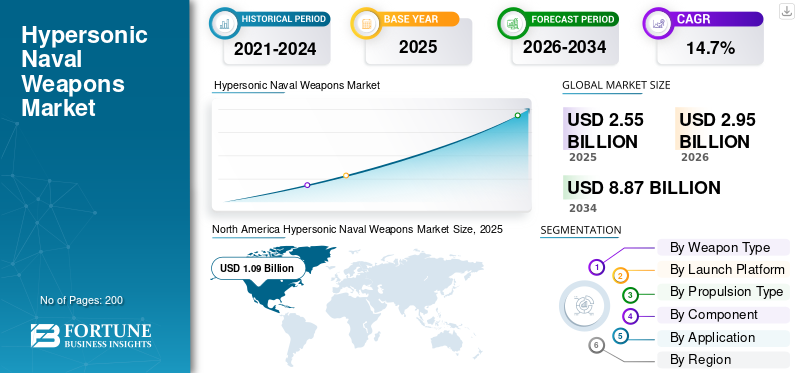
The global hypersonic naval weapons market size was valued at USD 2.55 billion in 2025. The market is projected to grow from USD 2.95 billion in 2026 to USD 8.87 billion by 2034, exhibiting a CAGR of 14.7% during the forecast period. North America dominated the hypersonic naval weapons market with a market share of 42.74% in 2025.
The global market is defined as the development, integration, and procurement of hypersonic weapons systems for naval vessels such as destroyers, submarines, and aircraft carriers. This industry is driven by an increase in naval modernization initiatives, the need for a quicker long-range precision-strike weapon, and a growing military interest in weapons systems with the capability of providing survivability in a more advanced adversary air and missile defense environment.
Considering the key players, Lockheed Martin is a notable company due to its role in the Navy’s Conventional Prompt Strike initiative and its work on integrating this technology onto Zumwalt-class destroyers. RTX, through its subsidiary Raytheon, is another key player with its HALO initiative, designed to deliver a high-speed ASBM for the Navy’s long-range fires initiative. Northrop Grumman is strengthening the supply side of this industry with its investments in production infrastructure for hypersonic production and propulsion.
Download Free sample to learn more about this report.
Hypersonic Naval Weapons Market Key Takeaways
 Market Size & Forecast
- 2025 Market Size: USD 2.55 billion
- 2026 Market Size: USD 2.95 billion
- 2034 Forecast Market Size: USD 8.87 billion
- CAGR: 14.7% from 2026–2034
 Market Share
- North America dominated the hypersonic naval weapons market with a 42.74% share in 2025.
- The coastal launch systems segment is projected to grow at the fastest CAGR of 23.0% during the forecast period.
- The thermal protection segment is anticipated to expand at a CAGR of 16.6% over the study period.
 Key Regional Highlights
North America
North America led the global market in 2025, supported by extensive defense modernization programs and strong investments in advanced naval strike capabilities.
Europe
Europe is witnessing rapid market acceleration due to rising geopolitical tensions, increasing defense budgets, and growing focus on long-range naval deterrence systems.
Asia Pacific
Asia Pacific is emerging as the second-largest and second-fastest-growing market, driven by increasing investments in hypersonic glide vehicles, scramjets, and strategic defense technologies.
U.S.
The U.S. hypersonic naval weapons market stood at approximately USD 1.08 billion in 2025, supported by strong defense spending and ongoing development of advanced hypersonic systems.
Japan
Japan’s market was valued at around USD 0.05 billion in 2025, driven by growing investments in long-range precision strike capabilities and regional defense preparedness.
Read More

HYPERSONIC NAVAL WEAPONS MARKET TRENDS
Naval Forces’ Shift from Hypersonic Research to Platform-Level Deployment
The global market is moving from early-stage development and deployment programs to actual naval integration. Current efforts focus on fielding precision ship-based systems capable of high-velocity maneuvering. This broader initiative is also influencing related air breathing and hypersonic cruise missile programs, although sea-based systems are following a distinct path from traditional ballistic missiles. This transition strengthens the joint force by directly integrating Navy initiatives with Air Force capabilities, Defense Advanced Research Projects Agency (DARPA), and national long-range deterrence priorities.
MARKET DYNAMICS
MARKET DRIVERS
Download Free sample to learn more about this report.
Growing Need for Fast Long-Range Naval Strike Capability to Drive the Market Growth
The rising need for faster and more survivable precision strike capability in contested maritime environments is fueling the hypersonic naval weapons market growth. Navies want weapons that can respond quickly, travel at speeds exceeding Mach 5, and get through advanced defenses better than most standard systems. This is speeding up the development and use of advanced hypersonic weapon systems, as well as increasing investment in guidance systems, propulsion, and other hypersonic technologies throughout the forecast period.
In May 2024, the U.S. Navy announced a successful end-to-end flight test of its sea-based Conventional Prompt Strike capability, marking an important step toward operational naval hypersonic deployment.
MARKET RESTRAINTS
High Cost and Technical Complexity of Hypersonic Systems to Restrain Market Growth
Developing reliable hypersonic naval weapons involves high cost and technical difficulties act as a major bottleneck for the entire global market. The engineering hurdles are huge as creating systems that can withstand extreme temperature, sustained heat, maneuver at blistering speeds, and still maintain pinpoint accuracy requires overcoming immense technical challenges. These complexities slow down the development and deployment cycle and limit procurement, even as hypersonic weapons industry continues to grow.
MARKET OPPORTUNITIES
Expanding Integration of Hypersonic Weapons across Naval Platforms to Create Major Market Opportunity
A major opportunity in the global market lies in the expansion of development and deployment programs. As nations tend to expand the hypersonic naval weapons programs from single-platform testing to broader fleet integration. This includes equipping both destroyers and submarines with advanced hypersonic weapon systems, which will result in an increasing demand for launch modules, guidance systems, thermal protection, and other enabling hypersonic technologies. This platform expansion creates opportunity for prime contractors and subsystem suppliers, especially as the U.S. pushes naval precision strike capability deeper into future force planning.
In FY2024 reporting released in 2025, the U.S. Department of Defense’s Director, Operational Test & Evaluation stated that the Conventional Prompt Strike program expects to demonstrate launch capability from representative launch canisters for both Zumwalt-class destroyers and Virginia-class submarines in future test events.
MARKET CHALLENGES
Testing Setbacks and System Reliability Risks Remain a Major Challenge for Market Growth
A major challenge in the global market is proving consistent system reliability during testing and transition to operational use. Hypersonic programs need to work under dangerous thermal stress, high-speed maneuvering, and tight accuracy requirements, making validation difficult. Even when the demand for precision strike capability is strong, failed or delayed tests can slow the development and deployment of hypersonic weapon systems and raise insecurity across the hypersonic weapons industry.
Impact of Russia Ukraine War and Middle East Conflicts
Ongoing Geopolitical Conflicts to Accelerate Hypersonic Weapons Demand and Global Arms Competition
The Russia-Ukraine war and rising tensions across the Middle East have reshaped the global market by reinforcing the importance of advanced military capabilities and rapid-response precision strike systems. These conflicts have exposed the limitations of traditional ballistic missiles and conventional strike options against modern air defense networks, pushing countries to prioritize hypersonic technologies capable of operating at hypersonic speeds.
As a result, major defense powers, including the U.S., are accelerating the development and deployment of hypersonic weapon systems. There has also been an increase in investments in guidance systems, interception countermeasures, and naval-based deterrence. Additionally, these conflicts are increasing the global arms race, driving both established players and emerging defense nations to expand their presence in the hypersonic weapons industry over the forecast period.
- In March 2022, Russia confirmed the operational use of the Kinzhal hypersonic missile in Ukraine, marking one of the first known combat uses of a hypersonic-class weapon.
Furthermore, ongoing Middle East tensions since late 2023 have prompted the U.S. Navy and allied forces to increase missile defense deployments in the Red Sea region. This highlights the growing relevance of high-speed strike and counter-strike systems in real-world conflict situations.
Segmentation Analysis
By Weapon Type
Hypersonic Glide Vehicles (HGVs) Segment Dominates the Market due to Superior Maneuverability
In terms of weapon type, the market is categorized into hypersonic glide vehicles and hypersonic cruise missiles.
The hypersonic glide vehicles segment holds the largest global hypersonic naval weapons market share as they are aligned with current naval precision strike requirements. Unlike traditional ballistic missiles, these systems can maneuver during flight, making them harder to track and intercept. Resulting navies get a more credible long-range strike option in heavily contested environments.
The hypersonic cruise missiles segment is expected to grow at a CAGR of 16.2% over the forecast period.
By Launch Platform
Surface Ships Segment Leads with Reliability for Operational Deployment
On the basis of launch platform, the market is classified into surface ships, submarines, and coastal launch systems.
The surface ships segment currently holds the largest share of the global market, serving as the most viable, reliable, and visible platform for near-term development and operational deployment. Additionally, current industry momentum is heavily driven by destroyer-based integration, with navies utilizing large surface vessels to accelerate the fielding of long-range precision strike capabilities with the broader fleet-wide application.
In May 2024, the U.S. Navy stated that its successful sea-based Conventional Prompt Strike flight test used the cold-gas launch approach planned for Navy platform. Moreover, the Naval Sea Systems Command confirmed continued integration work for the Conventional Prompt Strike weapon system on the USS Zumwalt (DDG 1000) class, showcasing that surface combatants remain the primary focus of current naval hypersonic deployment efforts.
The coastal launch systems segment is expected to show the fastest growth, registering a CAGR of 23.0% over the forecast period.
To know how our report can help streamline your business, Speak to Analyst
By Propulsion Type
Boost-Glide Segment Leads due to High Speed Capabilities
Based on propulsion type, the market is segmented into boost-glide, scramjet, and advanced systems.
The boost-glide segment currently dominates the global market as it is the foundation for most active naval development programs. This propulsion type aligns perfectly with long-range precision strike requirements, offering navies a way to achieve high-speed capabilities and also remain difficult to intercept. Additionally, the naval sector is advancing faster in boost-glide systems than in air breathing systems, as this technology is more mature and already integrated into recent platform deployments.
The advanced systems segment is the fastest growing segment and is expected to grow at a CAGR of 21.6% over the forecast period.
By Component
Missile Body Segment Dominates Due to Structural Importance in Sustaining High-Speed Flight and Thermal Survivability
Based on component, the market is segmented into missile body, propulsion, guidance, thermal protection, and others.
The missile body dominates the global market as it makes the core structure of the weapon and directly affects range, survivability, and performance at hypersonic speeds. Additionally, in naval systems, the body must withstand extreme thermal and aerodynamic stress and also need to support the glide body, propulsion stages, and internal guidance systems. As ongoing programs are still centered on proving full-weapon performance, investment remains heavily focused on the missile body and its associated materials, structure, and integration work.
The thermal protection segment is the fastest growing segment in the market and is expected to grow at a CAGR of 16.6% during the forecast period.
By Application
Land Attack Dominates Due to Rise in Long-Range Precision Strike Missions
Based on application, the market is segmented into anti-surface warfare, land attack, strategic deterrence, time-sensitive targeting, and others.
The land attack segment holds the largest share of global market as current naval hypersonic programs are developed around long-range precision strike missions against high-value land-based targets. Moreover, for naval forces, this application offers stronger strategic value, since it extends strike reach from sea and supports deterrence in contested regions. Due to this, most of the recent development effort, especially in the U.S., are centered on land-attack-focused hypersonic weapon systems.
The anti-surface warfare segment is expected to show the fastest growth, registering a CAGR of 16.3% over the forecast period.
Hypersonic Naval Weapons Market Regional Outlook
By geography, the market is categorized into North America, Europe, Asia Pacific, and rest of the world.
North America
North America Hypersonic Naval Weapons Market Size, 2025 (USD Billion)
To get more information on the regional analysis of this market, Download Free sample
North America leads the global market. The U.S. currently holds the most advanced portfolio of funded naval hypersonic programs and is focused on testing activity and advanced ship-based integration efforts. The market is driven by development and deployment initiatives instead of just theoretical models, with a primary focus on enhancing long-range precision strike capabilities, notably through the U.S. Navy’s Conventional Prompt Strike (CPS) program. This sector is propelled by a mature defense industrial base, advanced R&D infrastructure, and sustained military investment, accelerating the operational deployment of advanced hypersonic weapon systems.
U.S. Hypersonic Naval Weapons Market
Based on the strong contribution of North America to the market and the dominance of U.S. within the region, the U.S. market stood at around USD 1.08 billion in 2025. This market is anticipated to grow at a CAGR of 13.7% over the forecast period.
Europe
The Europe market is witness rapid acceleration, driven by geopolitical necessity and increasing defense budgets to enhance strategic deterrence. Major defense firms involved include MBDA, Thales Group, Leonardo S.p.A., Saab AB, and ArianeGroup. Germany is a key player, holding a large share of the long-range weapons market, while the U.K. is investing significantly in independent strike capabilities. During the forecast period, European efforts are aimed at closing the gap with major global powers (Russia, China, and the U.S.). The focus on naval applications is designed to protect sea lanes, neutralize air defenses, and provide high-speed, long-range targeting options for European naval platforms.
France Hypersonic Naval Weapons Market
The France market reached approximately USD 0.03 billion in 2025, equivalent to around 5.78% of Europe revenues.
Russia Hypersonic Naval Weapons Market
Russia's aggressive deployment and testing schedule have placed it ahead in the regional race. Owing to this, the Russia market stood at around USD 0.45 billion in 2025, representing roughly 79.48% of Europe revenues.
Asia Pacific
Asia Pacific is the second-largest market and is anticipated to be the second-fastest growing region, registering a CAGR of 16.3% during the forecast period. The regional market growth is driven by increasing regional security competition, nations are heavily investing in hypersonic glide vehicles (HGVs), scramjets, and counter-hypersonic defenses to maintain strategic deterrence. Significant investment is driven by China, India, Japan, and South Korea, aiming to enhance long-range precision strike capabilities.
China Hypersonic Naval Weapons Market
China is a leader in hypersonic technology, having deployed the DF-17 hypersonic glide vehicle. The China market is projected to be one of the largest in Asia Pacific, with 2025 revenues standing at around USD 0.68 billion, representing roughly 80.12% of the global sales.
Japan Hypersonic Naval Weapons Market
The Japanese market stood at around USD 0.05 billion in 2025, accounting for roughly 6.08% of Asia Pacific revenues.
Rest of the World
The rest of the world (Middle East & Africa and Latin America) holds a comparatively smaller market share but is expected to grow at a CAGR of 24.6% over the forecast period. The Middle East & Africa region is experiencing a surge in defense modernization, with hypersonic technologies increasingly important due to regional security threats and strategic significance, such as in the Gulf. Latin America’s hypersonic weapons market is emerging, driven by a desire for strategic autonomy, regional modernization programs, and strategic partnerships with global powers.
Latin America Hypersonic Naval Weapons Market
The market in Latin America reached around USD 0.01 billion, accounting for roughly 37.12% of rest of the world revenues, in 2025.
Middle East & Africa Hypersonic Naval Weapons Market
The Middle East & Africa market stood at around USD 0.02 billion in 2025 and is expected to reach USD 0.18 billion in 2034, representing roughly 62.88% of rest of the world market in 2025. This is due to ongoing regional conflicts and the need for advanced precision strike capabilities.
COMPETITIVE LANDSCAPE
Key Industry Players
Strategic Competition between Key Military Powers to Push Industry Participants to Develop Advanced Weapons
The global hypersonic naval weapons market is undergoing rapid expansion, driven by intense strategic competition between major military powers, particularly the U.S., China, and Russia. Naval-specific applications, including ship-launched hypersonic cruise missiles and glide vehicles, are a key focus for ensuring maritime superiority and penetrating advanced anti-access/area-denial (A2/AD) networks. Key industry leaders include Lockheed Martin, who is developing the Conventional Prompt Strike (CPS) system for U.S. Navy vessels, and RTX Corporation (Raytheon), recognized for its work on the Hypersonic Attack Cruise Missile (HACM) and Glide Breaker interceptors.
The market is also categorized by significant regional investment and international collaboration, with Asia Pacific emerging as a fast-growing segment due to programs from BrahMos Aerospace (India) and Mitsubishi Heavy Industries (Japan). Other prominent players involved in naval hypersonic technologies include BAE Systems, Boeing, and Thales Group, which support the development of guidance, avionics, and structural components. Russia continues to push the boundaries with its 3M22 Zircon scramjet-powered anti-ship missile, integrated into its Navy’s Project 22350 frigates, while emerging players such as Castelion are securing naval contracts for operational strike weapons. Competition is being shaped less by volume production and more by proven system maturity, platform integration, test reliability, and next-step readiness in advanced hypersonic weapon systems.
LIST OF KEY HYPERSONIC NAVAL WEAPONS COMPANIES PROFILED
- Northrop Grumman Corporation (U.S.)
- Lockheed Martin Corporation (U.S.)
- RTX (Raytheon Technologies) (U.S.)
- L3Harris Technologies, Inc. (U.S.)
- BAE Systems plc. (U.K.)
- Leidos Holdings, Inc. (U.S.)
- Boeing Company (U.S.)
- MBDA (France)
- General Dynamics Corporation (U.S.)
- BrahMos Aerospace (India)
KEY INDUSTRY DEVELOPMENTS
- June 2024: Leidos announced that its Mayhem air breathing hypersonic system successfully completed the conceptual design review and system requirements review for AFRL, indicating tangible progress from contract award toward program maturation.
- May 2024: OCCAR and MBDA, under the HYDIS program, launched the concept phase for a European hypersonic defense interceptor effort valued at around USD 161.55 million, with support from the European Defence Fund.
- May 2024: The U.S. Navy confirmed a successful end-to-end flight test of its sea-based Conventional Prompt Strike capability, using the cold-gas launch approach planned for naval fielding.
- March 2023: The U.S. Department of the Navy included procurement funding for eight Conventional Prompt Strike all-up rounds in its FY2024 budget request, showcasing that the program had moved beyond pure R&D and into funded acquisition planning.
- February 2023: Lockheed Martin received an initial USD 1.10 billion contract from the U.S. Navy to integrate the Conventional Prompt Strike (CPS) weapon system onto Zumwalt-class destroyers, supporting the first sea-based hypersonic strike capability for the U.S. Navy.
- January 2023: DARPA announced the final successful flight of the HAWC program, stating that the effort had produced two feasible hypersonic air breathing missile designs from Lockheed Martin and Raytheon, strengthening the future pipeline for hypersonic cruise missile development.
- December 2022: Leidos announced that it had been awarded a USD 334.00 million contract by the U.S. Air Force Research Laboratory (AFRL) to support the development of an air-breathing hypersonic system. This would expand competition and subsystem capability in the wider hypersonic weapons industry.
REPORT COVERAGE
The global hypersonic naval weapons market analysis provides an in-depth study of the market size, company profiling, and forecast by all the market segments included in the report. It includes details on the market dynamics and trends that are expected to drive the market during the forecast period. It offers information on the technological advances, new product launches, key industry developments, and details on strategic partnerships, mergers, and acquisitions. The research report also encompasses detailed competitive landscape with information on the market share and profiles of key market players.
Request for Customization to gain extensive market insights.
Report Scope & Segmentation
| ATTRIBUTE | DETAILS |
| Study Period | 2021-2034 |
| Base Year | 2025 |
| Estimated Year | 2026 |
| Forecast Period | 2026-2034 |
| Historical Period | 2021-2024 |
| Growth Rate | CAGR of 14.7% from 2026 to 2034 |
| Unit | Value (USD Billion) |
|
Segmentation
|
By Weapon Type
|
|
By Launch Platform
|
|
|
By Propulsion Type
|
|
|
By Component
|
|
|
By Application
|
|
|
By Region
|
Frequently Asked Questions
Fortune Business Insights says that the global market value is expected to reach USD 2.95 billion in 2026 and is projected to reach USD 8.87 billion by 2034.
In 2025, the North America market value stood at USD 1.09 billion.
The market is expected to exhibit a CAGR of 14.7% during the forecast period.
The hypersonic glide vehicles segment led the market by weapon type.
The growing need for fast long-range naval strike capability is a key factor driving the market growth.
Key players in the market include Northrop Grumman, Lockheed Martin, RTX, L3Harris, Leidos Holdings, Inc., and BAE Systems.
North America dominates the market in terms of share.



- 2021-2034
- 2025
- 2021-2024
- 200
Get 30-60 hrs Free Customization
Expand Regional and Country Coverage, Segments Analysis, Company Profiles, Competitive Benchmarking, and End-user Insights.




















Related Reports
-
US +1 833 909 2966 ( Toll Free )
-
Get In Touch With Us