Implantable Biosensors Market Size, Share & Industry Analysis, By Sensor Type (Electrophysiological Sensors, Piezoelectric Sensors, Electrochemical Biosensors, Strain-based Sensors, and Others), By Implant Location (Subcutaneous, Intravascular, Intracardiac, and Others), By Application (Diabetes Monitoring, Cardiac Monitoring, Activity Monitoring, Respiratory Monitoring, and Others), By End-user (Hospitals & Specialty Clinics, Homecare Settings, and Others), and Regional Forecast, 2026-2034
 Download Free Sample
Implantable Biosensors Market Size and Future Outlook
 Listen to Audio Version
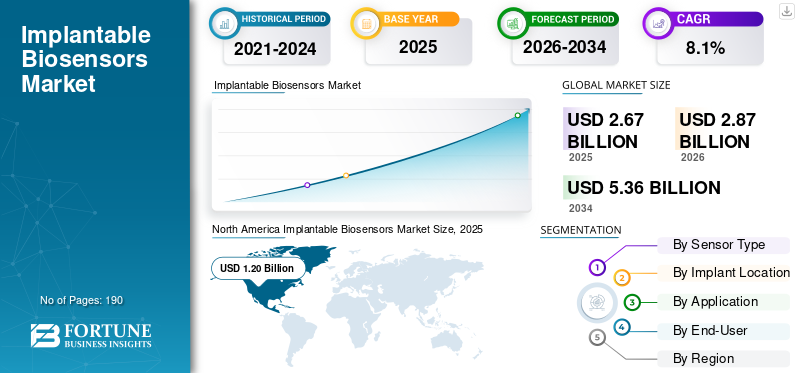
The global implantable biosensors market size was valued at USD 2.67 billion in 2025. The market is projected to grow from USD 2.87 billion in 2026 to USD 5.36 billion by 2034, exhibiting a CAGR of 8.1% during the forecast period. North America dominated the implantable biosensors market with a market share of 44.94% in 2025.
Implantable biosensors are small medical devices placed inside the body to continuously monitor health signals such as heart activity, nerve signals, or chemical changes. These sensors help healthcare professionals track patients over long periods without repeated hospital visits. Market growth is driven by the rising prevalence of chronic conditions, the emphasis on continuous monitoring, and technological advancements in biosensors. In addition, a growing number of product approvals and the introduction of new devices are also estimated to have a positive impact on the market.
- For instance, in May 2024, Medtronic announced the introduction of new AI models in insertable cardiac monitors. The new models are added in order to improve the efficiency of cardiac monitoring.
Moreover, many key industry players, such as Abbott, Medtronic plc, Boston Scientific Corporation, BIOTRONIK SE & Co. KG, and Senseonics Holdings, Inc., operating in the market, are focusing on developing various innovative technologies to offer better products with improved accuracy and efficiency.
Download Free sample to learn more about this report.
Download Free sample to learn more about this report.
IMPLANTABLE BIOSENSORS MARKET TRENDS
Increasing Demand for Miniaturization and Longer Device Life is a Key Market Trend
The market is currently witnessing growing demand for miniature, long-lasting devices for efficient implantation procedures. As there is a growing emphasis on minimally invasive surgeries, healthcare professionals and patients are focusing on miniature devices due to their small size. In addition, improvements in battery life and energy efficiency allow sensors to work for years without replacement. This reduces the need for repeat procedures and increases patient acceptance. Companies are focusing on compact designs that can deliver reliable data with minimal maintenance.
- For instance, in June 2025, Ottai announced the development of an AI-powered biosensor for chronic disease management. The device can continuously monitor key biomarkers.
Global Implantable Biosensors Market KEY TAKEAWAYS
 Market Size & Forecast
- 2025 Market Size: USD 2.67 billion
- 2026 Market Size: USD 2.87 billion
- 2034 Forecast Market Size: USD 5.36 billion
- CAGR: 8.1% from 2026–2034
 Market Share
- North America led with 44.94% share and USD 1.20 billion market value in 2025.
- Electrophysiological sensors led the market, driven by cardiac and neurological monitoring demand.
- Hospitals & specialty clinics are set to hold a 79.8% market share in 2026.
 Key Regional Highlights
North America
The market was valued at USD 1.20 billion in 2025.
Europe
The market is projected to reach USD 1.34 billion in 2026.
Asia Pacific
The market is expected to reach USD 0.62 billion in 2026.
U.S.
The market is expected to reach USD 1.10 billion in 2026.
Japan
The market is expected to reach USD 0.11 billion in 2026.
Read More

MARKET DYNAMICS
MARKET DRIVERS
Increasing Need for Continuous Patient Monitoring is Projected to Accelerate Market Growth
Healthcare professionals are increasingly focusing on continuous monitoring instead of one-time tests. Many health conditions, especially those affecting the heart and nervous systems, change over time and cannot be captured during short hospital visits. Moreover, implantable biosensors provide real time data, helping doctors detect issues early and adjust treatment quickly. In addition, hospitals also benefit from fewer emergency admissions and better long-term patient management.
- For instance, in September 2025, Smart Meter announced the launch of its new iAmbientHealth for contactless and continuous patient monitoring. The new system provides real time patient data for better treatment outcomes.
MARKET RESTRAINTS
High Cost and Invasive Procedures is Expected to Hamper Market Growth
Implantable biosensors require a medical procedure to place them inside the body, which increases cost and limits adoption in some cases. Moreover, not all patients are willing or suitable for implants. Hospitals also need trained staff and follow-up systems, which adds expense. In cost-sensitive regions, doctors may prefer external or wearable monitoring devices instead. These factors slow adoption, particularly in smaller hospitals and clinics, even though the long-term benefits are clear.
MARKET OPPORTUNITIES
Growing Demand for Remote and Preventive Healthcare to Offer Lucrative Market Growth Opportunities
The market is witnessing growing demand for continual remote monitoring for the investigation of patient’s health and overall body condition. In addition, healthcare systems are focusing more on preventing complications rather than treating emergencies. Implantable biosensors support this shift by allowing doctors to remotely monitor patients after discharge. This reduces repeat hospital visits and improves patient comfort. Moreover, the growing number of new products driven by technological advancements is expected to offer a favorable opportunity for the global implantable biosensors market growth during the forecast period.
- For instance, in December 2025, vTitan Corporation announced the launch of its new wearable point-of-care cardiac monitor, vCardio, for continuous monitoring. The newly introduced system is AI-powered, allowing it to detect cardiac events in the early phase.
MARKET CHALLENGES
Complexities in Data Handling and Long-term Reliability Issues Are Likely to Pose a Critical Market Challenge
Implantable biosensors generate large amounts of patient data that must be stored, analyzed, and protected. Hospitals need secure systems to manage this information. Long-term reliability is also critical, as device failure can require another procedure. Any safety concern affects a doctor’s confidence and patient trust. Manufacturers must ensure consistent performance over many years, which increases development and testing effort. Managing data quality and device reliability remains a key challenge for market players.
Segmentation Analysis
By Sensor Type
Superior Efficiency of Electrophysiological Sensors in Cardiac and Neurological Monitoring to Drive Segment Growth
Based on the sensor type, the market is divided into electrophysiological sensors, piezoelectric sensors, electrochemical biosensors, strain-based sensors, and others.
The electrophysiological sensors segment is anticipated to account for the largest implantable biosensors market share. The sensors have superior efficiency in cardiac and neurological monitoring, which is prominently driving the segment growth. Moreover, these sensors help detect irregular heart rhythms and abnormal electrical activity in the body. In addition, the increasing demand for continual heart-related monitoring in hospitals is expected to accelerate segment growth.
- For instance, in February 2023, Abbott received FDA and EU approval for its new sensors for the treatment of abnormal heart rhythms.
The electrochemical biosensors segment is anticipated to rise with a CAGR of 9.7% over the forecast period.
To know how our report can help streamline your business, Speak to Analyst
By Implant Location
Focus on Minimally Invasive Procedures to Boost Subcutaneous Segment Growth
Based on implant location, the market is segmented into subcutaneous, intravascular, intracardiac, and others.
In 2025, the subcutaneous segment dominated the global market. Subcutaneous implants, placed just under the skin, hold the largest share as they are less invasive and easier to monitor. These implants offer long-term data collection with a lower surgical risk than deeper implants. Patients recover faster, and hospitals can manage follow-ups more easily. Many cardiac monitoring devices use subcutaneous placement, making this location the preferred choice across hospitals and specialty clinics.
The intravascular segment is anticipated to rise with a CAGR of 9.2% over the forecast period.
By Application
Substantial Prevalence of Cardiac Conditions to Accelerate Cardiac Monitoring Segment Growth
Based on application, the market is segmented into diabetes monitoring, cardiac monitoring, activity monitoring, respiratory monitoring, and others.
In 2025, the cardiac monitoring segment dominated the global market. The market growth is attributed to the substantial prevalence of cardiac disease worldwide and the adoption of cardiac implants for its treatment, driven by superior treatment outcomes. In addition, rising investments by companies and government authorities to address cardiac conditions are estimated to positively impact market growth.
The diabetes monitoring segment is anticipated to rise with a CAGR of 9.9% over the forecast period.
By End-User
Higher Volume of Cardiac Surgeries in Hospitals to Boost Segment Growth
Based on end-user, the market is segmented into hospitals & specialty clinics, homecare settings, and others.
In 2025, the hospitals & specialty clinics segment held the highest market share. Implantable biosensors require medical procedures, expert evaluation, and ongoing follow-up. These settings have trained cardiologists and neurologists who interpret sensor data and adjust treatment. Specialty clinics focused on heart and nerve disorders increasingly use implantable biosensors to improve patient outcomes. Furthermore, the segment is set to hold a 79.8% share in 2026.
In addition, homecare settings segment is projected to grow at a CAGR of 8.6% during the forecast period.
Implantable Biosensors Market Regional Outlook
By geography, the market is categorized into Europe, North America, Asia Pacific, Latin America, and the Middle East & Africa.
North America
North America Implantable Biosensors Market Size, 2025 (USD Billion)
To get more information on the regional analysis of this market, Download Free sample
North America held the dominant share in 2024, valued at USD 1.12 billion, and also maintained the leading share in 2025, with USD 1.20 billion. The regional market is expected to grow due to greater emphasis on minimally invasive surgeries, the rising incidence of diabetes, and development in implemented biosensors.
U.S. Implantable Biosensors Market
Based on North America’s strong contribution and the U.S. dominance within the region, the U.S. market can be analytically approximated at around USD 1.10 billion in 2026, accounting for roughly 38.2% of global sales.
Europe
Europe is likely to record a growth rate of 7.6% in the coming years, and reach a valuation of USD 1.34 billion by 2026. The region is estimated to witness considerable market growth due to the approval of new products and technological developments.
U.K. Implantable Biosensors Market
The U.K. market in 2026 is estimated at around USD 0.12 billion, representing about 4.2% of global revenues.
Germany Implantable Biosensors Market
Germany’s market is projected to reach approximately USD 0.17 billion in 2026, equivalent to around 5.8% of global sales.
Asia Pacific
Asia Pacific is expected to reach USD 0.62 billion in 2026 and secure the position of the third-largest region in the market. Improving healthcare infrastructure coupled with the introduction of new products to accelerate regional growth.
Japan Implantable Biosensors Market
The Japanese market in 2026 is estimated at around USD 0.11 billion, accounting for roughly 3.8% of global revenues.
China Implantable Biosensors Market
China’s market is projected to be one of the largest worldwide, with 2026 revenues projected at around USD 0.21 billion, representing roughly 7.2% of global sales.
India Implantable Biosensors Market
The Indian market in 2026 is projected at around USD 0.14 billion, accounting for about 4.8% of global revenues.
Latin America and Middle East & Africa
The Latin America and the Middle East & Africa regions are expected to experience moderate growth in this market during the forecast period. The Latin America market is likely to reach a valuation of USD 0.12 billion in 2026. In the Middle East & Africa, the GCC is expected to reach a value of USD 0.03 billion in 2026.
South Africa Implantable Biosensors Market
The South Africa’s market is anticipated to reach around USD 0.01 billion in 2026, representing roughly 0.48% of global revenues.
COMPETITIVE LANDSCAPE
Key Industry Players
Technological Advancements and Focus on Technological Collaborations by Key Players to Boost Market Progress
The global implantable biosensors market holds a semi-consolidated market structure, including key players such as Abbott, Medtronic plc, Boston Scientific Corporation, BIOTRONIK SE & Co. KG, and Senseonics Holdings, Inc. The significant market share of these companies is driven by numerous strategic activities, including massive investments and technological collaborations.
- For instance, in January 2026, Abbott announced a strategic collaboration with AtaCor to develop and expand advanced extravascular ICD technology.
Other notable players in the global market are Profusa, Inc., Endotronix, Inc., NeuroPace, Inc., and Neuralink Corp. These companies are likely to prioritize collaborations to increase their market share.
LIST OF KEY IMPLANTABLE BIOSENSORS COMPANIES PROFILED
- Abbott (U.S.)
- Medtronic plc (Ireland)
- Boston Scientific Corporation (U.S.)
- BIOTRONIK SE & Co. KG (Germany)
- Senseonics Holdings, Inc. (U.S.)
- Profusa, Inc. (U.S.)
- Endotronix, Inc. (U.S.)
- NeuroPace, Inc. (U.S.)
- Neuralink Corp. (U.S.)
- Paradromics, Inc. (U.S.)
- Synchron, Inc. (U.S.)
KEY INDUSTRY DEVELOPMENTS
- October 2025: Boston Scientific Corporation announced the acquisition of Nalu Medical, Inc. to consolidate its position in the pain therapy market.
- April 2025: Medtronic plc received FDA approval for its SelectSecure Model 3830 pacing lead for the treatment of ventricular tachyarrhythmias and ventricular fibrillation.
- April 2024: Medtronic plc received FDA approval for its Inceptiv, spinal cord stimulator. The newly launched device has closed-loop functionality and automated programing for treatment of chronic pain.
- February 2024: Medtronic received FDA approval for its world’s first adaptive deep brain stimulation for the treatment of Parkinson’s disease.
- September 2023: Abbott received FDA approval for its world’s first dual chamber leadless pacemaker
REPORT COVERAGE
The global implantable biosensors market analysis includes a comprehensive study of the market size and forecast for all the market segments included in the report. It includes details on the market dynamics and trends expected to drive the market over the forecast period. It provides information on key aspects, including an overview of technological advancements, the regulatory environment, and product launches. Additionally, it details partnerships, mergers, and acquisitions, as well as key industry developments and investments by key regions. The global market research report also provides a depth competitive landscape with information on the market share and profiles of key operating players.
Request for Customization to gain extensive market insights.
Report Scope & Segmentation
| ATTRIBUTE | DETAILS |
| Study Period | 2021-2034 |
| Base Year | 2025 |
| Estimated Year | 2026 |
| Forecast Period | 2026-2034 |
| Historical Period | 2021-2024 |
| Growth Rate | CAGR of 8.1% from 2026-2034 |
| Unit | Value (USD Billion) |
| Segmentation | By Sensor Type, Implant Location, Application, End-User, and Region |
| By Sensor Type |
|
| By Implant Location |
|
| By Application |
|
| By End-User |
|
| By Region |
|
Frequently Asked Questions
According to Fortune Business Insights, the global market value stood at USD 2.67 billion in 2025 and is projected to reach USD 5.36 billion by 2034.
In 2025, the North Americas market value stood at USD 1.20 billion.
The market is expected to exhibit a CAGR of 8.1% during the forecast period of 2026-2034.
By sensor type, the electrophysiological sensors segment is expected to lead the market.
Rising emphasis on minimally invasive surgical procedures coupled with rising prevalence of cardiac conditions are the key factors driving market expansion.
Abbott, Medtronic plc, Boston Scientific Corporation, BIOTRONIK SE & Co. KG, and Senseonics Holdings, Inc. are the major players in the global market.
North America dominated the market in 2025 with the largest share.



- 2021-2034
- 2025
- 2021-2024
- 190
Get 30-60 hrs Free Customization
Expand Regional and Country Coverage, Segments Analysis, Company Profiles, Competitive Benchmarking, and End-user Insights.













.webp)






Related Reports
-
US +1 833 909 2966 ( Toll Free )
-
Get In Touch With Us