Industrial Automation Services Market Size, Share & Industry Analysis, By Service Type (Engineering, Integration & Deployment, Maintenance & Support, Consulting, Operational, Modernization & Migration), By Product Type (Distributed Control, SCADA, PLC, Manufacturing Execution Systems (MES), Industrial Robotics, Industrial IoT & Digital Automation Platforms), By Deployment Mode (On-Premise, Cloud-Based & Hybrid), By Industry (Oil & Gas, Automotive, Chemicals, Petrochemicals, Pharmaceuticals, Food & Beverage, Power, Electronics & Semiconductor), and Regional Forecast, 2026 – 2034
 Download Free Sample
Industrial Automation Services Market Size and Future Outlook
 Listen to Audio Version
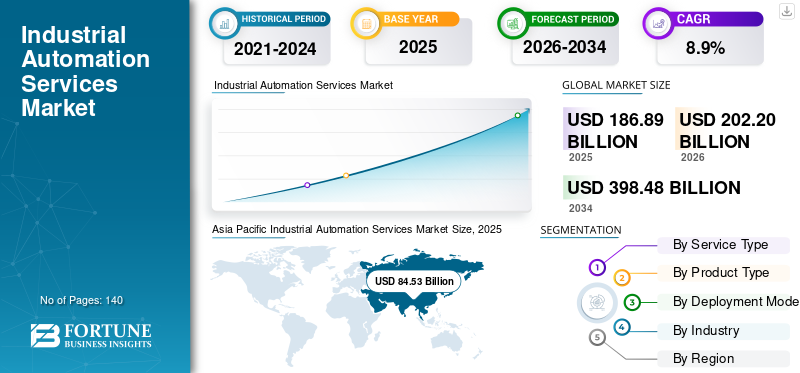
The global industrial automation services market size was valued at USD 186.89 billion in 2025. The market is projected to grow from USD 202.20 billion in 2026 to USD 398.48 billion by 2034, exhibiting a CAGR of 8.9% during the forecast period. Asia Pacific dominated the industrial automation services market with a market share of 45.23% in 2025.
Industrial automation services comprise specialized engineering, integration, deployment, maintenance, and operational support services designed to improve manufacturing efficiency, process reliability, production visibility, and industrial asset performance across discrete and process industry environments. These services support the integration of Programmable Logic Controllers (PLCs), Distributed Control Systems (DCS), Supervisory Control and Data Acquisition (SCADA) platforms, Manufacturing Execution Systems (MES), industrial robotics, Industrial IoT architectures, motion control systems, and plant asset management platforms. These technologies further enhance operational productivity, reduce unplanned downtime, improve process consistency, strengthen industrial cybersecurity, and enable real-time production monitoring across industrial facilities. Industrial automation services enable organizations to modernize legacy control infrastructure, optimize plant-wide automation workflows, improve predictive maintenance capabilities, support digital manufacturing initiatives, and accelerate smart factory transformation programs. These services are deployed across automotive, chemicals, oil & gas, food & beverage, pharmaceuticals, power generation, semiconductor, logistics, and heavy industrial sectors. Organizations are increasingly adopting advanced automation technologies to support the increasing adoption of Industry 4.0, while the integration of artificial intelligence, machine learning, and digital twins is improving operational intelligence and manufacturing performance.
- In April 2025, Siemens AG expanded its industrial AI-enabled automation service capabilities through enhanced digital industrial software and factory automation integration initiatives. Such an initiative was focused on improving predictive maintenance, production optimization, and industrial operational efficiency across manufacturing facilities globally.
Siemens AG, ABB Ltd., Schneider Electric SE, Rockwell Automation, Inc., Honeywell International Inc., Emerson Electric Co., Yokogawa Electric Corporation, Mitsubishi Electric Corporation, Johnson Controls International plc, and Bosch Rexroth AG are among the major companies operating in the market.
Download Free sample to learn more about this report.
INDUSTRIAL AUTOMATION SERVICES MARKET TRENDS
Growing Adoption of AI-Powered Industrial Operations and Software-Defined Automation is Reshaping Service Delivery Models
Demand for industrial automation services is increasingly being influenced by the growing adoption of AI, software-defined automation architectures, and data-driven industrial operations across manufacturing and process industry environments. Industrial enterprises are moving beyond traditional automation deployment models and increasingly leveraging AI-enabled analytics, autonomous process optimization, industrial digital twins, and intelligent decision-support systems to improve operational responsiveness and asset performance. The market is witnessing increasing demand for automation services that support industrial AI integration, edge-to-cloud connectivity, virtual commissioning, software-centric control architectures, and real-time operational intelligence platforms. These evolving requirements are transforming the role of automation service providers from system integrators into long-term digital transformation partners capable of managing continuous optimization, advanced analytics deployment, and enterprise-wide industrial data strategies. Across North America, Europe, and Asia Pacific, manufacturers are increasingly incorporating AI-enabled production environments, connected industrial ecosystems, and software-defined manufacturing platforms. These platforms improve flexibility, accelerate innovation cycles, and support next-generation smart factory initiatives across automotive, semiconductor, electronics, chemicals, and industrial manufacturing sectors.
- In June 2025, Rockwell Automation, Inc. announced enhancements to its FactoryTalk Optix platform and Emulate3D digital twin capabilities to improve industrial visualization, remote operations, and virtual commissioning across smart manufacturing environments.
MARKET DYNAMICS
MARKET DRIVERS
Download Free sample to learn more about this report.
Rising Smart Factory Investments and Industrial Digitalization Initiatives Driving Market Growth
The market is increasingly being driven by the growing adoption of Industry 4.0 technologies, intelligent manufacturing systems, industrial IoT platforms, and plant-wide automation modernization initiatives across manufacturing, energy, logistics, and process industry environments. As organizations seek to improve production efficiency, reduce operational downtime, optimize energy utilization, strengthen industrial cybersecurity, and enhance real-time operational visibility, demand for specialized industrial automation services is increasing across global markets. Industrial automation services are becoming a critical component within enterprise digital transformation ecosystems. Organizations increasingly require control system integration, SCADA and MES deployment, robotics engineering, predictive maintenance platforms, digital twin implementation, and lifecycle automation support services. These services help to improve operational agility, asset reliability, and long-term production scalability across industrial operations.
- In May 2025, ABB Ltd. announced the expansion of its AI-enabled industrial automation and digital operations portfolio through enhanced ABB Ability solutions focused on predictive maintenance, energy optimization, and real-time process monitoring across industrial facilities.
MARKET RESTRAINTS
High Automation Deployment Costs and Legacy Infrastructure Complexity Limiting Market Expansion
The industrial automation services market growth is constrained by high automation implementation costs, integration complexity associated with legacy industrial infrastructure, and increasing enterprise concerns related to cybersecurity risks, operational disruption, and long-term modernization investment requirements. Implementing plant-wide industrial automation strategies often requires significant investment in control system upgrades, industrial software platforms, robotics integration, IIoT infrastructure, cybersecurity frameworks, workforce training, and production process redesign. Further, creating financial and operational barriers for many industrial enterprises.
In addition, fragmented industrial communication protocols, compatibility limitations between legacy and modern automation systems, and shortages of skilled automation engineers are increasing deployment complexity across global markets. Concerns surrounding industrial cybersecurity vulnerabilities, system downtime during migration projects, integration scalability challenges, and uncertain returns on automation investments continue to create operational and strategic challenges for organizations. These challenges are particularly significant for those pursuing large-scale smart manufacturing and digital industrial transformation initiatives across highly regulated and uptime-critical industries worldwide.
MARKET OPPORTUNITIES
Rising Brownfield Plant Modernization and Legacy Control System Migration Creating Long-Term Market Opportunities
A major opportunity emerging within the market is the increasing demand for brownfield industrial modernization, legacy PLC/DCS migration, and plant-wide automation upgrades across aging manufacturing and process industry infrastructure globally. As industrial facilities operating on decades-old control architectures face rising maintenance costs, cybersecurity vulnerabilities, spare-part shortages, and operational inefficiencies, demand is increasing for specialized automation services. These services are capable of supporting phased modernization strategies, multi-vendor interoperability integration, and downtime-minimized migration projects across critical industrial operations. Further, creating substantial opportunities for service providers offering legacy system replacement, industrial software reconfiguration, virtual commissioning, digital twin-assisted migration, industrial cybersecurity retrofitting, and lifecycle automation optimization services across oil & gas, chemicals, power generation, metals, pulp & paper, and heavy manufacturing sectors. The opportunity is especially strong in industrial facilities where complete greenfield replacement is financially impractical, requiring enterprises to implement gradual modernization programs while maintaining uninterrupted production continuity and operational safety standards.
- For instance, in February 2025, Yokogawa Electric Corporation announced expanded lifecycle modernization services for legacy DCS focused on improving operational continuity, cybersecurity resilience, and digital transformation capabilities across process industry facilities.
MARKET CHALLENGES
Industrial Workforce Shortages and Multi-Vendor Automation Complexity is Challenging Service Scalability
One of the major challenges affecting the market is the growing shortage of skilled automation engineers, controls specialists, robotics programmers, and industrial cybersecurity professionals required to support increasingly complex automation environments across global industrial sectors. Automation service providers must continuously manage integration challenges associated with multi-vendor industrial ecosystems involving PLCs, SCADA systems, MES platforms, robotics infrastructure, industrial software, and proprietary communication protocols operating simultaneously within the same production environment. At the same time, industrial enterprises expect automation projects to deliver rapid deployment timelines, minimal operational disruption, scalable interoperability, and measurable productivity improvements despite increasing technical complexity and evolving industrial software architectures. This creates operational pressure for automation service providers to improve workforce training capabilities, maintain cross-platform engineering expertise, support legacy-to-digital migration compatibility, and address rising implementation complexity across geographically distributed manufacturing and process industry operations worldwide.
Segmentation Analysis
By Service Type
Engineering, Integration & Deployment Services Segment Led the Market Owing to Rising Demand for Plant-Wide Automation Modernization and Industrial Digital Transformation Initiatives
By service type, the market is segmented into engineering, integration & deployment services, maintenance & support services, consulting services, operational services, modernization & migration services, and others.
Engineering, integration & deployment services held the largest market share in 2025, as these services remain the most commercially critical and widely adopted component across industrial automation implementation and smart manufacturing transformation initiatives. Industrial enterprises across automotive, chemicals, oil & gas, food & beverage, semiconductor, power generation, logistics, and heavy manufacturing environments increasingly utilize industrial automation services. This is to integrate PLCs, SCADA systems, DCS, industrial robotics, MES, and industrial IoT platforms across complex production environments. Compared with operational support or specialized consulting activities, the segment has broader applicability across factory automation deployment, process control optimization, industrial software integration, robotics commissioning, control system configuration, and plant-wide digital infrastructure modernization. Further, making it the primary revenue-generating segment within the industrial automation services ecosystem.
- In March 2025, Mitsubishi Electric Corporation expanded its digital manufacturing and factory automation engineering services through advanced integrated FA solutions focused on improving industrial productivity, operational efficiency, and smart factory deployment across global manufacturing facilities.
Operational services is expected to witness the highest growth rate, registering a CAGR of 9.9% during the forecast period. It is driven by increasing enterprise demand for remote industrial operations, predictive maintenance management, AI-enabled monitoring platforms, and continuous operational optimization services across connected manufacturing environments.
To know how our report can help streamline your business, Speak to Analyst
By Product Type
Programmable Logic Controllers Segment Led the Market Owing to Widespread Deployment Across Industrial Automation and Manufacturing Operations
By product type, the market is segmented into Distributed Control Systems (DCS), Supervisory Control & Data Acquisition (SCADA), Programmable Logic Controllers (PLC), Manufacturing Execution Systems (MES), industrial robotics & motion control systems, Industrial IoT (IIoT) & digital automation platforms, and others.
The programmable logic controllers segment held the largest market share in 2025, as PLC-based automation systems remain the most widely deployed industrial control architecture across discrete manufacturing, process industries, utilities, warehousing, and industrial infrastructure environments. Industrial enterprises across automotive, food & beverage, packaging, chemicals, semiconductor, logistics, and heavy manufacturing sectors increasingly utilize PLC-integrated automation services. This is to support machine control, production line automation, real-time operational monitoring, robotics coordination, and industrial process optimization across complex manufacturing operations. Compared with highly specialized automation platforms such as MES or IIoT analytics systems, PLC environments offer broader applicability across machine-level automation, legacy system modernization, industrial equipment integration, and scalable factory automation deployments. Further, making them the most commercially established automation category within the market.
The Industrial IoT (IIoT) & digital automation platforms segment is expected to witness the highest growth rate, registering a CAGR of 11.3% during the forecast period. It is driven by increasing enterprise demand for cloud-connected manufacturing systems, AI-enabled industrial analytics, predictive maintenance platforms, edge computing integration, and real-time industrial data visibility solutions.
By Deployment Mode
On-Premise Segment Led the Market Owing to Rising Demand for Secure, Low-Latency, and Mission-Critical Industrial Automation Infrastructure
By deployment mode, the market is segmented into on-premise, cloud-based, and hybrid.
On-premise held the largest market share in 2025, as industrial enterprises increasingly prioritize secure, highly reliable, and low-latency automation environments for managing mission-critical manufacturing and process operations across industrial facilities. Organizations across automotive, oil & gas, chemicals, power generation, food & beverage, semiconductor, and heavy manufacturing sectors widely utilize on-premise industrial automation architectures. This is to support real-time machine control, process automation, industrial cybersecurity management, and uninterrupted operational continuity across production environments. Compared with cloud-native automation environments, on-premise deployment models offer greater control over industrial data, enhanced system reliability, lower network dependency, and stronger compatibility with legacy control infrastructure. Further, making them the most commercially established deployment category within the market.
The cloud-based segment is expected to witness the highest growth rate, registering a CAGR of 12.2% during the forecast period. It is driven by increasing enterprise demand for scalable industrial analytics platforms, cloud-connected manufacturing operations, remote asset monitoring, AI-enabled predictive maintenance, and centralized multi-site automation management solutions.
By Industry
Chemicals, Petrochemicals & Pharmaceuticals Segment Led the Market Owing to Rising Demand for Process Automation, Operational Reliability, and Industrial Safety Optimization
By industry, the market is segmented into oil & gas, automotive, chemicals, petrochemicals & pharmaceuticals, food & beverage, power & utilities, electronics & semiconductor, and others.
Chemicals, petrochemicals & pharmaceuticals held the largest industrial automation services market share in 2025, as process-intensive industrial environments remain among the most automation-dependent sectors. Further, requiring continuous operational monitoring, advanced process control systems, industrial safety integration, and high-reliability production infrastructure. Industrial enterprises across chemicals, refining, specialty materials, and pharmaceutical manufacturing increasingly utilize industrial automation services. This is to support DCS modernization, industrial cybersecurity implementation, batch process optimization, predictive maintenance deployment, and plant-wide operational efficiency improvement across complex production facilities.
The electronics & semiconductor segment is expected to witness the highest growth rate, registering a CAGR of 10.5% during the forecast period. It is driven by increasing semiconductor fabrication investments, electronics manufacturing expansion, precision automation requirements, and rising adoption of AI-enabled smart factory technologies across advanced manufacturing environments.
Industrial Automation Services Market Regional Outlook
By region, the market is categorized into Europe, North America, Asia Pacific, South America, and the Middle East & Africa.
Asia Pacific
Asia Pacific Industrial Automation Services Market Size, 2025 (USD Billion)
To get more information on the regional analysis of this market, Download Free sample
Asia Pacific remains the dominating market during the forecast period, generating revenue of USD 84.53 billion in 2025 globally. Within the region, China and Japan are projected to reach approximately USD 38.43 billion and USD 14.23 billion, respectively by 2026. Regional market expansion is strongly associated with increasing smart manufacturing investments, rising industrial automation deployment, and growing adoption of Industry 4.0 technologies across commercial and industrial sectors. Demand is also supported by expanding semiconductor manufacturing capacity, automotive production automation, industrial robotics implementation, warehouse automation initiatives, and increasing deployment of industrial IoT, predictive maintenance, and digital factory transformation solutions. These solutions are implemented across manufacturing, electronics, chemicals, logistics, food & beverage, power generation, and heavy industrial industries.
China Industrial Automation Services Market
China’s market is projected to remain the dominant in the Asia Pacific region, with 2026 revenues estimated at around USD 38.43 billion, representing roughly 19.0% of global sales.
Japan Industrial Automation Services Market
The Japan market in 2026 is estimated at around USD 14.23 billion, accounting for roughly 7.0% of the global sales.
India Industrial Automation Services Market
The Indian market size in 2026 is estimated at around USD 10.90 billion, accounting for roughly 5.4% of global sales.
North America
The North America market accounted for over USD 40.56 billion in revenue in 2025, supported by increasing smart manufacturing investments, industrial digitalization initiatives, and rising deployment of advanced factory automation technologies across U.S., Canada, and Mexico. Regional demand is strongly influenced by growing adoption of industrial IoT platforms, robotics integration, predictive maintenance systems, SCADA and MES modernization, and industrial cybersecurity solutions across automotive, oil & gas, chemicals, food & beverage, semiconductor, logistics, and power generation sectors. The region benefits from strong industrial automation spending, expanding semiconductor manufacturing investments, increasing reshoring initiatives, and rising implementation of Industry 4.0 transformation programs across large-scale industrial and manufacturing operations.
U.S. Industrial Automation Services Market
The U.S. is expected to dominate in the North American market with an estimated revenue of about USD 34.29 billion in 2026. It is driven by the country’s large industrial automation ecosystem, increasing factory modernization investments, and rising deployment of AI-enabled manufacturing and smart industrial infrastructure solutions. Demand for industrial automation services remains particularly strong across automotive manufacturers, semiconductor fabrication facilities, energy providers, logistics operators, food processing companies, and chemical manufacturers. These industries increasingly require industrial control integration, robotics deployment, predictive maintenance systems, industrial cybersecurity implementation, and digital manufacturing optimization services to improve operational efficiency and long-term production scalability. The country also demonstrates strong demand for cloud-connected industrial analytics platforms, digital twin technologies, and intelligent automation systems as enterprises increasingly integrate industrial AI and smart manufacturing strategies into large-scale production environments.
Europe
The Europe market is expected to witness substantial growth during the forecast period. It is driven by increasing Industry 4.0 adoption, expanding industrial modernization programs, and rising deployment of sustainable and energy-efficient manufacturing technologies across Germany, U.K., France, Italy, Spain, BENELUX, Nordics, and other European markets. Regional demand is closely associated with factory automation upgrades, industrial robotics integration, smart manufacturing initiatives, and increasing adoption of advanced process control systems across industrial and commercial sectors. Europe remains one of the most important consumption markets as manufacturers, automotive OEMs, energy providers, pharmaceutical companies, food processing facilities, and industrial infrastructure operators increasingly utilize automation integration services, industrial software platforms, predictive maintenance systems, and digital manufacturing solutions. These solutions support operational efficiency, industrial sustainability, production flexibility, and long-term smart factory transformation initiatives across complex multinational industrial environments.
U.K. Industrial Automation Services Market
The U.K. market in 2026 is estimated at around USD 5.79 billion, representing roughly 2.9% of global sales.
Germany Industrial Automation Services Market
Germany’s market is projected to reach approximately USD 8.18 billion in 2026, equivalent to around 4.0% of global sales.
Middle East & Africa
The Middle East & Africa market is driven by increasing investments in industrial infrastructure modernization, smart energy facilities, and rising adoption of advanced automation technologies across GCC countries, South Africa, Israel, North Africa, and the rest of the Middle East & Africa. The demand is closely linked to oil & gas automation upgrades, power generation modernization, industrial cybersecurity deployment, water treatment automation, and digital transformation initiatives across energy, mining, infrastructure, transportation, and industrial manufacturing sectors. GCC countries lead regional consumption due to strong investments in refinery automation, petrochemical process optimization, smart industrial cities, and large-scale energy infrastructure modernization programs. However, Israel benefits from advanced industrial AI innovation, cybersecurity integration capabilities, and increasing adoption of intelligent manufacturing and industrial analytics solutions across high-technology industrial environments.
GCC Industrial Automation Services Market
The GCC market is projected to reach around USD 5.71 billion in 2026, representing roughly 2.8% of the global sales.
South America
The South America market is driven by increasing industrial modernization initiatives, mining automation investments, and growing adoption of digital manufacturing technologies across Brazil, Argentina, Chile, Colombia, and other regional markets. The demand is primarily associated with mining operators, energy providers, food & beverage manufacturers, automotive companies, and industrial infrastructure developers seeking process automation integration, predictive maintenance systems, industrial control modernization, and operational efficiency optimization solutions.
Brazil Industrial Automation Services Market
The Brazil market is projected to reach around USD 4.96 billion in 2026, representing roughly 2.5% of the global sales.
COMPETITIVE LANDSCAPE
Key Industry Players
Competitive Advantage Driven by Industrial Automation Integration Expertise, Digital Manufacturing Capabilities, and Smart Factory Transformation Solutions
The industrial automation services market is moderately fragmented, with competitive positioning shaped by capabilities in industrial system integration, process automation engineering, industrial IoT deployment, robotics implementation, predictive maintenance services, and smart manufacturing transformation solutions. Leading companies, including Siemens AG, ABB Ltd., Schneider Electric SE, Rockwell Automation, Inc., Honeywell International Inc., Emerson Electric Co., Yokogawa Electric Corporation, and FANUC Corporation, maintain strong market positions. These companies leverage industrial automation expertise, digital manufacturing platforms, lifecycle automation services, and integrated operational technology capabilities to support manufacturing, energy, logistics, and process industry environments globally.
Competitive differentiation is increasingly influenced by the ability to provide AI-enabled industrial analytics, industrial cybersecurity integration, cloud-connected manufacturing platforms, digital twin implementation, predictive maintenance optimization, and scalable multi-site automation orchestration capabilities. Companies are continuously investing in industrial AI platforms, software-defined automation architectures, industrial edge computing systems, robotics engineering solutions, and advanced process control technologies. These investments support operational efficiency, asset reliability, industrial sustainability, and long-term smart factory transformation initiatives across global industrial sectors.
- For instance, in June 2025, Schneider Electric SE expanded its industrial AI and software-defined automation capabilities through enhanced EcoStruxure Automation Expert solutions. Such solutions are mainly designed to improve industrial flexibility, operational efficiency, and digital manufacturing transformation across process and hybrid industrial environments.
LIST OF KEY INDUSTRIAL AUTOMATION SERVICES COMPANIES PROFILED
- Siemens AG (Germany)
- ABB Ltd. (Switzerland)
- Schneider Electric SE (France)
- Rockwell Automation, Inc. (U.S.)
- Honeywell International Inc. (U.S.)
- Emerson Electric Co. (U.S.)
- Yokogawa Electric Corporation (Japan)
- Mitsubishi Electric Corporation (Japan)
- Johnson Controls International plc (Ireland)
- Bosch Rexroth AG (Germany)
KEY INDUSTRY DEVELOPMENTS
- October 2025: Bosch Rexroth AG introduced expanded ctrlX Automation platform capabilities focused on open industrial automation, software-driven manufacturing integration, and scalable smart factory deployment across industrial facilities.
- September 2025: Emerson Electric Co. strengthened its DeltaV automation platform capabilities with advanced industrial AI and operational analytics features focused on improving process reliability and plant performance across chemical and pharmaceutical facilities.
- August 2025: ABB Ltd. expanded its ABB Ability industrial digitalization portfolio through enhanced AI-enabled predictive maintenance and energy optimization solutions designed for process manufacturing and utility operations.
- July 2025: FANUC Corporation expanded intelligent robotics integration capabilities through advanced AI-enabled robotic automation solutions designed to improve manufacturing flexibility and precision across automotive and electronics sectors.
- May 2025: Mitsubishi Electric Corporation launched enhanced factory automation engineering services integrating edge computing and smart manufacturing technologies to support high-speed industrial production environments globally.
REPORT COVERAGE
The global industrial automation services market analysis includes a comprehensive study of the market size & forecast by all the market segments included in the report. It includes details on the market dynamics and market trends expected to drive the market over the forecast period. It provides information on key aspects, including an overview of technological advancements, the regulatory environment, and product launches. Additionally, it details partnerships, mergers & acquisitions, and key industry developments and prevalence by key regions. The global market research report also provides a depth competitive landscape with information on the market share and profiles of key operating players.
Request for Customization to gain extensive market insights.
Report Scope & Segmentation
| ATTRIBUTE | DETAILS |
| Study Period | 2021-2034 |
| Base Year | 2025 |
| Estimated Year | 2026 |
| Forecast Period | 2026-2034 |
| Historical Period | 2021-2024 |
| Growth Rate | CAGR of 8.9% from 2026-2034 |
| Unit | Value (USD Billion) |
| Segmentation | By Service Type, Product Type, Deployment Mode, Industry, and Region |
| By Service Type |
|
| By Product Type |
|
| By Deployment Mode |
|
| By Industry |
|
| By Region |
|
Frequently Asked Questions
According to Fortune Business Insights, the global market value stood at USD 202.20 billion in 2026 and is projected to reach USD 398.48 billion by 2034.
In 2025, the market value stood at USD 84.53 billion.
The market is expected to exhibit a CAGR of 8.9% during the forecast period.
By industry, the chemicals, petrochemicals & pharmaceuticals segment leads the market.
Rising Industry 4.0 adoption, industrial IoT deployment, factory automation modernization, robotics integration, predictive maintenance demand, and smart manufacturing investments.
Siemens AG, ABB Ltd., Schneider Electric SE, Rockwell Automation, Inc., Honeywell International Inc., Emerson Electric Co., and Yokogawa Electric Corporation are the top players in the market.
Asia Pacific held the largest market share in 2025.



- 2021-2034
- 2025
- 2021-2024
- 140
Get 30-60 hrs Free Customization
Expand Regional and Country Coverage, Segments Analysis, Company Profiles, Competitive Benchmarking, and End-user Insights.











Related Reports
-
US +1 833 909 2966 ( Toll Free )
-
Get In Touch With Us