Industrial Electrification Market Size, Share & Industry Analysis, By Technology (Industrial Heat Electrification, Industrial Motion Electrification, Industrial Electrical Infrastructure, and Others), By Component (Hardware, Software, and Services), By Voltage (Low Voltage, Medium Voltage, and High Voltage), By Deployment Type (New Installation and Retrofit & Modernization), By End-User (Oil & Gas, Chemicals & Petrochemicals, Mining & Metals, Automotive, Water & Wastewater, Cement Industry, Electronics & Semiconductor, Pulp & Paper, and Others), and Regional Forecast, 2026–2034
 Download Free Sample
Industrial Electrification Market Size and Future Outlook
 Listen to Audio Version
The global industrial electrification market size was valued at USD 261.39 billion in 2025 and is projected to grow from USD 281.34 billion in 2026 to USD 500.66 billion by 2034, exhibiting a CAGR of 7.47% during the forecast period. Asia Pacific dominated the industrial electrification market with a market share of 40.03% in 2025.
Industrial electrification refers to the replacement of fossil fuel-based industrial energy systems with electrically powered technologies across heating, motion, process operations, and facility infrastructure. It encompasses a wide range of solutions including electric furnaces, industrial heat pumps, electric boilers, induction heating systems, high-efficiency electric motors, variable frequency drives (VFDs), electrified pumps and compressors, industrial electrical infrastructure, and advanced energy management software.
The product demand is accelerating globally due to stringent decarbonization targets, rising carbon reduction commitments, increasing energy efficiency regulations, and growing investments in sustainable industrial infrastructure. Governments and industrial operators are actively pursuing electrification strategies to reduce dependence on fossil fuels, lower operating costs, and achieve net-zero emission objectives. Rapid advancements in industrial power electronics, smart control systems, digital energy management platforms, and renewable power integration technologies are further supporting market growth. In addition, increasing investments in industrial modernization, factory automation, electrified process heating, and grid-connected manufacturing facilities are creating significant opportunities for technology providers and equipment manufacturers across developed and emerging economies.
The global market is moderately fragmented and characterized by the presence of multinational electrical equipment manufacturers, industrial automation companies, power infrastructure providers, software developers, and specialized electrification solution providers. Leading companies such as Siemens AG, ABB Ltd., Schneider Electric SE, and Eaton Corporation plc are focusing on expanding their electrification portfolios through technological innovation, digitalization, strategic partnerships, and capacity expansion initiatives.
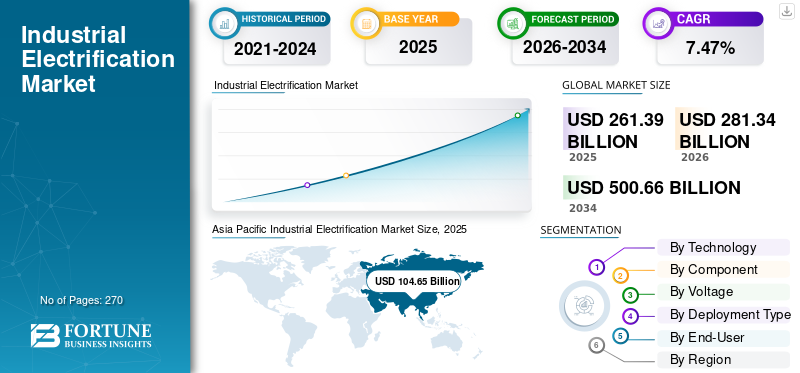
Download Free sample to learn more about this report.
INDUSTRIAL ELECTRIFICATION MARKET KEY TAKEAWAYS
 Global Market Size & Forecast
- 2025 Market Size: USD 261.39 Billion
- 2026 Market Size: USD 281.34 Billion
- 2034 Forecast Market Size: USD 500.66 Billion
- CAGR: 7.47% from 2026–2034
 Market Share
- Asia Pacific dominated the industrial electrification market with a market share of 40.03% in 2025.
- The hardware segment dominated the market in 2025, accounting for a share of 75.27%.
- The software segment is anticipated to expand at a CAGR of 10.79% during the forecast period.
 Key Regional Highlights
North America
North America was valued at USD 61.05 billion in 2025 and is projected to reach USD 65.07 billion in 2026, driven by industrial automation and infrastructure modernization.
Europe
Europe reached USD 64.21 billion in 2025, supported by industrial decarbonization initiatives and stringent carbon reduction regulations.
Asia Pacific
Asia Pacific led the global market, valued at USD 104.65 billion in 2025, driven by rapid industrialization and manufacturing expansion.
U.S.
U.S. industrial electrification market was valued at USD 51.65 billion in 2025.
Japan
Japan continues to benefit from investments in industrial automation, electrified manufacturing, and advanced energy management systems, supporting steady market growth.
Read More

Industrial Electrification Market Trends
Growing Adoption of Electric Process Heating Technologies across Energy-Intensive Industries
Industrial manufacturers are increasingly replacing fossil fuel-based heating systems with electric process heating technologies such as electric furnaces, induction heating systems, industrial heat pumps, and electric boilers to reduce carbon emissions and improve energy efficiency. Industries including metals, chemicals, food processing, cement, and pulp & paper are accelerating investments in electrified thermal processes as governments implement stricter emissions regulations and carbon reduction targets. Electric heating technologies offer precise temperature control, lower maintenance requirements, and greater compatibility with renewable electricity sources, making them a key component of industrial decarbonization strategies.
For instance, in June 2025, ArcelorMittal announced continued investments in electric arc furnace (EAF) steelmaking facilities across Europe to reduce carbon emissions and increase the use of renewable electricity in steel production operations.
MARKET DYNAMICS
MARKET DRIVERS
Download Free sample to learn more about this report.
Rising Investments in Industrial Automation and Energy Efficiency Upgrades to Drive the Market Growth
Industrial facilities are increasingly investing in advanced automation, digitalization, and energy efficiency initiatives to improve productivity and reduce operating costs. The deployment of electric motors, variable frequency drives (VFDs), electrified pumps, intelligent control systems, and energy management software enables manufacturers to optimize energy consumption and enhance process performance. The growing electricity price volatility and increasing pressure to improve energy productivity are encouraging industries to modernize legacy equipment with highly efficient electrified alternatives. This trend is creating significant demand for integrated electrification solutions across developed and emerging economies, propelling industrial electrification market growth.
For instance, in January 2025, several global manufacturers such as ABB and Siemens expanded investments in smart factory modernization programs that included motor efficiency upgrades, digital energy monitoring platforms, and advanced electrical control systems to improve operational performance.
MARKET RESTRAINTS
High Initial Capital Requirements for Electrification Projects May Hinder Market Expansion
Despite its long-term operational and environmental benefits, industrial electrification often requires substantial upfront investment in equipment, electrical infrastructure upgrades, and system integration. The replacement of conventional fossil fuel-based systems with electrified alternatives may involve modifications to production processes, power distribution networks, and facility infrastructure. Small and medium-sized industrial operators, particularly in developing regions, may face financial constraints that limit the pace of electrification adoption. In addition, uncertainties related to electricity pricing, grid capacity, and project payback periods may delay investment decisions for certain industrial users.
For instance, large-scale electrification projects in sectors such as steelmaking, cement production, and petrochemical processing frequently require multi-million-dollar investments in electric process heating technologies and supporting electrical infrastructure before realizing long-term efficiency gains.
MARKET OPPORTUNITIES
Expansion of Renewable Energy Integration in Industrial Operations to Offer New Growth Avenues
The increasing availability of renewable electricity is creating substantial opportunities for industrial electrification across multiple industries. As solar, wind, hydroelectric, and other renewable energy sources become more cost-competitive, industrial facilities are seeking to electrify production processes to utilize cleaner power sources and reduce carbon intensity. Electrified industrial systems provide greater compatibility with renewable energy integration compared to conventional combustion-based technologies. The growing investments in green industrial hubs, renewable-powered manufacturing facilities, and low-carbon industrial clusters are expected to further accelerate the demand for industrial electrification solutions over the forecast period.
For instance, in 2025, the European Commission launched the USD 1.1 billion IF25 Heat Auction under the Innovation Fund to support industrial projects deploying electric boilers, electric furnaces, heat pumps, and other renewable-powered industrial heating technologies across sectors including chemicals, steel, food & beverage, pulp & paper, and pharmaceuticals. The initiative is designed to accelerate the adoption of renewable electricity-based industrial process heat and strengthen industrial decarbonization efforts across Europe.
MARKET CHALLENGES
Electrical Grid Capacity and Infrastructure Limitations to Create Challenges for Industry Expansion
The successful deployment of industrial electrification technologies depends heavily on the availability of reliable electrical infrastructure and sufficient grid capacity. Many industrial regions continue to face challenges related to grid congestion, transmission constraints, power quality issues, and limited access to stable electricity supplies. As industrial facilities transition from fossil fuel-based processes to electricity-intensive operations, the demand for grid upgrades, transformers, switchgear, energy storage systems, and power quality management solutions is increasing significantly. Addressing these infrastructure challenges remains critical to supporting large-scale industrial electrification across both developed and developing markets.
For instance, in 2025, Amazon Web Services (AWS) reported delays in the expansion of several European data center projects due to grid connection constraints and lengthy connection approval processes, with some locations facing waits of up to seven years for grid access. The project delays underscored the growing challenge that transmission infrastructure limitations pose for electricity-intensive industrial and digital infrastructure developments.
Segmentation Analysis
By Technology
Industrial Motion Electrification Segment Led the Market Owing to Widespread Deployment of Electric Motors across Industrial Applications
Based on technology, the global market is segmented into industrial heat electrification, industrial motion electrification, industrial electrical infrastructure, and energy management & electrification software.
The industrial motion electrification segment dominated the market, accounting for approximately 39.83% share in 2025, driven by the extensive use of industrial electric motors, variable frequency drives (VFDs), electrified pumps, compressors, and servo systems across manufacturing and process industries. Electric motors alone account for a significant portion of industrial electricity consumption globally, making motor electrification and efficiency upgrades a key priority for industrial operators. The growing investments in factory automation, energy efficiency improvement programs, and industrial modernization initiatives are further supporting segment growth. The widespread adoption of electrified motion technologies across sectors such as chemicals, mining, automotive, food processing, and water treatment continues to strengthen the segment's leadership.
The energy management & electrification software segment is emerging as the fastest-growing segment and is projected to expand at the CAGR of 9.63% during the forecast period. The growth is driven by the increasing adoption of industrial energy management systems, power monitoring solutions, energy optimization software, and smart electrical control platforms. As industrial facilities pursue digital transformation and decarbonization objectives, software-enabled energy optimization solutions are becoming essential for improving energy efficiency, reducing operating costs, and enhancing asset performance. The growing integration of artificial intelligence, industrial IoT, and predictive analytics into industrial energy management systems is expected to accelerate segment growth over the coming years.
By Component
Hardware Segment Dominated the Market Due to Large-Scale Investments in Electrification Equipment and Electrical Infrastructure
Based on component, the market is segmented into hardware, software, and services.
The hardware segment dominated the market in 2025, accounting for a share of 75.27%, supported by substantial investments in electric motors, switchgear, transformers, power distribution systems, industrial UPS systems, electric heating technologies, and associated electrical infrastructure. Industrial electrification projects typically require significant capital expenditure on physical equipment, making hardware the largest revenue-generating component within the value chain. Rising industrial modernization activities and the growing deployment of electrified process equipment continue to support segment expansion.
The software segment is anticipated to expand at a CAGR of 10.79% during the forecast period. The increasing demand for energy monitoring, power management, digital twins, predictive maintenance, and advanced analytics solutions is driving software adoption across industrial facilities. The growing convergence of electrification, automation, and digitalization is expected to create significant growth opportunities for software providers.
By Voltage
Medium Voltage Segment Leads the Market Owing to Extensive Application across Industrial Facilities
Based on voltage, the market is segmented into low voltage, medium voltage, and high voltage.
The medium voltage segment dominated the market in 2025, accounting for a share of 47.57% due to its widespread deployment across manufacturing plants, mining operations, chemical facilities, oil & gas installations, and other energy-intensive industrial environments. Medium-voltage systems provide an optimal balance between power handling capability, operational efficiency, and installation economics, making them suitable for a broad range of industrial end-users. The increasing investments in industrial power distribution infrastructure and facility electrification projects continue to drive segment growth.
The high voltage segment is poised to expand at a CAGR of approximately 7.58% during the forecast period. The segment growth is primarily driven by the increasing electrification of industrial operations, grid-connected manufacturing facilities, and energy-intensive industries requiring substantial electrical loads. Expanding industrial infrastructure investments in emerging economies are expected to further support segment expansion.
By Deployment Type
Retrofit & Modernization Segment Dominated the Market as Industries Upgrade Existing Facilities to Meet Decarbonization Goals
Based on deployment type, the market is segmented into new installation and retrofit & modernization.
The retrofit & modernization segment captured a dominant industrial electrification market share in 2025, as operators increasingly upgrade existing fossil fuel-based systems with electrified alternatives. Many industrial facilities worldwide are focusing on improving energy efficiency, reducing emissions, and complying with evolving environmental regulations through the modernization of existing assets. Retrofitting electric motors, VFDs, electric heating systems, and intelligent energy management platforms often offers a more cost-effective pathway to decarbonization than constructing entirely new facilities.
The new installation segment is expected to witness the fastest growth at a CAGR of 7.92% during the forecast period. The segment growth is being driven by increasing investments in greenfield manufacturing projects, industrial parks, renewable-powered production facilities, and advanced industrial infrastructure developments. As governments and private-sector organizations continue to prioritize sustainable industrial development, the demand for fully electrified new-build industrial facilities is expected to increase significantly.
By End-User
To know how our report can help streamline your business, Speak to Analyst
Chemicals & Petrochemicals Segment Dominated the Market Due to High Energy Consumption and Decarbonization Requirements
Based on end-user, the market is segmented into oil & gas, chemicals & petrochemicals, mining & metals, automotive, food & beverage, water & wastewater, cement industry, electronics & semiconductor, pulp & paper, and others.
The chemicals & petrochemicals segment dominated the market in 2025, accounting for a share of 13.89%, due to its highly energy-intensive operations and increasing focus on emissions reduction. Chemical manufacturers are actively investing in electric heating technologies, advanced motor systems, power distribution infrastructure, and energy management platforms to improve process efficiency and meet sustainability targets. The sector's continuous demand for reliable, high-performance electrification solutions positions it as one of the largest consumers of industrial electrification technologies globally.
The electronics & semiconductor segment is projected to emerge as the fastest-growing category depicting a CAGR of 9.49% during the forecast period. The rapid expansion of semiconductor fabrication facilities, increasing investments in advanced electronics manufacturing, and growing adoption of smart factory technologies are driving the demand for highly reliable electrified infrastructure and intelligent energy management solutions. Additionally, the rising government support for domestic semiconductor production and supply chain localization initiatives is expected to further accelerate segment growth.
Industrial Electrification Market Regional Outlook
By geography, the market is categorized into Europe, North America, Asia Pacific, Latin America, and the Middle East & Africa.
Asia Pacific
Asia Pacific Industrial Electrification Market Size, 2025 (USD Billion)
To get more information on the regional analysis of this market, Download Free sample
Asia Pacific dominated the global market, accounting for approximately USD 104.65 billion in 2025. The region is experiencing robust growth due to rapid industrialization, expanding manufacturing activities, increasing investments in industrial automation, and growing government support for decarbonization initiatives across major economies. Countries such as China, India, Japan, South Korea, and the Southeast Asian nations are accelerating investments in electric process heating, industrial motors, power distribution infrastructure, and energy management systems to improve operational efficiency and reduce industrial emissions. Furthermore, the expansion of electronics manufacturing, automotive production, and renewable energy-powered industrial facilities is supporting the widespread adoption of electrification technologies throughout the region.
China Industrial Electrification Market
The China market touched a value of approximately USD 45.91 billion in 2025. The market growth is driven by the large-scale industrial modernization programs, rapid deployment of electric manufacturing technologies, increasing adoption of high-efficiency motors and drives, and government-led initiatives aimed at achieving carbon neutrality goals.
India Industrial Electrification Market
The India market reached a value of approximately USD 12.73 billion in 2025. The growth is supported by rising investments in industrial infrastructure, expansion of manufacturing activities, increasing adoption of energy-efficient technologies, and government programs promoting industrial decarbonization and energy efficiency.
Europe
The Europe market accounted for approximately USD 64.21 billion in 2025. The market is expanding due to stringent carbon reduction regulations, ambitious net-zero commitments, and substantial investments in industrial decarbonization technologies. European industries are increasingly replacing fossil fuel-based systems with electric heating technologies, intelligent motor systems, and advanced energy management solutions. Additionally, the European Green Deal and electrification initiatives for the industrial sector are encouraging investments in low-carbon manufacturing infrastructure across the region.
Germany Industrial Electrification Market
In 2025, the Germany market touched a valuation of approximately USD 15.88 billion. The growth is supported by the country's strong manufacturing base, increasing deployment of Industry 4.0 technologies, and growing investments in electrified industrial processes across automotive, chemicals, and machinery sectors.
U.K. Industrial Electrification Market
The U.K. market reached a valuation of approximately USD 8.94 billion in 2025. The market is growing due to increasing investments in industrial energy efficiency, factory electrification projects, and the adoption of advanced energy management systems aimed at supporting national decarbonization targets.
North America
The North America market touched a value of USD 61.05 billion in 2025 and is expected to reach USD 65.07 billion in 2026. The market is witnessing strong growth driven by increasing investments in industrial automation, energy efficiency upgrades, electrified manufacturing processes, and modernization of aging industrial infrastructure. The region is also benefiting from favorable government policies promoting clean energy adoption, industrial decarbonization, and domestic manufacturing expansion.
U.S. Industrial Electrification Market
The U.S. market touched a value of approximately USD 51.65 billion in 2025. The growth is driven by the increasing deployment of electric process heating technologies, high-efficiency motor systems, industrial software solutions, and smart manufacturing initiatives across multiple industries.
Middle East & Africa
The Middle East & Africa market accounted for approximately USD 13.44 billion in 2025. The market is growing due to increasing industrial diversification efforts, expansion of manufacturing and mining activities, and rising investments in modern electrical infrastructure across the region. Governments are actively promoting electrification across the industrial sector to improve energy efficiency, reduce emissions, and support long-term economic diversification strategies. Furthermore, large-scale industrial projects, mining developments, and petrochemical investments are contributing to an increased demand for electrification technologies.
GCC Industrial Electrification Market
The GCC market touched a valuation of approximately USD 6.42 billion in 2025. The market growth is supported by industrial diversification initiatives, smart manufacturing investments, and increasing deployment of electrified systems across oil & gas, petrochemical, and industrial processing facilities.
Latin America
The Latin America market accounted for USD 18.05 billion in 2025. The market is primarily driven by the increasing industrial development, mining investments, modernization of manufacturing facilities, and growing focus on improving energy efficiency across industrial operations. Governments and private-sector companies are increasingly adopting electrified equipment and advanced electrical infrastructure to improve productivity and reduce operational costs.
Brazil Industrial Electrification Market
The Brazil market touched a value of approximately USD 7.03 billion in 2025. The market growth in the country is supported by expanding manufacturing activities, increasing investments in mining and metals operations, and the growing deployment of industrial automation and electrification technologies.
COMPETITIVE LANDSCAPE
KEY INDUSTRY PLAYERS
Major Industry Participants to Expand Electrification and Energy Management Portfolios to Capitalize on Industrial Decarbonization Trends
The industrial electrification market remains highly competitive, with leading companies focusing on expanding their electrical infrastructure, industrial automation, and digital energy management capabilities to strengthen market positioning. Manufacturers are increasingly developing integrated solutions that combine electrified industrial equipment, advanced control systems, industrial software platforms, and intelligent power management technologies. Strategic acquisitions, product launches, R&D investments, and partnerships with industrial operators are becoming key competitive strategies as organizations seek to capture opportunities arising from global decarbonization efforts and industrial modernization programs. The growing adoption of electric process heating, smart motors, power monitoring systems, and energy optimization software is encouraging market leaders to continuously enhance their technology portfolios and geographical market presence.
For instance, in April 2025, ABB Ltd. announced the expansion of its industrial electrification and automation offerings through new digital energy management and motor efficiency solutions. These solutions have been designed to help industrial customers improve operational efficiency, reduce energy consumption, and accelerate decarbonization initiatives across manufacturing, mining, and process industries.
LIST OF KEY INDUSTRIAL ELECTRIFICATION COMPANIES PROFILED
- Siemens AG (Germany)
- ABB Ltd. (Switzerland)
- Schneider Electric SE (France)
- Eaton Corporation plc (Ireland)
- Rockwell Automation, Inc. (U.S.)
- Mitsubishi Electric Corporation (Japan)
- Honeywell International Inc. (U.S.)
- General Electric Company (U.S.)
- Danfoss A/S (Denmark)
- Yokogawa Electric Corporation (Japan)
- Hitachi Energy Ltd. (Switzerland)
KEY INDUSTRY DEVELOPMENTS
- January 2026: Schneider Electric SE expanded its EcoStruxure™ industrial energy management portfolio with enhanced AI-enabled energy optimization and electrical asset monitoring capabilities. The development was aimed at helping industrial facilities improve energy efficiency, reduce operational costs, and accelerate decarbonization initiatives through intelligent electrification and real-time energy management solutions.
- November 2025: ABB Ltd. introduced advanced medium-voltage electrification and smart motor control solutions designed to support industrial decarbonization and energy efficiency improvement programs. The newly launched technologies focused on optimizing industrial power consumption, improving equipment reliability, and enabling greater integration of renewable electricity into industrial operations.
- September 2025: Siemens AG expanded its Siemens Xcelerator platform with additional electrification, automation, and industrial software capabilities to support sustainable manufacturing and smart factory deployment. The enhanced platform was developed to improve energy transparency, optimize industrial power usage, and strengthen digital transformation initiatives across manufacturing facilities.
- July 2025: Eaton Corporation plc announced the expansion of its intelligent power management and industrial electrical infrastructure portfolio through advanced switchgear, power distribution, and energy resilience solutions. The development was aimed at helping industrial customers modernize electrical infrastructure, improve power quality, and support increasing electrification requirements across industrial facilities.
- March 2025: Rockwell Automation, Inc. expanded its industrial energy management and smart manufacturing offerings with new digital solutions designed to improve energy efficiency, optimize production performance, and support industrial sustainability goals. The development focused on integrating electrification technologies, automation systems, and real-time analytics to enhance operational efficiency and reduce industrial carbon emissions.
REPORT COVERAGE
The global industrial electrification market analysis provides an in-depth study of the market size and forecast by all the market segments included in the report. It contains details on the market dynamics and trends expected to drive the market over the forecast period. It offers information on technological advancements, new product launches, key industry developments, partnerships, mergers, and acquisitions. The market research report also includes a detailed competitive landscape, providing market share and the profiles of key players.
Request for Customization to gain extensive market insights.
Report Scope & Segmentation
| ATTRIBUTE | DETAILS |
| Study Period | 2021-2034 |
| Base Year | 2025 |
| Estimated Year | 2026 |
| Forecast Period | 2026-2034 |
| Historical Period | 2021-2024 |
| Growth Rate | CAGR of 7.47% from 2026-2034 |
| Unit | Value (USD Billion) |
| Segmentation | By Technology, By Component, By Voltage, By Deployment Type, By End-User, and By Region |
| By Technology |
|
| By Component |
|
| By Voltage |
|
| By Deployment Type |
|
| By End-User |
|
| By Region |
|
Frequently Asked Questions
Fortune Business Insights says that the global market value stood at USD 261.39 billion in 2025 and is projected to reach USD 500.66 billion by 2034.
The market is expected to exhibit a CAGR of 7.47% during the forecast period (2026-2034).
The chemicals & petrochemicals segment led the market in terms of end-user in 2025.
Rising investments in industrial automation and energy efficiency upgrades are key factors driving the market growth.
ABB Ltd, Siemens AG, Schneider Electric, and Eaton Corporation are the prominent players in the market.
Asia Pacific dominated the market, with the highest share in 2025.



- 2021-2034
- 2025
- 2021-2024
- 270
Get 30-60 hrs Free Customization
Expand Regional and Country Coverage, Segments Analysis, Company Profiles, Competitive Benchmarking, and End-user Insights.



















Related Reports
-
US +1 833 909 2966 ( Toll Free )
-
Get In Touch With Us