Electric Bus Market Size, Share & Industry Analysis, By Propulsion Type (BEV and HEV), By Bus Type (Single Deck Electric Bus and Double Deck Electric Bus), By Length (Less than 9 meters, 9–12 meters, and Above 12 meters), By Range (Less than 150 km, 150–300 km, and Above 300 km), and Regional Forecast, 2026–2034
 Download Free Sample
(Offer valid till 15th Aug 2026)
Electric Bus Market Size and Future Outlook
 Listen to Audio Version
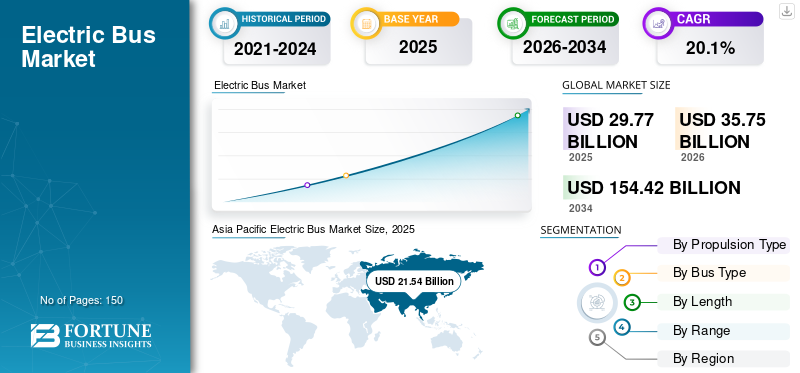
The global electric bus market size was valued at USD 29.77 billion in 2025. The market is projected to grow from USD 35.75 billion in 2026 to USD 154.42 billion by 2034, exhibiting a CAGR of 20.1% during the forecast period. Asia Pacific dominated the electric bus market with a market share of 72.35% in 2025.
The global market refers to the worldwide industry for buses powered fully or partially by electricity instead of conventional fuels. It includes battery electric buses, plug-in hybrid buses, charging infrastructure, batteries, components, manufacturers, and related services. The market is driven by urban decarbonization, government incentives, stricter emission regulations, lower operating costs, and growing public transport electrification across cities, schools, airports, and corporate fleets.
Key drivers of the global market include rising demand for low-emission public transportation, stricter government regulations on vehicle emissions, and growing efforts to reduce urban air pollution. Supportive policies, subsidies, and investments in charging infrastructure are accelerating adoption. Lower operating costs, advancements in battery technology, and increasing electrification of municipal, school, and corporate bus fleets further support market growth.
Major players in the global market include BYD Company Ltd., Yutong Bus Co., Ltd., Volvo Group Daimler Truck, VDL Groep, and Proterra, Inc, competing through longer driving ranges, fast-changing technologies, battery efficiency, fleet electrification partnerships, and smart mobility solutions. Market growth is driven by emission-reduction targets, government subsidies, rising public transport electrification, and expanding charging infrastructure.
Download Free sample to learn more about this report.
ELECTRIC BUS MARKET TRENDS
Smart Charging and Battery Optimization to Emerge as a Key Market Trend
A key trend in the global market is the adoption of smart charging, route-based energy planning, and battery optimization systems. Transit agencies are moving beyond simple fleet electrification toward integrated electric bus operations that balance vehicle schedules, charging windows, electricity tariffs, battery health, and grid capacity. Smart charging platforms help operators avoid peak electricity costs, reduce charger congestion, and maintain bus availability during service hours. The trend is also encouraging interest in renewable energy integration, stationary energy storage, and vehicle-to-grid capabilities at depots. As fleets scale from pilot projects to hundreds of buses, digital tools will become essential for managing energy demand and reducing operational risk. This will strengthen demand for connected charging solutions and fleet analytics platforms.
MARKET DYNAMICS
MARKET DRIVERS
Download Free sample to learn more about this report.
Stringent Emission Regulations and Public Fleet Electrification to Drive Market Growth
A key driver of the global market is the growing push to decarbonize public transportation. Governments and city authorities are increasingly adopting clean mobility policies, low-emission zones, and public procurement rules that favor zero-emission buses. Since buses operate on fixed routes and often return to depots, they are well suited for electrification compared with many other heavy-duty vehicles. Transit agencies are also replacing diesel fleets to reduce tailpipe emissions, noise pollution, and fuel dependency. Supportive funding programs for low- and no-emission buses, along with charging facilities, further strengthen adoption. These policy-led fleet replacement initiatives are expected to remain a major growth engine for electric bus manufacturers, battery suppliers, and charging infrastructure providers.
MARKET RESTRAINTS
High Initial Procurement and Infrastructure Costs to Restrain Adoption
A major restraint for the global electric bus market growth is the high upfront cost of electric buses and associated charging infrastructure. Although electric buses can offer lower operating and maintenance costs over their lifecycle, the initial purchase price is often higher than conventional diesel or CNG buses. Transit operators also need to invest in depot chargers, grid connections, software systems, electrical upgrades, and staff training before large-scale deployment. These requirements can be difficult for small municipalities, private operators, and developing regions with limited public transport budgets. Financing delays, tender complexity, and uncertainty around battery replacement costs may further slow procurement decisions. As a result, total project cost remains a key barrier despite long-term operational and environmental benefits.
MARKET OPPORTUNITIES
Expanding Charging Infrastructure and Clean Transport Funding to Create Growth Opportunities
A major opportunity in the global market lies in the rapid expansion of charging infrastructure and dedicated clean transport funding. Governments, development banks, and transit authorities are increasingly supporting depot electrification, fast-charging corridors, grid upgrades, and maintenance facilities for electric bus fleets. This creates opportunities not only for bus manufacturers but also for battery companies, charger suppliers, fleet management software providers, utilities, and energy storage firms. Public-private partnerships can help operators reduce capital pressure while accelerating fleet deployment. In emerging markets, electric buses can become a practical entry point for broader urban e-mobility programs because public fleets are centrally managed. As charging networks become more reliable, large-scale electrification of city, school, airport, and corporate bus fleets will become easier.
MARKET CHALLENGES
Grid Capacity Constraints and Operational Planning Complexity to Challenge Fleet Deployment
A key challenge for the global market is managing grid capacity and operational planning during large-scale fleet electrification. Electric buses require dependable charging within limited depot space and strict service schedules. When many buses charge at the same time, depots may face peak-load issues, higher electricity costs, and the need for power distribution upgrades. Operators must also redesign routes, charging cycles, maintenance workflows, and backup plans to ensure buses remain available throughout the day. Battery range can vary depending on passenger load, terrain, temperature, traffic, and accessory use such as air conditioning. These factors make deployment more complex than simply replacing diesel buses with electric models. Effective coordination among transit agencies, utilities, charging providers, and city planners is therefore critical.
Segmentation Analysis
By Propulsion Type
Rising Public Transport Electrification to Propel BEV Segmental Dominance
Based on propulsion type, the market is categorized into BEV and HEV.
The BEV segment dominates the market due to increasing government focus on zero-emission public transportation solutions and rising deployment of battery-electric buses across urban transit fleets. BEVs offer lower operating costs, reduced noise, and compliance with strict emission regulations, making them attractive for city transport agencies. Expanding charging infrastructure, falling battery costs, and supportive subsidies further strengthen adoption. Growing municipal fleet electrification continues to support BEV demand globally.
The HEV segment is projected to expand at a CAGR of 22.7% over the forecast period. Hybrid electric buses are gaining traction in regions with limited charging infrastructure, offering improved fuel efficiency, lower emissions, and operational flexibility compared to conventional diesel buses.
To know how our report can help streamline your business, Speak to Analyst
By Bus Type
Wide Suitability for Urban Public Transportation and Shuttle Services to Propel Single Deck Electric Bus Segmental Dominance
Based on bus type, the market is categorized into single deck electric bus and double deck electric bus.
The single deck electric bus segment dominates the electric bus market share due to its wide suitability for urban public transportation, shuttle services, and intra-city routes. These buses offer easier maneuverability, lower acquisition cost, and simpler charging integration compared to larger formats. High adoption by municipal transit agencies, schools, airports, and corporate fleets supports strong demand. Their compatibility with existing road infrastructure and frequent use on short-to-medium routes further reinforces segmental dominance globally.
The double deck electric bus segment is projected to expand at a CAGR of 23.8% over the forecast period. Growing demand for high-capacity, zero-emission public transport in dense urban areas is supporting adoption, especially on busy city routes where passenger volume is high.
By Length
Balanced Capacity and Route Flexibility to Propel 9–12 Meters Segmental Dominance
Based on length, the market is categorized into less than 9 meters, 9-12 meters, and above 12 meters.
The 9-12 meters segment dominates the market due to its ideal balance between passenger capacity, maneuverability, and operational efficiency for urban and suburban routes. These buses are widely preferred by public transit agencies as they can serve medium-to-high passenger volumes while fitting existing road infrastructure and depot layouts. Their suitability for city routes, airport shuttles, and institutional transport supports steady deployment. Lower operating emissions and improving battery range further strengthen segmental demand.
The above 12 meters segment is projected to expand at a CAGR of 21.4% over the forecast period. Demand is rising for high-capacity electric buses on busy corridors, bus rapid transit routes, and metropolitan networks requiring greater passenger movement with lower emissions.
By Range
Optimal Operating Range and Charging Efficiency to Propel 150-300 km Segment Dominance
Based on range, the market is categorized into less than 150 km, 150-300 km, and above 300 km.
The 150-300 km segment dominates the market due to its suitability for most urban and intercity electric bus routes. This range offers a strong balance between daily operating needs, battery cost, charging frequency, and vehicle efficiency. Transit agencies prefer buses in this category as they can complete regular duty cycles with limited charging interruptions. Growing deployment across city fleets, airport shuttles, and institutional transport further supports steady segmental dominance.
The above 300 km segment is projected to expand at a CAGR of 21.4% over the forecast period. Rising demand for long-route electric buses, improved battery energy density, and expanding fast-charging infrastructure are supporting adoption across intercity and high-utilization public transport routes.
Electric Bus Market Regional Outlook
By region, the market is categorized into Europe, North America, Asia Pacific, Latin America, and the Middle East & Africa.
Asia Pacific
Asia Pacific Electric Bus Market Size, 2025 (USD Billion)
To get more information on the regional analysis of this market, Download Free sample
Asia Pacific dominates the global market due to strong government support, large-scale public transport electrification, and rapid urbanization across China, India, Japan, and South Korea. China remains the leading contributor, supported by domestic manufacturing strength, battery supply chains, and extensive electric bus deployment in city fleets. Rising investments in charging infrastructure and emission reduction programs further support adoption. Growing demand for cost-efficient, low-emission public transport continues to strengthen the region’s leadership in the market.
China Electric Bus Market
The China market in 2026 is estimated at around USD 20.09 billion, supported by large-scale public fleet electrification, strong battery supply chains, domestic manufacturing leadership, and extensive charging infrastructure deployment.
Japan Electric Bus Market
The Japan market in 2026 is estimated at around USD 2.33 billion, driven by urban decarbonization goals, smart mobility initiatives, government support, and increasing adoption across municipal and shuttle fleets.
Europe
Europe holds the second-largest market share and is projected to expand at a CAGR of 22.0% over the forecast period. Strict emission regulations, zero-emission mobility targets, and strong government funding are accelerating the adoption across Germany, France, U.K., Netherlands, and Nordic countries. Public transit agencies are replacing diesel fleets with electric buses to meet climate goals. Expanding charging networks, clean transport policies, and increasing city-level electrification mandates continue to support regional market growth.
U.K. Electric Bus Market
The U.K. market in 2026 is estimated at around USD 1.09 billion, driven by zero-emission bus funding, clean air policies, fleet replacement programs, and expanding urban charging infrastructure.
Germany Electric Bus Market
The Germany market in 2026 is estimated at around USD 1.36 billion, supported by strict emission targets, municipal fleet electrification, strong OEM presence, and rising investments in depot charging networks.
North America
North America represents the third-largest market, supported by rising investments in clean public transportation and fleet electrification across the U.S. and Canada. Government funding programs, emission reduction targets, and growing demand for sustainable urban mobility are encouraging transit agencies to adopt electric buses. School bus electrification is also gaining momentum, particularly in the U.S. Improving battery performance, domestic manufacturing initiatives, and charging infrastructure development are further supporting regional adoption across municipal and institutional fleets.
U.S. Electric Bus Market
The U.S. market in 2026 is estimated at around USD 1.69 billion, driven by federal clean transit funding, school bus electrification, state-level emission mandates, and expanding domestic manufacturing capacity.
Middle East & Africa
The Middle East & Africa market is gradually expanding as governments invest in sustainable mobility, smart city development, and modern public transport systems. Countries in the Gulf region are introducing electric buses as part of clean transportation and carbon reduction initiatives. Growing tourism, urban development, and infrastructure modernization are supporting early adoption. However, high upfront costs, limited charging infrastructure, and hot-climate operating challenges may slow growth. Long-term sustainability goals are expected to create steady opportunities.
UAE Electric Bus Market
The UAE market in 2026 is estimated at around USD 0.26 billion, supported by smart city development, sustainability targets, public transport modernization, and growing pilot deployments across major urban centers.
Latin America
Latin America is witnessing steady growth in the market, driven by urban pollution concerns, public transport modernization, and government efforts to reduce dependence on diesel buses. Countries such as Brazil, Chile, Colombia, and Mexico are increasingly deploying electric buses in major cities. Support from international financing institutions and partnerships with manufacturers is helping improve affordability. Expanding charging infrastructure and growing awareness of lower operating costs are expected to support gradual market expansion across the region.
Brazil Electric Bus Market
The Brazil market in 2026 is estimated at around USD 0.26 billion, driven by urban pollution reduction efforts, fleet modernization programs, international financing support, and rising adoption in major metropolitan transit systems.
COMPETITIVE LANDSCAPE
Key Industry Players
Leading Electric Bus Manufacturers Strengthen Market Position Through Innovation and Fleet Partnerships
The global electric bus market is moderately consolidated, with leading players focusing on product innovation, battery efficiency, range improvement, and large-scale fleet supply agreements. Key companies are investing in advanced battery technologies, lightweight bus designs, fast-charging capabilities, and telematics-enabled fleet management to strengthen their market position. Manufacturers are also expanding production capacities and forming partnerships with governments, transit agencies, and charging infrastructure providers to support electric bus deployment. Competitive intensity is increasing as regional players enter the market with cost-effective models and localized manufacturing capabilities.
Major companies in the market, including BYD Company Ltd., Yutong Bus Co., Ltd., Volvo Group Daimler Truck, VDL Groep, and Proterra, Inc, are competing through strategic collaborations, new model launches, and expansion across high-growth regions. Established players benefit from strong brand presence, technical expertise, and long-term contracts with public transport authorities, while emerging companies focus on affordability and customized solutions. The shift toward zero-emission public transportation is encouraging manufacturers to improve vehicle performance, lifecycle cost efficiency, and after-sales support. As fleet electrification accelerates globally, companies with strong battery integration, charging partnerships, and scalable production networks are expected to gain a competitive advantage.
LIST OF KEY ELECTRIC BUS COMPANIES PROFILED
- BYD Co., Ltd (China)
- Proterra, Inc. (U.S.)
- AB Volvo (Sweden)
- New Flyer Industries (Canada)
- Daimler AG (Germany)
- Scania AB (Sweden)
- Iveco (Italy)
- Yutong (China)
- Ebusco (Netherlands)
- Xiamen King Long United Automotive Industry Co., Ltd. (China)
- VDL Groep bv (Netherlands)
KEY INDUSTRY DEVELOPMENTS
- June 2026: Tata Motors announced orders for over 3,400 electric commercial vehicles, including around 500 electric buses, strengthening its position in India’s zero-emission public transport market through Starbus EV and Ultra EV platforms.
- June 2026: Tata Motors secured more than 3,400 electric commercial vehicle orders across India’s freight and passenger transport sectors. The order intake included approximately 2,000 small commercial vehicles and pick-ups, around 900 trucks, and nearly 500 electric buses. These vehicles are expected to be deployed across applications such as e-commerce, logistics, FMCG and FMCD distribution, intra-city transportation, cement, steel, mining, airport tarmac operations, and urban and intercity passenger mobility, strengthening Tata Motors’ position in India’s electric commercial vehicle market.
- May 2026: Yutong showcased its latest battery-electric buses and long-life EV technologies at Next Mobility Exhibition in Milan, highlighting integrated electric architecture, fleet digitalization, and European-market models including IC12E, U10, U18, and E7S.
- May 2026: Yutong showcased its latest battery-electric buses and EV long-life technologies at the Next Mobility Exhibition 2026 in Milan, Italy. The company presented four battery-electric vehicles for the European market, including the IC12E intercity bus, U10 and U18 urban buses, and E7S mini-electric bus.
- February 2026: Yutong deployed 68 electric buses in Italy to support public transport operations during the Milano Cortina Winter Olympics, demonstrating the company’s capability in large-event fleet electrification and high-demand urban mobility operations.
- January 2026: PostAuto signed a framework agreement with Solaris Bus & Coach for up to 115 battery-electric buses, with deliveries planned for 2026 and 2027 across Switzerland’s public transport network.
- November 2025: EBS ordered 73 electric buses from BYD for operations in Zeeland, the Netherlands, with vehicles scheduled to enter service from December 2026 under the Reizen Door Zeeland public transport brand.
- September 2025: Solaris secured its first electric bus order for Gdańsk, Poland, covering 30 zero-emission buses, including 12-meter and articulated Urbino 18 models, expected to be operational by September 2026
- June 2025: De Lijn awarded contracts for 290 electric buses to BYD, Iveco Bus, and VDL Bus & Coach, supporting the Belgian operator’s long-term target to operate a fully emission-free fleet by 2035.
REPORT COVERAGE
The global electric bus market analysis provides an in-depth study of market size and forecast by all the market segments included in the report. It includes details on the market dynamics and market trends expected to drive the market in the forecast period. It offers information on the technological advancements, new product launches, key industry developments, and details on partnerships, mergers & acquisitions. The market research report also encompasses a detailed competitive landscape, including market share and profiles of key operating players.
Request for Customization to gain extensive market insights.
Report Scope & Segmentation
| ATTRIBUTE | DETAILS |
| Study Period | 2021-2034 |
| Base Year | 2025 |
| Estimated Year | 2026 |
| Forecast Period | 2026-2034 |
| Historical Period | 2021-2024 |
| Growth Rate | CAGR of 20.1% from 2026-2034 |
| Unit | Value (USD Billion) |
| Segmentation | By Propulsion Type, By Bus Type, By Length, By Range, and By Region |
| By Propulsion Type |
|
| By Bus Type |
|
| By Range |
|
| By Length |
|
| By Range |
|
Frequently Asked Questions
Fortune Business Insights says that the global market value stood at USD 29.77 billion in 2025 and is projected to reach USD 154.42 billion by 2034.
In 2025, the market value stood at USD 21.54 billion.
The market is expected to exhibit a CAGR of 20.1% during the forecast period.
The BEV segment led the market by propulsion type.
Stringent emission regulations and public fleet electrification to drive market growth.
Asia Pacific dominated the market in 2025.


- 2021-2034
- 2025
- 2021-2024
- 150
-
(Offer valid till 15th Aug 2026)
Get 30-60 hrs Free Customization
Expand Regional and Country Coverage, Segments Analysis, Company Profiles, Competitive Benchmarking, and End-user Insights.




















-
US +1 833 909 2966 ( Toll Free )
-
Get In Touch With Us