Chlor Alkali Market Size, Share & Industry Analysis, By Application (Chlorine {Water Treatment, Paper & Pulp, Inorganics, Intermediates, Organics, Vinyl, and Others} and Caustic Soda {Textile, Alumina, Soap & Detergents, Organics, Inorganics, Pulp & Paper, Water Treatment, and others}), and Regional Forecast, 2026-2034
 Download Free Sample
Chlor Alkali Market Size
 Listen to Audio Version
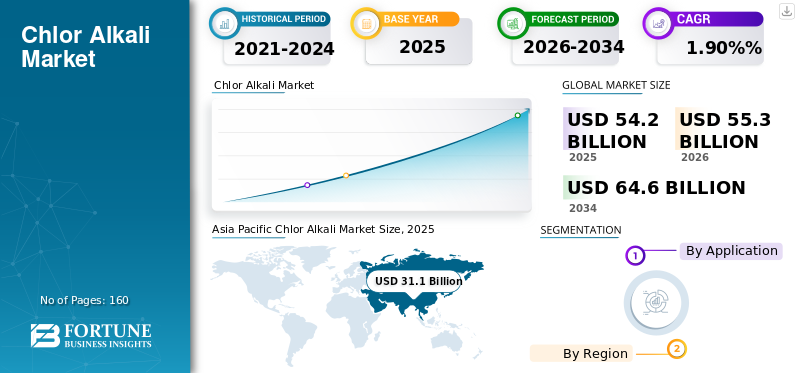
The global chlor alkali market size was USD 54.20 billion in 2025 and is projected to grow from USD 55.30 billion in 2026 to USD 64.60 billion by 2034 at a CAGR of 1.90% during the forecast period. Asia Pacific dominated the chlor-alkali market with a market share of 59.80% in 2025. Moreover, the chlor alkali market size in the U.S. is projected to grow significantly, reaching an estimated value of USD 9.66 billion by 2032, driven by increasing demand across multiple sectors, particularly in caustic soda applications and water treatment.
Chlor alkali manufacturing plants produce two widely used commodity chemicals such as chlorine and caustic soda (NaOH). The process consumes a significant amount of electricity which accounts for over 40% of total operating costs. Membrane cell technology is prominently used in the production of chlor alkali, and this technology accounts for a fourth-fifth of the total installed production capacity of chlor alkali around the world. Other technologies such as diaphragm and mercury cell account for the rest of the share in production technologies.
Download Free sample to learn more about this report.
Chlor Alkali Market Takeaways
 Market Size & Forecast
- 2025 Market Size: USD 54.20 Billion
- 2026 Market Size: USD 55.30 Billion
- 2034 Forecast Market Size: USD 64.60 Billion
- CAGR: 1.90% from 2026–2034
 Market Share
- Asia Pacific dominated the chlor alkali market with a 59.80% share in 2025.
- The alumina segment accounted for 10.85% of the caustic soda market in 2026.
- The vinyl segment remained the leading application for chlorine consumption, supported by strong PVC production demand.
 Key Regional Highlights
North America
North America accounted for USD 9.3 billion in 2025 and is expected to grow to USD 9.4 billion in 2026, supported by demand from water treatment and caustic soda applications.
Europe
Europe contributed USD 6.2 billion in 2025, representing 11.60% of global revenue, and is projected to reach USD 6.3 billion in 2026.
Asia Pacific
Asia Pacific led the global market with USD 31.1 billion in 2025 and is projected to reach USD 31.7 billion in 2026, driven by strong industrial and chemical manufacturing activity.
U.S.
The market is projected to reach USD 8.3 billion by 2026 and is expected to grow to USD 9.66 billion by 2032, driven by increasing demand across water treatment and industrial applications.
Japan
The chlor alkali market is projected to reach USD 2.0 billion by 2026, supported by stable demand from chemical processing and manufacturing industries.
Read More

Chlor Alkali Market Trends
Rising Adoption of Greener Production Technologies by Major Manufacturers to Bolster Market Growth
Chlor alkali production technology is subjugated by using membrane cell technology. However, many production facilities still operate using the mercury cell process. Mercury is a highly toxic element, and environmental concerns have compelled lawmakers to implement stringent environmental regulations on such processes. As a result, manufacturers are converting their mercury cell technologies to greener technologies such as membrane cells. In recent times, many plants in Europe converted their technologies, and the same is likely to get reciprocated in different parts of the world in the coming years on the back of rising environmental concerns. Asia Pacific witnessed a chlor alkali market growth from USD 30.46 billion in 2022 to USD 31.09 billion in 2023.
Download Free sample to learn more about this report.
Chlor Alkali Market Growth Factors
Rising Demand for Vinyl Polymers to Augment Market Growth
Chlorine is used in large quantities in vinyl production. Various downstream chemicals are produced using chlorine that is further used to manufacture polyvinyl chloride (PVC). PVC is the world’s third-largest used polymer. It is prominently used in the construction industry to make pipes, window frames, and other products. The thriving construction industry in emerging countries has boosted the demand for chlorine in vinyl production. Moreover, PVC applications in various end-use industries are steadily increasing, which is expected to generate lucrative growth opportunities in the forthcoming years. For example, PVC tapes and cases are healthily used in electrical applications due to their unique properties. The emergence of electric vehicles in the developing world is likely to boost the consumption of PVC and chlorine used in vinyl. Thus, healthy demand from end-use industries is expected to drive the market.
Expanding Water Treatment Industry is Contributing to the Growth of the Market
The water treatment industry is witnessing considerable growth, resulting in a surge in product demand. This is primarily because chlor alkali is a crucial component used in water treatment plants to produce sodium hypochlorite. This disinfectant is widely utilized for treating drinking water and wastewater. Sodium hypochlorite is known for its effective and reliable disinfection properties, which makes it an indispensable element for ensuring the safety and purity of water.
Moreover, the expanding population and increasing industrialization have increased water pollution levels, further fueling the demand for water treatment solutions. As a result, the water treatment industry is projected to grow significantly in the coming years. Furthermore, chlor alkali is used to produce a wide range of products, such as paper, textiles, detergents, and plastics. Therefore, the increasing demand for these products will also contribute to the chlor alkali market growth.
RESTRAINING FACTORS
Stringent Environmental Regulations Confines the Market Growth
The market is exposed to various environmental regulations around the world. Mercury cell production technology has a high risk of polluting water bodies and other ecological bodies. Consequently, lawmakers are implementing stringent environmental regulations on such production processes. Moreover, the European chlor alkali industry already phased out membrane cell technology used in chlorine production after the European Union passed a regulation in 2017. Similarly, regulations are being made around the globe to minimize the impact on the environment. For Instance, Canada also amended chlor alkali Mercury Liquid Effluent Regulations.
Chlor Alkali Market Segmentation Analysis
By Application Analysis
To know how our report can help streamline your business, Speak to Analyst
Vinyl segment dominates the consumption of Chlorine and Alumina leads the Market growth for Caustic Soda
Based on application, the market is segmented into chlorine (water treatment, paper & pulp, inorganics, intermediates, organics, vinyl, and others) and caustic soda (textile, alumina, soap & detergents, organics, inorganics, pulp & paper, water treatment, and others). The vinyl segment dominates the global market in terms of chlorine consumption. Chlorine derivatives are prominently used in PVC production. The chlorine demand often fluctuates in tandem with the production of PVC. Besides, chlorine produces several organic, inorganic, and intermediate chemicals that collectively account for over one-third of global consumption. Water treatment and paper & pulp account for a single-digit share in chlorine consumption.
On the other hand, the alumina segment dominates the caustic soda market in terms of revenue and volume & with a share of 10.85% in 2026. The increasing use of aluminium in the automotive industry is set to aid the growth of caustic soda consumption. The organics segment accounted for the second-largest share due to the healthy adoption of caustic soda in the organic chemical industry. Textile is the second-fastest-growing segment used for scouring, mercerization, and dyeing in the textile industry. Soap & detergent segment has been one of the first industrial users of caustic soda. The strong presence of alternatives has hampered the adoption of caustic in soaps and detergent applications. Pulp & paper, inorganics, water treatment, and others accounted for around half of the global demand for caustic soda.
REGIONAL INSIGHTS
Asia Pacific Chlor Alkali Market Size, 2025 (USD Billion)
To get more information on the regional analysis of this market, Download Free sample
Asia Pacific
In 2025, the Asia Pacific market stood at USD 31.1 billion, representing 59.80% of global demand, and is projected to grow to USD 31.7 billion in 2026. China dominates the Asia-Pacific region with over 70% share in the regional consumption. Strong growth in the construction industry has boosted the chlorine demand used in vinyl production. Besides, substantial growth in demand for PVC pipes in the agricultural sector has further aided the market's growth. The demand for caustic soda has been strongly driven by the adoption of aluminum in the automotive and industrial sectors. Moreover, the paper & pulp industry has also contributed to significant growth. The bolstering paper packaging industry in the region is expected to increase the demand for caustic soda over the forecast period. The Japan market is projected to reach USD 2.0 billion by 2026, the China market is projected to reach USD 23.6 billion by 2026, and the India market is projected to reach USD 2.4 billion by 2026.
To know how our report can help streamline your business, Speak to Analyst
North America
The market in North America reached USD 9.3 billion in 2025, representing 17.20% of total market revenue, and is projected to reach USD 9.4 billion in 2026. North America held the second-largest market share, closely followed by Europe. North America is one of the largest exporters of chlor alkali products in the world. The resurgent construction industry is likely to boost the production of PVC and demand for chlorine over the foreseeable period. The U.S. market is projected to reach USD 8.3 billion by 2026.
Europe
Europe contributed approximately USD 6.2 billion to the global market in 2025, accounting for 11.60% share, and is expected to reach USD 6.3 billion in 2026. The supply in Europe is tight, and the region is a forerunner in achieving green goals in the industry. The demand is expected to increase steadily over the forecast period due to slow developments in the end-use industries. Western European countries such as Germany, France, U.K., Spain, and Italy dominate the regional market. The UK market is projected to reach USD 0.5 billion by 2026, while the Germany market is projected to reach USD 1.5 billion by 2026.
Middle East & Africa
The Middle East & Africa is one of the fastest-growing markets. The region is a net exporter of chlor alkali products, and the improving economic conditions in the sub-African region are likely to boost consumption in the forthcoming years. Middle East & Africa maintained a strong presence in the global market, reaching USD 4.3 billion in 2025, accounting for 8.30% share, and is expected to reach USD 4.4 billion in 2026.
Latin America
The Latin America market accounted for USD 1.6 billion in 2025, representing 3.10% of the global industry, and is expected to reach USD 1.7 billion in 2026. Latin America accounts for the smallest share in the market. Brazil, Mexico, and Argentina are set to drive regional demand over the forecast period.
List of Key Companies in Chlor Alkali Market
Leading Players to Focus on Production Capacities
The market is fairly fragmented around the world. Due to surging demand, there have been continuous capacity additions by leading global and regional players. The growing demand is set to outnumber the presently installed capacity figures over the long-term forecast, creating the need for more capacities in the coming years. Many players have already started to expand their capacities, and some have been evaluating the same.
LIST OF KEY COMPANIES PROFILED:
- Olin Corporation (U.S.)
- Tata Chemicals Limited (India)
- Tosoh Corporation (Japan)
- Occidental Petroleum Corporation (U.S.)
- Xinjiang Zhongtai Chemical Co. Ltd. (China)
- AGC Inc. (Japan)
- Inovyn (U.K.)
- Formosa Plastics Corporation (Taiwan)
- Hanwha Chemical Corporation (South Korea)
- Akzonobel N.V. (Netherlands)
KEY INDUSTRY DEVELOPMENTS:
- May 2023 – AGC Inc, a Japanese company, announced to invest more than USD 767 million to expand its chlor-alkali production capacity in Thailand by the first quarter of 2025. The investment is expected to boost the company's production capacity significantly, thereby increasing its competitiveness in the market.
- April 2023 – PT Chandra Asri Petrochemical Tbk and Indonesia Investment Authority (INA) signed a MoU to build a chlor-alkali plant in Indonesia jointly. The plant will produce over 400,000 metric tons per year of caustic soda and 500,000 metric tons per year of ethylene dichloride. Chandra Asri partnered with Asahi Kasei Corp. to provide engineering and licensing support.
- April 2023 – DCM Shriram Ltd, a diversified conglomerate with activities spanning chemicals, textiles, alcohol, and sugar, recently augmented its chlor alkali production capacity. The increase, which amounts to 420 tons per day (TPD), has been realized at the company's Bharuch plant. This strategic move is projected to bolster the company's position in the market as it continues to expand its foothold across various sectors.
- July 2021 – Olin Corporation announced acquisition with ASHTA Chemicals to purchase and sell the chlorine produced at ASHTA’s Ohio manufacturing facility.
- March 2021- AGC Inc, a Tokyo-based manufacturing company, decided to integrate and reorganize the three chlor alkali companies in Thailand and CLMV market.
REPORT COVERAGE
The market report provides a detailed analysis of the market and focuses on crucial aspects such as leading companies, products, and raw materials. Also, the report offers insights into key market trends and highlights vital industry outlook with developments. In addition to the factors mentioned above, the report encompasses various factors contributing to the market's growth in recent years. This report includes historical data & forecasts revenue growth at global, regional, and country levels and analyzes the industry's latest market dynamics and opportunities.
Request for Customization to gain extensive market insights.
Report Scope & Segmentation
|
ATTRIBUTE |
DETAILS |
|
Study Period |
2021-2034 |
|
Base Year |
2025 |
|
Estimated Year |
2026 |
|
Forecast Period |
2026-2034 |
|
Historical Period |
2021-2024 |
|
Growth Rate |
CAGR of 1.90% from 2026 to 2034 |
|
Unit |
Value (USD Billion) |
|
Segmentation |
By Application
|
|
By Region
|
Frequently Asked Questions
According to Fortune Business Insights, the global chlor-alkali market was valued at USD 54.20 billion in 2025 and is projected to reach USD 64.60 billion by 2034, growing at a CAGR of 1.90% between 2026 and 2034.
Registering a compounded annual growth rate of 1.90%, the market will exhibit steady growth in the forecast period (2026-2034).
The chlor-alkali market includes three core products: chlorine, caustic soda (sodium hydroxide), and soda ash. These are widely used across industries such as construction, chemicals, textiles, water treatment, and pulp and paper.
Growth is driven by strong demand for polyvinyl chloride (PVC) in the construction and automotive industries, increasing applications in water treatment, and rising use of caustic soda in soaps, detergents, and textile processing.
Asia Pacific leads the market, with China and India being key contributors. The region benefits from rapid industrialization, construction activity, and a growing demand for chemical derivatives. North America also holds a significant market share.
Prominent companies include Olin Corporation, Occidental Petroleum, Xinjiang Zhongtai Chemical, Tata Chemicals, Tosoh Corporation, AGC Inc., Formosa Plastics, and Hanwha Chemical.
Challenges include strict environmental regulations, particularly regarding mercury use, high energy requirements for production, and volatile raw material costs. Transitioning to more sustainable technologies is also a major hurdle.
Key trends include the adoption of membrane-based electrolysis technologies, integration of green hydrogen, and strategic partnerships for sustainable production. Companies are also focusing on vertical integration with downstream sectors like PVC.



- 2021-2034
- 2025
- 2021-2024
- 160
Get 30-60 hrs Free Customization
Expand Regional and Country Coverage, Segments Analysis, Company Profiles, Competitive Benchmarking, and End-user Insights.


















-
US +1 833 909 2966 ( Toll Free )
-
Get In Touch With Us