 Download Free Sample



Get a Quote
Receive a tailored pricing based on your needs.
- Choose license type
- Multiple user options
- Custom scope & coverage
- Fast turnaround
"Designing Growth Strategies is in our DNA"
 Listen to Audio Version
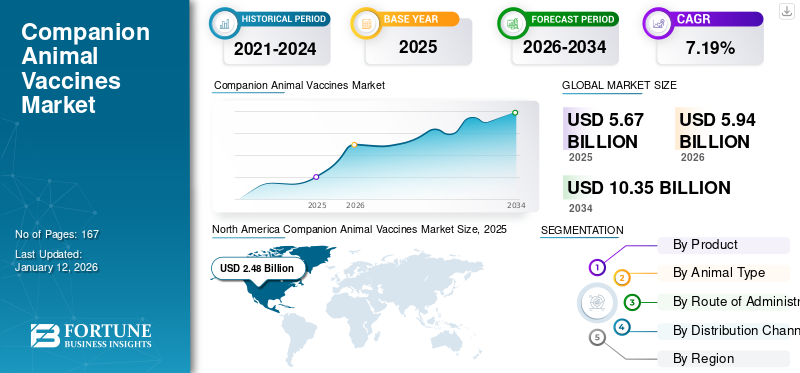
The global companion animal vaccines market size was valued at USD 5.67 billion in 2025. The market is projected to grow from USD 5.94 billion in 2026 to USD 10.35 billion by 2034, exhibiting a CAGR of 7.19% during the forecast period. North America dominated the companion animal vaccines market with a market share of 43.55% in 2025.
Companion animal vaccines are crucial for protecting pets from various animal diseases, improving their quality of life, and preventing costly treatments. They often play a crucial role in animal health protection by controlling and preventing serious epizootic diseases. The companion animal vaccines market is experiencing significant growth, driven by increasing pet ownership, heightened awareness of animal health, and advancements in vaccine production technology. Additionally, companies are continuously launching new vaccines and collaborating on research to address emerging diseases, which is expected to propel the market growth.
Furthermore, the increasing prevalence of animal disease across the globe are the factors supporting the demand for efficient immunizations. Moreover, the presence of key players in the market, such as Zoetis Services LLC, Elanco, and Virbac, with a strong focus on strategic initiatives such as new product launches, collaboration for R&D and new product development is expected to fuel the market growth during the forecast period.
Download Free sample to learn more about this report.
 Global Market Size & Forecast
 Market Share
 Key Regional Highlights
North America
The market was valued at USD 2.48 billion in 2025, driven by advanced veterinary healthcare infrastructure.
Europe
The market reached USD 1.38 billion in 2025, supported by a large pet population.
Asia Pacific
The market was valued at USD 0.91 billion in 2025, fueled by rising pet ownership.
U.S.
The market is expected to witness strong growth, driven by the presence of leading vaccine manufacturers.
Japan
The market is expected to witness steady growth, supported by expanding veterinary healthcare services.
Read More

Rising Number of Pet Ownerships to Propel Market Growth
The companion animal vaccine market is poised for significant growth, driven largely by the rising number of pet ownerships worldwide. The increasing adoption of pets, particularly dogs and cats, is a key driver of the market.
Strategic collaborations and product launches by major players such as Elanco Animal Health Incorporated and Zoetis Inc. are also contributing to the companion animal vaccines market growth. Additionally, emerging advancements in the veterinary healthcare infrastructure and rising pet insurance coverage are boosting the trend in the market. These factors are expected to fuel the segment growth over the projected years.
Limited Access to Veterinary Services in Developing Countries May Hinder Market Growth
Limited access to veterinary services in developing countries significantly constrains the companion animal vaccine market. The barriers such as financial limitations, geographic isolation, and limited veterinary personnel and equipment hinder the distribution and administration of vaccines. This situation is exacerbated by economic struggles and political instability, which further impede the development of veterinary infrastructure necessary for vaccine delivery.
As a result, companion animal owners in such areas often face challenges in accessing vaccinations, leading to reduced market penetration and growth opportunities for vaccine manufacturers.
These factors such as insufficient investment in veterinary services and education further limit the services and product penetration in these regions.
Rising Adoption of Pet Insurance to Offer New Market Opportunities
The companion animal vaccine market is witnessing significant growth due to several factors, including the increasing adoption of pets globally and the rising awareness of animal health and zoonotic diseases. One of the key opportunities in this market is the growing demand for pet population insurance. As pet owners increasingly view their pets as family members, there is a growing interest in comprehensive insurance coverage for pets.
This trend is further supported by the expansion of pet insurance policies, which not only cover routine vaccinations but also provide financial protection against unexpected veterinary expenses. This helps foster a more stable and growing market for companion animal vaccines.
High Development Costs
The high costs associated with developing veterinary vaccines pose a significant challenge for the companion animal vaccines market. These costs include substantial investments in research, clinical trials, and regulatory approvals, which can be particularly daunting for smaller enterprises. As a result, the financial burden may limit the entry of new players into the market, potentially reducing competition and innovation in companion animal vaccines.
Regulatory Hurdles
Stringent regulatory frameworks governing veterinary vaccines also impact the companion animal vaccine market. The rigorous safety and efficacy standards for vaccines can lead to extended approval timelines and increased costs. These stringent requirements ensure the quality of vaccines but can slow down the introduction of new products to the market.
Logistical Constraints
Logistical constraints, particularly maintaining the cold chain during vaccine distribution, pose another challenge for the market. The need for strict temperature control to preserve vaccine efficacy adds complexity and expense to the distribution process. In regions with limited infrastructure, such as rural areas in developing countries, these logistical challenges can result in reduced vaccine availability and effectiveness. This situation can hinder the growth of the market by limiting access to vaccines in areas where they are most needed.
Technological Advancements in Animal Immunization Development is a Vital Trend
The novel technologies such as recombinant and DNA vaccines enhance vaccine efficacy and safety, leading to broader immunization coverage among companion animals. This technological progress is driving innovation in the companion animal vaccine market, enabling more effective disease prevention and contributing to the overall health and well-being of pets. Additionally, this advancement is leading to new product launches in the market.
For instance, in November 2024, Boehringer Ingelheim launched EURICAN L4 vaccine, for protection against leptospirosis in dogs.
Preventive Healthcare Focus to Boost Product Adoption
There is a growing emphasis on preventive healthcare in the market, with pet owners increasingly seeking vaccinations to avert potential diseases. This trend is driven by the desire to ensure longer and healthier lives for pets. As a result, the demand for vaccinations is rising among the companion animals
Download Free sample to learn more about this report.
Strong and Long-lasting Immune Response Lead to Live Attenuated Segment Dominance
On the basis of product, the market is segmented into inactivated, live attenuated, recombinant, and others.
The live attenuated segment accounted for the dominant share of the market due to an increasing number of product launches by key players, rising investments in research and development, and expanding immunization programs.
For instance, Merck Animal Health launched Nobivac Intra-Trac Oral BbPi formulation, which is an oral Bordetella bronchiseptica and canine parainfluenza virus vaccine. Such product launches are driving the growth of the segment within the market.
Inactivated vaccines segment held the second-largest share of the global market in 2024. The growing population of companion animals, increasing prevalence of zoonotic diseases, and increasing investments in research and development.
The recombinant vaccines are anticipated to grow at the highest CAGR during the forecast period due to their incorporation of genes from different pathogens, enabling the creation of vaccines against multiple diseases or strains and strong immune response.
High Adoption Rates lead to Dominance of the Canine Segment
On the basis of animal type, the market is divided into feline, canine, avian, and other companion animals.
In 2024, the canine segment captured a dominant market share due to their popularity as pets and increasing adoption rates. Additionally, increasing awareness of the importance of preventive healthcare for dogs, driving demand for routine vaccinations. Moreover, the introduction of combination vaccines that offer multivalent protection against multiple diseases enhances convenience and encourages vaccination compliance among dog owners.
The feline segment is expected to grow at a comparatively higher CAGR than other animal types, due to shifting trend toward cat adoption across the globe. Strong advocacy from veterinary organizations for regular vaccination protocols helps drive compliance among cat owners. Moreover, increasing product launches for companion animal vaccines will propel the segment’s growth in the market.
The growing popularity of non-traditional pets such as rabbits and ferrets is expanding the market for specialized vaccines in the others segment.
Greater Adoption of Parenteral Vaccines to Lead to Their Market Dominance
On the basis of route of administration, the market is segmented into parenteral, oral, and others.
The parenteral segment held a dominant companion animal vaccines market share. Parenteral vaccines, administered via injection (e.g., intramuscular or subcutaneous), are a dominant route due to their proven efficacy and ability to deliver a strong immune response. Additionally, the high immunogenicity, and wide adoption of these products are growing the segment at a stable rate.
The oral segment held the second largest share of the market and is expected to grow with a significant CAGR during the forecast period. The growth of the segment is augmented by the ease of administration and ability to target mucosal immunity. Additionally, an increasing number of programs offer vaccinations to stray animals with oral formulations to boost the growth of the segment in the market.
The others segment is projected to grow at a robust CAGR during the forecast period, driven by technological advancements in vaccine formulations and increasing demand for easier administration methods for animals. Intranasal vaccines are gaining traction, particularly for respiratory diseases in specific species, while transdermal options are being explored for their convenience and effectiveness.
Rising Number of Veterinary Clinics to Result in Segmental Dominance
On the basis of distribution channel, the market is segmented into veterinary hospitals, veterinary clinics, pharmacies & drug stores, and others.
The veterinary clinics segment is estimated to have the dominant share during the forecast period due to the rising number of veterinary clinics. Additionally, increased investments by governments and organizations to address the shortage of veterinary professionals is expected to drive segment growth.
Increasing visits by pet owners to veterinary hospitals for administering vaccines and post-vaccination care are significant growth drivers. These hospitals offer advanced care infrastructure, reducing complications and attracting more pet owners. This trend is expected to bolster the segment's growth during the forecast period.
On the other hand, the pharmacies and drug stores segment is also expected to witness significant growth opportunities during the forecast period. These facilities cater to a large volume of vaccinations, contributing to their steady growth during the forecast period.
North America Companion Animal Vaccines Market Size, 2025 (USD Billion)
To get more information on the regional analysis of this market, Download Free sample
North America maintained a strong presence in the global market, reaching USD 2.48 billion in 2025, accounting for 43.55% share, and is expected to reach USD 2.6 billion in 2026. The growth of the market in North America is driven by the availability of advanced animal healthcare facilities and increasing disposable income among pet owners. Additionally, the rising adoption of immunization programs for pets and the introduction of innovative, technologically advanced vaccines have significantly supported the regional market expansion.
In terms of country, the U.S., accounted for the largest share of North America, which is due to the strong and established presence of major players in the U.S., and stringent regulatory standards to ensure the quality and efficacy of these vaccines, and facilitating widespread adoption.
In 2025, Europe generated USD 1.38 billion, contributing 42.45% to global market revenue, and is projected to grow to USD 1.45 billion in 2026. Europe holds the second-largest share of the market due to the high population of pet dogs and cats across the U.K., Germany, and France. Rising awareness about pet health and welfare, coupled with government initiatives to prevent zoonotic diseases, supports market growth. Additionally, increased adoption of advanced vaccine technologies contributes to the expansion of this regional market
The Asia Pacific market accounted for USD 0.91 billion in 2025, representing 50.13% of the global industry, and is expected to reach USD 0.95 billion in 2026. Asia Pacific is expected to grow at the highest CAGR in the market, fueled by increasing disposable income, and rising pet ownership. Additionally, the region's growth aids in increasing awareness about pet health, and expanding veterinary healthcare infrastructure. For instance, In March 2024, DCC Animal Hospitals announced the grand opening of its new DCC Animal Hospital in Japan, expanding its footprint in the Asia Pacific region. Furthermore, the emerging markets such as China and India within Asia Pacific, are also witnessing investments in innovative vaccine technologies to cater to the evolving needs of pet owners.
In 2025, Middle East & Africa represented USD 0.28 billion, accounting for 50.30% of the worldwide market, and is projected to grow to USD 0.29 billion in 2026. Latin America contributed 51.83% to the global market in 2025, with a valuation of USD 0.62 billion, and is projected to reach USD 0.65 billion in 2026. The Middle East & Africa and Latin America are expected to witness stable growth rates during the forecast period. The increasing number of diseases in companion animals and the rising demand for effective immunization to protect from deadly and contagious diseases is propelling the demand for companion animal vaccines in the region.
Strong Global Presence and Robust Product Offerings by Elanco, Inc., and Other Players to Strengthen their Positions
In the competitive landscape of the companion animal market, companies such as Zoetis, Merck Animal Health, and Elanco have emerged as dominant players, leveraging their robust product portfolios and strategic initiatives to secure significant market shares. These industry leaders have consistently invested in research and development to introduce innovative pharmaceuticals, vaccines, and diagnostic tools tailored to the evolving needs of pet health.
Their extensive geographical reach and ability to navigate regulatory complexities further strengthen their positions. The market's growth is fuelled by increasing pet ownership, the humanization of pets, and heightened awareness of animal health, driving demand for advanced healthcare solutions.
The global companion animal vaccines market research report provides a detailed analysis of the market. It focuses on key aspects such as leading companies, products, animals, route of administration, and distribution channels. Besides this, it offers insights into the market trends, the impact of COVID-19, and the increasing prevalence of zoonotic diseases, among other key insights. In addition to the factors mentioned above, the report encompasses several factors that have contributed to the growth of the market over recent years.
Request for Customization to gain extensive market insights.
|
ATTRIBUTE |
DETAILS |
|
Study Period |
2021-2034 |
|
Base Year |
2025 |
|
Estimated Year |
2026 |
|
Forecast Period |
2026-2034 |
|
Historical Period |
2021-2024 |
|
Growth Rate |
CAGR of 7.19% from 2026 to 2034 |
|
Unit |
Value (USD Billion) |
|
Segmentation |
By Product
|
|
By Animal Type
|
|
|
By Route of Administration
|
|
|
By Distribution Channel
|
|
|
By Region
|
Fortune Business Insights says that the market stood at USD 5.67 billion in 2025 and is projected to reach USD 10.35 billion by 2034.
By registering a CAGR of 7.19%, the market will exhibit steady growth during the forecast period (2026-2034).
The live attenuated segment is expected to lead the market during the forecast period.
Increased animal healthcare awareness and the efficient launch of immunization products will drive the growth of the market.
Elanco, Inc. and Merck Animal Health are the top players in the market.
North America is expected to hold the largest share of the market.
Increased awareness about animal health, the rising transmission of zoonotic diseases, surging animal ownership, and new product launches would drive the adoption of companion animal vaccines.
The current market trends are the adoption of advanced vaccines, novel modes of vaccine delivery, stringent regulatory norms with respect to livestock animals, and increased awareness amongst owners.

Get 30-60 hrs Free Customization
Expand Regional and Country Coverage, Segments Analysis, Company Profiles, Competitive Benchmarking, and End-user Insights.













.webp)






Related Reports
Get In Touch With Us
US +1 833 909 2966 ( Toll Free )
Receive a tailored pricing based on your needs.
Discuss your questions with our industry experts.
Have questions? Get quick answers before you purchase.

