Decaffeinated Tea Market Size, Share & Industry Analysis, By Type (Decaffeinated Black Tea, Decaffeinated Green Tea, Decaffeinated Oolong Tea, Decaffeinated White Tea, and Others), By Decaffeination Method (Carbon Dioxide Decaffeination, Water Processing, Ethyl Acetate Decaffeination, and Others), By Form (Tea Bags, Ready-to-Drink, Instant Tea, and Concentrates), By Nature (Organic, and Conventional), By End-Use (Food Processing, Food Service, and Retail {Supermarkets/Hypermarkets, Convenience Stores, Specialty Tea Stores, and Online Retail}), and Regional Forecast, 2026-2034
 Download Free Sample
(Offer valid till 30th Sep 2026)

Decaffeinated Tea Market Size and Future Outlook
 Listen to Audio Version
The global decaffeinated tea market size was valued at USD 2.52 billion in 2025. The market is projected to grow from USD 2.79 billion in 2026 to USD 6.37 billion by 2034, exhibiting a CAGR of 10.85% during the forecast period. North America dominated the decaffeinated tea market with a market share of 38.89% in 2025.
Decaffeinated tea is tea that has undergone a processing method to remove the majority of its caffeine. According to the standard regulatory guidelines, teas labeled as "decaf" must have at least 97% of their original caffeine content removed. Demand is increasingly supported by consumers who want to reduce caffeine intake without shifting completely away from tea, especially for evening consumption, sleep-supportive routines, digestive wellness, pregnancy-sensitive consumption, caffeine sensitivity, and low-stimulant beverage occasions. The broader parent category also supports this opportunity, as FAO identifies tea as the world’s most consumed beverage after water, while global tea consumption expanded by 2.0% in 2022 compared with 2021 and increased at around 3.3% annually over the last decade. This indicates that the market is expected to reach stronger growth levels as health consciousness and the demand for caffeine-free or reduced-caffeine beverages increase globally.
Furthermore, major players such as LIPTON Teas and Infusions, Associated British Foods plc, Tata Consumer Products Limited, R.C. Bigelow, Inc., and The Hain Celestial Group, Inc. influence the competitive landscape. This is done through increasing brand strength, regional distribution, supply chain networks, product innovation, and market share across the U.S., U.K., Asian, and other emerging and mature markets. The competitive position of premium and specialty brands is also strengthened by clean-label decaffeination methods such as carbon dioxide processing.
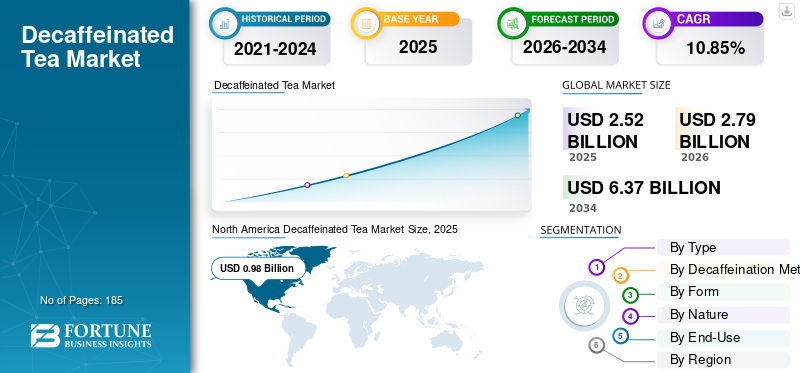
Download Free sample to learn more about this report.
DECAFFEINATED TEA MARKET TRENDS
Emerging Functional Product Development in Decaf RTD Beverages to Push Market Growth
Tea-based beverages are expanding from traditional hot tea into RTD, sparkling, cold-brew, and functional formats, creating a stronger platform for decaf tea manufacturers. This trend is supported by the growing health-conscious consumer base that prefers convenient, low-sugar, low-stimulant, and wellness-positioned beverages. RTD decaf tea can combine low/no caffeine positioning, antioxidants, vitamins, botanical flavors, hydration, and clean-label claims in one format. The trend is gaining relevance in the U.S., the U.K., South Korea, and premium urban markets across Asia Pacific, where consumers are increasingly choosing functional drinks through supermarkets and online retail channels.
- In September 2024, Twinings, a U.K.-based tea company, launched Twinings Sparkling Tea, a ready-to-drink canned tea range available in fruit-based variants. The company stated that the range contains vitamins and minerals, no added sugar, no artificial sweeteners or colors, and less than 50 calories per can. This launch is not purely positioned as decaffeinated tea. Still, it is relevant as it shows how major players are moving tea into functional RTD formats that can be extended into low-caffeine and decaf tea platforms.
MARKET DYNAMICS
MARKET DRIVERS
Download Free sample to learn more about this report.
Rising Health and Wellness Concern Among Consumers to Drive the Market Growth
Rising health consciousness, sleep-quality concerns, digestive wellness, and reduced stimulant intake are driving the global decaffeinated tea market growth. Consumers with caffeine sensitivity, pregnant women, older consumers, wellness-focused millennials, and evening tea drinkers are increasingly shifting toward decaf tea without fully abandoning tea consumption. This supports demand for decaffeinated black tea, green tea, flavored tea, specialty tea, and RTD formats. The demand for caffeine-free and reduced-caffeine beverages is also strengthening the market segment across key markets such as the U.S., U.K., Germany, and other European countries. In contrast, Southeast Asian countries are expected to gain momentum as modern retail and wellness beverage adoption expands.
- The U.S. Census Bureau, citing the Tea Association of the USA, reported that more than 159 million Americans drink tea on any given day. At the same time, Americans consumed almost 85 billion servings or over 3.9 billion gallons of tea in 2021. In addition, IFIC’s caffeine survey found that beverages are the leading caffeine source for U.S. caffeine consumers, with coffee at 54%, soft drinks at 17%, energy drinks at 7%, and tea at 7%. This supports the role of decaf tea as a practical caffeine-reduction alternative.
Market Drivers - Impact & CAGR Contribution (2026–2034)
| Rank | Market Drivers | Expected Impact on Market Growth | CAGR Contribution / Impact, 2026–2034 | Impact: 2026-2028 | Impact: 2029-2031 | Impact: 2032-2034 |
|---|---|---|---|---|---|---|
| 1 | Rising health consciousness, caffeine sensitivity, and consumer shift toward low-caffeine and caffeine-free beverages | High | 4.13% | High | High | High |
| 2 | Expansion of decaf tea availability across supermarkets, specialty tea stores, foodservice channels, and online retail | High | 3.39% | High | Medium | High |
| 3 | Growth in premium, organic, clean-label, and specialty decaf tea products using advanced decaffeination methods | Medium-High | 2.62% | Medium | Medium | High |
| 4 | Increasing innovation in RTD, cold-brew, flavored, functional, and convenient decaf tea formats | Medium | 1.83% | Medium | Medium | Medium |
| 5 | Rising adoption of decaf tea in foodservice, hospitality, institutional, and beverage-manufacturing applications | Medium-Low | 1.32% | Medium | Low | Medium |
| 6 | Others, including private-label expansion, supply chain improvement, sustainability positioning, and wider packaged tea consumption growth | Low | 0.83% | Low | Low | Medium |
| Total Positive Growth Contribution | 14.12% | |||||
Source: Fortune Business Insights
MARKET RESTRAINTS
Technical Complexity and High Production Cost to Hamper the Market Growth
Despite rising demand, decaffeinated tea faces restraints due to complex decaffeination processes, higher processing costs, and taste-retention challenges. Decaffeination requires caffeine extraction, solvent or carbon dioxide handling, residue monitoring, quality testing, and flavor preservation, which increases production costs compared with regular tea. Tea is sensitive to processing, as aroma compounds, polyphenols, bitterness balance, and leaf structure influence final taste. This can affect repeat purchases if decaf tea has a weaker body or reduced aroma. The restraint is stronger in price-sensitive markets, especially in developing countries such as Brazil, India, China, and others, where consumers may be less willing to pay premium prices for advanced decaffeination methods.
- The European Commission notes that extraction solvents are used during food processing and may leave technically unavoidable residues, making solvent compliance and residue control important for decaf tea producers. Premium CO₂ and water-based methods can improve clean-label perception, but they also add cost to the supply chain. This creates a challenge for smaller manufacturers competing with major players that have stronger quality systems, supplier control, and regulatory capabilities in the competitive landscape.
Market Restraints - Impact & Negative CAGR Contribution (2026–2034)
| Rank | Market Restraints | Expected Negative Impact on Market Growth | Estimated Reduction in Market CAGR | Impact: 2026-2028 | Impact: 2029-2031 | Impact: 2032-2034 |
|---|---|---|---|---|---|---|
| 1 | Technical complexity and high production cost related to decaffeination processes, residue control, quality testing, and flavor retention | High | -1.32% | High | High | Medium |
| 2 | Higher retail pricing of decaf tea compared with regular tea, limiting adoption in price-sensitive markets | Medium-High | -0.92% | High | Medium | Medium |
| 3 | Taste-quality concerns and weaker consumer perception of decaf tea compared with regular tea | Medium | -0.64% | Medium | Medium | Low |
| 4 | Others, including limited availability in emerging markets, consumer confusion with naturally caffeine-free herbal infusions, and supply chain constraints | Low | -0.39% | Medium | Low | Low |
| Total Negative Growth Impact | -3.27% | |||||
Source: Fortune Business Insights
MARKET OPPORTUNITIES
Emerging Technologies and New Product Developments to Create the Market Opportunities
Emerging technologies and product development are creating opportunities to improve decaf tea taste, clean-label positioning, and functional differentiation. Carbon dioxide decaffeination, water-based processing, and improved extraction control help brands address the perception that decaf tea tastes weaker than regular tea. These decaffeination methods also support premium claims such as solvent-free, antioxidant-retaining, naturally processed, and clean-label decaf tea. As health-conscious consumer demand increases, specialty brands and major players can use technology-led positioning to improve market share across retail, foodservice, online retail, and functional beverage applications.
- In September 2025, Tea Research Association’s Tocklai Tea Research Institute in India launched Decaffeinated Green Tea Powder developed from Assam elite clones TV 9, TV 11, and TV 12. The product reportedly contains 75% less caffeine than conventional green tea and is enriched with antioxidants. While it should be treated as reduced-caffeine unless it meets the strict 97% decaf threshold, the launch demonstrates innovation in reduced-caffeine tea powders, functional tea ingredients, and premium wellness formats that are expected to reach wider commercial relevance.
Segmentation Analysis
By Type
Decaffeinated Black Tea Segment Led the Market Due to Strong Mainstream Retail Demand
Based on type, the market is segmented into decaffeinated black tea, decaffeinated green tea, decaffeinated oolong tea, decaffeinated white tea, and others.
The decaffeinated black tea segment accounted for the largest share of the global market in 2025. Its leadership is supported by strong consumer familiarity, wide supermarket availability, and regular household consumption in mature markets such as the U.S. and U.K. Black tea is also the most established format for decaf tea bags, iced tea, breakfast tea, and foodservice tea servings. The segment benefits from strong brand presence among major players such as Lipton, Twinings, Tetley, Bigelow, and Luzianne.
The decaffeinated green tea segment is projected to register the fastest CAGR of 12.13% during the forecast period. Growth is expected to be driven by rising health consciousness, antioxidant positioning, weight management appeal, and demand from health-conscious consumers seeking lower-caffeine wellness beverages.
To know how our report can help streamline your business, Speak to Analyst
By Decaffeination Method
Carbon Dioxide Decaffeination Segment Led Due to Clean-Label and Flavor-Retention Benefits
Based on decaffeination method, the market is segmented into carbon dioxide decaffeination, water processing, ethyl acetate decaffeination, and others.
The carbon dioxide decaffeination segment accounted for the largest global decaffeinated tea market share in 2025. Its leadership is supported by strong acceptance among premium tea brands, specialty tea manufacturers, and health-conscious consumers. CO₂ decaffeination is widely preferred as it is associated with better flavor preservation, clean-label positioning, and reduced solvent-related consumer concerns. This method is especially important in premium decaf tea, specialty blends, and organic-positioned products.
The water processing decaffeination segment is also projected to register a CAGR of 11.29% during the forecast period. Water processing is one of the fastest-growing methods due to its natural positioning, while ethyl acetate grows more slowly due to stronger consumer scrutiny around solvent-based methods.
By Form
Tea Bags Segment Led the Market Due to Convenience and Household Penetration
Based on form, the market is segmented into tea bags, ready-to-drink, instant tea, and concentrates.
The tea bags segment accounted for the largest share of the global market in 2025. Tea bags dominate as they are convenient, affordable, portion-controlled, and widely available through supermarkets, hypermarkets, specialty stores, and online retail. They are the most common format for decaffeinated black tea, green tea, flavored tea, and everyday household consumption. The segment is also supported by strong private-label participation and foodservice use in hotels, offices, hospitals, and institutional channels.
The ready-to-drink segment is projected to register the fastest CAGR of 12.23% during the forecast period. Growth is expected to be driven by demand for convenient low-caffeine beverages, cold-brew tea, iced tea, sparkling tea, and functional beverage formats. RTD decaf tea is gaining relevance as consumers seek healthier alternatives to carbonated soft drinks, coffee, and energy drinks.
By Nature
Conventional Decaf Tea Led the Market Due to Wider Availability and Lower Price
Based on nature, the market is segmented into organic and conventional.
The conventional segment accounted for the largest share of the global market in 2025, as it is widely available across mass retail, supermarkets, foodservice, private-label channels, and mainstream tea brands. It is more affordable than organic decaf tea and benefits from stronger availability in tea bags, RTD tea, instant tea, and foodservice packs. The segment is especially strong in price-sensitive markets and mainstream household consumption.
The organic segment is projected to register the fastest CAGR of 12.04% during the forecast period. Growth is expected to be driven by rising health consciousness, pesticide-residue concerns, clean-label demand, and premium tea consumption. Organic decaf tea is gaining stronger traction among health-conscious consumers, online retail buyers, specialty tea store customers, and consumers seeking premium decaffeination methods such as CO₂ or water processing.
By End-Use
Retail Segment Led the Market Due to Strong Household Consumption
Based on end-use, the market is segmented into food processing, food service, and retail, with retail further segmented into supermarkets/hypermarkets, convenience stores, specialty tea stores, and online retail.
The retail segment accounted for the largest share of the global market in 2025. Retail dominates as decaf tea is mainly purchased by household consumers for daily consumption, evening tea routines, caffeine sensitivity, pregnancy-sensitive consumption, and wellness-led beverage occasions. Supermarkets and hypermarkets remain the largest retail channel due to strong shelf presence of decaf tea bags, branded tea, and private-label products. Specialty tea stores and online retail also support premium, organic, flavored, and CO₂-decaffeinated tea demand. Within retail channels, online retail is projected to be the fastest-growing sub-segment at a CAGR of 11.76% over the forecast period. Its growth is supported by premium decaf tea discovery, direct-to-consumer brands, subscription models, and wider availability of specialty decaf products.
The food processing segment is projected to register the fastest CAGR of 12.14% during the forecast period. Growth is expected to be driven by rising use of decaf tea extracts, concentrates, powders, and brewed bases in ready-to-drink beverages, functional drinks, dairy alternatives, desserts, bakery, confectionery, and nutritional formulations.
Decaffeinated Tea Market Regional Outlook
Based on region, the market is classified into North America, Europe, Asia Pacific, South America, and the Middle East & Africa.
North America
North America Decaffeinated Tea Market Size, 2025 (USD Billion)
To get more information on the regional analysis of this market, Download Free sample
North America held the largest share of the global market in 2025, valued at USD 0.98 billion, and is projected to reach USD 2.23 billion by 2034. The region is one of the most mature markets for decaf tea, supported by high packaged tea consumption, strong retail penetration, and established demand from caffeine-sensitive and health-conscious consumers. Decaffeinated black tea and decaf iced tea are widely available across supermarkets, hypermarkets, online retail, foodservice, and institutional channels. Growth is further supported by rising demand for caffeine-free and low-caffeine beverages, sleep-friendly beverage routines, cold-brew decaf tea, and sugar-free iced tea formats.
U.S. Decaffeinated Tea Market
In 2026, the U.S. is projected to reach USD 0.88 billion, accounting for approximately 31.38% of global revenues. The market growth is supported by strong household tea consumption, large-scale supermarket distribution, and growing demand among consumers with caffeine sensitivity. The U.S. market benefits from strong availability of decaf black tea, decaf green tea, cold-brew decaf tea, sweet iced decaf tea, and premium CO₂-decaffeinated tea products. Online retail is also becoming important as consumers search for specialty decaf tea, organic decaf tea, flavored decaf tea, and subscription-based tea products.
- According to the U.S. Census Bureau survey in 2024, in the U.S., over 159 million people drink tea daily, creating a large base for caffeine-reduction conversion.
Europe
Europe is projected to record a growth rate of 10.55% during the forecast period, reaching USD 0.86 billion by 2026. The region has a strong tea culture, high consumer awareness of wellness beverages, and growing demand for clean-label and premium decaffeination methods. The U.K. remains the most important European market due to its strong black tea consumption base, mature retail tea shelves, and high consumer familiarity with decaffeinated everyday tea. Germany and France are also important due to growing demand for organic tea, specialty tea, herbal-blended decaf tea, and premium wellness beverages. European growth is supported by consumer preference for lower-caffeine beverages, stronger interest in sleep-supportive drinks, and wider availability of decaf tea through supermarkets, specialty tea stores, online retail, and foodservice. The region also benefits from strict regulatory attention to extraction solvents, residues, labeling, and decaffeination processes, which supports demand for transparent and clean-label decaf tea products.
U.K. Decaffeinated Tea Market
The U.K. market value is expected to reach USD 0.26 billion by 2026, accounting for roughly 9.27% of global revenues.
Germany Decaffeinated Tea Market
Germany's market size is projected to reach USD 0.19 billion by 2026, accounting for approximately 6.72% of global revenues.
Asia Pacific
In 2026, Asia Pacific will account for USD 0.63 billion and is projected to reach USD 1.66 billion by 2034, making it one of the fastest-growing regions. Growth is supported by rising health consciousness, urban premiumization, expansion of online retail, and stronger interest in low-caffeine green tea, functional tea powders, RTD tea, and wellness beverages. Japan, China, South Korea, Australia, and urban Southeast Asian markets are expected to lead regional demand. The market is also supported by product innovation in reduced-caffeine green tea, specialty tea, and functional tea formats.
Japan Decaffeinated Tea Market
Japan is projected to generate USD 0.20 billion in revenue by 2026, accounting for approximately 7.24% of global sales.
China Decaffeinated Tea Market
China’s market is expected to reach nearly USD 0.16 billion by 2026, accounting for 5.68% of global revenues.
India Decaffeinated Tea Market
India’s market is projected to reach USD 0.06 billion by 2026, accounting for around 2.23% of global revenues.
South America and Middle East & Africa
Both South America and the Middle East & Africa are expected to grow moderately in the coming years. The South America market is projected to reach USD 0.13 billion by 2026. The region currently represents a smaller share of the global market. Still, growth is expected to be supported by rising health awareness, expansion of modern retail, and increasing availability of imported and premium tea brands.
The Middle East & Africa market was valued at USD 0.10 billion in 2025 and is projected to reach USD 0.25 billion by 2034. The region has strong tea consumption in several countries, but decaffeinated tea remains an emerging and premium-oriented category. Growth is supported by urban retail development, hospitality demand, premium hotels, expatriate consumers, wellness-led beverage adoption, and rising availability of imported tea brands.
GCC Decaffeinated Tea Market
In 2026, the GCC market is expected to reach USD 0.05 billion, accounting for 1.81% of total revenues.
COMPETITIVE LANDSCAPE
Key Industry Players
Increasing Product Breadth and Premium Decaffeination Positioning to Strengthen Market Shares of Key Players
In 2025, LIPTON Teas and Infusions, Associated British Foods plc, Tata Consumer Products Limited, R.C. Bigelow, Inc., and The Hain Celestial Group, Inc. held strong positions in the global decaffeinated tea market. These major players benefit from established packaged tea portfolios, strong supermarket and online retail availability, broad geographic reach, and consumer trust in decaf black tea, decaf green tea, flavored decaf tea, and specialty decaf blends. Moreover, the competitive landscape is increasingly shaped by clean-label decaffeination processes and product differentiation. Premium and specialty tea brands such as Harney & Sons Fine Teas, The Republic of Tea, Stash Tea, Luzianne, and Southern Breeze are using decaf tea portfolios to serve consumers seeking lower-caffeine, evening, iced tea, and wellness-led beverage occasions.
LIST OF KEY DECAFFEINATED TEA COMPANIES PROFILED
- LIPTON Teas and Infusions B.V. (Netherlands)
- Associated British Foods plc (U.K.)
- Tata Consumer Products Limited (India)
- C. Bigelow, Inc. (U.S.)
- The Hain Celestial Group, Inc. (U.S.)
- The Republic of Tea, Inc. (U.S.)
- Yamamotoyama Co., Ltd. (Japan)
- Harney & Sons Fine Teas (U.S.)
- Reily Foods Company (U.S.)
- Harris Tea Company (U.S.)
KEY INDUSTRY DEVELOPMENTS
- June 2026: Caff Off, a U.S.-based decaffeinated matcha brand sourcing from Kyoto, Japan, introduced and expanded its ceremonial-grade decaf matcha for caffeine-conscious consumers.
- January 2024: MATCHA DIRECT, a brand of a Japanese tea manufacturer, Tsuji Riichi Honten Co., Ltd., developed a new decaf matcha in partnership with Kataoka & Co., Ltd. for the U.S. market.
- June 2023: Clipper Tea, a U.S. fair trade tea company, launched an organic decaffeinated black tea, a blend of Assam Fairtrade-certified black tea. The new product is decaffeinated using the carbon dioxide process.
REPORT COVERAGE
The decaffeinated tea market report provides a detailed assessment of all market segments, highlighting key drivers, trends, opportunities, restraints, and challenges shaping industry growth. It also covers technological advancements, major industry developments, market share analysis, and comprehensive profiles of leading companies.
Request for Customization to gain extensive market insights.
Report Scope & Segmentation
| ATTRIBUTE | DETAILS |
| Study Period | 2021-2034 |
| Base Year | 2025 |
| Estimated Year | 2026 |
| Forecast Period | 2026-2034 |
| Historical Period | 2021-2024 |
| Growth Rate | CAGR of 10.85% from 2026 to 2034 |
| Unit | Value (USD Billion) |
| Segmentation | By Type, Decaffeination Method, Form, Nature, End-Use, and Region |
| By Type |
|
| By Decaffeination Method |
|
| By Form |
|
| By Nature |
|
| By End-Use |
|
| By Region |
|
Frequently Asked Questions
Fortune Business Insights says that the global market value stood at USD 2.52 billion in 2025 and is projected to reach USD 6.37 billion by 2034.
In 2025, North America’s market value stood at USD 0.98 billion.
The market is expected to grow at a CAGR of 10.85% over the forecast period.
The decaffeinated black tea segment led the market by type.
Rising health and wellness concerns among consumers are driving market growth.
LIPTON Teas and Infusions, Associated British Foods plc, Tata Consumer Products Limited, R.C. Bigelow, Inc., and The Hain Celestial Group, Inc are among the prominent players in the market.
North America dominated the market in 2025.



- 2021-2034
- 2025
- 2021-2024
- 185
-
(Offer valid till 30th Sep 2026)
Get 30-60 hrs Free Customization
Expand Regional and Country Coverage, Segments Analysis, Company Profiles, Competitive Benchmarking, and End-user Insights.




















Related Reports
-
US +1 833 909 2966 ( Toll Free )
-
Get In Touch With Us