Cosmetics Market Size, Share & Industry Analysis, By Type (Haircare {Shampoo & Conditioner, Hair Colorants, and Hair Styling Products}, Skincare {Facial Care, Body Care, and Sun Care}, and Makeup {Face Makeup, Eye Makeup, and Lip Makeup}), By Product Form (Creams & Lotions, Powders, Liquids, Gels, and Sprays & Mists), By Ingredient Source (Conventional/Synthetic, Natural, Organic, and Vegan), By Consumer Group (Women, Men, and Unisex), By Distribution Channel (Supermarkets & Hypermarkets, Specialty Beauty Stores, Department Stores, and Online Retail), and Regional Forecast, 2026-2034
 Download Free Sample
(Offer valid till 31st Aug 2026)
Cosmetics Market Size and Future Outlook
 Listen to Audio Version
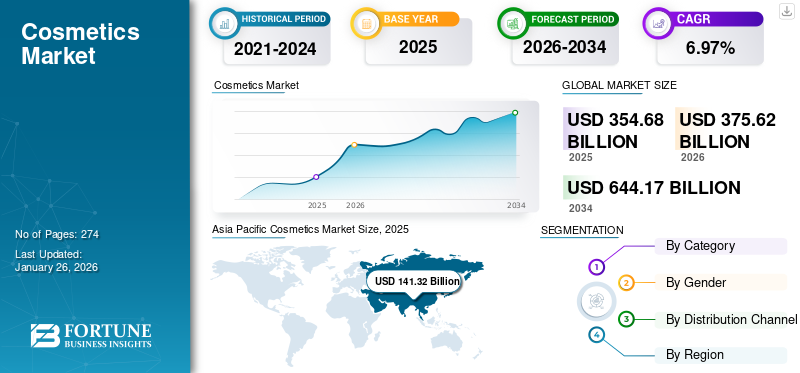
The global cosmetics market size was valued at USD 354.68 billion in 2025. The market is projected to grow from USD 375.62 billion in 2026 to USD 646.00 billion by 2034, exhibiting a CAGR of 7.01% during the forecast period.
Cosmetics are beauty & personal care products used for skin cleansing and beautification purposes. Cosmetics include various products, including skincare products, haircare products, and makeup products. Rising consciousness among individuals regarding personal appearance and well-being propels market growth.
Various prominent players are operating in the market, including L’Oreal, Unilever plc, Procter & Gamble (P&G), Johnson & Johnson Services, Inc., and The Estée Lauder Companies Inc.
Download Free sample to learn more about this report.
COSMETICS MARKET TRENDS
Collaboration with Social Media Influencers & Celebrities is a Key Market Trend
Partnerships between cosmetic brands and social media influencers have a positive impact on the demand for various cosmetic products. Social media influencers have large and engaged audiences across various platforms such as Instagram, YouTube, Facebook, and TikTok. Partnering with influencers allows beauty industry brands to tap into these audiences and increase the visibility of their products. Furthermore, partnerships with popular personalities and celebrities assist in increasing brand awareness and provide significant growth opportunities to market players. For instance, in February 2023, Dolce Glow, a self-tanning products brand in the U.S., partnered with Miley Cyrus, a popular Singer in the U.S., to promote their brand value in the region.
MARKET DYNAMICS
MARKET DRIVERS
Download Free sample to learn more about this report.
Rising Awareness Regarding Personal Care & Grooming to Fuel Market Growth
The consumer focus on self-care and grooming has increased across countries in recent years. Moreover, concerns regarding well-being are increasing due to a busy schedule, changes in routine, eating habits, and fluctuations in the sleep cycle. Skin care, makeup, and hair care products enhance the user’s appearance and assist in maintaining hygiene. These factors boost the adoption of various cosmetic products among both young and aged populations and drive global market expansion. In addition, factors such as the rapidly growing fashion industry, easy availability of cosmetics from multiple local and international brands on e-commerce websites, rising working women population, and increasing men's grooming trends are expected to support global cosmetics market growth in the coming years.
|
Rank |
Market Drivers |
Expected Impact on Market Growth |
Estimated Gross Market Growth Contribution (USD Billion) |
Impact: 2026-2028 |
Impact: 2029-2031 |
Impact: 2032-2034 |
|
1 |
Rising Awareness Regarding Personal Care & Grooming to Fuel Product Demand |
High |
88.15 |
High |
High |
High |
|
2 |
Increasing Product Innovation and Development of Multifunctional, Science-backed and Sustainable Cosmetics |
High |
68.40 |
High |
High |
High |
|
3 |
Increasing Product Innovation and Development of Multifunctional, Science-backed and Sustainable Cosmetics |
High |
57.25 |
High |
High |
High |
|
4 |
Rising Disposable Income, Urbanization and Middle-class Expansion in Emerging Markets |
Medium |
51.80 |
Medium |
High |
High |
|
5 |
Expanding Demand for Men’s Grooming, Gender-inclusive and Unisex Cosmetics |
Medium |
45.30 |
Medium |
Medium |
High |
|
6 |
Others: Premiumization, growth of beauty salons and professional channels, travel-retail recovery, subscription-based beauty services and increasing demand for customized products |
Low |
31.60 |
Low |
Low |
Low |
|
Total Gross Growth Contribution |
342.50 |
MARKET RESTRAINTS
Rising Awareness Regarding Side Effects and Counterfeit Products Hampers Market Growth
Cosmetic formulations are a mixture of multiple components, including synthetic ingredients, such as sulfates and phthalates. Rising awareness regarding the adverse health effects and toxicity of these ingredients is likely to limit product demand. Synthetic chemicals, such as preservatives, pigment molecules, and other additives, have serious side effects on the body, such as allergic reactions, the formation of black patches, acne or discoloration, and others. Furthermore, the prevalence of counterfeit cosmetics, such as shampoo, conditioner, makeup, face cream, serum, and others, poses a significant challenge to market growth.
|
Rank |
Market Restraints |
Expected Impact on Market Growth |
Estimated Reduction in Market Size (USD Billion) |
Impact: 2026-2028 |
Impact: 2029-2031 |
Impact: 2032-2034 |
|
1 |
Rising Awareness Regarding the Side-effects and Counterfeit Products to Hamper Market Growth |
High |
28.74 |
High |
High |
Medium |
|
2 |
Stringent Product Safety, Ingredient, Labelling and Environmental Regulations |
Medium |
18.63 |
Medium |
High |
High |
|
3 |
Fluctuating Raw Material, Packaging, Energy and Transportation Costs |
Medium |
16.42 |
High |
Medium |
Medium |
|
4 |
Others: Economic uncertainty, reduced discretionary expenditure, intense private-label competition, short product life cycles and supply-chain disruptions |
Low |
8.33 |
Low |
Low |
Low |
|
Total Market Reduction |
72.12 |
MARKET OPPORTUNITIES
Increasing Adoption of Organic & Sustainable Cosmetics to Provide Growth Opportunities
Rising consumer preference toward organic cosmetics has accelerated research & development activities among cosmetic product manufacturers to seek organic and natural ingredients and formulations. The demand for these sustainable beauty products made using eco-friendly ingredients is significantly increasing among eco-conscious consumers. For instance, according to the Soil Association, retail sales of organic health and beauty products in the U.K. reached USD 182.94 million in 2022, up from USD 38.90 million in 2012. Furthermore, consumer preference is also shifting toward vegan products that do not contain any ingredients derived from animals.
MARKET CHALLENGES
Fluctuating Raw Material and Packaging Costs to Hinder Market Growth
Cosmetic products, including anti-aging creams, BB creams, and eyebrow products, require several materials and inputs such as preservatives, fragrances, pigments, essential oils, plastic, and glass. Factors such as supply shortages, transportation expenses, energy costs, agricultural output, and exchange rates can fluctuate the cost of these essential inputs. In addition, manufacturers are focusing on low-plastic, recyclable, and premium packaging, which triggers packaging costs. These factors can negatively impact the company’s profit margins and impede growth.
Segmentation Analysis
By Type
Consistent Product Demand & Rising Skin Problems Boosted Skincare Sales
By type, the market is segmented into haircare (shampoo & conditioner, hair colorants, hair styling products, and hair treatment products), skincare (facial care, body care, sun care, and hand & foot care), makeup (face makeup, eye makeup, lip makeup, and nail makeup), and others.
The skincare segment exhibited a leading global cosmetics market share in 2025. The segment is projected to grow at a CAGR of 7.88% from 2026 to 2034. Consistent demand for multiple skincare items such as serums and moisturizers, as they are used regularly, favors segmental expansion. Rising skin issues, including sun damage, dryness, and acne, also boost product sales. Furthermore, development of innovative formulations using various active ingredients is likely to boost the adoption of skincare products in the coming years.
The makeup segment is projected to grow at the second fastest CAGR of 7.21% from 2026 to 2034.
To know how our report can help streamline your business, Speak to Analyst
By Product Form
Widespread Availability Across Categories & Easy Application Fueled Creams & Lotions Segment’s Growth
By product form, the market is divided into creams & lotions, powders, liquids, gels, sticks, sprays & mists, and others.
The creams & lotions segment exhibited a leading market share of 36.98% in 2025. The segment is projected to grow at a CAGR of 6.26% from 2026 to 2034. Numerous cosmetics, including sun care products, hair masks, and facial moisturizers, are developed in lotion or cream forms. Thus, their widespread availability in various product types supports segmental growth. Furthermore, these product forms have strong moisturizing benefits and are designed to have a smooth texture, which makes them easy to apply.
The sticks segment is projected to grow at the fastest CAGR of 9.94% from 2026 to 2034.
By Ingredient Source
Affordability and Strong Performance Boosted Conventional/Synthetic Segment Growth
Based on ingredient source, the market is divided into conventional/synthetic, natural, organic, vegan, and others.
The conventional/synthetic segment exhibited a leading global market share of 47.94% in 2025. Conventional/synthetic material-based cosmetic items are typically sold at affordable prices, accelerating their sales among budget-conscious shoppers. These products also contain stabilizers and preservatives, which increases their shelf life. In addition, the strong performance of these ingredients in sun protection, moisturizing, and cleansing boosts their adoption.
The vegan segment is projected to grow at the fastest CAGR of 9.03%, from 2026 to 2034.
By Consumer Group
Women Segment Led Market Due to High Beauty Awareness and Product Usage
Based on the consumer group, the market is divided into women, men, and unisex.
The women segment exhibited a leading global market share of 68.38% in 2025. Women consumers typically use a broader variety of cosmetics such as nail products and makeup. Brands also design extensive cosmetic ranges for women. Moreover, high beauty awareness leading to increasing adoption of everyday beauty and care routines among women fuels product demand.
The unisex segment is projected to grow at the fastest CAGR of 8.20% from 2026 to 2034.
By Distribution Channel
Specialty Beauty & Cosmetic Stores Led Market Due to Wide Product Selection & Product Testing Benefits
Based on the distribution channel, the market is divided into supermarkets & hypermarkets, specialty beauty & cosmetic stores, department stores, pharmacies & drugstores, duty-free & cosmetics stores, direct selling, online retail, and others.
The specialty beauty & cosmetic stores segment exhibited a leading global market share of 23.23% in 2025. These shops provide a diversified product selection, including multiple types of cosmetics from various reputed brands to attract more shoppers. Moreover, buyers can test fragrances, textures, and shades of cosmetics and get personalized suggestions in these stores, which triggers sales.
The online retail segment is projected to grow at the fastest rate of 9.41% from 2026 to 2034.
Cosmetics Market Regional Outlook
By region, the market is categorized into North America, Europe, Asia Pacific, South America, and Middle East & Africa.
Asia Pacific
Asia Pacific Cosmetics Market Size, 2025 (USD Billion)
To get more information on the regional analysis of this market, Download Free sample
Asia Pacific exhibited the leading global market share of 40.16% in 2025 and is expected to maintain its position during the forecast period of 2026-2034. The Asia Pacific market size is estimated to reach USD 150.85 billion in 2026. The region has experienced significant economic growth in recent years. As a result, numerous affluent consumers have emerged in the region with the financial capacity to invest in luxury and premium cosmetics. Moreover, the region's expanding middle-class population is increasingly focusing on adopting affordable cosmetics, driving regional market growth.
China Cosmetics Market
The Chinese market in 2025 was valued at around USD 41.31 billion, accounting for roughly 11.65% of global revenues.
Japan Cosmetics Market
Japan’s market is projected to be one of the largest worldwide, with revenues valued at around USD 20.75 billion in 2025, representing roughly 5.85% of global revenues.
India Cosmetics Market
The India market in 2025 was valued at around USD 25.56 billion, accounting for roughly 7.21% of global revenues.
Europe
Europe exhibited the second-leading global market share of 26.86%, with a market size reaching USD 95.45 billion in 2025. The rapidly growing fashion industry throughout the region, due to the presence of fashion-forward cities, high disposable incomes, demand for luxury, organization of several fashion events, and the presence of various salons and prestigious fashion schools, contributes to the regional growth. Furthermore, numerous renowned cosmetics brands such as L'Oreal, Beiersdorf AG, and Estee Lauder Companies Inc. offer a wide range of products throughout the region.
U.K. Cosmetics Market
The U.K. market in 2025 was valued at around USD 15.75 billion, representing approximately 4.44% of global revenues.
Germany Cosmetics Market
Germany’s market was valued at approximately USD 18.52 billion in 2025, equivalent to around 5.22% of global sales.
North America
The North America market is projected to grow at a CAGR of 6.50% from 2026 to 2034. The North America market size reached USD 88.81 billion in 2025. The presence of numerous fashion-conscious individuals with high spending power in the region fuels the demand for cosmetics. Furthermore, numerous working women across the region use cosmetics daily to enhance their appearance, supporting regional market expansion.
U.S. Cosmetics Market
The U.S. market size reached USD 67.53 billion in 2025. The U.S. market accounted for around 19.04% of global sales in 2025. The U.S. is the most prominent country in the region owing to the presence of prominent companies and numerous working women who demand various cosmetic products for daily use. According to the Bureau of Labor Statistics, a government agency, in 2022, the labor force participation rate for women was 56.8% across the U.S.
South America and Middle East & Africa
Over the forecast period, the markets in the South America and Middle East & Africa regions are expected to witness a moderate growth rate from 2026 to 2034. The South America market in 2025 reached a valuation of USD 20.66 billion. Rapid urbanization and changing lifestyles in South American countries, such as Brazil and Argentina, have increased demand for high-quality cosmetic products across the region. In addition, social media platforms, such as YouTube, Instagram, and Facebook, have increased awareness regarding global fashion and makeup trends, which has heightened consumer demand for various cosmetic products. In the Middle East & African market, South Africa was valued at USD 1.74 billion in 2025. Growing consumers’ accessibility to a variety of cosmetic products through different distribution channels drives Middle East & African market growth. Furthermore, the growing number of middle-income population groups and their spending on personal care goods also increases product sales.
UAE Cosmetics Market
The UAE market was valued at approximately USD 1.30 billion in 2025, accounting for roughly 0.37% of global revenues.
COMPETITIVE LANDSCAPE
Key Industry Players
Prominent Companies Focus on Retail Expansion to Strengthen Their Brand Presence
Intense competitive rivalry characterizes the global cosmetics market. International prominent market players leverage their strong brand loyalty & presence to stay ahead of the competition. Several key market players are focusing on launching new retail stores to expand their reach and strengthen their brand presence. For instance, in October 2024, Caudalie, a France-based skincare company, launched its new flagship store in Kuala Lumpur, Malaysia.
Companies can expand their daily beauty essentials offerings with cruelty-free cosmetics, niacinamide products, paraben-free cosmetics, and sulfate-free products to appeal to more end users. In addition, cosmetics retailers can invest in augmented reality (AR) beauty, beauty CRM platforms, and digital skin diagnostics to enhance customer experience. Moreover, rising social commerce beauty and direct-to-consumer (DTC) beauty brands will likely fuel online sales in the coming years.
LIST OF KEY COSMETICS COMPANIES PROFILED
- L'Oréal S.A. (France)
- Natura & Co. (Brazil)
- Shiseido (Japan)
- Unilever plc (U.K.)
- Procter & Gamble Company (U.S.)
- The Estée Lauder Companies Inc. (U.S.)
- Beiersdorf AG (Germany)
- COTY INC. (Netherlands)
- Johnson & Johnson Services, Inc. (U.S.)
- Kao Corporation (Japan)
KEY INDUSTRY DEVELOPMENTS
- July 2026: Reliance Retail Ltd, an India-based retailer, introduced AJIO Beauty, a new category offering cosmetics, personal care, and skincare items.
- March 2026: Humuss Beauty, an India-based skincare brand, unveiled its new barrier care collection including sunscreen, moisturizer, and face wash. The product line is focused on sun protection and hydration.
- July 2026: Medik8, a U.K based skincare brand, expanded its presence in Canada with the introduction at Sephora Canada, a retailer of beauty and personal care items.
- August 2024: Kay Beauty, an India-based beauty brand, launched its new range of lipsticks, Kay Beauty Hydra Crème Lipstick. According to the company, the new 16 shades are made using hyaluronic acid and lychee extracts.
- July 2024: Curology, a U.S.-based skincare brand, launched its non-prescription skincare products across CSV Pharmacy, a U.S.-based retail corporation. According to the company, the skincare products will be available through CSV Pharmacy’s 3,800 stores countrywide and its website, CVS.com.
- July 2024: Cetaphil, a brand of Galderma (an India-based pharmaceutical company), launched its new range of skincare products, including Vitamin C Serum and Ceramide Serum. According to the company, the new range will reduce dark spots and support skin-barrier repair.
- April 2024: Epres, a U.S.-based haircare brand, launched its new healthy hair shampoo & healthy hair conditioner made using Biodiffusion technology.
REPORT COVERAGE
The global cosmetics market analysis provides an in-depth study of market insights, size, and forecast by product, as well as all other market segments included in the report. In addition, the report outlooks global market trends and dynamics expected to drive the market over the forecast period. The report on the market includes information on the technological advancements, new launches, key industry developments, and details on partnerships, mergers & acquisitions. The global market report also encompasses a detailed competitive landscape with information on the market share and profiles of key operating players.
Request for Customization to gain extensive market insights.
Report Scope and Segmentation
| ATTRIBUTE | DETAILS |
| Study Period | 2021-2034 |
| Base Year | 2025 |
| Estimated Year | 2026 |
| Forecast Period | 2026-2034 |
| Historical Period | 2021-2024 |
| Growth Rate | CAGR of 7.01% from 2026 to 2034 |
| Unit | Value (USD Billion) |
| Segmentation | By Type, Product Form, Ingredient Source, Consumer Group, Distribution Channel, and Region |
| By Type |
|
| By Product Form |
|
| By Ingredient Source |
|
| By Consumer Group |
|
| By Distribution Channel |
|
| By Region |
|
Frequently Asked Questions
According to Fortune Business Insights, the global cosmetics market was valued at USD 354.68 billion in 2025 and is projected to reach USD 646.00 billion by 2034.
In 2025, the market value in Asia Pacific stood at USD 141.31 billion.
The global market is expected to grow at a CAGR of 7.01% during 2026-2034.
By type, the skincare segment led the market.
Rising awareness regarding personal care & grooming is fueling market growth.
L'Oréal S.A, Natura & Co., Shiseido, and Unilever plc are among the prominent players in the market.
Asia Pacific dominated the market in 2025.



- 2021-2034
- 2025
- 2021-2024
- 274
-
(Offer valid till 31st Aug 2026)
Get 30-60 hrs Free Customization
Expand Regional and Country Coverage, Segments Analysis, Company Profiles, Competitive Benchmarking, and End-user Insights.



















Related Reports
-
US +1 833 909 2966 ( Toll Free )
-
Get In Touch With Us