Biogas Market Size, Share & Industry Analysis, By Feedstock (Organic Residue and Waste {Biowaste, Municipal, Sewage, Agriculture Waste, and Others} and Energy Crops), By Production Method (Biodigester, Wastewater Digester, Landfill Gas Recovery, and Others), By Application (Electricity Generation, Heating, Combine Heat and Power (CHP), and Others), and Regional Forecast, 2026-2034
 Download Free Sample
(Offer valid till 30th Sep 2026)

Biogas Market Size
 Listen to Audio Version
The global biogas market size was valued at USD 52.22 billion in 2025. The market is projected to grow from USD 56.10 billion in 2026 to USD 114.81 billion by 2034, exhibiting a CAGR of 9.36% during the forecast period. Europe dominated the biogas market with a market share of 71.25% in 2025.
The biogas market is the global sector engaged in the manufacturing, processing, delivery, and use of biogas, a sustainable energy source produced by the anaerobic digestion of organic materials, including agricultural waste, animal manure, municipal solid waste, sewage sludge, and food waste. This market includes technologies such as anaerobic digesters, biomethane upgrading systems, and associated infrastructure for the production of electricity, heat, and transportation fuel. The expansion of the biogas sector is fueled by a growing demand for sustainable energy, government incentives for waste-to-energy technologies, and initiatives to cut greenhouse gas emissions while fostering circular economy practices.
The growing need for renewable and sustainable energy sources to reduce reliance on fossil fuels is the main driver of the biogas industry. Governments globally have put in place supportive laws, subsidies, and incentives for biogas production in response to growing concerns about greenhouse gas emissions and climate change. Furthermore, the increasing demand for efficient waste management strategies, especially for organic waste from agriculture, municipalities, and industry, has hastened the integration of anaerobic digestion technologies.
Future Biogas Plant, Air Liquide, and Quantum Green are regarded as significant suppliers in the market due to their superior technological skills, capacity to execute large projects, and strategic focus on renewable gas solutions. Future Biogas Plant has made a name for itself as a top designer and operator of anaerobic digestion systems, with a focus on subsidy-free biomethane synthesis and carbon capture integration, particularly in Europe. Market vendors are increasingly engaging in partnerships and agreements to accelerate project development, expand market reach, and enhance technological capabilities.
In February 2025, the first unsubsidized industrial-scale biomethane factory in the U.K. was built and run in Lincolnshire by Future Biogas in collaboration with AstraZeneca. By generating about 100 GWh of renewable energy each year, the plant demonstrates that biogas initiatives can function without government funding and helps cut CO2 emissions by about 18,000 tons.
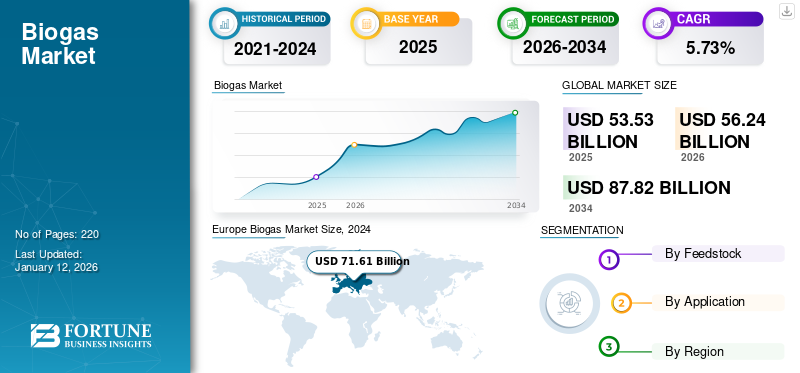
Download Free sample to learn more about this report.
Biogas Market Takeaways
 Global Market Size & Forecast
- 2025 Market Size: USD 52.22 billion
- 2026 Market Size: USD 56.10 billion
- 2034 Forecast Market Size: USD 114.81 billion
- CAGR: 9.36% from 2026–2034
 Market Share
- Europe dominated the biogas market with a market share of 71.25% in 2025.
- Organic residue and waste segment dominated the biogas market with a 77.01% share in 2025.
- Biodigester segment accounted for a 58.10% share in 2025.
 Key Regional Highlights
Europe
The European market in 2025 was valued at USD 37.21 billion and is expected to reach USD 39.95 billion in 2026.
Asia Pacific
The Asia Pacific market was valued at USD 9.09 billion in 2025 and is estimated to reach USD 9.83 billion in 2026.
North America
The North America market was valued at roughly USD 3.14 billion in 2025 and is estimated to reach USD 3.35 billion in 2026.
U.S.
The U.S. market was valued at around USD 2.79 billion in 2025. The U.S. market is expanding due to robust regulatory support, rising demand for renewable natural gas (RNG), and a sophisticated waste-management infrastructure.
Japan
The Japanese biogas market is expanding due to increasing focus on renewable energy generation, waste reduction initiatives, and the adoption of anaerobic digestion technologies.
Read More

BIOGAS MARKET TRENDS
Rising Demand for Renewable and Sustainable Energy Sources to Drive Market Growth
The rising demand for renewable and sustainable energy sources is a major driver of the biogas market growth. As countries globally aim to reduce their dependence on fossil fuels and transition toward cleaner energy systems, biogas has emerged as a reliable and eco-friendly alternative. Produced from organic waste, biogas generates energy, helps in waste management, and reduces greenhouse gas emissions. Governments and industries are increasingly adopting biogas to meet renewable energy targets, improve energy security, and support decarbonization goals. This growing shift toward sustainable energy solutions is significantly accelerating the expansion of the market.
In March 2026, as part of its effort to expand clean and sustainable energy solutions, Gujarat has operationalized 193 biogas facilities throughout the state and intends to add 60 more. The initiative is part of the state's campaign to encourage alternative fuel sources and lessen reliance on traditional fuels such as LPG. Organic waste, such as agricultural waste and cow feces, is used to produce biogas at existing plants established through a variety of government-funded programs. The output is mostly used for cooking and other energy needs, especially in semi-urban and rural regions, and to improve waste management procedures.
MARKET DYNAMICS
MARKET DRIVERS
Download Free sample to learn more about this report.
Advancements in Anaerobic Digestion and Gas Upgrading Technologies to Drive Market Growth
Enhancements in gas upgrading and anaerobic digestion technologies are major drivers of the biogas industry's expansion, enabling greater efficiency, scalability, and product quality. Modern anaerobic digestion systems reduce processing time and operating expenses while increasing biogas yield from a broader range of feedstocks, including municipal solid waste, industrial byproducts, and agricultural waste. In addition, advancements in gas upgrading technologies, such as membrane separation, pressure swing adsorption, and water scrubbing, enable the purification of raw biogas into high-quality biomethane suitable for use as a transportation fuel and for grid injection. By increasing the commercial viability of biogas projects, attracting investment, and encouraging wider adoption across industries, these technological advancements hasten overall market growth.
In October 2025, Clarke Energy commissioned a membrane-based upgrading system in Chennai that transforms municipal waste into biomethane. This project emphasizes advancements in anaerobic digestion coupled with upgrading technologies and helps India's SATAT program expand bio-CNG production. The integrated solution includes a biogas dryer, scrubber, low-pressure compressor, two-stage membrane separation system, and all necessary instruments and connecting pipes.
MARKET RESTRAINTS
High Initial Capital Investments for Plant Setup and Infrastructure to Restrain Market Growth
The high initial capital expenditure required to build infrastructure and plants is a significant barrier to the expansion of the biogas industry. The initial expenditures for the equipment needed to build a biogas plant are high, including anaerobic digesters, gas storage systems, upgrading units, and infrastructure for grid connection. The financial burden is also increased by expenditures for land purchase, raw material handling systems, and compliance with environmental regulations. These exorbitant expenses hinder adoption and postpone project execution for small-scale businesses and emerging areas. The significant initial investment and extended payback periods associated with biogas frequently deter investors, limiting the expansion of the market despite its long-term economic and environmental advantages.
MARKET OPPORTUNITIES
Expanding Use of Biomethane in Transportation and Power Generation to Drive Market Growth
The market is expanding primarily due to the growing use of biomethane in transportation and energy production. Biomethane, a purified form of biogas, can serve as a clean, renewable alternative to traditional fuels such as diesel, gasoline, and natural gas. It is increasingly used in the transportation industry as compressed natural gas (CNG) or liquefied natural gas (LNG) for vehicles, helping lower fuel costs and carbon emissions. In the same way, biomethane is being used for electricity and heat generation in power plants, providing a dependable and environmentally friendly energy source. The demand for biomethane is increasing due to rising government backing, infrastructure development, and an increasing emphasis on decarbonization, which is driving the expansion of the entire market.
A pilot project in Barcelona is powering buses with biomethane produced from wastewater (human waste), reducing CO₂ emissions by up to 80% and demonstrating a strong circular-economy model. The biomethane was produced from the wet substance generated by wastewater treated at the Baix Llobregat treatment facility. In other words, the waste produced by more than 1.5 million people in the Catalan city.
MARKET CHALLENGES
Technical Complexity in Plant Operation and Maintenance to Hamper Market Growth
A major barrier to the expansion of the biogas industry is the technical challenges of operating and maintaining plants. To ensure efficient anaerobic digestion and consistent gas production, biogas facilities require close monitoring and control of variables such as temperature, pH, and feedstock composition. A mismatch in these circumstances can result in decreased output or even system failure. Furthermore, the addition of sophisticated technologies, such as gas upgrading units and storage systems, increases operational complexity and requires competent workers for effective management. Operational difficulties are exacerbated across many areas by the shortage of trained staff and technical proficiency, leading to increased downtime and maintenance expenses. These challenges discourage new investments and hinder the widespread use of biogas technologies.
Segmentation Analysis
By Feedstock
Organic Residue and Waste Leads Market Due to Its Abundant Availability and High Biodegradability
Based on the feedstock, the market is classified into organic residue and waste (biowaste, municipal, sewage, agricultural waste, and others) and energy crops. The organic residue and waste segment dominates the market, with the largest share of 77.01% in 2025, primarily due to its abundant availability and high biodegradability, making it an ideal feedstock for biogas production. Agricultural residues, animal manure, food waste, and municipal organic waste are generated in large volumes globally, ensuring a consistent and cost-effective supply of raw materials for anaerobic digestion.
The energy crops segment is the second-largest segment in the market. The energy crops segment is projected to grow at a CAGR of 8.93% during the forecast period due to its superior energy yield and consistent quality compared to other feedstocks. To ensure a consistent, regulated supply of raw materials year-round, crops such as corn, silage, and grasses are grown specifically for biogas production. Energy crops enhance the efficiency of anaerobic digestion processes and produce a consistent methane output, unlike organic waste.
By Production Method
Biodigester Segment Commands Market as It is Crucial in Biogas Production
By production method, the market is categorized into biodigester, wastewater digester, landfill gas recovery, and others.
The biodigester segment dominates the market, accounting for a 58.10% share in 2025 due to its critical role as the core technology in biogas production. Biodigesters facilitate anaerobic digestion by breaking down organic waste into biogas and digestate under controlled conditions, ensuring continuous, efficient gas production.
Wastewater digester is the second-dominant segment in the market and is set to grow with a CAGR of 9.00% during the forecast period. The segment growth is driven by the rising demand for efficient wastewater treatment and sustainable energy generation. Wastewater treatment plants generate large volumes of sludge, which can be effectively processed through anaerobic digestion to produce biogas while reducing waste volume. This approach helps in meeting stringent environmental regulations and enables facilities to lower operational costs by generating their own energy.
By Application
To know how our report can help streamline your business, Speak to Analyst
High Demand for Reliable and Renewable Power Fuels Electricity Generation Segment Growth
By application, the market is categorized into electricity generation, heating, combine heat and power (CHP), and others.
The electricity generation segment dominates the market, accounting for a 55.05% share in 2025 due to rising demand for reliable, renewable power sources. Biogas can be used in combine heat and power (CHP) systems to generate electricity efficiently while utilizing waste materials as feedstock. This helps reduce dependence on fossil fuels and lowers greenhouse gas emissions.
Heating is the second-largest segment in the market and is expected to rise at a CAGR of 8.77% in the coming years due to its simplicity, cost-effectiveness, and widespread applicability. Biogas can be used directly for heating without complex upgrading or conversion, making it an efficient solution for residential, agricultural, and industrial heating applications. This direct use reduces energy losses and lowers operational costs compared to electricity generation or the conversion of transportation fuels.
Biogas Analysis Market Regional Outlook
By geography, the market is categorized into Europe, North America, Asia Pacific, Latin America, and the Middle East & Africa.
Europe
Europe Biogas Market Size, 2025 (USD Billion)
To get more information on the regional analysis of this market, Download Free sample
Europe holds the dominant biogas market share. The European market in 2025 was valued at USD 37.21 billion and is expected to reach USD 39.95 billion in 2026. The biogas industry in Europe is expanding due to ambitious climate goals aimed at achieving carbon neutrality and significant policy support for renewable energy. Initiatives such as the REPowerEU plan, which aims to boost the production of renewable gas while simultaneously reducing reliance on fossil fuels, are how the European Union promotes biogas and biomethane.
U.K. Biogas Market
The U.K. market in 2025 was valued at around USD 3.81 billion, representing roughly 10.23% of the global revenues. The U.K. biogas industry is expanding due to significant government backing for renewable energy and decarbonization targets, particularly through measures that encourage biomethane synthesis and grid injection. The nation has a well-established anaerobic digestion industry, supported by initiatives such as the Green Gas Support Scheme (GGSS), which promotes the use of organic waste for energy production.
Germany Biogas Market
The German market in 2025 was valued at around USD 7.57 billion, accounting for roughly 20.35% of the global revenues. Due to Germany's long-standing emphasis on the Energiewende (energy transition) and robust government policies favoring renewable energy, the nation's market is expanding. Incentives such as feed-in tariffs under the Renewable Energy Sources Act (EEG) have helped Germany establish one of the largest installed bases of biogas plants in Europe.
Asia Pacific
Asia Pacific was valued at USD 9.09 billion in 2025 and is estimated to reach USD 9.83 billion in 2026. The market in the Asia Pacific region is expanding rapidly due to rising energy demand, growing environmental concerns, and robust government support for renewable energy adoption. To manage large volumes of agricultural and municipal waste and reduce reliance on fossil fuels, nations such as China and India are investing in bio-CNG and biogas projects. In addition, there are opportunities for waste-to-energy solutions due to the area's rapid urbanization and industrialization, which generate significant organic waste.
China Biogas Market
In 2025, the Chinese market was valued at USD 5.21 billion. The market is expanding due to significant government support for renewable energy and waste management programs, as well as growing efforts to reduce air pollution and carbon emissions. The nation's large output of municipal solid waste, livestock manure, and agricultural waste creates a wealth of raw material for biogas production.
India Biogas Market
The Indian market in 2025 was valued at around USD 1.89 billion, accounting for roughly 20.82% of the global revenues. Growing government programs, such as the SATAT (Sustainable Alternative Toward Affordable Transportation) plan, which promote renewable energy and waste-to-energy solutions, are driving the growth of the market in India. Municipal trash, animal manure, and agricultural waste are produced in large quantities nationwide, making them abundant resources for biogas production.
North America
North America was valued at roughly USD 3.14 billion in 2025 and is estimated to reach USD 3.35 billion in 2026. Increasing attention to renewable energy adoption and stringent environmental legislation aimed at reducing greenhouse gas emissions are driving market growth in North America. The area's waste management infrastructure is well-established, enabling the efficient conversion of landfill gas, agricultural waste, and wastewater into biogas.
U.S. Biogas Market
The U.S. market was valued at around USD 2.79 billion in 2025. The U.S. market is expanding due to robust regulatory support, rising demand for renewable natural gas (RNG), and a sophisticated waste-management infrastructure. The manufacture and use of biogas, especially in transportation, are encouraged by national and federal legislation such as the Renewable Fuel Standard (RFS) and the Low Carbon Fuel Standard (LCFS).
Latin America and Middle East & Africa
Latin America and the Middle East & Africa were valued at USD 1.85 billion and USD 0.92 billion, respectively, in 2025. Growing attention to renewable energy adoption and sustainable waste management techniques is driving the Latin American biogas industry. There is a large amount of municipal solid waste, livestock manure, and agricultural waste produced in the area, providing ample raw material for biogas production.
Growing initiatives to diversify energy sources and reduce reliance on fossil fuels, particularly in oil-dependent economies, are driving the market in the Middle East & Africa. The area is also working to enhance waste management procedures, as increased urbanization and population growth are producing massive amounts of organic and municipal waste.
Turkey Biogas Market
The Turkish market in 2025 was valued at approximately USD 0.63 billion, accounting for roughly 67.76% of global revenues. The market is expanding due to growing government support for waste management and renewable energy policies aimed at reducing environmental impacts. Investments in biogas and biomethane initiatives are being driven by Turkey's attempts to diversify its energy imports and improve its energy security.
COMPETITIVE LANDSCAPE
Key Industry Players
Top Companies Emphasize Partnerships and New Project Development to Maintain Their Dominance
Key players in the biogas market are actively expanding their competitive positions through strategies such as partnerships, mergers and acquisitions, and new project development. Companies are investing in advanced anaerobic digestion and gas upgrading technologies to improve efficiency and scalability. They are also entering into long-term feedstock supply and offtake agreements to secure stable operations and revenue streams.
In February 2026, Future Biogas announced the acquisition of Burton Agnes Renewables Limited (BAR), a biomethane production facility located at Harpham Grange Farm in East Yorkshire. Future Biogas has managed, maintained, and operated the site since 2021 and has now acquired BAR, secured long-term ownership of the operational asset while continued to run the facility day to day.
LIST OF KEY BIOGAS COMPANIES PROFILED
- EnviTec Biogas AG (Germany)
- Future Biogas Ltd (U.K.)
- Air Liquide (France)
- PlanET Biogas Group (Germany)
- Weltec Biopower GmbH (Germany)
- Biokraft (Sweden)
- Ameresco Inc. (U.S.)
- Quantum Biopower (U.S.)
- AB HOLDING SPA (Italy)
- Renergon International AG (Germany)
- StormFisher (Canada)
- Wärtsilä (Finland)
- DMT International (U.S.)
- Gasum Oy (Finland)
- Praj Industries (India)
KEY INDUSTRY DEVELOPMENTS
- March 2026: Gasum made investment decisions on two additional large-scale biogas plants in Sweden. The Swedish Klimatklivet investment program has funded initiatives at both facilities that result in substantial reductions in emissions. The Klimatklivet investment scheme of the Swedish Environmental Protection Agency has provided a subsidy of USD 17.22 million for each project. The goal of the program is to support specific climate initiatives at the local and regional levels that lower greenhouse gas emissions. The goal of the program is to support specific climate initiatives at the local and regional levels that lower greenhouse gas emissions by promoting biogas-based renewable energy solutions.
- January 2026: Republic Services, Inc., a leader in the environmental services sector, and Ameresco, Inc., a top provider of energy infrastructure solutions, announced that in December, they successfully put a renewable natural gas (RNG) plant into operation at the Upper Rock Island County Landfill in East Moline, Illinois. The Ameresco-owned facility improvements convert the landfill biogas (landfill gas) from the Upper Rock Landfill into pipeline-quality RNG that may be utilized as a low-carbon transportation fuel and for other uses.
- September 2025: Wärtsilä Gas Solutions, a division of the technology company Wärtsilä, was selected to provide a full bioLNG solution for a brand-new biogas facility in Eskilstuna. Andion Scandinavia AB has signed the agreement. Andion will be the primary provider under a design-and-build agreement with the project's owner, Eskilstuna Biogas AB, and will be responsible for installing both the biogas liquefaction and upgrading technologies. Once operational, the facility will have the capacity to manufacture up to 17 tons of bioLNG per day from organic waste. Wärtsilä booked the order in Q2 2025.
- June 2024: Biokraft, a major participant in the Nordic biogas industry, reached an exclusive land agreement with the industrial behemoth Perstorp, granting the company the right to construct a biogas facility at the Group's industrial park in Perstorp, Sweden. In 2027, the plant is expected to be finished, with a planned output of 130 gigawatt-hours of biomethane and 17,000 tons of liquid carbon dioxide annually.
- April 2024: Ameresco unveiled a renewable energy project portfolio valued at USD 140 million, including biogas and renewable natural gas (RNG) projects that convert organic waste and landfill gas into clean energy. These projects aim to promote sustainable waste management, cut greenhouse gas emissions, and increase the usage of biogas as a low-carbon fuel in the transportation and power generation industries.
REPORT COVERAGE
The global biogas market analysis provides an in-depth study of the market size & forecast across all market segments included in the report. It contains details on the market dynamics and market trends expected to drive the market in the forecast period. It offers information on technological advancements, new product launches, key industry developments, and partnerships, mergers & acquisitions. The market research report also includes a detailed competitive landscape, providing market share and profiles of key players.
Request for Customization to gain extensive market insights.
Report Scope & Segmentation
| ATTRIBUTE | DETAILS |
| Study Period | 2021-2034 |
| Base Year | 2025 |
| Estimated Year | 2026 |
| Forecast Period | 2026-2034 |
| Historical Period | 2021-2024 |
| Growth Rate | CAGR of 9.36% from 2026-2034 |
| Unit | Value (USD Billion) |
| Segmentation | By Feedstock, By Production Method, By Application, and Region |
| By Feedstock |
|
| By Production Method |
|
| By Application |
|
| By Region |
|
Frequently Asked Questions
Fortune Business Insights says that the global market value stood at USD 52.22 billion in 2025 and is projected to reach USD 114.81 billion by 2034.
The market is expected to exhibit a CAGR of 9.36% during the forecast period (2026-2034).
The organic residue and waste segment led the market by feedstock.
Advancements in anaerobic digestion and gas upgrading technologies to drive market growth.
Air Liquide, Biokraft, and Future Biogas Ltd. are among the prominent players in the market.
Europe held the highest market share in 2025.
Expanding use of biomethane in transportation and power generation to drive market growth.



- 2021-2034
- 2025
- 2021-2024
- 200
-
(Offer valid till 30th Sep 2026)
Get 30-60 hrs Free Customization
Expand Regional and Country Coverage, Segments Analysis, Company Profiles, Competitive Benchmarking, and End-user Insights.



















Related Reports
-
US +1 833 909 2966 ( Toll Free )
-
Get In Touch With Us