Influencer Marketing Platform Market Size, Share & Industry Analysis, Component (Software and Services), By Application (Campaign Management, Brand Reputation Management, Influencer Management, and Others), By End User (Enterprises, Influencers Marketing Agencies, and E-commerce), By Industry (Food & Beverages, Fashion & Lifestyle, Health & Fitness, Beauty & Personal Care, Travel & Holiday, Apparel & Accessories, and Others), and Regional Forecast, 2026-2034
 Download Free Sample
KEY MARKET INSIGHTS
 Listen to Audio Version
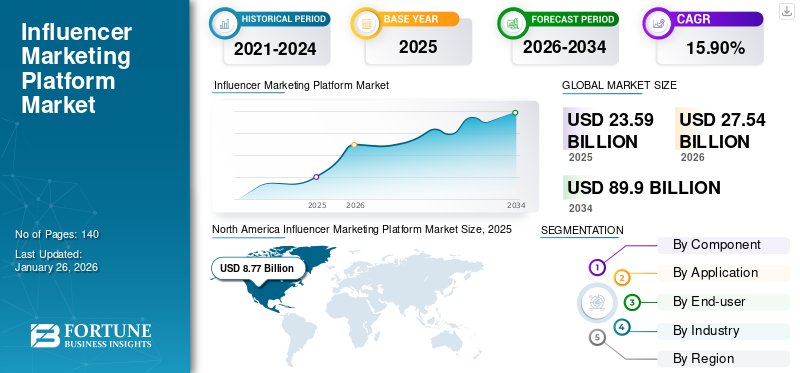
The global influencer marketing platform market size was valued at USD 23.59 billion in 2025 and is projected to grow from USD 27.54 billion in 2026 to USD 89.90 billion by 2034, exhibiting a CAGR of 15.90% during the forecast period. North America dominated the influencer marketing platform market with a market share of 37.20% in 2025.
Influencer marketing platforms enable businesses to identify suitable influencers, manage campaigns, track performance, and ensure compliance with industry regulations. The demand for influencer marketing platforms is rising as a result of reliance on digital content. A growing demand for social media-based brand endorsements also drives the market. According to Sprout Social, in 2025, it is estimated that there are currently 5.42 billion social media users across the globe, with individuals using an average of 6.83 distinct social networks each month. Moreover, businesses investing more in influencer discovery and campaign management platforms is also a growth factor for this market. These elements are driving market growth.
Artificial intelligence (AI), predictive analytics, and automation technologies are driving a structural transformation of the influencer marketing platform market. These tools facilitate real-time ROI measurement for marketing campaigns, improve influencer identification accuracy, and streamline content performance analytics. Additionally, by incorporating blockchain-based verification systems, influencer transactions are becoming more transparent and trustworthy, resolving long-standing issues in the industry like engagement fraud and phony followers. As brands shift their focus from mass reach to genuine engagement, the growth of micro and nano-influencers is also helping the influencer marketing industry.
Major players operating in the market are Dentsu Group, Sprout Social, Inc., Grin Technologies Inc., Upfluence, AspireIQ, Inc., Later (Powered by Mavrck), Traackr, Inc., Klear (Meltwater), SocialEdge Inc. (CreatorIQ), Brandwatch, Captiv8, and Neoreach.
The emergence of the COVID-19 pandemic significantly contributed to the growth of the market. Due to the emergence of new social media platforms and creator-centric content gained traction, brands utilized influencer marketing platforms during the pandemic to engage with their users more efficiently and lessen the negative impact associated with this.
Download Free sample to learn more about this report.
Influencer Marketing Platform Market KEY TAKEAWAYS
 Global Market Size & Forecast
- 2025 Market Size: USD 23.59 Billion
- 2026 Market Size: USD 27.54 Billion
- 2034 Forecast Market Size: USD 89.90 Billion
- CAGR: 15.90% from 2026–2034
 Market Share
- North America accounted for 37.20% market share in 2025.
- Software accounted for 75.72% market share in 2026.
- Brand Reputation Management accounted for 35.71% market share in 2026.
 Key Regional Highlights
Asia Pacific
Asia Pacific reached USD 5.11 billion in 2025 and is projected to reach USD 6.11 billion in 2026, driven by rising social media adoption.
North America
North America reached USD 8.77 billion in 2025 and is projected to reach USD 10.12 billion in 2026, supported by digital marketing growth.
Europe
Europe reached USD 6.55 billion in 2025 and is projected to reach USD 7.62 billion in 2026, driven by technology investments.
U.S.
The U.S. market is projected to reach USD 6.65 billion by 2026, fueled by influencer collaborations and social media usage.
Japan
The Japan market is projected to reach USD 1.45 billion by 2026, supported by digital content growth.
Read More

IMPACT OF GENERATIVE AI
Integration of Generative AI with Influencer Marketing Platforms by Enhancing Capabilities to Fuel Market Growth
The rise of generative AI has caused a wave of progress across several fields, mostly in influencer marketing. Generative AI has the potential to simplify content creation, which has a significant effect on influencer marketing. Through generative AI, brands can create a huge amount of content instantly. In addition, such models can now judge or evaluate the possible success of these influencers, which will then allow the brands to choose those who are most probably going to deliver positive results for them. For instance,
- Dreamwell AI, a company that automates influencer marketing, launched a platform for making tasks simple such as finding and contacting influencers. This automation will take care of 80-90% of the campaign activities so that people do not have to work manually, which will improve efficiency.
The integration of generative AI into the influencer marketing platform market is fundamentally reshaping the operational landscape of the influencer marketing industry. By enabling hyper-personalized content generation, AI-driven sentiment analysis, and predictive modeling, platforms are now capable of delivering data-backed insights that enhance influencer selection accuracy and campaign optimization.
Influencer Marketing Platform Market Trends
Rising Usage of Influencer Discovery Tools to Augment Market Growth
Enhanced search features on these platforms allow brands to find influencers based on more granular data such as audience demographics, engagement rates, content type, and niche. For instance, HypeAuditor offers a massive database of over 205 million influencers across platforms such as Instagram, YouTube, TikTok, Twitter, and Twitch. It provides filters for audience demographics, geo-location, and size of influencers, along with fraud detection for authenticity, which is checked. These tools are getting more advanced, offering brands better influencer matches that are likely more precisely targeted.
Additionally, the influencer marketing platform market is experiencing a marked evolution in the sophistication of discovery algorithms, driven by AI and machine learning advancements. Platforms are increasingly incorporating predictive analytics and natural language processing (NLP) to assess influencer-audience alignment and forecast engagement outcomes before campaign initiation. This analytical capability is transforming how brands allocate marketing budgets, ensuring higher ROI and transparency across the influencer marketing industry.
Also, the integration of cross-channel data analytics enables a unified view of influencer performance across multiple social platforms, strengthening strategic decision-making for enterprise clients. As these intelligent discovery systems become a competitive differentiator, their adoption is projected to significantly expand the influencer marketing market size through 2032.
MARKET DYNAMICS
Market Drivers
Growing Adoption of Effective Marketing Strategies to Aid Market Growth
The dependability of services and the genuineness of products drive consumer demand. Traditional advertising and marketing methods consistently urge customers to purchase items. In addition, the dispersion of the consumer base across various channels due to the transition toward OTT and social media has led to high marketing costs with no Return on Investment (ROI).
As a result, organizations are increasingly shifting toward data-driven influencer marketing strategies to achieve measurable performance outcomes. The influencer marketing platform market is witnessing accelerated adoption as brands seek tools that provide advanced audience analytics, engagement tracking, and performance attribution metrics. These capabilities enable marketers to optimize spending, improve conversion rates, and align promotional activities with target audience behaviors.
The integration of AI and machine learning technologies within influencer marketing platforms is allowing for predictive modeling and campaign forecasting, leading to enhanced decision-making accuracy. This digital-first approach is not only reshaping traditional marketing frameworks but also contributing significantly to the overall influencer marketing market size expansion. The growing emphasis on ROI-driven influencer collaborations and cross-channel marketing intelligence is expected to further reinforce the competitiveness of the influencer marketing industry over the forecast period.
Market Restraints
Over-saturation, Difficulties in Measurement, and ROI Hinder Market Expansion
As more companies engage in influencer marketing, the market might become saturated, which could decrease campaign effectiveness. If influencers have too many partnerships, they stand to lose their credibility and authenticity. Brand perception and sales conversion are two areas where measuring the impact of influencer campaigns is quite tricky. There is no metric standardization which makes performance evaluation by brands tough.
Inconsistent data transparency, fraudulent activity, and algorithmic changes across major social media platforms present challenges for the influencer marketing platform market. It is challenging for brands to justify marketing expenditures and determine true ROI because the influencer marketing industry lacks unified performance benchmarks, which frequently leads to unreliable metrics.
Market Opportunities
AR and VR Technologies are Opening New Opportunities for Influencer Marketing by Creating Immersive and Interactive Experiences
Augmented reality and virtual reality technologies shall evolve influencer marketing into something experiential and interactive. Influencers would get an opportunity to use unique AR filters and VR settings to interact with their audience, which makes the content more memorable as well as interactive. Brands are increasingly exploring these technologies to create innovative campaigns that stand out in a crowded digital marketplace. Furthermore, these factors are creating opportunities for the influencer marketing platform market growth.
Furthermore, it is projected that the incorporation of AR and VR features into influencer marketing platforms would revolutionize engagement tactics in the influencer marketing sector. With the use of these technologies, marketers can create immersive try-ons, virtual product experiences, and 3D narrative formats that greatly increase customer engagement and conversion rates. Platforms that provide AR and VR-compatible campaign management solutions are therefore becoming more popular, especially in industries like gaming, fashion, beauty, and travel.
SEGMENTATION ANALYSIS
By Component
Software Segment Led Due to Rising Need for Simplifying Influencer Marketing Processes
Based on component, the market is segmented into software and services.
From the point of view of share, the software segment dominated the market share 75.72% in 2026. Software designed especially for influencer marketing is a set of web-based tools that simplify the influencer marketing process for all brands. These tools contribute to the competence of the influencer marketing process by providing a number of functions, including audience analysis, influencer identification, campaign management, and content creation. The increasing integration of automation, predictive modeling, and AI-driven analytics is improving campaign efficiency and accuracy. Real-time performance monitoring and scalable, multi-channel campaign management are made possible by the growing use of SaaS-based influencer marketing solutions. The software segment's dominance is cemented by these innovations, which also strengthen its position as the cornerstone of the influencer marketing platform market and the expansion of the influencer marketing industry.
The services segment is anticipated to experience the highest CAGR during the forecast period, as brands require tailored campaigns to target specific audiences, necessitating expert services for strategic planning and optimization and globalization of campaigns.
By Application
Growing Value of Influencers Fueled Demand for Brand Reputation Management
Based on application, the market is segmented into campaign management, brand reputation management, influencer management, and others.
In 2025, the brand reputation management segment generated the most revenue as companies understood the significance of influencer relationship management and admitted the need to develop authentic partnerships with them with a share of 35.71% in 2026. These tools support the processes of identifying influencers, facilitating communication, and enabling collaboration, thereby improving the execution of campaigns. Additionally, companies have been forced to make significant investments in influencer-driven brand reputation systems due to the growing consumer scrutiny of brand ethics, transparency, and sustainability. In order to track brand perception in real time, platforms are including sentiment analysis and audience trust indicators. This development is influencing competing strategies in the influencer marketing sector. The market for influencer marketing platforms has grown significantly due to these solutions' capacity to protect brand reputation while maximizing digital visibility.
The influencer management segment is anticipated to register the highest CAGR during the forecast period owing to the benefits of several features. These include payment processing, contract management, and performance analytics that help to build and maintain long-term influencer relationships.
To know how our report can help streamline your business, Speak to Analyst
By End User
Enterprises Dominated Market Due to Rising Need for Effectively Reaching Target Audience
Based on end user, the market is segmented into enterprises, influencers marketing agencies, and e-commerce.
In 2026, the market was primarily dominated by the enterprises segment share 47.07%. The platform provides access to influencers who have established followers in specific niches. This enables enterprises to reach targeted audiences more effectively than traditional advertising. Large enterprises are increasingly adopting integrated influencer marketing solutions that consolidate analytics, content workflows, and campaign automation, allowing for greater marketing agility and compliance across global marketplaces. The growth of the influencer marketing market is anticipated to be significantly influenced by the increase in enterprise-level investments, especially as Fortune 500 businesses embrace data-driven marketing strategies.
The e-commerce segment is anticipated to register the highest CAGR during the forecast period. E-commerce brands are tapping into the global market by partnering with international influencers, expanding their reach, and increasing brand visibility across different regions.
By Industry
Fashion & Lifestyle Segment Dominated with Growing Changes in Lifestyle and its Promotion
Based on industry, the market is categorized into food & beverages, fashion & lifestyle, health & fitness, beauty & personal care, travel & holiday, apparel & accessories, and others.
In 2024, the fashion and lifestyle segment held the largest market share. Fashion and lifestyle trends are now heavily influenced by Pinterest and Instagram. Influencers on these platforms are active for brand promotion because they have large followings. High social commerce penetration is another factor contributing to the segment's dominance, with influencer-led product launches, styling guides, and live shopping events boosting conversion rates. The market for influencer marketing platforms is growing as a result of this trend, which highlights the increasing monetization potential of visual platforms.
The health & fitness segment is expected to record the highest CAGR during the forecast period. Influencer marketing platforms have become essential tools for businesses seeking to capitalize on the growing popularity of health and fitness influencers. Influencer marketing has experienced significant growth in the fitness industry due to increased health consciousness and online interaction. The convergence of wearable technology data, digital fitness communities, and personalized wellness campaigns is anticipated to further boost platform adoption in this category, reinforcing the long-term scalability of the influencer marketing industry.
INFLUENCER MARKETING PLATFORM MARKET REGIONAL OUTLOOK
By geography, the market is categorized into North America, South America, Europe, Middle East & Africa, and Asia Pacific.
North America
North America Influencer Marketing Platform Market Size, 2025 (USD Billion)
To get more information on the regional analysis of this market, Download Free sample
In 2025, North America represented USD 8.77 billion, accounting for 37.20% of the worldwide market, and is projected to grow to USD 10.12 billion in 2026. North America held a major influencer marketing platform market share in 2024. The U.S. influencer marketing platform market is predicted to grow significantly, reaching an estimated value of USD 246.0 million by 2032.
With the increasing penetration of the Internet and smartphones in North America, the use of social media platforms is growing exponentially. Platforms, including Instagram, YouTube, TikTok, Snapchat, and Facebook, have billions of active users monthly. These users spend the majority of their time on these platforms every day browsing content, connecting with friends, and following influencers in various niches such as lifestyle, fashion, entertainment, beauty, and others. Leading companies in this region are adopting various strategies, including product launches and influencer collaborations, to increase their returns. For instance,The U.S. market is projected to reach USD 6.65 billion by 2026.
- In June 2023, AnyMind Group launched Social Hack, a service-based offering, to enable businesses to leverage platform integrations between social media platforms such as TikTok and Instagram and AnyMind Group’s proprietary platforms for influencer marketing, direct commerce, and social commerce.
Download Free sample to learn more about this report.
As more people join social media, the engagement and reach of influencer marketing campaigns is increasing exponentially in the U.S. Additionally, the diversity of social media platforms allows for targeted marketing strategies, allowing brands to connect with specific demographics and niche markets.
To know how our report can help streamline your business, Speak to Analyst
Asia Pacific
Asia Pacific contributed 21.70% to the global market in 2025, with a valuation of USD 5.11 billion, and is projected to reach USD 6.11 billion in 2026. Asia Pacific is estimated to grow at the highest rate during the forecast period, driven by increasing social media usage across India, China, and ASEAN countries, including Indonesia and the Philippines. The market is primarily driven by the widespread use of social media platforms such as Instagram, TikTok (or Douyin in China), and YouTube. Brands in the Asia Pacific region are increasingly utilizing this trend to reach particular demographics by implementing localized campaigns that recognize cultural differences and local influencers.The Japan market is projected to reach USD 1.45 billion by 2026, the China market is projected to reach USD 1.86 billion by 2026, and the India market is projected to reach USD 1.39 billion by 2026.
Additionally, fast digitization, the growth of mobile commerce, and an expanding pool of local content providers are characteristics of the Asia Pacific influencer marketing platform market. A very dynamic market environment is being created by the rise in short-form video consumption, live commerce integration, and AI-enabled campaign analytics. Thanks to encouraging government programs for digital entrepreneurship, domestic influencer marketing businesses are growing significantly in nations like China and India. Together, these elements make Asia Pacific the fastest-growing center in the global influencer marketing sector, greatly increasing the size of the influencer marketing market as a whole over the course of the projection period.
Europe
The Europe market generated USD 6.55 billion in 2025, representing 27.70% of the global market landscape, and is expected to reach USD 7.62 billion in 2026. The market in Europe is estimated to grow significantly during the forecast period due to increasing investments in advanced technology, the rising application of nanotechnology, heightened smartphone usage, and supportive government regulations. European nations such as Spain, the U.K., France, Germany, and Italy play a significant role in generating revenue for the market in this area.The UK market is projected to reach USD 1.72 billion by 2026, while the Germany market is projected to reach USD 1.57 billion by 2026.
Stricter data protection regulations like GDPR are influencing the European influencer marketing platform market by encouraging businesses to use transparent, compliant marketing strategies. Additionally, in order to meet changing customer expectations, European firms are using influencer networks more frequently for purpose-driven marketing campaigns and sustainability campaigns. In the worldwide influencer marketing sector, this strategy shift is creating long-term growth prospects and establishing the area as a pioneer in moral and data-secure influencer marketing techniques.
South America
In South America, the adoption of influencer marketing platforms is rapidly growing, with brands progressively using this strategy to reach consumers through social media, particularly on platforms such as Instagram.
Due to increased smartphone penetration and the growing creative economy, nations like Brazil and Argentina are becoming important contributors to the expansion of the regional influencer marketing sector. Regional companies are adopting influencer marketing platforms for audience segmentation, campaign management, and engagement analytics due to the growing demand for micro and nano-influencers. This regional trend illustrates the increasing significance of culturally appropriate digital content and localized influencer marketing tactics in raising brand awareness and fostering consumer loyalty.
Middle East & Africa
The Middle East & Africa market was valued at USD 1.89 billion in 2025, capturing 8.00% of global revenue, and is estimated to reach USD 2.21 billion in 2026. The Middle East & Africa region has been evolving as one of the leading rates of digital penetration among the tech-savvy and youth population. From the Middle East & Africa, GCC countries offer a wide digital landscape in which both culture and technology drive brand engagement.
COMPETITIVE LANDSCAPE
KEY INDUSTRY PLAYERS
Market Players to Use Merger & Acquisition, Partnership, and Product Development Strategies to Expand Business Reach
Global influencer marketing platforms such as Dentsu Group, Sprout Social, Inc., Later, Brandwatch, and Grin Technologies Inc. are launching distinctive solutions with modern technologies such as AI, ML, and others. In addition, the market's intense competition prompts service providers to focus on acquisition methods to strengthen their market presence.
Major Players in the Influencer Marketing Platform Market
To know how our report can help streamline your business, Speak to Analyst
Key players are focusing on product portfolio expansion and technological updates, acquisitions and partnerships, and research & development activities to proliferate the demand for influencer marketing platforms.
List of Top Influencer Marketing Platform Companies Studied
- Dentsu Group (Japan)
- Sprout Social, Inc. (U.S.)
- Grin Technologies Inc. (U.S.)
- Upfluence (U.S.)
- AspireIQ, Inc. (U.S.)
- Later (Powered by Mavrck) (Canada)
- Traackr, Inc. (U.S.)
- Klear (Meltwater) (Israel)
- SocialEdge Inc. (CreatorIQ) (U.S.)
- Brandwatch (U.K.)
- Captiv8 (U.S.)
- Neoreach (U.S.)
- Socially Powerful (U.K.)
- Pearpop (U.S.)
- Influencity (Spain)
- Onalytica (U.K.)
- HypeAuditor (U.S.)
- Lefty (France)
- Storyclash GmbH (Germany)
- Emplifi Inc. (U.S.)
…and more
KEY INDUSTRY DEVELOPMENTS
- May 2024: Meltwater integrated its influencer marketing solution, Klear, with its social media management platform, Engage. This integration enables clients to consolidate their social media marketing efforts into a single platform, facilitating more organized and effective strategies.
- April 2024: Later, powered by Mavrck, introduced Beyond Influence, a podcast tailored for marketers, influencers, creators, and social media enthusiasts. This initiative aims to provide insights and discussions on industry trends, best practices, and innovations in influencer marketing.
- October 2023: Captiv8 partnered with Snapchat as an API partner, gaining access to Snapchat’s Creator Discovery API. This partnership allows marketers to leverage cross-channel influencer marketing metrics and enhance campaign effectiveness on the platform.
- July 2022: Traackr, an influencer marketing platform, launched an influencer marketing job board to connect marketers with opportunities in the industry. This initiative aims to help brands and professionals align their strategies and expand their influencer marketing expertise.
- March 2022: Brandwatch acquired Paladin, a comprehensive influencer marketing platform, to enhance its service offerings. This acquisition enables Brandwatch to provide end-to-end influencer marketing solutions, strengthening brand-consumer engagement strategies.
INVESTMENT ANALYSIS AND OPPORTUNITIES
The influencer marketing platform market offers promising investment opportunities driven by technological advancements and increasing automation across various sectors. Focusing on niche markets such as automation in health & fitness or leveraging IIoT capabilities could provide strategic advantages in this growing field.
REPORT COVERAGE
The report provides a detailed analysis of the market and focuses on key aspects, such as leading companies, product/components, and leading industry of the product. Besides, it offers insights into the market trends and highlights key industry developments. In addition to the factors mentioned above, the report encompasses several factors that have contributed to the growth of the market in recent years.
Request for Customization to gain extensive market insights.
REPORT SCOPE & SEGMENTATION
|
ATTRIBUTE |
DETAILS |
|
Study Period |
2021-2034 |
|
Base Year |
2025 |
|
Forecast Period |
2026-2034 |
|
Historical Period |
2021-2024 |
|
Growth Rate |
CAGR of 15.90% from 2026 to 2034 |
|
Unit |
Value (USD Billion) |
|
Segmentation |
By Component
By Application
By End User
By Industry
By Region
|
|
Companies Profiled in the Report |
Dentsu Group (Japan) Sprout Social, Inc. (U.S.) Grin Technologies Inc. (U.S.) Upfluence (U.S.) AspireIQ, Inc. (U.S.) Later (Powered by Mavrck) (Canada) Traackr, Inc. (U.S.) Klear (Meltwater) (Israel) SocialEdge Inc. (CreatorIQ) (U.S.) Brandwatch (U.K.) Captiv8 (U.S.) Neoreach (U.S.) |
Frequently Asked Questions
The market is projected to reach a valuation of USD 89.90 billion by 2034.
In 2025, the market was valued at USD 23.59 billion.
The market is projected to record a CAGR of 15.90% during the forecast period.
By component, the software segment led the market in 2025.
The growing adoption of effective marketing strategies drives market growth.
Dentsu Group, Sprout Social, Inc., Grin Technologies Inc., Upfluence, AspireIQ, Inc., Later (Powered by Mavrck), Traackr, Inc., Klear (Meltwater), SocialEdge Inc. (CreatorIQ), Brandwatch, Captiv8, and Neoreach are the top players in the market.
North America held the largest market share in 2025.
By industry, the health & fitness segment is expected to record the highest CAGR during the forecast period.



- 2021-2034
- 2025
- 2021-2024
- 140
Get 30-60 hrs Free Customization
Expand Regional and Country Coverage, Segments Analysis, Company Profiles, Competitive Benchmarking, and End-user Insights.




















Related Reports
-
US +1 833 909 2966 ( Toll Free )
-
Get In Touch With Us