Insect Fertilizers Market Size, Share & Industry Analysis, By Insect Type (Black Soldier Fly Larvae Frass, Mealworm Frass, Cricket Frass, and Others), By Form (Dry, Granules, and Liquid), By Application (Fruits & Vegetables, Turf, Ornamentals & Nursery Crops, Indoor, Urban & Home Gardening, Cereals & Grains, Oilseeds & Pulses, and Plantation & Cash Crops), and Regional Forecast, 2026-2034
 Download Free Sample
(Offer valid till 31st Oct 2026)

Insect Fertilizers Market Size and Future Outlook
 Listen to Audio Version
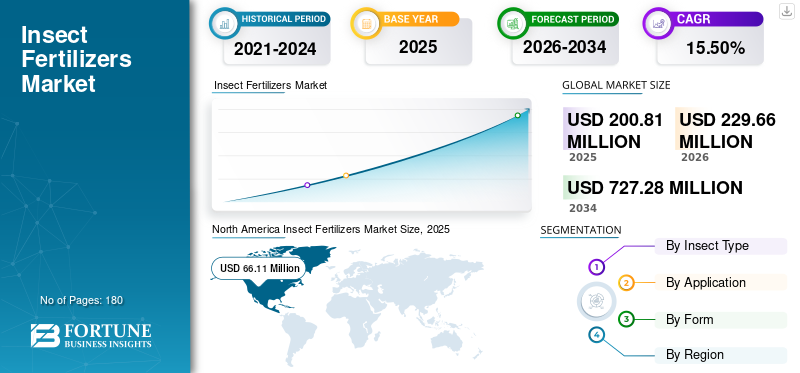
The global insect fertilizers market size was valued at USD 200.81 million in 2025. The market is projected to grow from USD 229.66 million in 2026 to USD 727.28 million by 2034, exhibiting a CAGR of 15.50% during the forecast period. North America dominated the insect fertilizers market with a market share of 32.92% in 2025.
Insect fertilizers are bio-based fertilizers which are produced from insect rearing by-products, mainly insect frass. Insect poop or excrement combined with mealworms, black soldier flies, and crickets are commonly known as insect frass. This includes insect manure, shed exoskeletons, feed residues, organic matter, nutrients, microbes, and chitin. Such products improve soil health, enhance microbial activity, support nutrient cycling, root development, and overall crop resilience. The market is growing rapidly as the fertilizers fit strongly into circular agriculture by converting food waste and agro-industrial residues into valuable farm inputs.
Companies such as Ynsect (SAS), Protix, and Innovafeed are some of the key players operating in this market. New product launch is the key strategy which is boosting product sales and supporting the market growth.
Download Free sample to learn more about this report.
Insect Fertilizers Market Key Takeaways
 Global Market Size & Forecast
- 2025 Market Size: USD 200.81 million
- 2026 Market Size: USD 229.66 million
- 2034 Forecast Market Size: USD 727.28 million
- CAGR: 15.50% from 2026–2034
 Market Share
- North America dominated the insect fertilizers market with a 32.92% share in 2025.
- Black soldier fly larvae frass segment led the market due to higher commercial-scale production.
- Dry form segment held the leading share in 2025 due to better storage and shipping advantages.
 Key Regional Highlights
North America
North America led the market with USD 66.11 million revenue in 2025.
Europe
Europe reached USD 54.34 million in 2025, driven by circular economy and organic farming trends.
Asia Pacific
Asia Pacific recorded USD 45.64 million in 2025 with rising sustainable agriculture adoption.
U.S.
The market reached USD 49.34 million in 2025, supported by regenerative and organic farming growth.
Japan
The market was valued at USD 5.48 million in 2025, accounting for 2.73% of global revenues.
Read More

INSECT FERTILIZERS MARKET TRENDS
Insect Fertilizers to Evolve from Waste-Derived Inputs to Functional Biofertilizers
Companies are increasingly investing in enhancing benefits such as organic matter enrichment, microbial stimulation, root-zone improvement, and chitin-linked plant defense of the products. Advanced product format is continually being developed and suppliers are shifting from selling loose dried frass to offering granules, pellets, blends, and liquid products that suit with current farm equipment. Products are also closely integrated with waste management, animal feed, aquafeed, and pet food value chains.
MARKET DYNAMICS
MARKET DRIVERS
Download Free sample to learn more about this report.
Circular Agriculture and Soil-Health Priorities to Support Product Adoption
The insect fertilizers market growth is being driven by the surging demand for sustainable agricultural practices, bio-based, and circular agricultural inputs. Insect frass typically consists of a combination of organic matter, macro- and micronutrients, chitin, and beneficial microbial activity. With soil organic carbon declining and farmers using nutrients more efficiently while reducing reliance on synthetic fertilizers, insect fertilizers are becoming more important for soil health. These fertilizers also help turn food waste and other organic leftovers into useful farm inputs, which supports circular economy practices. The growing demand for sustainable alternatives to chemical fertilizers also boost the product demand leading to higher growth.
MARKET RESTRAINTS
High Production Costs and Limited Farmer Familiarity to Restrict Wider Penetration
The market faces restraints due to high production costs, limited product standardization, and relatively low awareness among conventional farmers. Insect fertilizer production depends on insect-rearing infrastructure, controlled processing, drying, packaging, and safety treatment, which makes the production costlier than conventional compost, manure, or commodity fertilizers. Another major challenge is product variability, as nutrient composition and biological activity can differ based on insect species, feed substrate, rearing method, and processing conditions. Limited distribution, inconsistent availability, competition with conventional mineral fertilizers and unfamiliarity among agronomists and retailers also hold back commercial growth.
MARKET OPPORTUNITIES
Premiumization, Clean-Label Innovation, and Digital Distribution to Create New Growth Opportunities
The insect fertilizers market has the opportunity to expand its usage in specialty crops, organic agriculture, regenerative farming, and controlled-environment agriculture. Fruits, vegetables, ornamentals, turf, nursery crops, and greenhouse crops are attractive target areas as growers in these segments often prioritize soil structure, root development, microbial balance, and plant resilience in addition to nutrient supply. Manufacturers can offer granular frass, pellet fertilizers, liquid extracts, compost blends, and microbe-rich formulas to meet the needs of different crops and application styles.
Segmentation Analysis
By Insect Type
Higher Commercial-Scale Manufacturing to Drive Black Soldier Fly Larvae Frass Segment Leadership
The market is segmented by insect type into black soldier fly larvae frass, mealworm frass, cricket frass, and others.
The black soldier fly larvae frass segment held the largest insect fertilizers market share in 2025. Black soldier fly frass is manufactured at higher commercial scale than most other insect-derived fertilizer streams. It is widely used in insect protein, aquafeed, pet food, and organic waste bioconversion systems, which creates a steady and scalable supply of frass as a co-product.
The mealworm frass segment, another significant segment, is anticipated to expand at a CAGR of 15.21% during the forecast period. Mealworms are also commercially reared for protein, feed, pet food, and food applications, creating a usable fertilizer by-product. Mealworm frass usually contains organic matter, nutrients that support plant growth, helpful microbes, and chitin. These qualities make it suitable for improving soil and for specialty crops.
By Form
Dry Segment Led the Market Due to Low Moisture and Better Product Storage
Based on form, the market is segmented into dry, granules, and liquid.
The dry segment accounted for the largest market share in 2025 given that most insect frass is processed, stabilized, and sold as dried powder, granules, pellets, or compost blends. As dry product has lower moisture, it helps to store the products better, reduces odor, limits microbial spoilage, and makes it easier to ship to different markets.
The liquid segment is poised to surge at a CAGR of 15.42% during the forecast period. This form is convenient for fertigation, foliar spraying, greenhouse use, hydroponic-style growing, and precision farming. Growth-supporting agents such as liquid insect fertilizers, including extracts, teas, hydrolysates, and soluble blends, are easy to mix, and work well with irrigation systems as they provide nutrients quickly.
By Application
To know how our report can help streamline your business, Speak to Analyst
Fruits and Vegetables Segment Dominated the Market Due to Adoption of More Intensive Nutrition Programs
By application, the market is segmented into fruits & vegetables, turf, ornamentals & nursery crops, indoor, urban & home gardening, cereals & grains, oilseeds & pulses, and plantation & cash crops.
The fruits & vegetables segment led the global market in 2025. These crops need more nutrients, have shorter growing cycles, and are more affected by soil quality, root growth, and microbial balance. Fruit and vegetable growers use more intensive nutrition programs than those who grow broad-acre crops. Insect fertilizers, especially insect frass, work well for these crops. They add organic matter, slow-release nutrients, micronutrients, microbial residues, and chitin, all of which help soil health and root growth.
Turf, ornamentals & nursery crops is another significant category, which is estimated to expand at a CAGR of 15.49% during the forecast period. The segment accounts for the second-largest share since these focus on root growth, plant appearance, soil quality, and steady nutrient release instead of overall crop yield. The product fits these needs well as they provide nutrients and also help condition the soil.
Insect Fertilizers Market Regional Outlook
By geography, the market is categorized into Europe, North America, Asia Pacific, South America, and the Middle East & Africa.
North America
North America Insect Fertilizers Market Size, 2025 (USD Million)
To get more information on the regional analysis of this market, Download Free sample
The North America market reached a value of USD 66.11 million in 2025 and is the leading regional market. North America is at an early stage of using insect-based fertilizers, but the market has strong potential. The market growth in regenerative agriculture, organic farming, specialty crops, and waste-to-value businesses is helping drive this trend in the region. The product demand is growing among growers of fruits, vegetables, nurseries, turf, ornamentals, and greenhouse crops. More farmers are more willing to pay for biological fertilizers that also improve soil quality. However, higher product costs, a fragmented supply chain, and the need for more field trials on large-scale crops impacts wider adoption.
U.S. Insect Fertilizers Market
In 2025, the U.S. market reached a value of USD 49.34 million. The U.S. market is growing due to the rise of regenerative agriculture, organic farming, controlled-environment agriculture, and increasing demand for high-quality biological inputs. Growers of fruits, vegetables, turf, ornamentals, nursery plants, cannabis, and greenhouse crops are driving product adoption. Insect protein companies help make frass more available, especially from systems that use black soldier fly larvae. However, using insect-based fertilizers in row crops is still limited along with inconsistent supply, high product cost, and limited field trials impacting wider adoption.
Asia Pacific
The Asia Pacific market was valued at USD 45.64 million in 2025. Asia Pacific is likely to become a key growth region as it generates high amount of organic waste, has large areas of farmland, and records a growing pressure to improve soil quality. Countries such as China, Japan, South Korea, Australia, India, and those in Southeast Asia present high growth opportunities for manufacturers to produce and use insect-based fertilizers. As there is growing interest in sustainable farming, organic food, and making better use of waste in the region, the demand for such products is expected to increase in the future.
India Insect Fertilizers Market
The India market touched a value of around USD 4.46 million in 2025, accounting for roughly 2.22% of the global market revenues.
China Insect Fertilizers Market
The China market reached a value of around USD 12.61 million in 2025, representing roughly 6.28% of the global market share. China is well-positioned for growth due to its large agricultural sector, high levels of organic waste, and rising interest in sustainable nutrient management. China’s large fruit, vegetable, tea, greenhouse, and specialty crop industries offer strong demand for fertilizers made from insect frass. Hence, companies have the opportunity to expand their insect frass processing facilities in the country.
Japan Insect Fertilizers Market
The Japan market reached a valuation of around USD 5.48 million in 2025, accounting for roughly 2.73% of the global market revenues.
Europe
The European market reached a value of USD 54.34 million in 2025. The growth of this well-organized market is driven by circular economy policies, increased adoption of organic farming, and stricter rules that support bio-based agricultural products. The region’s well-developed insect farming industry and a strong push to use fewer synthetic fertilizers both help drive demand. France, the Netherlands, Germany, Spain, and Belgium are leading markets, especially in horticulture, greenhouse production, nursery crops, and organic farming. More European farmers are gradually using frass as it adds organic matter, releases nutrients slowly, and improves soil health. However, stringent regulatory norms still impact the commercialization of these fertilizers in the market.
Germany Insect Fertilizers Market
In 2025, the Germany market reached a value of around USD 8.83 million, representing roughly 4.39% of the global market revenues. Germany is a key European market due to its strong sustainability orientation, organic farming base, and advanced circular economy ecosystem.
U.K. Insect Fertilizers Market
The U.K. market reached a valuation of approximately USD 5.99 million in 2025, equivalent to around 2.98% of the global market sales.
South America and Middle East and Africa
The South America market is expected to experience significant growth over the forecast period. The regional market recorded a value of USD 19.83 million in 2025 and is slowly growing with an increasing number of farmers showing interest toward biological inputs, sustainable farming, and organic specialty crops. Countries such as Brazil, Chile, Argentina, Colombia, and Peru have strong agricultural sectors, especially in fruit, vegetables, coffee, and export crops, which create growth opportunities in the region.
The Middle East and Africa market reached USD 14.89 million in 2025. The market is still at the very early stage of development. Countries such as the UAE, Saudi Arabia, South Africa, Kenya, and Egypt are some of the prominent markets in the region as controlled-environment farming, landscaping, horticulture, and high-quality organic production is growing rapidly. However, the large-scale adoption is currently limited by a lack of insect farming infrastructure, high production costs, weak distribution networks, and low technical awareness.
Saudi Arabia Insect Fertilizers Market
The Saudi Arabia market is anticipated to grow at a CAGR of 12.15% during the forecast period. It is a niche but attractive market, mainly driven by controlled-environment agriculture, landscaping, organic farming, and food-security initiatives.
COMPETITIVE LANDSCAPE
Key Industry Players
Pivotal Companies Emphasize the Development of New Formulations to Strengthen Industry Positions
The insect fertilizers market is still fragmented and the competition depends more on insect-rearing capacity, access to substrates, product standardization, and regulatory readiness than on traditional fertilizer distribution scale. Some of the key companies operating in the market include Protix, Innovafeed, and Enterra Feed Corporation among others who are researching and developing new product formulations. Competitors are focused on developing formulated products, blends, and partnerships with specialty fertilizer companies and undergoing market expansion which leads to higher market growth.
LIST OF KEY INSECT FERTILIZERS COMPANIES PROFILED
- Ynsect (SAS) (France)
- Protix (Netherlands)
- Innovafeed (France)
- Darling Ingredients (U.S.)
- The Sentara Group (Malaysia)
- Entomo Farms (Canada)
- Bioflytech (Spain)
- nextProtein (France)
- Hexafly (Ireland)
- Beta Hatch (U.S.)
KEY INDUSTRY DEVELOPMENTS
- January 2025: Innovafeed, a leader in insect-based solutions for agriculture and aquaculture, partnered with Agryco, a leading platform for the valorization of natural agricultural inputs, to commercialize its Hilucia “Frass for plants” organic fertilizer.
- March 2024: SureSource Agronomy, a Canada-based company, introduced a new line of crop nutrient products that are manufactured using the excrement, exoskeletons, and discarded feed materials of crickets.
- September 2023: Nutrition Technologies developed Vitalis, a 100% natural bioactive spray which is derived from Black Soldier Fly (BSF) frass. This product is fermented and enhanced with additional chitin and a microbial inoculant to create a highly effective plant protection product.
- August 2022: India-based insect biotech startup Loopworm raised USD 3.40 million in seed funding. The company planned to launch its first factory to scale production on insect-based aquafeed and other circular economy applications.
- June 2022: Golfgreen, one of the leading lawn care and garden brands in Canada, launched an innovative, sustainable, and unique fertilizer solution in the market. The product named Golfgreen Organic Cricket Manure Plant Fertilizer is suitable for lawn and gardens.
REPORT COVERAGE
The global insect fertilizers market research provides an in-depth study of market sizes and forecast by all the market segments included in the report. The market analysis includes details on the market dynamics and market trends expected to drive the market forecast. It offers information on technological advancements, new product launches, key industry developments, and details on partnerships, mergers, and acquisitions. The report also encompasses detailed competitive landscape with information on the market segmentation, market share and profiles of key operating players.
Request for Customization to gain extensive market insights.
Report Scope & Segmentation
| ATTRIBUTE | DETAILS |
| Study Period | 2021-2034 |
| Base Year | 2025 |
| Estimated Year | 2026 |
| Forecast Period | 2026-2034 |
| Historical Period | 2021-2024 |
| Growth Rate | CAGR of 15.50% from 2026-2034 |
| Unit | Value (USD Million) |
| Segmentation | By Insect Type, By Application, By Form, and Region |
| By Insect Type |
|
| By Application |
|
| By Form |
|
| By Region |
|
Frequently Asked Questions
Fortune Business Insights says that the global market value stood at USD 200.81 million in 2025 and is projected to reach USD 727.28 million by 2034.
In 2025, the North America market value stood at USD 66.11 million.
The market is expected to exhibit a CAGR of 15.50% during the forecast period.
By application, the fruits and vegetables segment led the global market in 2025.
Circular agriculture and soil-health priorities are key factors driving the market.
Ynsect (SAS), Protix, and Innovafeed are the key players in the market.
North America held the largest market share in 2025.
The evolution of insect fertilizers from waste-derived inputs to functional biofertilizers is a major trend in the market.



- 2021-2034
- 2025
- 2021-2024
- 180
-
(Offer valid till 31st Oct 2026)
Get 30-60 hrs Free Customization
Expand Regional and Country Coverage, Segments Analysis, Company Profiles, Competitive Benchmarking, and End-user Insights.














Related Reports
-
US +1 833 909 2966 ( Toll Free )
-
Get In Touch With Us