Insulated Packaging Market Size, Share & Industry Analysis, By Material (Plastic, Paper & Paperboard, Metal, and Others), By Product Type (Boxes & Containers, Wraps & Liners, Pouches & Envelopes, and Others), By Application (Foods, Beverages, Healthcare & Pharmaceuticals, Chemicals, and Others), and Regional Forecast, 2026-2034
 Download Free Sample
(Offer valid till 30th Sep 2026)

KEY MARKET INSIGHTS
 Listen to Audio Version
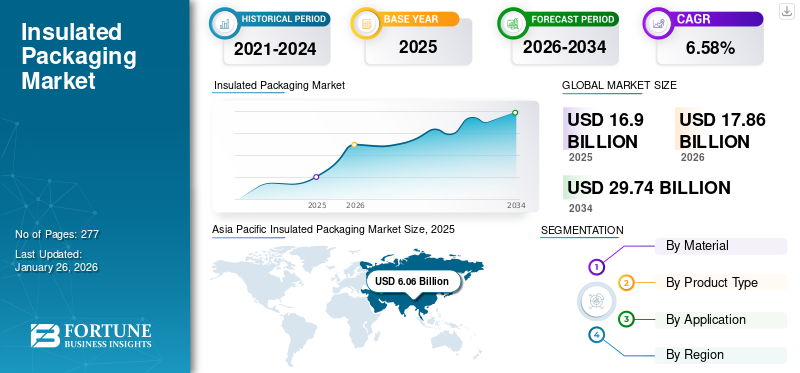
The global insulated packaging market size was valued at USD 16.90 billion in 2025 and is projected to grow from USD 17.86 billion in 2026 to USD 29.74 billion by 2034, growing at a CAGR of 6.58% during the forecast period. Asia Pacific dominated the insulated packaging market with a market share of 35.84% in 2025.
Insulated packaging refers to a type of packaging designed to protect products from temperature variations and maintain their desired temperature conditions. The primary purpose of this packaging is to prevent heat transfer, whether keeping a cold or hot environment, thereby safeguarding the integrity and quality of the packaged goods during transportation, storage, or shipping. This type of packaging is essential for products that are sensitive to temperature fluctuations, such as perishable foods, pharmaceuticals, vaccines, biotechnological products, and certain chemicals. This packaging helps to control and stabilize the internal temperature of the package, thereby preserving the freshness, efficacy, and safety of the contents. One significant market driver is the increased demand for temperature-sensitive goods across varying climates. It plays a crucial role in the supply chain and helps to ensure that products reach their destination in optimal condition.
The demand for this packaging is driven by the increasing need for maintaining specific temperature control conditions during transportation, particularly for pharmaceuticals, perishable food, and chemicals. Market growth is supported by the rise of e-commerce, which requires efficient and reliable packaging solutions for temperature-sensitive products.
The market plays a crucial role in ensuring the protection of temperature-sensitive goods during transit. It spans across multiple industries, including pharmaceuticals, food and beverages, chemicals, and more. Insulated packaging solutions maintain a controlled environment to protect products from extreme temperature variations, ensuring their quality, safety, and compliance with industry regulations. The market is expected to continue expanding due to advancements in technology, growing demand for temperature-sensitive logistics, and sustainability initiatives.
Sancell Pty Ltd. and Cold Chain Technologies are the leading manufacturers, accounting for the largest global market share.
Download Free sample to learn more about this report.
INSULATED PACKAGING MARKET Key Takeaways
 Market Size & Forecast
- 2025 Market Size: USD 16.90 Billion
- 2026 Market Size: USD 17.86 Billion
- 2034 Forecast Market Size: USD 29.74 Billion
- CAGR: 6.58% from 2026–2034
 Market Share
- Asia Pacific dominated the insulated packaging market with a 35.84% share in 2025.
- The plastic segment is projected to account for 43.22% of the market in 2026.
- The food segment is expected to hold a 42.10% market share in 2026.
 Key Regional Highlights
Asia Pacific
Asia Pacific generated USD 6.06 billion in 2025 and is projected to reach USD 6.47 billion in 2026.
North America
North America accounted for USD 4.60 billion in 2025 and is expected to grow to USD 4.87 billion in 2026.
Europe
Europe reached USD 3.97 billion in 2025 and is projected to grow to USD 4.17 billion in 2026.
U.S.
The insulated packaging market is projected to reach USD 4.31 billion by 2026.
Japan
The insulated packaging market is projected to reach USD 1.40 billion by 2026.
Read More

MARKET DYNAMICS
MARKET DRIVERS
Growing Demand for Ambient Packaging for On-the-Go Lifestyle Fuels Market Growth
The rapid pace of modern lifestyles and the growing preference for convenience have propelled the insulated packaging market forward. Particularly in urban settings, consumers are gravitating towards easily accessible food options that don't necessitate refrigeration.
Ambient packaging meets this high demand by providing a range of ready-to-eat snacks, meals, and beverages that can be conveniently stored at room temperature, aligning perfectly with the trend toward on-the-go consumption.
Expansion of Cold Chain Logistics Drives Market Growth
The expansion of cold chain logistics, driven by the need to transport temperature-sensitive products efficiently, is a significant driver for the market. This is particularly evident in industries such as pharmaceuticals, where the cold chain is vital for preserving the efficacy of drugs and vaccines.
As companies invest in cold chain infrastructure and seek reliable packaging solutions to maintain the integrity of their products, the demand for insulated packaging is expected to grow. The expansion of cold chain networks globally is a key driver shaping the market landscape.
MARKET RESTRAINTS
Cost Constraints is Hindering the Growth of the Market
One significant restraint in the market is the associated costs. The materials used for effective thermal insulation, such as advanced foams, reflective barriers, and vacuum panels, can be relatively expensive. Production companies find it difficult to manufacture these products without increasing prices while catering to customized requirements from businesses. These costs often lead to higher prices for such packaging solutions, which can be a deterrent for some businesses, notably smaller enterprises with budget constraints. Companies must evaluate the benefits of maintaining product integrity in comparison to the additional expenses incurred in implementing this type of specialty packaging.
MARKET OPPORTUNITIES
Rising Demand for Sustainable and Eco-Friendly Products Offer Potential Growth Opportunities
As private entities and governments are focusing on environmentally friendly products, there is a growing demand for sustainable packaging options, such as biodegradable plastics, compostable materials, and recyclable packaging. Businesses are increasingly adopting circular economy practices by designing packaging that can be reused, recycled, or repurposed, reducing waste and creating new business opportunities in the process.
For instance, in December 2024, Cincinnati-based packaging manufacturer ProAmpac introduced a patent-pending curbside insulated bag named FiberCool. This is a pioneering one-piece design that improves insulation properties, removes assembly time, keeps storage space, and reduces materials and costs.
With the growth of e-commerce, especially in the post-pandemic world, there is a greater need for packaging that can ensure safe delivery, easy returns, and an enhanced unboxing experience. Many e-commerce brands are incorporating personalized packaging to improve the customer experience, offering businesses the chance to innovate with packaging designs and features. It thus creates potential opportunities for the global packaging market growth.
MARKET CHALLENGES
High Production Costs and Specialized Recycling Needs Hinder Adoption of Eco-Friendly Insulated Packaging
As environmental issues increase, businesses are under greater pressure to embrace eco-friendly options such as biodegradable plastics or PET-based liners. Nevertheless, these materials frequently necessitate advanced manufacturing methods, which elevate production expenses. Moreover, obtaining sustainable raw materials can be pricier than conventional choices such as Styrofoam or expanded polystyrene. These increased costs are often transferred to consumers, resulting in eco-friendly insulated packaging being less competitive in markets sensitive to price. In addition, specialized recycling centers are required to handle these materials, creating logistical and financial challenges for manufacturers and distributors. This cost hurdle presents a notable obstacle, especially for small enterprises or sectors with limited profit margins, restricting broader adoption even with the rising demand for sustainable options.
Download Free sample to learn more about this report.
INSULATED PACKAGING MARKET TRENDS
Advancements in Temperature-control Technologies are Emerging as a Key Trend in the Market
The market is witnessing a transformative shift with the integration of smart packaging technologies. The market is witnessing advancements in temperature-control technologies to enhance the efficiency of maintaining specific temperature conditions. This includes the incorporation of Phase Change Materials (PCMs), smart temperature-monitoring devices, and vacuum insulation panels. These technologies aim to provide more precise control over temperature fluctuations during transportation and storage, ensuring that products, especially pharmaceuticals and biotechnological materials, remain within the required temperature range.
- Asia Pacific witnessed a insulated packaging market growth from USD 5.33 billion in 2023 to USD 5.68 billion in 2024.
Intelligent packaging solutions equipped with sensors and connectivity enable real-time tracking of temperature, humidity, and other environmental conditions, increase the product’s adoption, and lead to the insulated packaging market growth.
IMPACT OF COVID-19
The COVID-19 pandemic had a significant impact on various industries worldwide, including the market. The pandemic brought about a range of challenges and disruptions that affected the production, supply chain, demand dynamics, and overall business operations within the market.
The packaging was stable due to the requirement of specified packaging for transportation and preservation of the vaccines and heat-sensitive health products in general. Technically, Aqueous eutectic solutions and other phase-change materials are used for the temperature ranges from +2/+8 °C, +15/+25 °C, -25/-15 °C, and other specific ranges. These insulated materials cover temperatures ranging from -30 °C to +40 °C with acceptable performances.
On the other hand, the market was facing issues in the industrial manufacturing of insulated packaging due to the unavailability of the raw materials. Moreover, the market was down owing to the strict rules and regulations of the government, and the food delivery e-commerce business faced backlash.
TRADE PROTECTIONISM
Trade protectionism can significantly impact the insulated packaging market by increasing the costs of raw materials and limiting access to key components. Tariffs, import/export restrictions, and trade barriers can lead to increased production costs for manufacturers and disrupt global supply chains. To mitigate these challenges, companies may need to adopt alternative sourcing strategies and explore local production options to avoid high import taxes and customs duties.
Trade protectionism can also lead to a shift in regional market dynamics, as companies may decide to relocate manufacturing plants to countries with more favorable trade conditions. This could result in a more localized market with a focus on regional production and consumption.
SEGMENTATION ANALYSIS
By Material
Cost-effectiveness and Barrier Properties offered by the Plastic is Contributing to the Segment’s Growth
Based on material, the market is segmented into plastic, paper & paperboard, metal, and others.
Plastic is expected to dominate the market with a share of 43.22% in 2026. Plastic packaging has excellent barrier properties to protect food items from bacteria, moisture, gases, and other environmental factors. Plastics, particularly Expanded Polystyrene (EPS) and polyurethane, have become the material of choice for insulated packaging. These materials offer excellent thermal insulation properties, providing a reliable barrier against heat transfer. The lightweight nature of plastic makes it an attractive option for shipping and transportation, reducing overall shipping costs.
Paper & paperboard is the second-largest and highest-growing segment of this market. Despite the prevalence of plastic in the market, there is a growing awareness of environmental concerns associated with single-use plastics. Paper packaging, as an eco-friendly alternative, is gaining traction due to its biodegradability, recyclability, and renewable nature.
By Product Type
Versatility of Boxes & Containers in Accommodating a Wide Range of Products Dominates the Segment
Based on product type, the market is segmented into boxes & containers, wraps & liners, pouches & envelopes, and others.
The boxes & containers segment is expected to account for the largest market share of 43.11% in 2026. This dominance is driven by the inherent advantages and diverse applications of boxes and containers in preserving the temperature-sensitive integrity of various products. Whether protecting the integrity of pharmaceuticals, perishable foods, vaccines, or other temperature-sensitive goods, boxes and containers offer a customizable and thermally insulated solution. The rigid structure of boxes provides enhanced protection during transit, reducing the risk of damage and temperature fluctuations.
Pouches & envelopes are the second most dominant segment of this market and are suitable for lightweight and smaller items.
By Application
To know how our report can help streamline your business, Speak to Analyst
Foods Segment Holds the Largest Market Share Owing to Essential Role of Packaging in Global Supply Chains
Based on application, the market is segmented into beverages, chemicals, foods, healthcare & pharmaceuticals, and others.
Food is expected to hold the largest insulated packaging market share of 42.10% in 2026. The demand for ready-to-eat and fresh food products has expanded significantly. Such type of packaging plays a critical role in preserving the freshness and quality of these items. The globalization of the food supply chain has necessitated the transportation of perishable goods over longer distances. Insulated packaging has become indispensable in maintaining the temperature stability of food products, preventing spoilage, and ensuring that food products reach consumers in optimal condition.
Healthcare & pharmaceuticals are the second dominating segment of this market. Insulated packaging solutions played a crucial role in the safe transportation and storage of vaccines, medications, and other temperature-sensitive medical supplies, leading to the growth of this segment. The foods segment is expected to hold a 41.19% share in 2024.
INSULATED PACKAGING MARKET REGIONAL OUTLOOK
The market has been studied geographically across five main regions: North America, Europe, Asia Pacific, Latin America, and the Middle East & Africa.
Asia Pacific Insulated Packaging Market Size, 2025 (USD Billion)
To get more information on the regional analysis of this market, Download Free sample
Rising Disposable Income and Expanding Cold Chain Logistics Drive Growth in Asia Pacific
Asia Pacific
Asia Pacific dominated the market with a valuation of USD 6.06 billion in 2025 and is projected to reach USD 6.47 billion in 2026. Asia Pacific holds the largest share of the insulated packaging industry, with Japan, India, and China representing a rapidly growing market. The expansion of the pharmaceutical and healthcare industries and increasing disposable income in Asian countries are driving the demand for convenience foods and, subsequently, driving the need for such packaging solutions. The region includes several developing countries such as India, China, and Japan, where agriculture serves as the primary foundation of the economy. India is also known as the biggest producer and exporters of meat, dairy products, fruits, and vegetables in the Asia Pacific region. These perishable items require optimal cold-chain refrigerants and insulated packaging to preserve their freshness while being transported as countries move their products across various temperature regions. This variation in temperature throughout product transport boosts the need for insulated packaging in the Asia Pacific area, thereby fostering market growth in the region. The Japan market is projected to reach USD 1.4 billion by 2026, the China market is projected to reach USD 2.12 billion by 2026, and the India market is projected to reach USD 1.24 billion by 2026.
- For instance, according to the statistics by the Agricultural and Processed Food Products Export Development Authority (APEDA), exports of fruits and vegetables have increased by 11% to account for USD 1.8 billion in the financial year 2023-24 while volume has declined 10% to 3.91 million tonnes. Moreover, floriculture exports augmented 8% accounting for USD 208 million, and volume was down marginally to 34,132 tonnes.
Robust Pharmaceutical Industry and E-Commerce Expansion Propel North America's Market Growth
North America
In 2025, North America generated USD 4.6 billion, contributing 27.22% to global market revenue, and is projected to grow to USD 4.87 billion in 2026. North America holds the second leading position in the market, benefitting from well-established packaging practices and stringent regulatory standards. In North America, the market is driven by the robust pharmaceutical and healthcare sectors, e-commerce growth, and a rising demand for sustainable packaging solutions. In addition, with diverse applications across food, beverage, pharmaceuticals, consumer goods, and industrial sectors, the market has significantly grown in recent years in the U.S. Moreover, increasing demand from both the healthcare and food industries is influencing the market in the region. The U.S. market is projected to reach USD 4.31 billion by 2026.
- For Instance, in April 2023, Novolex, a packaging solution provider based in the U.S., introduced the laminated and insulated fresh food packaging product for transpiration and freezing applications. Moreover, Power Prep uses non-fluorinated oil-and-grease-resistant paper, which is coated using a honeycomb pattern to generate an insulated layer for the product.
Sustainability Focus and Cold Chain Logistics Drive Europe's Market Growth
Europe
The Europe market accounted for USD 3.97 billion in 2025, representing 23.50% of the global industry, and is expected to reach USD 4.17 billion in 2026. Following North America, Europe is projected to show significant growth over the coming years. Europe is a mature market for insulated packaging, with a strong emphasis on sustainability and eco-friendly solutions. The food and beverage industry, particularly the cold chain logistics for perishable goods, contributes significantly to the demand. Countries such as Germany, France, Norway, and the U.K. are already focusing on the sustainability and efficiency of the products in the insulated packaging market. Moreover, privately owned businesses are seeking strategies to minimize their ecological footprint so that automation can aid them in accomplishing this by reducing waste, enhancing material utilization, and increasing the efficiency of the packaging process.
- The European Commission recently adopted a strategy for plastics that aims at significantly improved capacity for plastic recycling, with a target of 55% of the EU’s total plastic waste recycled by 2025. With the goal of ensuring 100% recyclable plastic by 2030, the European Union is leading the world’s governing bodies in a drive to accept and adopt recyclates. To meet its halfway target of 55% recycling by 2025, the EU needs to create an end market for 12 million tons of plastic recyclates by 2025.
Urbanization and Demand for Cold Chain Logistics Drive Insulated Packaging Growth in Latin America
Latin America
Latin America accounted for USD 1.54 billion in 2025, representing 9.11% of the global market share, and is projected to reach USD 1.6 billion in 2026. Latin America is experiencing economic development driven by increasing urbanization, changing consumer lifestyles, and an increasing demand for temperature-sensitive drugs and vaccines. The food sector has significantly transformed in recent years because of evolving consumer preferences and increasing demand for safety and quality. The insulated products in cold chain packaging create a temperature-regulated supply chain that ensures the secure transportation and storage of perishable items, such as food and medications.
- For Instance, in February 2025, Daewoong Pharmaceutical signed a contract of USD 125 million for the export of botulinum toxin (BTX) with M8 Pharmaceuticals, its partner in Brazil, marking its largest deal in Latin America since entering the market.
Extreme Temperatures and Changing Consumer Preferences Drive Insulated Packaging Growth in Middle East & Africa
Middle East & Africa
The Middle East & Africa market generated USD 0.73 billion in 2025, representing 4.31% of the global market landscape, and is expected to reach USD 0.75 billion in 2026. The Middle East & African insulated packaging industry is expected to register a moderate growth rate over the assessment period due to growing consumer preferences toward packaged and convenience foods. Additionally, the food and beverage industry, particularly in regions with extreme temperatures, contributes to the demand for such packaging solutions. The market in the Middle East & Africa is evolving rapidly due to a combination of factors such as population growth, urbanization, changes in consumer preferences, and a growing focus on sustainability.
- As per the information released by the United Nations Economic Commission for Africa, Egypt sends 50% of its pharmaceutical exports to other nations in the Middle East and North Africa, 29% to other global markets, 14% to the European Union, and 7% to the North African Mediterranean countries. Likewise, Moroccan pharmaceutical exports rose from approximately USD 58.8 million in 2008 to USD 117.1 million in 2019.
COMPETITIVE LANDSCAPE
KEY INDUSTRY PLAYERS
Key Market Participants to Witness Significant Growth Opportunities with New Product Launches
The global market is highly fragmented and competitive. A few significant players are dominating the market by offering innovative insulated packaging solutions. These major market players constantly focus on expanding their customer base across regions by innovating their existing wide range of products. The market report also highlights the key developments by the manufacturers.
Major players in the industry include Sancell Pty Ltd., Cold Chain Technologies, Mondi, Smurfit Kappa, Peli BioThermal Limited, and others. Numerous other companies operating in the market are focused on market scenarios and delivering advanced insulated packaging solutions.
List of the Key Companies Profiled in the Report:
- Sancell Pty Ltd. (Australia)
- Cold Chain Technologies (U.S.)
- Mondi (U.K.)
- Smurfit Kappa (Ireland)
- Peli BioThermal Limited (U.S.)
- Insulated Products Corporation (U.S.)
- Cryopak (U.S.)
- Polar Tech Industries Inc. (U.S.)
- CSafe Global, LLC (U.S.)
- Ranpak (U.S.)
- Snyder Industries, LLC (U.S.)
- COMBITHERM A/S (Denmark)
- EMBALL'ISO (France)
- Sonoco ThermoSafe (U.S.)
- Stora Enso (Finland)
- EPG INDUSTRIES (U.S.)
- Huhtamaki Inc. (Finland)
- DGP INTELSIUS LTD (U.K.)
- Zhejiang Pengyuan New Material Co. Ltd. (China)
- Suzhou Star New Material Co. Ltd. (China)
KEY INDUSTRY DEVELOPMENTS
- February 2025: Mondi Group, one of the top players in sustainable packaging and paper, announced a three-year postponement of its partnership with the UN World Food Programme (WFP). This organization provides food assistance to those recovering from conflict, disasters, and the impact of climate change.
- January 2025: Mauser Packaging Solutions, a worldwide leader in packaging solutions and services throughout the packaging lifecycle, revealed the enhancement of its capabilities at its facility in Haiyan, China. The tactical investment comprises cutting-edge machinery for the production of Intermediate Bulk Containers (IBCs). The updated line manufactures UN-certified IBCs suitable for the chemical, food, and additive sectors while providing clients with a wide range of IBC options to fulfill their unique requirements. Furthermore, this funding aids the expansion of Mauser Packaging Solutions' Infinity Series IBC line that features Recolene.
- October 2024: Silgan Holdings Inc., a top leader of eco-friendly rigid packaging solutions for essential consumer goods globally, revealed that it had finalized its acquisition of Weener Plastics Holdings B.V., a prominent manufacturer of unique dispensing solutions for personal care, food, and healthcare items. The company financed the acquisition price and associated costs and expenses via term and revolving loan borrowings under its senior secured credit facility, which included a USD 734 million incremental term loan.
- September 2024: Marigold Health Foods, in partnership with Sonoco, introduced its new, completely recyclable packaging for an array of natural, plant-based food items. Marigold offers a variety of products, including Engevita nutritional yeast, bouillon, gravy, stock cubes, sauces, and plant-based alternatives for meat and fish. The completely recyclable packaging solution developed by Sonoco showcases Marigold's dedication to sustainability and innovation, establishing a new benchmark in the industry.
- May 2024: Gerresheimer, an innovative systems and solutions provider and a worldwide partner for the pharmaceutical, biotech, and cosmetics sectors, is greatly enhancing its manufacturing capabilities for medical systems such as inhalers and autoinjectors in the U.S. Gerresheimer is increasing the production space at its Peachtree City facility in Georgia, U.S., by approximately 18,000 m² (194,000 sqft.) in two phases. The firm is allocating approximately USD 180 million for the building and furnishing of the two new structures.
INVESTMENT ANALYSIS AND OPPORTUNITIES
Several investments made by the key manufacturers are cushioning the market growth worldwide.
- In April 2025, Fiberwood, a Finland-based materials technology startup, secured USD 8.73 million to develop sustainable building insulation and packaging materials.
With the investment, the Finnish firm is planning to start a commercial phase and expand on a global scale. The startup has innovated a technology and manufacturing process for producing circular, fossil-free insulation and packaging materials using forestry side streams and other natural fibers.
REPORT COVERAGE
The market research report provides a detailed market analysis. The insulated packaging market overview also focuses on key aspects, such as top key players, competitive landscape, product/service types, market segments, Porter’s five forces analysis, and leading segments of the product. Besides, it offers insights into the market trends and highlights key industry developments. In addition to the abovementioned factors, it encompasses several factors that have contributed to the market intelligence & growth in recent years.
Request for Customization to gain extensive market insights.
Report Scope and Segmentation
|
ATTRIBUTE |
DETAILS |
|
Study Period |
2021-2034 |
|
Base Year |
2025 |
|
Estimated Year |
2026 |
|
Forecast Period |
2026-2034 |
|
Historical Period |
2021-2024 |
|
Growth Rate |
CAGR of 6.58% from 2026 to 2034 |
|
Unit |
Value (USD Billion) |
|
Segmentation |
By Material
|
|
By Product Type
|
|
|
By Application
|
|
|
By Region
|
Frequently Asked Questions
As per the Fortune Business Insights study, the market size was USD 16.90 billion in 2025.
The market is likely to grow at a CAGR of 6.58% during the forecast period.
The plastic segment leads the market by material segment.
The market size of Asia Pacific stood at USD 6.06 billion in 2025.
The market thrives due to the use of intelligent insulated packaging systems to control, monitor, and optimize material flow and fuel market growth.
Some of the top players in the market are Sancell Pty Ltd., Cold Chain Technologies, Mondi, Smurfit Kappa, and Peli BioThermal Limited, among others.
The global market size is expected to record a valuation of USD 29.74 billion by 2034.



- 2021-2034
- 2025
- 2021-2024
- 277
-
(Offer valid till 30th Sep 2026)
Get 30-60 hrs Free Customization
Expand Regional and Country Coverage, Segments Analysis, Company Profiles, Competitive Benchmarking, and End-user Insights.









Related Reports
-
US +1 833 909 2966 ( Toll Free )
-
Get In Touch With Us