IoT Node and Gateway Market Size, Share & Industry Analysis, By Component (Hardware, Software, and Services), By Connectivity (ZigBee, Wi-Fi, Bluetooth, Z-Wave, and Others), By End User (Consumer Electronics, Wearable Devices, Automotive & Transportation, BFSI, Healthcare, Aerospace and defense, and Others), and Regional Forecast, 2026-2034
 Download Free Sample
IOT NODE AND GATEWAY Market Size and Future Outlook
 Listen to Audio Version
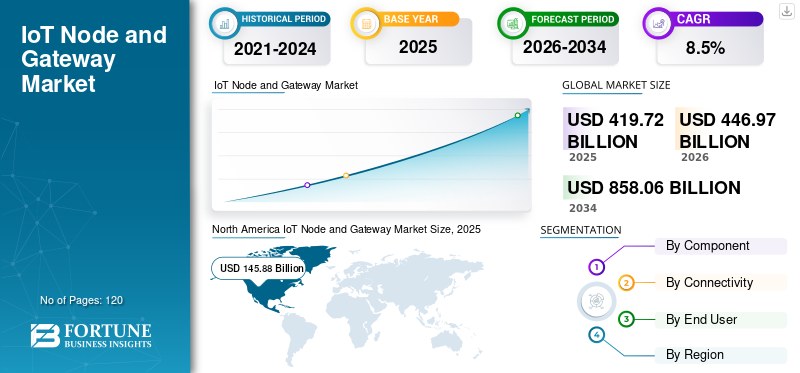
The global IoT node and gateway market size was valued at USD 419.72 billion in 2025 and is projected to grow from USD 446.97 billion in 2026 to USD 858.06 billion by 2034, exhibiting a CAGR of 8.5% during the forecast period. North America dominated the IoT node and gateway market with a market share of 36.31% in 2025.
The IoT node and gateway market is transitioning from basic connectivity enablers into intelligent edge infrastructure designed to support real time data processing, localized analytics, and secure device orchestration across distributed environments. Expansion is driven by the rapid proliferation of connected devices, increasing enterprise focus on edge computing to reduce latency, and growing demand for reliable connectivity in mission-critical applications such as industrial automation, smart cities, energy management, and connected healthcare.
Customers are placing strong emphasis on high-performance processing, robust security frameworks, and seamless interoperability with diverse sensors, cloud platforms, and enterprise systems. There is significant interest in gateways equipped with AI acceleration, multi-protocol support, and edge intelligence capable of filtering and analyzing data before transmitting it to centralized platforms.
Major IoT node and gateway providers such as Cisco Systems, Inc., Advantech Co., Ltd., Huawei Technologies Co., Ltd., Dell Technologies Inc., Eurotech S.p.A., and ADLINK Technology Inc. are strengthening their market presence by delivering integrated edge to cloud solutions combining hardware, software, and lifecycle services. Cisco emphasizes secure edge intelligence and industrial networking platforms to enable scalable IoT operations. Advantech Co., Ltd., focuses on modular gateways and edge computing systems tailored for manufacturing and smart infrastructure.
Download Free sample to learn more about this report.
IoT Node and Gateway Market Key Takeaways
 Global Market Size & Forecast
- 2025 Market Size: USD 419.72 billion
- 2026 Market Size: USD 446.97 billion
- 2034 Forecast Market Size: USD 858.06 billion
- CAGR: 8.5% from 2026–2034
 Market Share
- North America dominated the IoT node and gateway market with a 36.31% share in 2025.
- The hardware segment accounted for the largest market share in 2025.
- The consumer electronics segment held the largest market share in 2025.
 Key Regional Highlights
North America
North America generated USD 145.88 billion in 2025, maintaining its leadership in the global market.
Europe
Europe reached USD 112.43 billion in 2025, driven by strong industrial IoT and smart factory adoption.
Asia Pacific
Asia Pacific recorded USD 96.32 billion in 2025 and is projected to grow at the fastest 11.0% CAGR.
U.S.
The U.S. IoT node and gateway market reached approximately USD 114.04 billion in 2025.
Japan
Japan's IoT node and gateway market reached approximately USD 19.04 billion in 2025, supported by industrial automation and connected vehicle adoption
Read More

Generative-AI Impact
Increasing Adoption of Generative AI in IoT Node and Gateway to Boost Market Growth
In IoT environments, generative AI is enabling gateways and edge nodes to perform intelligent data interpretation, contextual reasoning, and autonomous decision support at the source of data generation. Instead of simply transmitting sensor outputs to the cloud, AI-enabled gateways can generate summaries, detect operational anomalies, and provide human-readable insights for operators. This improves response times, reduces network congestion, and enhances operational awareness across industrial plants, smart buildings, and energy systems.
Generative AI is also transforming lifecycle management and network optimization of IoT infrastructure. AI models embedded within gateways can evaluate connectivity performance, device health, and traffic behavior to predict disruptions, recommend configuration changes, and automate firmware management.
- For instance, in 2025, several semiconductor vendors introduced IoT-focused edge platforms designed to accelerate generative AI workloads directly on the device, enabling localized inference and data-driven actions without dependence on cloud-centric processing. These platforms support deploying advanced models for tasks such as natural language analysis, multimodal sensor fusion, and model-based simulation at the edge.
IoT Node and Gateway Market Trends
Rapid Increase in Connected Devices and Industrial IoT Deployments is a Major Market Trend
The rapid expansion of connected devices and Industrial IoT deployments is significantly increasing the need for reliable IoT nodes and gateways to manage and control device ecosystems. Industries such as manufacturing, energy, and logistics are deploying large-scale sensor networks to enable real-time monitoring, asset tracking, and automated process optimization. This surge in connected endpoints is generating massive volumes of operational data, creating strong demand for gateways that can aggregate, filter, and securely transmit information to enterprise platforms.
The growing shift toward smart factories, connected infrastructure, and autonomous industrial operations continues to drive sustained demand for advanced IoT node and gateway solutions.
- For instance, in February 2024, Siemens AG expanded its Industrial IoT portfolio through enhancements to its Industrial Edge platform, enabling factories to connect thousands of machines and sensors through edge gateways for real-time analytics and automation. This development highlights the increasing scale of connected industrial devices and the critical role of IoT gateways in supporting intelligent, data-driven manufacturing environments.
Download Free sample to learn more about this report.
MARKET DYNAMICS
MARKET DRIVERS
Growing Expansion of Edge Computing Infrastructure to Drive the Demand for Product
The growing expansion of edge computing infrastructure is significantly driving the demand for IoT nodes and gateways, as organizations increasingly require faster data processing closer to the source of data generation. Instead of relying entirely on centralized cloud platforms, enterprises are deploying edge gateways to analyze and filter data locally, which reduces latency and improves response times for critical operations. This is particularly important in industries such as manufacturing, energy, and transportation, where real-time decision-making is essential for operational efficiency and safety.
Edge-enabled gateways also help reduce bandwidth costs by transmitting only relevant data to the cloud, making IoT deployments more cost-effective and scalable. In addition, edge infrastructure supports continuous operations even in environments with limited or unstable connectivity. It also enhances data security by allowing sensitive information to be processed locally rather than transmitted over networks. The increasing adoption of automation, AI-driven analytics, and real-time monitoring across industries is accelerating investments in edge computing, thereby driving sustained demand for advanced IoT node and gateway solutions.
MARKET RESTRAINTS
High Security Risks and Vulnerability to Cyberattacks Limit Market Expansion
High security risks and vulnerability to cyberattacks are major factors limiting the adoption of IoT nodes and gateways, as these devices serve as critical connection points between edge devices and enterprise networks. If gateways are compromised, attackers can gain access to sensitive operational data, disrupt connected systems, or manipulate device behavior. Many IoT deployments operate in distributed and unattended environments, making them more exposed to physical tampering and unauthorized access.
In addition, inconsistent security configurations, weak encryption, and delayed firmware updates increase the risk of exploitation. Industrial sectors such as manufacturing, utilities, and transportation are particularly vulnerable, as cyber incidents can lead to operational downtime and financial losses. The increasing sophistication of ransomware and network intrusion attacks is further raising concerns among enterprises. These concerns make some enterprises hesitant to scale their IoT infrastructure, thereby restraining the IoT node and gateway market growth.
MARKET OPPORTUNITIES
Rapid Growth of Smart Cities and Connected Infrastructure to Offer Several Market Growth Opportunities
The rapid growth of smart cities and connected infrastructure is creating strong opportunities for the IoT node and gateway market, as cities increasingly rely on connected systems to improve urban management and service delivery. IoT nodes and gateways enable communication between distributed sensors and centralized platforms used for traffic control, smart lighting, waste management, and environmental monitoring. These gateways play a critical role in collecting and processing real-time data, helping city authorities make faster and more efficient decisions.
Governments are launching digital transformation programs to modernize existing infrastructure, further boosting deployment. The need for reliable, secure, and scalable connectivity across large geographic areas continues to drive demand for solutions in smart city environments.
- For instance, in March 2024, the European Commission continued expanding its smart city initiatives under the Digital Europe Programme, supporting large-scale deployment of IoT infrastructure, including connected sensors and edge gateways across urban transport, energy, and environmental monitoring systems.
Segmentation Analysis
By Component
Rising Deployment of Industrial IoT Propelled HardwareSegment Growth
Based on component, the market is divided into hardware (Connectivity Integrated Circuited (ICS), logic devices, processors, memory devices, and others), software, and services.
Hardware accounted for the largest market share due to the essential role of physical components such as processors, connectivity ICs, and memory devices in enabling device communication and edge data processing. Every IoT deployment requires reliable hardware to connect sensors, collect data, and transmit it to enterprise or cloud platforms, making it a foundational element of the ecosystem. The increasing deployment of industrial IoT, smart infrastructure, and connected devices is driving high demand for advanced processors and communication chipsets. In addition, the growing adoption of edge computing is increasing the need for powerful gateway hardware capable of supporting real-time analytics and secure connectivity.
Services are anticipated to rise with a CAGR of 13.9% over the forecast period, owing to the increasing need for installation, integration, device management, and maintenance support across large-scale IoT deployments. Enterprises are relying on service providers to ensure seamless connectivity, system optimization, and ongoing operational support.
By Connectivity
Reliable Connectivity for a Broad Range of IoT Applications to Propel IoT Node and Gateway Growth
Based on the connectivity, the market is divided into ZigBee, Wi-Fi, Bluetooth, Z-Wave, and others.
Wifi accounted for the largest market share and is anticipated to rise with a CAGR of 10.2% over the forecast period, mainly due to the widespread availability, high data transmission speed, and seamless integration with existing enterprise and consumer network infrastructure. Wi-Fi enables reliable connectivity for a broad range of IoT applications, including smart buildings, healthcare monitoring, and industrial automation, where continuous data transfer is required. Its compatibility with cloud platforms and ease of deployment without additional specialized network infrastructure make it a preferred choice. Additionally, advancements such as Wi-Fi 6 are improving device capacity, efficiency, and performance, further supporting its adoption in dense IoT environments.
Z-wave is growing at a considerable rate owing to its low power consumption and strong suitability for smart home and building automation applications. It operates on a dedicated low-frequency band, reducing interference from other wireless technologies and ensuring reliable communication between devices.
By End User
Widespread Adoption of Smart Home Devices to Propel Consumer Electronics Growth
Based on end user, the market is divided into consumer electronics, wearable devices, automotive & transportation, BFSI, healthcare, aerospace and defense, and others.
The consumer electronics segment accounted for the largest market share owing to the widespread adoption of smart home devices, connected appliances, and personal smart systems that rely on IoT nodes and gateways for seamless connectivity and control. Devices such as smart TVs, home automation hubs, security cameras, and voice-controlled assistants require gateways to enable communication between devices and cloud platforms. The growing consumer demand for convenience, energy efficiency, and remote device management is accelerating the deployment of IoT-enabled consumer products. In addition, the expansion of home internet penetration and wireless connectivity technologies is further supporting segment growth.
Automotive & transportation is anticipated to rise with a CAGR of 13.6% over the forecast period, driven by the increasing integration of connected vehicle technologies, fleet management systems, and intelligent transportation infrastructure. IoT nodes enable real-time vehicle monitoring, predictive maintenance, and vehicle-to-infrastructure communication, improving operational efficiency and safety.
To know how our report can help streamline your business, Speak to Analyst
IoT Node and Gateway Market Regional Outlook
By geography, the market is categorized into Europe, North America, Asia Pacific, South America, and the Middle East & Africa.
North America
North America IoT Node and Gateway Market Size, 2025 (USD Billion)
To get more information on the regional analysis of this market, Download Free sample
North America held the dominant IoT Node and Gateway market share in 2024, valued at USD 138.27 billion, and also maintained its leading position in 2025, with USD 145.88 billion. The market growth in the region is driven by the strong presence of major technology providers such as Cisco Systems, Inc., Intel Corporation, and Dell Technologies Inc., which are continuously investing in advanced IoT and edge computing solutions. In addition, increasing deployment of smart infrastructure and connected systems across cities and enterprises is accelerating demand for IoT gateways. Strong availability of advanced connectivity infrastructure and early adoption of emerging technologies further support regional market expansion.
U.S IoT Node and Gateway Market
Based on North America’s strong contribution and the U.S. dominance within the region, the U.S. market can be analytically approximated at around USD 114.04 billion in 2025, accounting for roughly 27.0% of global sales.
Asia Pacific
Asia Pacific is projected to record the highest growth rate of 11.0% in the coming years and reach a valuation of USD 96.32 billion in 2025. The IoT Node and Gateway market growth in the region is driven by rapid industrialization and large-scale adoption of IoT across manufacturing, energy, and transportation sectors in countries such as China, India, and Japan. Governments across the region are heavily investing in smart city projects, digital infrastructure, and industrial automation, which is increasing the deployment of connected devices and gateway systems.
Japan IoT Node and Gateway Market
The Japanese market in 2025 reached around USD 19.04 billion, accounting for roughly 5.0% of global revenues. Japan’s growth is attributed to its strong focus on industrial automation and smart manufacturing, where IoT gateways are widely used to connect factory equipment and enable real-time monitoring. The country’s advanced automotive sector is also integrating connected vehicle platforms and intelligent transport systems, increasing demand for gateway infrastructure.
China IoT Node and Gateway Market
China’s market is projected to be one of the largest worldwide, with 2025 revenues standing at around USD 35.06 billion, representing roughly 8% of global sales.
India IoT Node and Gateway Market
The Indian market in 2025 reached around USD 18.75 billion, accounting for roughly 4% of global revenues.
Europe
Europe is projected to record a growth rate of 7.9% in the coming years and the second-highest among all regions to reach a valuation of USD 112.43 billion in 2025. This growth is owing to strong adoption of industrial IoT and automation across manufacturing hubs in countries such as Germany, France, and the U.K., where companies are deploying IoT gateways to enable smart factory operations and real-time monitoring.
U.K IoT Node and Gateway Market
The U.K. market in 2025 stood at around USD 21.53 billion, representing roughly 5.0% of global revenues.
Germany IOT Node and Gateway Market
Germany’s market reached approximately USD 24.70 billion in 2025, equivalent to around 6.0% of global sales.
South America and the Middle East & Africa
The South America and Middle East & Africa regions are expected to witness moderate growth in the market during the forecast period. The South American market reached a valuation of USD 29.63 billion in 2025. The market is growing owing to increasing investments in digital infrastructure and the rising adoption of IoT across energy, mining, transportation, and smart city projects. Countries such as Brazil and Saudi Arabia are deploying connected systems to improve industrial efficiency and infrastructure monitoring. In the Middle East & Africa, the GCC reached a value of USD 16.42 billion in 2025.
COMPETITIVE LANDSCAPE
Key Industry Players
Market Players Adopting Product Innovation and Edge AI Integration Strategies to Strengthen Their Market Position
Market players are increasingly adopting product innovation and edge AI integration strategies to strengthen their market position by delivering more intelligent and efficient IoT node and gateway solutions. Companies are developing gateways with built-in AI accelerators and high-performance processors that enable real-time data analysis and faster-decision making at the edge. This reduces dependence on centralized cloud infrastructure and improves operational responsiveness in critical environments. These advanced gateways can also support functions such as anomaly detection, predictive maintenance, and automated system optimization.
In addition, vendors are focusing on modular designs and multi-protocol support to ensure compatibility with diverse industrial and enterprise applications. This approach helps customers improve operational efficiency, reduce latency, and enhance data security.
LIST OF KEY IoT NODE AND GATEWAY COMPANIES PROFILED
- Intel Corporation (U.S)
- Cisco Systems, Inc. (U.S.)
- Huawei Technologies Co., Ltd. (China)
- Advantech Co., Ltd. (Taiwan)
- NXP Semiconductors N.V. (Netherlands)
- Texas Instruments Incorporated (U.S.)
- STMicroelectronics N.V. (Switzerland)
- Dell Technologies Inc. (U.S.)
- Sierra Wireless, Inc (Canada)
- Qualcomm Technologies, Inc. (U.S.)
- Microchip Technology Inc. (U.S.)
- Hewlett Packard Enterprise Development LP (U.S.)
- Eurotech S.p.A. (Italy)
- Samsara Inc. (U.S.)
- U-blox Holding AG (Switzerland)
KEY INDUSTRY DEVELOPMENTS
- February 2026: EVA Live, Inc., an AI-driven digital advertising company, launched its first client-facing web application for NeuroServer, the company’s AI-driven ad server. The NeuroServer web application provides online advertising clients with a centralized, real-time environment to launch, manage, and scale digital marketing campaigns.
- January 2026: Qualcomm Technologies, Inc. expanded its IoT portfolio, unveiling a broader Industrial and Embedded IoT (IE-IoT) lineup featuring Dragonwing Q-series processors and developer tools aimed at edge compute and AI use cases across industrial and embedded applications.
- January 2026: Lacuna Space announced the opening of its LoneWhisper Direct-to-Device (D2D) satellite IoT technology for collaboration through the Lacuna Network.
- September 2025: Cisco and Tata Communications partnered to enhance IoT and eSIM connectivity by integrating the Tata Communications MOVE platform with Cisco's IoT Control Center. This collaboration aimed to reduce fragmentation, simplifying device management across 200+ countries.
- August 2025: Eurotech launched the BoltGATE 10-14, a powerful multi-service AIoT edge gateway designed for applications in rail transportation, maritime, and other harsh environments. With the new BoltGATE 10-14, the company is responding to the need for a secure, easy-to-manage AIoT platform for outdoor, rolling stock, and maritime applications.
REPORT COVERAGE
The global IoT Node and Gateway market analysis includes a comprehensive study of the market size & forecast by all the market segments included in the report. It includes details on the market dynamics and market trends expected to drive the market over the forecast period. It provides information on key aspects, including an overview of technological advancements, pipeline candidates, the regulatory environment, and product launches. Additionally, it details partnerships, mergers & acquisitions, and key industry developments and prevalence by key regions. The global market research report also provides a depth competitive landscape with information on the market share and profiles of key operating players.
Request for Customization to gain extensive market insights.
Report Scope & Segmentation
|
Study Period |
2021-2034 |
|
Base Year |
2025 |
|
Forecast Period |
2026-2034 |
|
Historical Period |
2021-2024 |
|
Growth Rate |
CAGR of 8.5% from 2026 to 2034 |
|
Unit |
Value (USD Billion) |
|
Segmentation |
By Component, By Connectivity, By End User, and Region |
|
By Component |
|
|
By Connectivity |
|
|
By End User |
|
|
By Region |
|
Frequently Asked Questions
According to Fortune Business Insights, the global market value stood at USD 419.72 billion in 2025 and is projected to reach USD 858.06 billion by 2034.
In 2025, North America’s market value stood at USD 145.88 billion.
The device market is expected to exhibit a CAGR of 8.5% during the forecast period (2026-2034).
By end user, consumer electronics lead the market.
The rapid increase in connected devices and industrial IOT deployments is the key factor driving the market.
Intel, Cisco, and Huawei are the major players in the global market.
North America dominated the market in 2025.


- 2021-2034
- 2025
- 2021-2024
- 120
Get 30-60 hrs Free Customization
Expand Regional and Country Coverage, Segments Analysis, Company Profiles, Competitive Benchmarking, and End-user Insights.




















-
US +1 833 909 2966 ( Toll Free )
-
Get In Touch With Us