Ketchup Market Size, Share & Industry Analysis, By Type (Flavored and Non-Flavored), By Packaging Type (Pouch, Bottle, and Others), By Distribution Channel (Food Service and Retail [Supermarkets/Hypermarkets, Convenience Stores, Online Retail and Others]), and Regional Forecast, 2026-2034
 Download Free Sample
(Offer valid till 30th Sep 2026)

KEY MARKET INSIGHTS
 Listen to Audio Version
The global ketchup market size was valued at USD 25.92 billion in 2025. The market is projected to grow from USD 27.51 billion in 2026 to USD 44.22 billion by 2034, exhibiting a CAGR of 6.11% during the forecast period. North America dominated the ketchup market with a market share of 39.18% in 2025.
Ketchup is a popular condiment that is usually made with tomatoes and other seasonings. The product is a staple in many cuisines and is commonly used to add flavor or served as a side for french fries, burgers, and other fast food items. The global market growth is driven majorly by the increasing demand for processed and fast foods. While North America dominates the market, the increasing adoption of Western food culture in regions such as Asia Pacific and South America is fueling demand for condiments and sauces such as ketchup.
Some of the prominent players operating in the global market are The Kraft Heinz Company, Del Monte Foods, Inc., Conagra Brands, Inc., Nestle S.A., and Unilever Ltd.
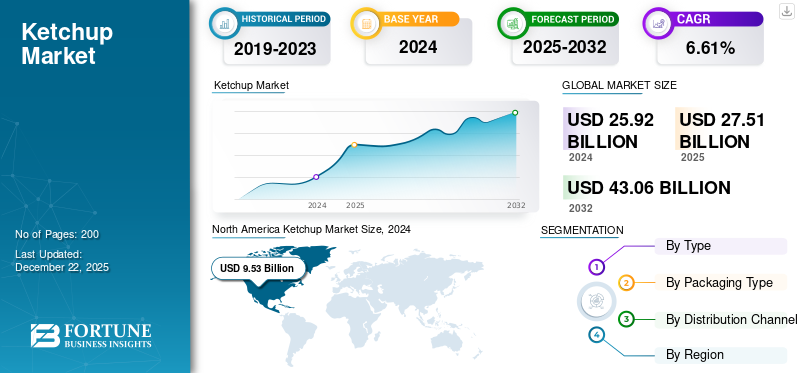
Download Free sample to learn more about this report.
Ketchup Market KEY TAKEAWAYS
 Global Market Size & Forecast
- 2025 Market Size: USD 25.92 billion
- 2026 Market Size: USD 27.51 billion
- 2034 Forecast Market Size: USD 44.22 billion
- CAGR: 6.11% from 2026–2034
 Market Share
- North America dominated the ketchup market with a 39.18% share in 2025.
- The Non-flavored (Regular) segment accounted for the largest market share in 2025.
- The Bottle packaging segment held the largest market share in 2025.
 Key Regional Highlights
Asia Pacific
Asia Pacific reached USD 5.85 billion in 2025, driven by rising disposable incomes and growing demand for processed foods.
North America
North America accounted for USD 10.16 billion in 2025, supported by strong demand for convenience foods and sauces.
Europe
Europe reached USD 7.93 billion in 2025, fueled by increasing consumption of ready-to-eat meals and home cooking.
U.S.
U.S. leads the regional market, driven by high consumption of ketchup and growing demand for convenience foods.
Japan
Japan is witnessing steady growth, supported by increasing adoption of Western diets and processed food consumption.
Read More

MARKET DYNAMICS
MARKET DRIVER
Growing Demand for Convenience Foods to Aid Market Growth
As urbanization accelerates and lifestyles become busier, there is a rising preference for convenience foods. Consumers are looking for quick and easy meal solutions, and product serves as a simple way to enhance the flavor of ready-to-eat or pre-packaged meals. This trend is particularly prominent among dual-income households, where time for cooking is limited. Moreover, people have been increasingly seeking hassle-free and quick dining options, including ready-to-eat (RTE) meals, fast-food outlets, and home-delivered foods. Responding to this shift, prominent players are capitalizing on the convenience trend by launching user-friendly packaging formats, such as squeeze bottles designed for on-the-go (OTG) consumption.
- For instance, in July 2023, Heinz launched a fully recyclable squeeze ketchup bottle. The new packaging features a “100% recyclable” cap and is designed to help consumers extract more ketchup from the bottle.
MARKET RESTRAINTS
Presence of High Sodium and Sugar in Tomato Ketchup to Hamper Product Demand
Nowadays, there is an increasing awareness among consumers regarding health consciousness and wellness, leading to the negligence of ketchup products containing high amounts of sugar and sodium. This is particularly significant as consumers seek to reduce their salt intake due to health concerns such as hypertension and heart disease. According to the Food and Drug Administration (FDA), elevated sodium blood pressure can lead to serious cardiovascular conditions, including heart attacks and strokes. Tomato ketchup is often high in salt and sugar and also contains preservatives, which can lead to severe health impacts if over-consumed. Moreover, manufacturers frequently add sugar to enhance flavor and extend shelf life, which further raises health concerns.
MARKET OPPORTUNITY
Surging Demand for Fusion-Flavored Products to Pave Growth Prospects
The market is witnessing a surge in demand for fusion-flavored ketchup products. Traditional tomato ketchup is no longer the only option on supermarket shelves, as key manufacturers in the market are innovating a variety of new flavors such as garlic, sweet chili, or exotic options. This innovation is further attracting a large consumer base, especially those consumers who seek novel and unique condiment experiences.
- For instance, in September 2024, The Kraft Heinz Company expanded its ketchup line by launching Heinz Pickle flavored Ketchup in Ireland. This new product launch marked a significant milestone in the company’s strategy to expand its taste elevation platform across the globe.
KETCHUP MARKET TRENDS
Increasing Popularity of Organic and Clean-label Products to Pave Growth Prospects
The popularity of organic and clean-label products has been on the rise as consumers have become more aware of the importance of sustainable practices and natural ingredients. Tomato ketchup, which is known to be a staple condiment in various households, is no exception to this trend. Therefore, as the clean-label moment is gaining traction, in response, brands are coming up with innovative launches that align with the changing preferences of the consumer, boosting ketchup market growth.
- For instance, in April 2025, Granos, a premium health food brand, launched a new clean-label product, Granos Better Ketchup. The new product is a sugar-free sweetened with jaggery and made from 100% natural ingredients.
Segmentation Analysis
By Type
Non-Flavored Segment Dominates the Market owing to its Familiarity and Traditional Consumer Preferences
Based on type, the market is classified into flavored and non-flavored.
The non-flavored or regular segment dominates the market owing to its versatile applications, traditional consumer preference, and balanced taste profile. Its familiarity and broad appeal make it a stable accompaniment for various food items such as fries, sandwiches, burgers, and other processed foods.
The flavored segment is expected to witness the fastest growth in the ketchup market. The consumer’s palate has evolved over the years due to the increasing globalization and evolving food preferences among individuals. This has led to rising consumer demand for unique and diverse flavors, such as hot and spicy, garlic, and others, further fueling the segment's growth in the future.
- For instance, in April 2025, Heinz launched a brand new sauce, Heinz Tomato Ketchup Sweet Sriracha. The new product consists of a sweet and spicy flavor and is available across the U.K.
By Packaging Type
Bottle Segment dominates the Market owing to Widespread Availability and Attractive Packaging
Based on packaging type, the market is classified into bottle, pouch, and others.
The bottle segment accounted for a major global ketchup market share. Bottles provide precise control over the amount poured and ensure the right usage of the amount to be used. Moreover, bottles offer ample surface area for product details, labeling, and branding, making it easier for consumers to identify their preferred product. Glass bottles also help preserve the quality of the product for a longer period and provide protection against spoilage and degradation, making them a popular choice among both consumers and manufacturers.
The pouch segment is expected to have the fastest growth in the global market. The rising demand for attractive and innovative packaging products is fueling the growth of this segment. The key players in the market are also adopting sustainable and fully recyclable methods in order to cater to environmentally friendly consumers.
- For instance, in November 2024, Masterfoods, Australia's favorite tomato sauce brand, launched Australia’s first paper-recyclable single-serve tomato sauce packs. The new packaging contains 58% less plastic than the original packs, contributing to the environment and fueling its demand among consumers.
By Distribution Channel
Retail Segment Dominates the Market owing to Extensive Product Assortment and Competitive Pricing
Based on distribution channel, the market is classified into food service and retail.
The retail segment consists of supermarkets/hypermarkets, convenience stores, online retail, and others. Under retail, the supermarkets/hypermarkets segment dominates the global market. The success of supermarkets arises from the numerous benefits they provide to customers, specifically in terms of choice and quality. The first and most crucial advantage of supermarkets is that individuals can purchase a broad array of items, ranging from food to beverages. In order to improve the consumer base, these supermarkets provide deals and offers on products, unlike the traditional markets, which further enhances their market value. Other benefits include lower prices of products as these centers purchase large amounts of products in bulk from third parties, which increases their sales volume, and the products can be bought at cheaper prices.
The food service segment is expected to grow significantly during the forecast period, owing to the rising culture of dining out and the trend of trying multiple cuisines, further increasing product’s usage in food service sectors.
Ketchup Market Regional Outlook
By geography, the market is categorized into North America, Europe, Asia Pacific, South America, and the Middle East and Africa.
North America
North America Ketchup Market Size, 2025 (USD Billion)
To get more information on the regional analysis of this market, Download Free sample
North America contributed approximately USD 10.16 billion to the global market in 2025, accounting for 39.18% share, and is expected to reach USD 10.84 billion in 2026. The U.S. is known to be the largest consumer of product owing to its large population, positive economic outlook, and significant concentration of affluent consumers. The country is known to be a net importer of sauces and condiments. According to the Government of Canada Publications, in 2022, the U.S. imported worth USD 55.4 million or 30.6 million kilograms of tomato ketchup and sauces. Moreover, busy lifestyles of consumers in the region are leading to a greater preference for convenience foods, including processed options. Ready-to-cook and ready-to-eat meals are becoming staples for many households, which aligns with the use of ketchup as a quick and easy flavor enhancer in various dishes.
Download Free sample to learn more about this report.
Europe
In 2025, the Europe market stood at USD 7.93 billion, representing 30.59% of global demand, and is projected to grow to USD 8.44 billion in 2026. The robust growth of Europe’s ketchup market is driven by rising demand for ethnic and spicy foods, coupled with evolving dietary preferences. In line with global trends, the demand for convenient food options such as ready meals, soups, and sauces is on the rise in the region. The growing urban population in the region often lives in smaller spaces with limited cooking facilities, further fueling the demand for convenient and ready-to-eat products. The product fits into this trend as a versatile ingredient that can be easily incorporated into various dishes. Moreover, the trend toward home cooking has accelerated, especially in the post-pandemic period, with consumers looking for convenient meal solutions.
Asia Pacific
The Asia Pacific region captured 22.57% of the global market in 2025, generating USD 5.85 billion in revenue, and is projected to reach USD 6.23 billion in 2026. Asia Pacific is expected to experience moderate growth in the global market. Countries such as China, India, and Japan boast a large consumer base, which significantly drives demand for product in the region. Ongoing economic development across various Asia Pacific countries, particularly India and China, has increased disposable incomes, allowing consumers to explore processed products. The expanding middle class is showing a growing willingness to spend on high-quality products, further fueling market growth. According to the National Institute of Urban Affairs, the urban population in India experienced a six-fold increase since 1951, to 377.1 million in 2011, and it is estimated to grow to 590 million by 2032. Therefore, the rising disposable incomes, along with the growing urban population, further lead to the adoption of Western diets, contributing to the overall demand in the region.
South America
In South America, Brazil leads the market due to its large population and growing popularity in processed foods, which has increased the demand for product as a versatile condiment. Argentina also presents significant potential, supported by its expanding food service sector and rising consumer preferences for diverse flavors. The influence of international food trends has been encouraging consumers in the region to experiment with new flavors and uses for product, further boosting demand.
Middle East & Africa
In 2025, Middle East & Africa generated USD 1.42 billion, contributing 5.48% to global market revenue, and is projected to grow to USD 1.47 billion in 2026. With respect to Middle Eastern cuisines, the use of condiments is a defining feature that sets them apart from any other cuisine. Known for its rich heritage, the region is also renowned for its unique traditional and culinary landscape, which captivates the demand for a variety of sauces, as they act as a crucial ingredient in the preparation of an array of dishes. Countries with significant expatriate populations, such as the UAE and Saudi Arabia, witnessed a higher demand for convenient food options, including ketchup. According to the United Nations Department of Economic and Social Affairs, in 2020, expatriates made up 88.1% of the UAE’s population, the second-largest proportion worldwide. The increased availability and accessibility of ketchup products in retail outlets across the region further support rising consumption levels.
Latin America
Latin America recorded a market size of USD 2.15 billion in 2025, capturing 8.31% of the global market share, and is projected to reach USD 2.26 billion in 2026.
COMPETITIVE LANDSCAPE
Key Industry Players
Key Players Focus on Mergers & Acquisitions to Strengthen their Market Positions
Major players in the global market continuously strive to gain a competitive advantage through mergers and acquisitions, expansion of distribution networks, launching innovative products, and strategic partnerships. For instance, in March 2025, Indian FMCG major Adani Wilmar (AWL) acquired GD Foods Manufacturing (India), a local sauces and pickles manufacturer, in order to expand its value-added food products portfolio. Moreover, the companies have also been investing in advertising and marketing campaigns in order to promote their ketchup brands and differentiate themselves from competitors. The Kraft Heinz Company, Del Monte Foods, Inc., Conagra Brands, Inc., Nestle S.A., and Unilever Ltd. are a few of the prominent players operating in the market.
Kraft Heinz emerged as a leading player in the market owing to its portfolio of well-known brands under Heinz and its strong global presence. Del Monte Foods also stands out as a tough competitor, known for its tomato-based products, including ketchup.
LIST OF KEY KETCHUP COMPANIES PROFILED
- Nestle S.A. (Switzerland)
- The Kraft Heinz Company (U.S.)
- Unilever Ltd. (India)
- The Fremont Company (U.S.)
- Agro Tech Foods Limited (ATFL) (India)
- Conagra Brands, Inc. (U.S.)
- General Mills Inc. (U.S.)
- Campbell Soup Company (U.S.)
- Premier Foods Plc (U.K.)
- Kagome Co., Ltd (Japan)
- Lee Kum Kee (Hong kong)
KEY INDUSTRY DEVELOPMENTS
- November 2024: Agro Tech Foods Limited (ATFL), backed by Samara Capital, acquired Del Monte Foods Private Limited (DMFPL) for over USD 154.03 million. The acquisition granted Agro Tech Foods Limited (ATFL) ownership of Del Monte products such as ketchup, pasta, oil, and brands in India.
- July 2024: Shark Tank Winner Noshi announced the launched of new organic ketchup, made specially for kids. The new product is made from organic ingredients, kosher-certified, gluten-free, and vegan.
- August 2023: The Kraft Heinz Company launched its latest product, Heinz Tomato Ketchup Filled Hash Browns. The new product is the incarnation of frozen-filled breakfast accompaniments.
- April 2023: The Kraft Heinz Company introduced four new additions to its line of classic ketchup and sauces. The new product offerings include Jalapeño (hot), Chipotle (medium), Habanero (hotter), and Heinz Hot 57 Sauce.
- May 2022: The Kraft Heinz Company launched Heinz Cold Ketchup, catering to consumers who prefer cold condiments. The new product was offered for a limited time at participating Wendy's locations across Canada.
REPORT COVERAGE
The global ketchup market analysis provides market size and forecast for all segments included in the report. It includes details on the market dynamics and emerging market trends. It offers information on key regions, key food industry developments, new product launches, partnerships, and mergers & acquisitions. The report also covers a detailed competitive landscape with information on the market share and profiles of key players.
Request for Customization to gain extensive market insights.
Report Scope & Segmentation
|
ATTRIBUTE |
DETAILS |
|
Study Period |
2021-2034 |
|
Base Year |
2025 |
|
Estimated Year |
2026 |
|
Forecast Period |
2026-2034 |
|
Historical Period |
2021-2024 |
|
Growth Rate |
CAGR of 6.11% from 2026-2034 |
|
Unit |
Value (USD Billion) |
|
Segmentation |
By Type
|
|
By Packaging Type
|
|
|
By Distribution Channel
|
|
|
By Geography
|
Frequently Asked Questions
Fortune Business Insights says that the global market value stood at USD 27.51 billion in 2026 and is projected to reach USD 44.22 billion by 2034.
In 2025, the market value stood at USD 10.16 billion.
The market is expected to exhibit a CAGR of 6.11% during the forecast period.
The non-flavored segment led the market, by type.
Growing demand for convenience foods coupled with innovative product launches are key factors driving market growth.
The Kraft Heinz Company, Del Monte Foods, Inc., Conagra Brands, Inc., Nestle S.A., and Unilever Ltd. are some prominent players in the global market.
North America dominated the market in 2025.
Rising disposable incomes and urbanization are some of the factors that are expected to favor product adoption.



- 2021-2034
- 2025
- 2021-2024
- 200
-
(Offer valid till 30th Sep 2026)
Get 30-60 hrs Free Customization
Expand Regional and Country Coverage, Segments Analysis, Company Profiles, Competitive Benchmarking, and End-user Insights.




















Related Reports
-
US +1 833 909 2966 ( Toll Free )
-
Get In Touch With Us