Kitchen Soap Market Size, Share & Industry Analysis, By Product Form (Solid and Liquid), By Application (Household and Commercial), By Distribution Channel (Supermarkets & Hypermarkets, Pharmacies, Online, and Others), and Regional Forecast, 2026-2034
 Download Free Sample
(Offer valid till 31st Oct 2026)

KEY MARKET INSIGHTS
 Listen to Audio Version
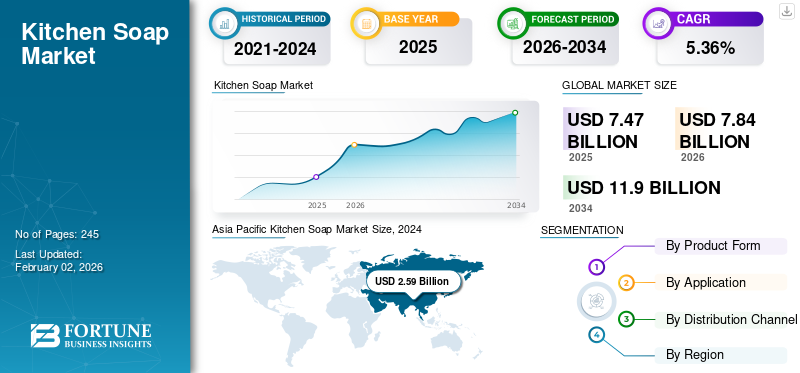
The global kitchen soap market size was valued at USD 7.47 billion in 2025. The market is projected to grow from USD 7.84 billion in 2026 to USD 11.9 billion by 2034, exhibiting a CAGR of 5.26% during the forecast period. Asia Pacific dominated the kitchen soap market with a market share of 36.27% in 2024.
The market comprises cleaning products specifically formulated for washing dishes, utensils, and kitchen surfaces. This includes solid bar soap and dishwashing liquids designed to cut through grease, remove food residues, and maintain hygiene in kitchen environments. Rising consumer emphasis on cleanliness and food safety drives demand for effective kitchen cleaning solutions. Busier lifestyles and increased cooking at home post-pandemic have boosted dishwashing product consumption. Moreover, key players such as, Procter & Gamble, Unilever, Reckitt Benckiser Group, and Colgate-Palmolive, are constantly investing in antibacterial, eco-friendly, and multi-purpose kitchen soaps, catering to sustainability-conscious consumers.
- An article published by TetraPak, a food processing and packaging solutions company, cited in their “Tetra Pak Index 2021” report that more than 60% of global respondents say they are cooking at home more, and 20% expect to continue to do so post-pandemic.
Download Free sample to learn more about this report.
KITCHEN SOAP MARKET KEY TAKEAWAYS
 Global Market Size & Forecast
- 2025 Market Size: USD 7.47 billion
- 2026 Market Size: USD 7.84 billion
- 2034 Forecast Market Size: USD 11.9 billion
- CAGR: 5.26% from 2026–2034
 Market Share
- Asia Pacific dominated the market with a 36.27% share in 2024.
- The Solid segment held the largest market share in 2024.
- The Household segment held the largest market share in 2024.
 Key Regional Highlights
Asia Pacific
Dominated the market, driven by rapid urbanization, rising hygiene awareness, and expanding e-commerce.
Europe
Held the second-largest market share, supported by strong hygiene awareness and demand for sustainable cleaning products.
North America
Accounted for a significant market share, driven by home cooking trends and demand for eco-friendly products.
U.S.
Dominated the North American market, supported by strong demand from the food service industry and growing e-commerce adoption.
Japan
Growth is driven by increasing hygiene awareness and demand for premium, high-quality kitchen cleaning products.
Read More

MARKET DYNAMICS
MARKET DRIVERS
Expansion of Hotels, Restaurants, and Catering (HoReCa) Industry to Fuel Market Growth
The global soap market is experiencing significant growth due to the rapid global expansion of the hotels, restaurants, and catering (HoReCa) industry. As consumer dining habits shift toward increased out-of-home consumption, particularly in urban areas and tourist destinations, the demand for large-scale, efficient, and hygienic kitchen cleaning solutions is surging. Commercial kitchens in these establishments operate under strict hygiene and sanitation regulations, often mandated by government bodies and food safety authorities. Compliance requires using high-strength, reliable kitchen cleaning soaps capable of effectively removing stains, greases, residues, and bacteria from utensils, dishes, and preparation surfaces. This drives steady and often large-volume purchases of cleaning soaps.
Moreover, the rise of cloud kitchens and quick-service restaurants (QSRs), especially post-pandemic, has further widened the scope for institutional cleaning products. These establishments favor concentrated, cost-effective formulations that can handle heavy-duty cleaning while remaining gentle on the skin, prompting product innovations tailored to commercial users. The international growth of hospitality, fueled by travel, tourism, and events, bolsters demand. Suppliers are responding by offering B2B product lines in bulk quantity, subscription models, and eco-friendly variants to meet sustainability goals, further propelling market expansion in this segment.
MARKET RESTRAINTS
Rising Raw Material Costs and Supply Chain Disruptions to Hinder Market Expansion
The market faces growth challenges due to fluctuating prices of key raw materials such as fragrances, surfactants, and packaging components, many of which are petroleum-based. These cost pressures can reduce manufacturer margins or lead to higher consumer prices, affecting demand. Additionally, global supply chain disruptions caused by geopolitical tensions, environmental regulations, and transportation bottlenecks impact production and distribution's timely availability and cost-efficiency, particularly for small and mid-sized manufacturers, affecting kitchen soap market growth.
MARKET OPPORTUNITIES
Premiumization and Sensory Appeal to Offer Numerous Growth Opportunities
Consumers are increasingly seeking kitchen cleaning soaps that offer both efficiency and a pleasant user experience. This has led to a rise in premium kitchen cleaning products featuring appealing fragrances, skin-friendly ingredients, and aesthetic packaging. The shift from purely functional to sensorially pleasing products creates new growth prospects, especially among urban, health-conscious buyers who value performance and experience in household products.
KITCHEN SOAP MARKET TRENDS
Surge in Demand for Natural, Organic, and Eco-friendly Options to Favor Market Expansion
Consumers are becoming more conscious of the need for safe and eco-friendly products, leading manufacturers to create formulas made from natural and sustainable components. Various awareness initiatives and rules encouraging sustainability strengthen this rising demand for environment-friendly kitchen soaps.
Download Free sample to learn more about this report.
Segmentation Analysis
By Product Form
Longer Usage Life and Wider Availability Boosted Demand for Solid Product Form
Based on product form, the market is segmented into solid and liquid.
The solid segment accounted for the largest market share. Solid soaps are generally cheaper to produce and purchase compared to liquid alternatives, making them highly popular in price-sensitive markets across Asia, Africa, Latin America, and the Middle East. Also, bar soaps tend to last longer and offer more usage per unit, making them cost-effective option for households. Further, solid soap bars require minimal packaging, reducing costs and appealing to environmentally conscious consumers seeking low-waste solutions, supplements market expansion.
The liquid segment is expected to grow at the highest CAGR over the assessment years. Liquid soaps are perceived as more hygienic, easier to dispense, and more efficient for quick cleaning tasks, especially in fast-paced urban households. Moreover, advancements in formulation, such as concentrated liquids, antibacterial properties, and skin-friendly ingredients, make liquid alternatives more appealing to health-conscious end-users.
By Application
Rising Home Cooking Trend and Growing Urbanization Fueled Household Segment Growth
Based on application, the market is segmented into household and commercial.
The household segment contributed the highest kitchen soap market share in 2024. Hygiene-related increased awareness, especially post-pandemic, has boosted product demand. More and more people cooking at home lead to greater use of kitchen cleaning products, including dish soaps, which further spurs their demand for residential applications. Growing urbanization in developing countries is spending more on household cleaning supplies. In addition, developing eco-friendly, skin-sensitive, and multi-functional soaps, such as grease-cutting antibacterial, has attracted wider consumer segments.
The commercial segment is expected to expand at the fastest CAGR over the coming years due to stringent hygiene regulations, expanding food service industry, brand reputation & consumer trust, and the availability of specialized formulations for commercial application. Moreover, long-term supplier contracts and bulk purchasing for cost efficiency support sustained use and market growth.
By Distribution Channel
High Footfall & Visibility and Competitive Pricing Led to Growth of Supermarkets & Hypermarkets
Based on distribution channel, the market is segmented into supermarkets & hypermarkets, pharmacies, online, and others.
Supermarkets & hypermarkets dominated the market in 2024. These stores attract many daily shoppers, giving kitchen soap brands prominent shelf exposure and impulse purchase opportunities. Supermarkets and hypermarkets also offer various varieties from economy to premium and eco-friendly options, catering to diverse consumer preferences. Furthermore, frequent discounts, bundle offers, and loyalty programs drive higher sales volumes than smaller retail formats, strengthening segmental growth.
The online segment is expected to grow at the fastest CAGR over the projected years from 2025 to 2032. Consumers can order hand hygiene products anytime without visiting a store, making it ideal for busy consumers. Further, e-commerce platforms offer auto-refill or subscription models for regular purchases, enhancing consumer retention. Besides, brands are leveraging social media, reviews, and influencer endorsements to drive awareness and boost sales online are likely to intensify segment growth.
Kitchen Soap Market Regional Outlook
By geography, the market is categorized into North America, Europe, Asia Pacific, South America, and the Middle East & Africa.
Asia Pacific
Asia Pacific Kitchen Soap Market Size, 2024 (USD Billion)
To get more information on the regional analysis of this market, Download Free sample
Asia Pacific is dominating the global market, owing to rapid urbanization in emerging economies such as India and China, a growing middle-class population, a booming HoReCa industry, and growing sensitivity toward hygiene. The market in this region is projected to grow at the highest CAGR during the assessment period. Furthermore, rising disposable income levels have increased the sales of premium cleaning products, such as herbal liquid soaps, which has expanded the market size. Additionally, expanding retail infrastructure and growing penetration of e-commerce platforms, enabling easy accessibility, have helped the adoption of modern kitchen hygiene practices and the growth of branded cleaning products.
North America
North America accounted for a significant share of the global kitchen cleaning products market in 2024. The region's growth is driven by heightened hygiene awareness, the growing practice of home cooking, and rising demand for eco-friendly and skin-safe cleaning supplies. Consumers prioritize products with natural ingredients and sustainable packaging, fueling innovation in the segment. The rise of dual-income households and busy lifestyles also supports the demand for convenient, high-efficiency dishwashing solutions.
U.S. dominated North America due to the growing demand for kitchen cleaning solutions from the country's food service and hospitality sector. Moreover, e-commerce and subscription-based models are further expanding the product accessibility of cleaning kitchen supplies.
Europe
Europe ranked in the second position in the global market. The region’s strong market position reflects the highly sensitive and health-conscious population toward hygiene, who are willing to spend more for maintaining sanitation. For instance, according to data released by the International Association for Soaps, Detergents and Maintenance Products (A.I.S.E.), the industry substantially contributes to the European economy with an annual output of USD 46.04 billion in 2022-23. Furthermore, shifting consumer preference for sustainable and organic products and government auxiliary activities, such as European organic and eco-label product certification, are prompting brands in the market to innovate and offer novel products.
South America and Middle East & Africa
The market in South America & the Middle East & Africa is projected to experience notable growth owing to the increasing number of nuclear households in Brazil, Colombia, and Argentina. The rapid development of the hospitality, tourism, and food service sectors, particularly in UAE, Saudi Arabia, and South Africa, significantly boosts institutional demand for kitchen cleaning soaps.
COMPETITIVE LANDSCAPE
Key Industry Players
Targeted Brand Positioning and Expanding Omni-Channel Presence to Sustain Market Position
The global kitchen soap industry is moderately fragmented, with a mix of global giants and regional players competing across price points, product features, and distribution networks. While major brands dominate the urban market and premium segments, smaller and private-label brands are strong in price-sensitive regions and online platforms.
Brands invest in eco-friendly, multi-functional, and skin-safe formulations to meet changing consumer needs and stand out in a crowded market. Companies are segmenting their offering by price and lifestyle, balancing affordable mass products with premium, wellness-focused alternatives. Moreover, green packaging, refill options, and ethical sourcing & manufacturing are becoming central to brand identity, appealing to eco-conscious consumers and enhancing brand loyalty. Furthermore, players are incorporating physical retail and online platforms, including D2C websites and subscription models, to broaden market access.
LIST OF KEY KITCHEN SOAP COMPANIES PROFILED
- Procter & Gamble (U.S.)
- Unilever (U.S.)
- Reckitt Benckiser Group (U.K.)
- Colgate-Palmolive (U.S.)
- S.C. Johnson & Son, Inc. (U.S.)
- Henkel AG & Co. KGaA (Germany)
- Kao Corporation (Japan)
- LG Household & Health Care (South Korea)
- Ecover (Belgium)
- Seventh Generation (U.S.)
KEY INDUSTRY DEVELOPMENTS
- May 2025: Klin space Innovations, UAE-based cleaning products manufacturer, partnered with Birth Marque to launch innovative organic products such as dish wash gels, all-purpose cleaners, fabric conditioners and floor cleaners. These products are claimed to environmentally friendly and meet stringent quality standards emphasizing safety and sustainability for modern families seeking eco-conscious, effective cleaning solutions
- August 2024: Dawn, a dishwashing liquid brand owned by Procter & Gamble (P&G), launched PowerSuds, innovative liquid dish soap formula that traps, locks, and removes up to 99% of grease to tackle cleaning efficiently and easily. Other features of the product include longer-lasting cleaning power technology with two times suds and is made of ingredients that help break up soils and prevent grease from re-depositing on the next dish.
- March 2023: Unilever, a British multinational consumer goods company, launched the first-ever Lifebuoy liquid dishwashing product in Indonesia to cater to the growing number of value-conscious consumers seeking superior cleaning products at reasonable pricing.
- April 2022: J.R. Watkins, manufacturer of household items, launched clean and powerful Foaming Dish Soap in select Target stores across the U.S. This lemon-fragranced liquid soap features recyclable bottles and is available in spray or foam options to clean pots and pans via activated suds.
- February 2021: Hindustan Unilever (HUL), a fast-moving Indian consumer goods brand, designed and launched the new Vim Matic range to remove tough “Indian” grease stains from utensils. The brand is one of the fast movers in the dishwashing soap category and has entered into the machine dishwash segment with this product launch.
REPORT COVERAGE
The global kitchen soap market analysis provides market size & forecast by all the segments included in the report. It includes details on the market trends and dynamics expected to drive the market in the forecast period. The market forecast report offers information on the key industry developments, new product launches, details on partnerships, mergers & acquisitions, and a number of manufacturers in key countries. The report covers detailed regional insights and the competitive landscape with information on the market share and profiles of key players.
Request for Customization to gain extensive market insights.
Report Scope & Segmentation
|
ATTRIBUTE |
DETAILS |
|
Study Period |
2021-2034 |
|
Base Year |
2025 |
|
Estimated Year |
2026 |
|
Forecast Period |
2026-2034 |
|
Historical Period |
2021-2024 |
|
Growth Rate |
CAGR of 5.36% from 2026-2034 |
|
Unit |
Value (USD Billion) |
|
Segmentation |
By Product Form
|
|
By Application
|
|
|
By Distribution Channel
|
|
|
By Region
|
Frequently Asked Questions
Fortune Business Insights says that the global market value stood at USD 7.84 billion in 2026 and is projected to reach USD 11.9 billion by 2036.
In 2025, the market value stood at USD 7.47 billion.
At a CAGR of 5.36%, the market is forecast to grow during the forecast period.
The solid segment led the market by product form.
Growing hygiene awareness, rapid urbanization & lifestyle changes, along with product innovation and e-commerce expansion, drive the growth of the market.
Procter & Gamble, Unilever, Reckitt Benckiser Group, Colgate-Palmolive, and S. C. Johnson & Son, Inc. are among the top players in the market.
Asia Pacific dominated the market in 2025.
Rising demand for eco-friendly, sustainable cleaning supplies that are multi-purpose is likely to uplift product demand and favor increased adoption.



- 2021-2034
- 2025
- 2021-2024
- 245
-
(Offer valid till 31st Oct 2026)
Get 30-60 hrs Free Customization
Expand Regional and Country Coverage, Segments Analysis, Company Profiles, Competitive Benchmarking, and End-user Insights.














Related Reports
-
US +1 833 909 2966 ( Toll Free )
-
Get In Touch With Us