Carbohydrase Market Size, Share & Industry Analysis, By Form (Liquid, Dry/Powder, and Granulated/Coated), By Type (Amylases, Xylanases, Cellulases, Pectinases, and Others), By End-Use (Bioethanol, Animal Feed, Food & Beverages, Textiles & Pulp, and Others), and Regional Forecast, 2026-2034
 Download Free Sample
 KEY MARKET INSIGHTS
 Listen to Audio Version
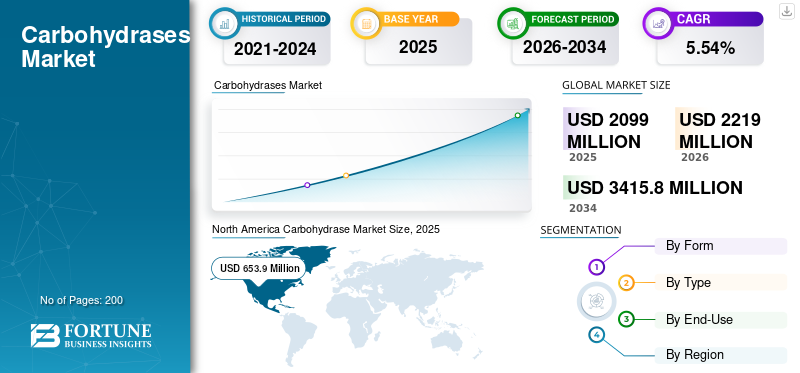
The global carbohydrase market size was valued at USD 2,099.0 million in 2025. The market is projected to grow from USD 2,219.0 million in 2026 to USD 3,415.8 million by 2034, exhibiting a CAGR of 5.54% during the forecast period. North America dominated the global carbohydrase market with a market share of 31.15% in 2025.
Carbohydrases are enzyme systems that catalyze the hydrolysis of complex carbohydrates into simpler sugars and include amylase, cellulase, xylanase, pectinase, lactase, and invertase. These enzymes play a critical role across food and beverage processing, animal feed, bioethanol production, textile processing, detergents, and pharmaceuticals, where efficiency improvement, yield optimization, and cost reduction are primary drivers.
The global carbohydrase market is witnessing rising demand from the food and beverage industries due to its expanding applications in baked goods, dairy products, and animal feed. According to FAO and USDA, global cereal production consistently exceeds 2.8 billion tons annually, creating sustained demand for carbohydrase enzymes to improve starch conversion, feed digestibility, and processing efficiency. The growing global demand for processed foods, coupled with evolving dietary preferences, continues to drive innovation and expansion.
The industry is led by multinational enzyme manufacturers with strong fermentation capabilities, proprietary strains, and application-specific formulations. Key players include Novozymes (Novonesis), DSM-Firmenich, BASF SE, DuPont (IFF), and AB Enzymes, which collectively account for a significant share of global enzyme revenues.
Download Free sample to learn more about this report.
Carbohydrase Market Trends
Clean-Label and Natural Processing Enzymes are Gaining Traction
The clean-label and natural processing movement has emerged as one of the most influential structural forces shaping the global carbohydrase market, fundamentally altering how food, beverage, and feed manufacturers design formulations and processing workflows. Clean-label positioning emphasizes minimal ingredient lists, recognizable inputs, and the reduction or elimination of chemical additives, and this shift has directly accelerated the adoption of carbohydrase enzymes as natural processing aids.
- According to FAO food system transformation reports and OECD consumer studies, more than 60% of global consumers actively seek products with “natural” or “no artificial additives” claims, with the proportion exceeding 70% in North America and Western Europe.
Download Free sample to learn more about this report.
MARKET DYNAMICS
Market Drivers
Rising Demand for Processed Foods and Beverages Support Enzyme Adoption Along with Market Expansion
The rising demand for processed foods and beverages has emerged as one of the most powerful demand-side drivers supporting the adoption of carbohydrase enzymes globally, as manufacturers scale production while seeking efficiency, consistency, and regulatory compliance. Rapid urbanization, changing lifestyles, higher disposable incomes, and the growing participation of working populations have structurally shifted dietary patterns away from home-prepared foods toward ready-to-eat (RTE), ready-to-cook (RTC), packaged bakery products, functional beverages, and convenience foods.
- According to the United Nations Department of Economic and Social Affairs (UN DESA), the global urban population reached approximately 56% of the total population in 2023, up from 51% in 2010, and is projected to rise to nearly 68% by 2050.
Market Restraints
Sensitivity to Raw Material and Fermentation Input Costs May Restrain Market Growth
Sensitivity to raw material and fermentation input costs represents a structural restraint on the carbohydrase market growth, as enzyme manufacturing economics are tightly linked to agricultural commodity prices, energy costs, and fermentation efficiency. Carbohydrases are predominantly produced through microbial fermentation, using substrates such as corn-derived glucose, molasses, wheat hydrolysates, and other carbohydrate-rich feedstocks. These inputs are directly exposed to volatility in global agricultural markets, which can significantly affect production costs, pricing stability, and profit margins for enzyme manufacturers.
- USDA data shows that global corn prices increased by more than 45% between 2020 and 2022, driven by drought conditions in major producing regions, higher fertilizer prices, and supply chain disruptions.
Market Opportunities
Rising Use of Carbohydrases in Industrial Food Processing and Bio-Manufacturing Unlock New Opportunities
The rising use of carbohydrases in industrial food processing and bio-manufacturing is unlocking new growth opportunities, as manufacturers increasingly prioritize process efficiency, yield optimization, cost reduction, and sustainability compliance. Carbohydrases enable controlled enzymatic breakdown of starches, fibers, and complex carbohydrates into fermentable or functional sugars, making them indispensable in large-scale food manufacturing, fermentation-based production, and emerging bio-industrial applications. This shift is not incremental but structural, driven by scale expansion in processed foods, renewable materials, and bio-based chemicals.
SEGMENTATION ANALYSIS
By Form
Liquid Form to Maintain Dominance Due to Ease of Handling
By form, the market is segmented into liquid, dry/powder, and granulated/coated.
The liquid segment dominated in 2025 with a revenue of USD 1,101.6 million, accounting for 52.5% of global share, supported by ease of dosing and rapid solubility in food and beverage processing.
The granulated/coated is the fastest growing, projected to expand at a CAGR of 8.75%, driven by stability requirements in animal feed applications.
To know how our report can help streamline your business, Speak to Analyst
By Type
Amylases to Lead Owing to Widespread Usage in Multiple Applications
Based on type, the market is segmented into amylases, xylanases, cellulases, pectinases, and others.
Amylases dominated the market at USD 800.4 million in 2025, reflecting widespread use in bakery, brewing, and starch processing. The segment is expected to grow at a CAGR of 4.06%.
Xylanases and cellulases are expected to grow at a CAGR of 7.11%, driven by rising adoption in animal feed, biofuel, and fiber processing applications.
By End-Use
Bioethanol Segment Leads Driven by the Critical Role of Carbohydrases
On the basis of end-use, the market is segmented into bioethanol, animal feed, food & beverages, textiles & pulp, and others.
The bioethanol segment dominates with a 39.7% market share and valuation of USD 832.2 million in 2025. This leadership position is projected to continue over the forecast period, supported by sustained investments in renewable fuels and industrial biotechnology. The dominance of the segment is primarily driven by the critical role of carbohydrases, especially amylases and cellulases, in converting starch- and cellulose-rich feedstocks into fermentable sugars.
The animal feed segment valued at USD 469.3 billion is projected to register the fastest CAGR of 7.58%, driven by efficiency-focused livestock production systems. The animal feed segment is expanding rapidly as carbohydrase enzymes help in improved nutrient absorption, thereby enhancing feed efficiency and livestock performance.
Carbohydrase Market Regional Outlook
Regionally, the report covers the global market analysis across North America, Europe, Asia Pacific, South America, and the Middle East & Africa.
North America
North America Carbohydrase Market Size, 2025 (USD Million)
To get more information on the regional analysis of this market, Download Free sample
North America holds a significant global carbohydrase market share owing to well-established food and beverage industries and the growing use of carbohydrase enzymes to enhance product texture and shelf life. The region accounted for USD 653.9 million in 2025 and is projected to grow at a CAGR of 3.86%. It benefits from advanced food processing infrastructure, strong demand for animal feed enzymes, and large-scale bioethanol production, particularly in the U.S.
U.S. Carbohydrase Market
The U.S. market was valued at USD 569.2 million in 2025, accounting for the majority of North American demand. The country will depict a CAGR of 3.61% driven by large-scale bioethanol production, high enzyme penetration in animal feed, and widespread use in bakery and beverage processing under clean-label formulations.
Europe
Europe is expected to grow significantly in the global market, and gained a market size of USD 421.4 million in 2025. The region is projected to grow at a CAGR of 4.26% during the forecast period. Europe’s leadership is driven by its highly developed bakery, brewing, and processed food industries, early adoption of enzyme-based clean-label solutions, and strong regulatory push toward reducing chemical processing aids.
Germany Carbohydrase Market
Germany represents one of the largest European markets, valued at USD 87.7 million in 2025, supported by advanced bakery, brewing, and industrial biotechnology sectors. The country is projected to grow at a CAGR of 3.47%, driven by strong regulatory support for enzyme-based processing and sustainability-focused manufacturing.
U.K. Carbohydrase Market
The U.K. carbohydrases market reached USD 61.8 million in 2025, supported by high demand from the bakery, brewing, and processed food industries. The market is expected to grow at a CAGR of 4.93%, driven by clean-label reformulation and rising enzyme usage in premium food applications.
Asia Pacific
Asia Pacific is expected to be the fastest-growing regional market, supported by increasing consumption in the food industry and the growing availability of cost-effective enzyme formulations. The region represents a high-growth, garnering USD 603.9 million in 2025 and is projected to expand at theCAGR of 7.84% through 2034.
China Carbohydrase Market
China’s market was valued at USD 208.4 million in 2025, reflecting rapid expansion in food processing, starch conversion, and animal feed industries. The country is projected to grow at a CAGR of 7.76%, supported by industrial fermentation investments and rising domestic enzyme production capacity.
India Carbohydrase Market
India accounted for USD 154.9 million in 2025, driven by growing bakery output, ethanol blending mandates, and expanding poultry and aquaculture feed sectors. The market is expected to grow at a CAGR of 10.27%, among the fastest globally, supported by rising enzyme penetration in cost-sensitive processing.
South America and the Middle East & Africa
South America reached USD 266.4 million in 2025, growing at a CAGR of 4.88%, supported by sugarcane-based bioethanol production and rising enzyme use in feed and starch processing, led by Brazil.
The Middle East & Africa market was valued at USD 153.4 million in 2025 and is projected to grow at a CAGR of 6.60%, driven by expanding food processing capacity, increasing poultry feed production, and gradual adoption of industrial enzymes to improve cost efficiency.
UAE Carbohydrase Market
The UAE carbohydrases market reached USD 19.8 million in 2025, driven by growing food processing capacity, bakery imports, and poultry feed production. The market is projected to grow at a CAGR of 9.32%, supported by industrial diversification and the rising adoption of enzyme-based processing technologies.
COMPETITIVE LANDSCAPE
Key Industry Players
Innovation, Strain Engineering, and Application Customization Drive Competitive Advantage
The global carbohydrase market is moderately consolidated, with competition driven by fermentation efficiency, enzyme performance under variable pH and temperature conditions, and customer-specific formulation capabilities. The market catering to feed manufacturers is benefiting from easy access to diverse raw materials and advancements in enzyme technologies. Leading players invest heavily in R&D, strain optimization, and digital enzyme modeling to enhance efficacy and reduce dosage costs. Moreover, companies such as AB Enzymes and Amano Enzyme are focusing on developing specialized enzyme solutions that are both cost effective and adaptable for use across a wide range of food and feed applications.
Key Players in the Carbohydrase Market
|
Rank |
Company Name |
|
1 |
Novozymes (Novonesis) |
|
2 |
DSM-Firmenich |
|
3 |
BASF SE |
|
4 |
DuPont (IFF) |
|
5 |
AB Enzymes |
List of Key Carbohydrase Companies Profiled
- Novozymes A/S (Novonesis) (Denmark)
- DSM-Firmenich AG (Switzerland)
- BASF SE (Germany)
- International Flavors & Fragrances Inc. (U.S.)
- AB Enzymes (Associated British Foods plc) (Germany)
- Amano Enzyme Inc. (Japan)
- Advanced Enzyme Technologies Ltd. (India)
- Kerry Group plc (Ireland)
- Hansen Holding A/S (Denmark)
- Sunson Industry Group Co., Ltd. (China)
KEY INDUSTRY DEVELOPMENTS
- May 2024: Bionetix International launched its new ECL3000 enzyme line, targeting manufacturers in the laundry, textile, paper, and food industries with a high-efficiency cellulase enzyme. This product breaks down cellulose into simpler sugars such as glucose, enabling greener processes across these sectors.
- March 2021: IFF launched POWERFresh and POWERSoft enzymes, a new range of anti-staling amylases, specifically for sweet baked products in China. These products, under the Danisco brand now part of IFF, target improver houses and industrial bakeries to enhance taste, texture, softness, and shelf life in cakes, sweet rolls, and buns.
- December 2020: EW Nutrition launched Axxess XY, a thermostable xylanase enzyme, in Malaysia. This product targets animal feed producers to enhance gut health, reduce antibiotic use, and cut feed costs. The launch occurred via an online customer event focused on poultry nutrition innovations.
- June 2020: DuPont Nutrition & Biosciences launched SPEZYME HN, a new alpha-amylase enzyme blend. This product targets ethanol producers in dry grind plants facing harsh liquefaction conditions.
- May 2020: AB Enzymes announced the launch of ROHAPECT MC, the latest addition to its ROHAPECT fruit processing enzymes portfolio. ROHAPECT MC features an optimized blend of pectolytic enzymes for rapid pectin breakdown, high anthocyanin extraction, and smooth ultrafiltration.
REPORT COVERAGE
The global carbohydrase market industry report analyzes the market in depth and highlights crucial aspects such as market trends, market dynamics, prominent companies, investment in research and development, and end-use. Besides this, the report also provides insights into the global market analysis and highlights significant industry developments.
Request for Customization to gain extensive market insights.
Report Scope & Segmentation
|
ATTRIBUTE |
DETAILS |
|
Study Period |
2021-2034 |
|
Base Year |
2025 |
|
Estimated Year |
2026 |
|
Forecast Period |
2026-2034 |
|
Historical Period |
2021-2024 |
|
Growth Rate |
CAGR of 5.54% from 2026 to 2034 |
|
Unit |
Value (USD Million) |
|
Segmentation |
By Form
|
|
By Type · Amylases · Xylanases · Cellulases · Pectinases · Others |
|
|
By End-Use
|
|
|
By Region · North America (By Form, Type, End-Use, and Country) • U.S. (By Type) • Canada (By Type) • Mexico (By Type) · Europe (By Form, Type, End-Use, and Country) • Germany (By Type) • Spain (By Type) • Italy (By Type) • France (By Type) • U.K. (By Type) • Rest of Europe (By Type) · Asia Pacific (By Form, Type, End-Use, and Country) • China (By Type) • Japan (By Type) • India (By Type) • Australia (By Type) • Rest of Asia Pacific (By Type) · South America (By Form, Type, End-Use, and Country) • Brazil (By Type) • Argentina (By Type) • Rest of South America (By Type) · Middle East & Africa (By Form, Type, End-Use, and Country) • South Africa (By Type) • UAE (By Type) • Rest of the MEA (By Type) |
Frequently Asked Questions
Fortune Business Insights says that the global market was at USD 2,099.0 million in 2025 and is anticipated to reach USD 3,415.8 million by 2034.
At a CAGR of 5.54%, the global market will exhibit steady growth over the forecast period.
By type, the amylases segment leads the market.
North America held the largest market share in 2025.
Rising demand for processed foods and beverages supporting enzyme adoption drives market growth.
Novozymes (Novonesis), DSM-Firmenich, BASF SE, DuPont (IFF), and AB Enzymes are the leading companies in the market.
Clean-label and natural processing enzymes is the leading trend.



- 2021-2034
- 2025
- 2021-2024
- 200
-

(Offer valid till 31st May 2026)
Get 20% Free Customization
Expand Regional and Country Coverage, Segments Analysis, Company Profiles, Competitive Benchmarking, and End-user Insights.



















Related Reports
-
US +1 833 909 2966 ( Toll Free )
-
Get In Touch With Us