 Download Free Sample



Get a Quote
Receive a tailored pricing based on your needs.
- Choose license type
- Multiple user options
- Custom scope & coverage
- Fast turnaround
"Designing Growth Strategies is in our DNA"
 Listen to Audio Version
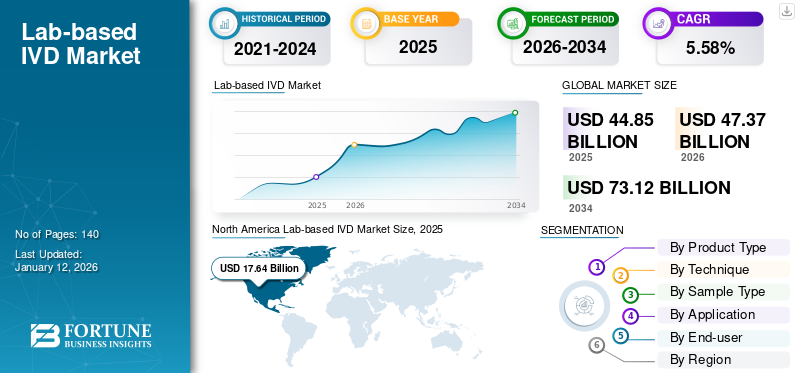
The global lab-based IVD market size was valued at USD 44.85 billion in 2025. The market is projected to grow from USD 47.37 billion in 2026 to USD 73.12 billion by 2034, exhibiting a CAGR of 5.58% during the forecast period. North America dominated the lab-based IVD market, accounting for a 39.33% market share in 2025.
The lab-based in vitro diagnostics (IVD) market plays an important role in the healthcare sector, involving tests conducted in specialized laboratory environments to diagnose and monitor diseases. The lab-based IVD market is fueled by the rising incidence of chronic and infectious diseases and a growing focus on personalized medicine.
The market is semi-consolidated with the presence of key players, such as Bio-Rad Laboratories, Inc., BD, F. Hoffmann-La Roche Ltd., Abbott, and Thermo Fisher Scientific Inc. Several players are engaging in new product launches and strategic acquisitions & partnerships to enhance their capabilities and product range in the global market.
Furthermore, technological advancements in instruments and the launch of new tests for effective diagnosis and treatment of several diseases are some of the additional factors supplementing market growth.
Download Free sample to learn more about this report.
 Global Market Size & Forecast
 Market Share
 Key Regional Highlights
North America
The market in North America reached USD 17.64 billion in 2025, representing 39.33% of total market revenue, and is projected to reach USD 18.63 billion in 2026.
Europe
Europe contributed approximately USD 9.9 billion to the global market in 2025, accounting for 22.07% share, and is expected to reach USD 10.45 billion in 2026.
Asia Pacific
In 2025, the Asia Pacific market stood at USD 11.51 billion, representing 25.65% of global demand, and is projected to grow to USD 12.31 billion in 2026.
U.S.
The U.S. lab-based IVD market is projected to reach USD 17.27 billion by 2026, driven by strong diagnostic capabilities and continuous adoption of advanced IVD technologies.
Japan
The Japan lab-based IVD market is projected to reach USD 2.9 billion by 2026, supported by rising demand for early diagnostics and ongoing advancements in laboratory testing technologies.
Read More

Growing Prevalence of Chronic and Infectious Diseases Likely to Propel Market Growth
Chronic infectious diseases, such as tuberculosis and hepatitis B and C, along with outbreaks of other illnesses, such as H1N1 and COVID-19, have significantly increased the need for early diagnosis through in-vitro diagnostic tools. The high burden of infectious diseases is leading to an increasing demand for diagnostic procedures.
The increasing geriatric population susceptible to more infectious diseases and chronic conditions is also another attributable factor fueling the demand for these tests and solutions.
Rising Awareness about Early Disease Diagnosis of Chronic Conditions Fuels Market Growth
Increasing awareness about the importance of screening and early detection of these chronic medical conditions in both developed and emerging nations is driving the demand for in-vitro testing solutions across different healthcare facilities. Additionally, the growing initiatives by governmental agencies, national organizations, and market players to promote awareness about early screening are resulting in a higher acceptance of IVD testing solutions among the population.
Increasing Strategic Initiatives such as Partnerships and Acquisitions Among Market Players to Support Market Development
The growing focus of market players on strategic collaborations and acquisitions to develop and launch products with the latest technology to cater to the rising demand among the population is expected to boost market growth.
Unfavorable Reimbursement Policies for In-Vitro Diagnostics to Hinder Market Growth
The high cost of in-vitro diagnostic testing, including genetic testing and molecular testing for chronic diseases, hinders the adoption of these tests in emerging countries such as Brazil, Australia, African countries, and many others.
The reimbursement scenario for in-vitro diagnostics products has been unfavorable in many countries worldwide. Various regions and their changing reimbursement policies have impacted the growth of the in-vitro diagnostics market globally.
Thus, limited reimbursement for lab-based in-vitro diagnostic tests, especially in emerging countries, coupled with higher costs of advanced and innovative IVD tests, limits the adoption of these tests, thereby hindering market growth.
Gradual Shift of Preference Toward Adoption of Molecular Diagnostics Techniques to Provide Growth Opportunities for Market Players
Molecular diagnostics is one of the most dynamic techniques in the in-vitro diagnostics industry, leading to advances in monitoring and revolutionizing healthcare across the globe. Over the past few years, the adoption of molecular diagnostics has surged, becoming the predominant method for transplant and transfusion diagnostics and disease testing. As a result, industry players are increasingly focused on the development and introduction of advanced technologies.
Moreover, advancements in molecular diagnostic techniques, such as next-generation sequencing (NGS), coupled with the rising prevalence of cancer and other chronic diseases, are expected to offer diverse opportunities for companies operating in the in-vitro diagnostics market.
The shift of preference from traditional diagnostic methods to advanced molecular diagnostics is likely to expand further avenues for market players capable of meeting these emerging demands through the introduction of advanced testing solutions in the global market.
Stringent Regulatory Guidelines for Manufacturing of Lab-based IVD Products is Considered a Major Challenge for Market Players
Regulatory changes pose a significant challenge for the lab-based IVD market due to the diverse and evolving regulatory landscape globally. Differences in regulations across countries, stringent requirements, and the time-consuming nature of obtaining approvals can hinder market access, innovation, and growth for IVD manufacturers.
Different countries globally follow varying regulatory frameworks for in-vitro devices, making it difficult for in-vitro manufacturers to comply uniformly. It is one of the biggest and most difficult challenges for in-vitro diagnostic product manufacturers asmedical devices in-vitro device industry has yet to have globally harmonized regulations.
Therefore, adherence to stringent safety and quality standards for the manufacturing and supply of in vitro diagnostic products are the main challenges faced by market players.
Rising Emphasis on Technological Advancements, Automation, and Personalized Medicine by Key Players are Key Market Trends
In recent years, there has been a growing focus on precision medicine, where diagnostics are tailored to individual genetic profiles. The next-generation sequencing (NGS) is gaining traction for cancer and genetic disorder detection. Therefore, due to the increasing demand for personalized medicine, several market players are focusing on the development and launch of technologically advanced devices and novel diagnostic tests.
The growing focus of companies on the development of state-of-the-art devices to create automation in laboratory testing is considered one of the major trends in the lab-based IVD market.
Download Free sample to learn more about this report.
Reagents & Consumables Segment Led due to Increasing Regulatory Approvals and New Product Launches
On the basis of product type, the market is divided into instruments and reagents & consumables.
The reagents & consumables segment dominated the market, accounting for the major proportion of the global lab-based IVD market share in 2024. The dominant share of this segment is attributed to the increasing regulatory approvals and product launches for novel IVD kits.
Furthermore, growing awareness about the importance of early diagnosis in developed and emerging countries is leading to the rising number of patients undergoing routine tests. This further enhances the demand for kits and reagents in the global market.
On the other hand, the instruments segment is expected to grow at a considerable CAGR from 2025-2032. Technologically advanced instruments and the introduction of rapid testing tools are some of the factors propelling the segment's growth.
To know how our report can help streamline your business, Speak to Analyst
Immunodiagnostics Segment Led Due to Rising New Product Launches
On the basis of technique, the market is divided into immunodiagnostics, clinical chemistry, molecular diagnostics, hematology, and others. The immunodiagnostics segment is further categorized into enzyme-linked immunosorbent assay (ELISA), fluorescence immunoassay (FIA), rapid test, and others. Moreover, the clinical chemistry segment is sub-segmented into electrolyte panels, basic and comprehensive metabolic panels, liver tests, renal tests, lipid panels, and others. On the other hand, the molecular diagnostics segment is further divided into polymerase chain reaction (PCR), in situ hybridization, DNA sequencing & next-generation sequencing, and others.
The immunodiagnostics segment dominated the market, accounting for the major proportion of the global lab-based IVD market share in 2024. The dominant share of this segment is attributed to the increasing product launches for novel immunoassay products.
The clinical chemistry segment held a moderate market share in 2024. The growing focus of market players on receiving regulatory approvals for assay test kits for the assessment of various diseases-related biomarkers is one of the factors propelling the segment's growth.
The molecular diagnostics segment accounted for the second-largest market share in 2024, owing to the increasing launch of novel molecular diagnostic solutions, including polymerase chain reaction (PCR) devices. This, along with the rising number of clinical laboratories in developing countries, is further driving the segment's growth.
The hematology segment held considerable market share in 2024 and is expected to grow at the second-highest CAGR from 2025-2032. The growing collaborations among market players for the development of innovative hematology solutions are the main factors of the segment growth. Additionally, the increasing number of surgeries requiring blood transfusions, along with the growing prevalence of hematology disorders, are some of the prominent factors driving the demand for hematology tests in the global lab-based in-vitro diagnostics market.
The others segment is expected to grow at a moderate CAGR during the forecast period. Constant focus on research and development aimed at discovering new uses for in vitro diagnostic (IVD) tests has resulted in the creation of tests for various applications such as allergies, autoimmune disorders, neurology, and nephrology. This innovation is projected to drive the adoption of these non-invasive IVD tests for diagnosing various medical conditions during the forecast period.
Blood Segment Dominated Due to Its Increased Usage as a Sample for Assessment
Among sample type, the market is categorized into blood, urine, saliva, tissue, and others.
The blood segment accounted for a dominant share of the market in 2024 and is anticipated to grow at the highest CAGR during the forecast period. This is due to the growing regulatory approvals and product launches for IVD kits, and IVD systems utilizing blood as a sample for assessment.
The saliva segment accounted for the second-largest market and is expected to grow at the second-largest CAGR during the forecast period. The growing focus of market players on receiving regulatory approvals for test kits that detect specific biomarkers or genes directly from saliva samples is augmenting the segment’s growth.
The urine segment accounted for a moderate market share in 2024 and is expected to grow at a moderate CAGR during the forecast period. The growing emphasis by pharmaceutical and biotechnological companies on the development of novel diagnostic solutions for detecting chronic diseases via urine samples is supplementing the segment’s growth.
The tissue and others segments are expected to grow at a stagnant CAGR from 2025-2032. The rising prevalence of chronic diseases and increasing utilization of tissue and other samples for assessment of diseases are some of the important factors driving segment growth.
High Burden of Chronic Infectious Diseases Boosted Segment Growth
Based on application, the market is divided into infectious diseases, cardiology, oncology, gastroenterology, allergy, autoimmunity, prenatal screening, and others.
The infectious diseases segment held a dominant market share in 2024 and is expected to grow at a moderate CAGR throughout the forecast period. The dominant share of this segment is attributed to the high burden of chronic infectious diseases across the globe.
The others segment is expected to grow at the highest CAGR from 2025-2032. The rising focus of market players on research and development activities to explore new application areas for IVD tests has led to the development of tests for different applications, including metabolic disorders, neurology, and nephrology. This is anticipated to drive the adoption of these lab-based IVD tests for the diagnosis of various disease conditions during the forecast period.
The oncology segment is expected to grow at the second-largest CAGR throughout the forecast period, owing to the high burden of cancer across the globe.
Furthermore, the development of innovative tests for cancer diagnosis based on new techniques, including analysis of DNA/ RNA, proteins, and other novel biomarkers, has been pivotal in driving the growth of the oncology segment in the global market.
High Burden of Chronic Diseases Increases Patients Shift Toward Clinical Laboratories for Diagnosis Purpose, Augmented Segmental Growth
Based on end-user, the market is divided into hospitals, clinical laboratories, and others.
The clinical laboratories segment dominated the market in 2024 and is estimated to grow at the highest CAGR during the forecast period. The high burden of chronic and infectious diseases has resulted in a greater influx of patients seeking diagnostic tests for various medical conditions. This has led to an increased demand for in-vitro diagnostic instruments and consumables in clinical laboratories. Additionally, the rapid growth of clinical laboratories in emerging countries is contributing to a larger share of this segment in the global market by 2024.
The hospitals segment accounted for a moderate market share in 2024. The increasing number of hospitalizations for the treatment of chronic diseases is one of the major factors propelling the growth of the hospitals segment during the 2025-2032 period. This trend is anticipated to elevate the demand for in-vitro diagnostics (IVD) tests in hospitals to diagnose chronic conditions.
The others segment is expected to grow at a stagnant CAGR during the forecast period. The increasing utilization of in vitro diagnostic instruments and kits in academic and research institutes is supplementing the segment’s growth.
In terms of regions, the global market can be divided into North America, Europe, Asia Pacific, Latin America, and the Middle East & Africa.
North America Lab-based IVD Market Size, 2025 (USD Billion)
To get more information on the regional analysis of this market, Download Free sample
The market in North America reached USD 17.64 billion in 2025, representing 39.33% of total market revenue, and is projected to reach USD 18.63 billion in 2026. The dominance of this region is largely attributed to the presence of advanced healthcare infrastructure and the presence of key companies in this region. The U.S. market is projected to reach USD 17.27 billion by 2026.
In addition, the growing focus of industry players on receiving regulatory approvals and product launches has fueled lab-based IVD market growth in the U.S.
Europe contributed approximately USD 9.9 billion to the global market in 2025, accounting for 22.07% share, and is expected to reach USD 10.45 billion in 2026, driven by the increasing prevalence of chronic diseases, new product launches, and growing strategic partnerships among market players. The UK market is projected to reach USD 1.59 billion by 2026, while the Germany market is projected to reach USD 3.04 billion by 2026.
In 2025, the Asia Pacific market stood at USD 11.51 billion, representing 25.65% of global demand, and is projected to grow to USD 12.31 billion in 2026. owing to the increasing product launches and rising awareness about early diagnosis of chronic and infectious diseases are some of the prominent factors boosting market growth in this region. The Japan market is projected to reach USD 2.9 billion by 2026, the China market is projected to reach USD 5.19 billion by 2026, and the India market is projected to reach USD 1.49 billion by 2026.
The Latin America market accounted for USD 2.87 billion in 2025, representing 6.41% of the global industry, and is expected to reach USD 2.95 billion in 2026. The market in Latin America and the Middle East & Africa are expected to grow at a stagnant CAGR during the forecast period. The rising burden of chronic and infectious diseases such as diabetes, cancer, and tuberculosis play a significant role in driving demand for in-vitro diagnostics. Additionally, the rising number of R&D activities among market players to develop and introduce novel products in these regions is another factor contributing to market growth. Middle East & Africa maintained a strong presence in the global market, reaching USD 2.94 billion in 2025, accounting for 6.54% share, and is expected to reach USD 3.02 billion in 2026.
Market Players Focus on Launch of New Products to Enhance their Product Offerings
The global market is led by key companies such as F. Hoffmann-La Roche Ltd., Abbott, Thermo Fisher Scientific Inc., and Siemens Healthineers AG. These companies offer a wide range of lab-based in vitro diagnostic products, with a growing focus on new product launches, which has been a major driver for their significant share in the global market.
Moreover, other market players include BD, QIAGEN, Sysmex Corporation, and several small-scale companies across the globe. These players are focusing on strategic collaborations and acquisitions to expand their geographic presence and establish a strong brand presence in the global market.
The global market report provides a detailed competitive landscape and market insights. It focuses on key aspects such as competitive landscape, product type, technique, sample type, application, end-user, and region. In addition to the global lab-based IVD market size, it covers regional analysis of different market segments, profiles of key market players, and market dynamics. Moreover, the report encompasses several factors that have contributed to the growth of the market over recent years.
Request for Customization to gain extensive market insights.
|
ATTRIBUTE |
DETAILS |
|
Study Period |
2021-2034 |
|
Base Year |
2025 |
|
Estimated Year |
2026 |
|
Forecast Period |
2026-2034 |
|
Historical Period |
2021-2024 |
|
Growth Rate |
CAGR of 5.58% from 2026-2034 |
|
Unit |
Value (USD billion) |
|
Segmentation |
By Product Type
|
|
By Technique
|
|
|
By Sample Type
|
|
|
By Application
|
|
|
By End-user
|
|
|
By Region
|
Fortune Business Insights says that the global market stood at USD 44.85 billion in 2025 and is projected to reach USD 73.12 billion by 2034.
In 2025, the market value stood at USD 44.85 billion.
The market will exhibit steady growth at a CAGR of 5.58% during the forecast period (2026-2034).
By sample type, the blood segment led the market.
Growing awareness about early diagnosis and the rising prevalence of chronic diseases are the key factors driving market growth.
Abbott, Thermo Fisher Scientific Inc., and Sysmex Corporation are the major players operating in the market.

Get 30-60 hrs Free Customization
Expand Regional and Country Coverage, Segments Analysis, Company Profiles, Competitive Benchmarking, and End-user Insights.













.webp)






Related Reports
Get In Touch With Us
US +1 833 909 2966 ( Toll Free )
Receive a tailored pricing based on your needs.
Discuss your questions with our industry experts.
Have questions? Get quick answers before you purchase.

