Land-based Terrestrial Military SATCOM Market Size, Share & Industry Analysis, By Product (OTM Land, OTP Land), By Infrastructure Type (Fixed Strategic, Fixed Operational), By Mobility Level (Fixed, Semi, Transportable, Mobile, Portable), By Antenna Type (Parabolic, Stabilized Land-Mobile, Low-Profile, other), By Modem (Standard Wideband, Narrowband Tactical), By Frequency Band (UHF, X-Band, Military Ka-Band, Ku-Band), By Platform (Fixed Ground-Based, Vehicle-Mounted), By Application (Command-Control, Battlefield), By Service Model (Equipment-Only Procurement) & Regional Forecast, 2026-2034
 Download Free Sample
Land-based Terrestrial Military Satellite Communication (SATCOM) Market Size and Future Outlook
 Listen to Audio Version
The global land-based terrestrial military satellite communication (SATCOM) market size was valued at USD 9.17 billion in 2025. The market is projected to grow from USD 10.08 billion in 2026 to USD 22.14 billion by 2034, exhibiting a CAGR of 10.3% during the forecast period. North America dominated the land-based terrestrial military satellite communication (SATCOM) market with a market share of 46.12% in 2025.
Land-based terrestrial military SATCOM refers to satellite communication links that connect ground forces and headquarters using fixed, transportable, or mobile land-based terminals. It gives beyond-line-of-sight, high-capacity voice, data, and video connectivity so commanders and units can communicate over large distances and in austere terrain without relying on local telecom infrastructure.
Leading industry players such as Thales Group, L3Harris Technologies, Viasat Inc., Indra, and Hughes Network Systems are pioneering innovations in land-based terrestrial military SATCOM. These companies are advancing multi-band fixed, transportable, and on-the-move terminals that deliver high-throughput, secure connectivity to ground forces in dispersed, contested environments.
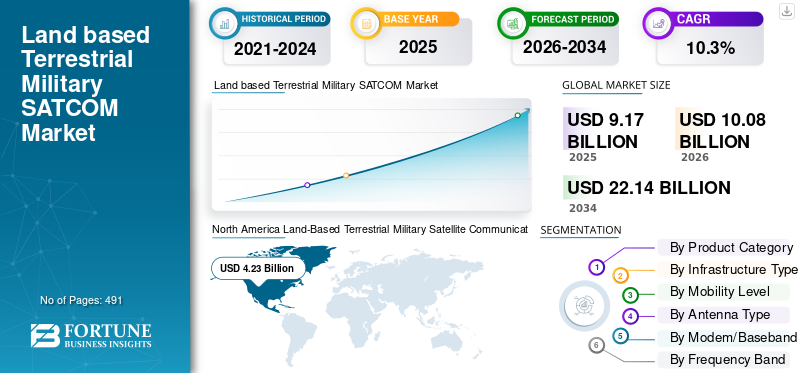
Download Free sample to learn more about this report.
LAND-BASED TERRESTRIAL MILITARY SATELLITE COMMUNICATION (SATCOM) MARKET KEY TAKEAWAYS
 Global Market Size & Forecast
- 2025 Market Size: USD 9.17 billion
- 2026 Market Size: USD 10.08 billion
- 2034 Forecast Market Size: USD 22.14 billion
- CAGR: 10.3% from 2026–2034
 Market Share
- North America dominated the market with a 46.12% share in 2025.
- Antenna systems held a leading share, supported by rising multi-orbit and multi-band SATCOM demand.
- Fixed strategic infrastructure captured a major share, driven by modernization of permanent military SATCOM assets.
 Key Regional Highlights
North America
North America led with a 46.12% market share in 2025.
Asia Pacific
Asia Pacific is projected to grow at the fastest 12.4% CAGR.
Europe
Europe is expanding through rising defense modernization.
U.S.
Remains the largest North American market.
Japan
Held a 2.7% global share in 2025.
Read More

LAND-BASED TERRESTRIAL MILITARY SATELLITE COMMUNICATION (SATCOM) MARKET TRENDS
Shift toward Smaller and Deployable Low-Signature Tactical SATCOM Terminals is a Significant Market Trend
Modern land forces are shifting away from large, static SATCOM nodes that require heavy vehicles, long setup times, and fixed operating locations. Instead, demand is growing for compact terminals that can be carried, transported in small vehicles, or deployed quickly by small tactical teams.
This trend is being driven by the need for survivability in contested environments, where large command posts and fixed communication nodes are easier to detect, jam, or target. ISR teams, special operations units, forward observers, and mobile command posts increasingly require SATCOM systems that can be set up quickly, moved frequently, and operated with limited manpower.
- For instance, in February 2026, Gilat Satellite Networks Ltd. announced that its subsidiary, Gilat DataPath, had won a USD 16 million contract from a European Ministry of Defense for multiple DKET 3421 transportable terminals, marking the company's first deal with this MoD and boosting its European defense footprint.
As a result, terminal design is moving toward lighter antennas, ruggedized control units, auto-acquisition features, reduced power consumption, and simpler operator workflows. Flat-panel and low-profile antenna concepts are also gaining relevance as they reduce visual signature and support mobile or short-haul operations.
This trend increases demand for deployable terminals, portable modem kits, ruggedized power units, compact antennas, and integrated field communication packages. It also creates opportunities for suppliers that can combine mobility, fast setup, encryption, network resilience, and interoperability with existing military SATCOM networks.
MARKET DYNAMICS
MARKET DRIVERS
Download Free sample to learn more about this report.
Rising Need for Assured Beyond-Line-of-Sight (BLOS) Communication to Propel Market Growth
The land-based terrestrial military satellite communication (SATCOM) market growth is directly driven by the growing need for assured beyond-line-of-sight communication across modern ground operations. As land forces become more dispersed, mobile, and data-intensive, reliable satellite connectivity has become essential for maintaining command and control between headquarters, forward operating bases, tactical units, and deployed assets. Traditional terrestrial communication networks, including fiber, radio relay, and cellular infrastructure, often face limitations in remote, contested, or rapidly changing operational environments.
- In March 2024, the U.S. Army assessed LEO, MEO, and GEO satellite communications capabilities to improve tactical network resilience, bandwidth, and survivability for future land operations. The program directly supports beyond-line-of-sight command and control by giving commanders multiple transport paths when terrestrial links are degraded, jammed, or unavailable.
As modern militaries prioritize real-time data sharing and battlefield and situational awareness, the demand for reliable communication across diverse, often remote or contested, terrestrial environments continue to intensify. SATCOM addresses this gap by enabling secure, long-range connectivity even where conventional networks are unavailable, degraded, or vulnerable to disruption. This requirement is becoming more critical as military operations increasingly depend on real-time intelligence sharing, ISR feeds, mission coordination, logistics tracking, and joint-force interoperability.
- For instance, in November 2023, the U.S. Space Development Agency successfully demonstrated Link 16 network entry from low Earth orbit satellites to ground receivers using terrestrial radios. Using L-band radios on Tranche 0 Transport Layer satellites, operators achieved passive and active network entry, fine synchronization, and transmission of multiple tactical messages to a ground site in a Five Eyes partner nation.
Expansion and Investment in Military SATCOM Programs Drive Market Growth
Global defense spending has surged during geopolitical tensions, enabling huge investments in SATCOM programs. The land-based terrestrial military SATCOM market is strongly driven by rising government investment in dedicated military satellite communication programs. Defense agencies are modernizing SATCOM architectures to improve secure connectivity, operational resilience, and command continuity across deployed land forces.
- For instance, in March 2025, the U.S. Department of Defense implemented an enterprise SATCOM approach to integrate military and commercial satellite communication options into a more flexible architecture. This supports demand for interoperable terrestrial SATCOM systems that can route communications through multiple pathways when one link is unavailable or disrupted.
Militaries globally are upgrading to advanced SATCOM for real-time data in surveillance, targeting, and mobility, driving the need for miniaturized, anti-jam terrestrial systems on vehicles and bases. Programs integrating commercial satellite constellations with military networks increase bandwidth requirements, which in turn increase land terminal deployments for tactical units.
MARKET RESTRAINTS
High Vulnerability of SATCOM Links to Jamming, Spoofing, and Cyber Disruption Hamper Market Expansion
A major restraint for the land-based terrestrial military SATCOM market is the growing vulnerability of satellite communication links to electronic warfare and cyber disruption. Although SATCOM provides long-range and beyond-line-of-sight connectivity, its signals can be targeted through jamming, spoofing, interception, or denial tactics in contested environments. This creates operational risk for land forces that depend on SATCOM for command and control, ISR data transfer, logistics coordination, and mission execution.
SATCOM links are increasingly exposed to electronic warfare threats in contested environments. For instance, in July 2025, U.S. Space Systems Command announced a new Protected Tactical SATCOM Family of Systems to accelerate the deployment of wideband, anti-jam satellite-based communication capability for deployed warfighters. The need for protected waveforms, anti-jam modems, resilient terminals, and secure ground infrastructure increases system cost, integration complexity, and procurement timelines for land-based military SATCOM users. As a result, defense agencies need to invest in anti-jam waveforms, encryption, protected terminals, cyber-hardened gateways, and resilient network architectures.
MARKET OPPORTUNITIES
Domestic Mandates, Electrification of Aircraft Systems, & Adoption of AI and Autonomy Present Market Growth Opportunities
Modernization of Ground Infrastructure
A major opportunity in the land-based terrestrial military SATCOM market lies in modernizing tactical ground infrastructure to enable multi-orbit connectivity. Armed forces are moving beyond traditional fixed and single-orbit SATCOM models. They are increasingly seeking terminals, gateways, modems, and network-management systems that can connect to both military and commercial satellite capacity.
- For instance, in June 2024, the 44th Army signal unit received new Phoenix E satellite technology gear and began using it to replace the old Phoenix D version. The Phoenix E is a quad-band, multi-tactical terminal operating in the SHF band, featuring IP-capable modems for frequency- and time-division multiple access, enabling dual satellite/band access to improve network diversity, robustness, and capacity.
The defense sectors of various countries are shifting toward a department-wide SATCOM enterprise that integrates existing military systems, planned government assets, and commercial SATCOM options, creating clear demand for interoperable ground equipment.
Moreover, there is an increase in investment in modernization & replacement of aging ground equipment, dispersed systems to improve communication for defense forces. For instance, in June 2025, the U.S. Army launched a SATCOM modernization project at Fort Buckner in Okinawa, Japan, to strengthen Pacific communications. PdM WESS will deliver three Modernized Earth Terminals and new baseband IT hardware to the 78th Signal Battalion.
Adoption of Multi-Orbit Satellite Communication Systems
The defense sector is shifting away from single-orbit, sovereign SATCOM systems toward hybrid multi-orbit architectures designed to improve survivability, reduce latency, and maintain communications under contested space conditions.
- For instance, in November 2024, Australia’s Defence Department canceled its procurement with Lockheed Martin Australia for a single-orbit GEO satellite communications system. Instead, Australia announced prioritization of a more resilient multi-orbit satellite communications capability to support the Australian Defence Force’s future operations.
For land forces, this opens opportunities for vendors offering vehicle-mounted terminals, manpack systems, deployable hubs, electronically steered antennas, and software-defined SATCOM solutions with multi-orbit capabilities. For instance, in April 2026, L3Harris and Comtech released the 5650C2/MP multi-orbit tactical SATCOM embeddable modem for selected L3Harris terminals. The modem is designed to operate across SES’s MEO Global Services and the U.S. Space Force’s WGS system, with WGS certification currently underway through Space Force Delta 8.
These systems are especially relevant for forward operating bases, mobile command posts, air-defense units, artillery formations, and dispersed tactical teams that require resilient connectivity in remote or contested areas.
MARKET CHALLENGES
High Capital and Lifecycle Cost of Deploying and Sustaining Resilient SATCOM Infrastructure
One major challenge for the land-based terrestrial military SATCOM market is the high capital and lifecycle cost of deploying and sustaining resilient SATCOM infrastructure. This includes the expense of satellites, protected ground terminals, hardened gateways, and secure network management systems, all designed to withstand jamming, cyber threats, and harsh environments. These high costs can delay procurement cycles, force trade-offs with other defense priorities, and make it difficult for some militaries, especially in emerging markets, to upgrade from legacy narrowband systems to modern, high-throughput, multi-band solutions.
Segmentation Analysis
By Product Category
Increasing Use of Multi-orbit and Multi-band Networks to Propel Antenna Systems Segment Growth
Based on product category, the market is divided into OTM land terminals, OTP land terminals, manpack terminals, man-transportable terminals, vehicular terminals, SATCOM Modems, EPM/protected modems, antenna systems, baseband/network control systems, terminal, modem and element management system, and support and sustainment services.
The antenna systems segment is expected to hold a leading share in the market, driven by rising demand for higher-performance SATCOM links across mobile vehicles, deployable nodes, fixed sites, and soldier-carried systems. The growing use of multi-orbit and multi-band networks is driving militaries to procure antennas with improved tracking, lower profiles, and faster satellite acquisition.
- For instance, in March 2026, Kymeta unveiled its KuKa 8-Series terminal, positioned as a multi-band, multi-orbit, single-aperture flat-panel user terminal for mission-critical SATCOM connectivity.
The EPM/protected modems segment is anticipated to grow at the fastest rate, with a 15.2% CAGR over the forecast period.
By Infrastructure Type
Fixed Strategic Modernization and High‑Bandwidth Upgrades Drive Fixed Strategic Infrastructure Segment Growth
By infrastructure type, the market is segmented into fixed strategic infrastructure, fixed operational infrastructure, deployable infrastructure, transportable infrastructure, and tactical end-user infrastructure.
The fixed strategic infrastructure segment holds the largest market share, fueled by the modernization of permanent strategic SATCOM ground assets supporting high-priority military communications, missile defense, and global reachback. Aging fixed terminals are being replaced with higher-bandwidth X/Ka-band infrastructure compatible with WGS and legacy systems.
The deployable infrastructure segment is projected to grow with the fastest CAGR of 9.8% over the forecast period. Segment growth is driven by rising demand for rapidly deployable SATCOM nodes that can be moved to expeditionary locations & support forward-deployed forces. Dispersed operations are increasing the need for transportable terminals with high throughput & scalable modems.
- For instance, in September 2025, Gilat DataPath received orders worth more than USD 7 million to supply DKET 3421 transportable SATCOM terminals to the U.S. Army.
By Mobility Level
Stable Gateway Investment and Secure Network Integration Support Fixed Systems Segment Expansion
By mobility level, the market is segmented into fixed systems, semi-mobile systems, transportable systems, mobile systems, and highly portable systems.
The fixed systems segment is expected to account for a major land-based terrestrial military satellite communication (SATCOM) market share due to continued investment in stable ground anchors for gateway access, strategic command connectivity, and secure military network integration. Fixed SATCOM systems remain critical where long-duration availability and controlled infrastructure outweigh mobility.
- For instance, the U.S. Space Force states that the WGS ground segment includes thousands of tactical SATCOM terminals, including fixed and transportable terminals with antenna sizes from 0.4 meters to 18.4 meters.
The highly portable systems segment is estimated to be the fastest-growing during the forecast period with a CAGR of 13.9%. Segment growth is attributed to the increasing use of small, dispersed teams that require independent BLOS connectivity in remote or infrastructure-poor environments.
To know how our report can help streamline your business, Speak to Analyst
By Antenna Type
Mature High‑Gain Requirements and Proven Throughput Needs Fuel Parabolic Antennas Segment Growth
By antenna type, the market is segmented into parabolic antennas, stabilized land-mobile antennas, low-profile antennas, flat-panel antennas, electronically steered antennas, phased-array antennas, and multi-band antennas.
The parabolic antennas segment is expected to hold the majority share in the market. Segment growth is supported by continued demand for mature, high-gain antenna designs for fixed, transportable, and rapidly deployable SATCOM networks. Parabolic antennas remain significant for link budget, throughput, and proven field performance. For instance, in November 2023, Cobham Satcom secured a multi-year contract worth at least USD 10 million with an unnamed U.S. prime contractor to supply its Tracker series multi-band satellite antennas, with options for annual renewals.
Electronically steered antennas are estimated to be the fastest-growing segment during the forecast period with a CAGR of 15.1%.
By Modem/Baseband Type
Broadband C2/ISR Backhaul and Multi‑Orbit Access Push Standard Wideband Modems Segment Expansion
On the basis of modem/baseband type, the market is segmented into standard wideband modems, narrowband tactical modems, EPM modems, anti-jam/protected modems, software-defined modems, multi-waveform modems, and legacy interoperability modems.
The standard wideband modem segment is projected to hold the largest market share. The segment growth is attributed to rising demand for broadband SATCOM supporting C2, ISR backhaul, video transmission, logistics data, and command-post networking. Modern wideband modems are becoming essential as land forces digitize SATCOM ground networks and expand multi-orbit access.
- For instance, in March 2026, L3Harris and Comtech introduced a new C2 tactical SATCOM modem aligned with rapidly deployable multi-orbit terminals, including Panther II and Hawkeye flyaway terminals.
The anti-jam/protected modems segment is expected to grow at a CAGR of 14.7% during the forecast period. The segment growth is driven by the need to preserve SATCOM connectivity during jamming, interference, and contested-spectrum operations.
By Frequency Band
Sovereign Resilience and WGS Compatibility Sustain X‑Band Segment Dominance
On the basis of frequency band, the market is segmented into UHF, X-Band, military Ka-Band, Ku-band, EHF/protected, and multi-band.
The X-band segment is expected to dominate the market globally. The segment growth is supported by sustained military preference for sovereign, resilient, defense-controlled wideband SATCOM capacity. X-band remains important for deployed headquarters, strategic terminals, operational reachback, and WGS-compatible terrestrial SATCOM networks. For instance, L3Harris’ 12.2-meter Large Wideband Satellite Communications Terminal is designed for reliable WGS operation and converts signals between L-band and Ka/X-band RF.
The EHF/protected segment is expected to grow at a CAGR of 13.9% over the forecast period.
By Platform/ Installation Type
Permanent Gateways and National Network Needs Bolster Fixed Ground‑Based Systems Segment Growth
On the basis of platform/installation type, the market is segmented into fixed ground-based systems, vehicle-mounted systems, trailer-/shelter-mounted systems, command-post systems, and dismounted soldier-carried systems.
The fixed ground-based systems segment holds a major share, owing to the need for permanent ground terminals, gateways, and strategic SATCOM access points tied into national and theater communication networks. These systems support secure reachback, network control, high-priority communications, and long-duration mission availability.
- For instance, in February 2026, ThinKom secured a military contract to provide portable satellite communications ground stations, enhancing mobile connectivity for defense users in the field.
The dismounted soldier-carried systems segment is estimated to grow at a CAGR of 13.5% during the forecast period. The segment growth is supported by rising requirements for small teams to maintain secure BLOS communications away from vehicles, command posts, and terrestrial networks.
By Application
Operational Reachback and Terrestrial Gaps Propel Command and Control Communications Segment Growth
On the basis of application, the market is segmented into command and control communications, tactical battlefield communications, ISR backhaul to ground nodes, mobility communications, special operations communications, protected communications, remote-site connectivity, border-security communications, and continuity and emergency communications.
The command and control communications segment leads the market, driven by the need for resilient command authority, operational awareness, and decision flow across dispersed land forces. SATCOM is increasingly adopted in terrain, distance, enemy activity, or infrastructure gaps that limit terrestrial communications. For instance, in November 2024, the U.K. Strategic Command began efforts to modernize its SKYNET strategic satellite communications by upgrading terrestrial terminals across land and maritime domains. The U.K. Ministry of Defense issued a request for information for new Maritime Military SATCOM Terminals and is pursuing a Next Generation Land Terminal (Strategic) project to replace existing high-resilience land terminals.
The protected communications segment is estimated to be the fastest-growing during the forecast period, with a CAGR of 13.5%.
By Service Model
Sovereign Ownership Preferences and In‑House Sustainment Propel Equipment‑Only Procurement Segment Growth
On the basis of the service model, the market is classified into equipment-only procurement, integrated hardware + software procurement, turnkey terrestrial ground segment solution, managed SATCOM service, and long-term support and maintenance contract.
The equipment-only procurement segment holds the largest share of the market and is growing significantly. The segment growth is supported by militaries that prefer direct ownership and control of SATCOM terminals, antennas, modems, and supporting equipment. This model is increasingly being used by forces that already maintain internal SATCOM operators, sovereign networks, and sustainment structures.
- For instance, in October 2023, the U.S. Army awarded Comtech a USD 48.6 million contract to design, develop, test, and deliver EDIM modem units for SATCOM digitization and modernization.
The managed SATCOM service segment is estimated to be the fastest-growing during the forecast period with a CAGR of 13.3%.
Land-based Terrestrial Military Satellite Communication (SATCOM) Market Regional Outlook
By region, the market is segmented into North America, Europe, Asia Pacific, Latin America, and the Middle East & Africa.
North America
North America Land-Based Terrestrial Military Satellite Communication (SATCOM) Market Size, 2025 (USD Billion)
To get more information on the regional analysis of this market, Download Free sample
North America accounted for the largest share of 46.06% in 2025, and is likely to remain dominant throughout the forecast period. Market growth in North America is attributed to sustained U.S. investment in resilient, high-capacity, and protected land-based SATCOM infrastructure for strategic command, tactical networking, ISR backhaul, and deployed force connectivity. The region is moving from legacy terminal architectures toward WGS-compatible, multi-band, multi-orbit, software-defined, and managed-service SATCOM models to improve survivability and operational flexibility.
- For instance, in October 2025, L3Harris completed the Critical Design Review for the U.S. Army’s Large Wideband Satellite Communications Terminal program, advancing a new X-/Ka-band fixed ground terminal toward first-article testing and WGS network certification. The program supports modernization of terrestrial military SATCOM terminals used for high-capacity, secure, long-range military communications.
U.S. Land-based Terrestrial Military Satellite Communication (SATCOM) Market
The U.S. remains the largest shareholder in the North America land-based military SATCOM market, as it modernizes both strategic fixed terminals and tactical user-terminal networks simultaneously. Demand is moving toward integrated SATCOM architectures and multi-band ground systems to access multiple military and commercial paths, rather than relying on single-purpose legacy links.
For instance, in September 2025, Cubic Defense secured a contract from the U.S. Air Force Research Laboratory to advance Halo, a next-generation SATCOM antenna for high-speed, resilient satellite communications. The software-defined antenna is designed to support multi-band, multi-orbit connectivity, allowing users to access both commercial and government satellite networks.
Europe
Market growth in Europe is driven by rising defense budgets and a renewed focus on collective defense amid heightened geopolitical tensions along NATO’s eastern flank. European armed forces are accelerating the modernization of command, control, communications, computers, intelligence, surveillance, and reconnaissance (C4ISR) infrastructure, which increases demand for high-throughput, secure SATCOM links to connect dispersed land units. There is a strong push to ensure interoperability within NATO, driving procurement of standardized ground terminals and gateways that can operate across allied sovereign and commercial constellations.
U.K. Land-based Terrestrial Military Satellite Communication (SATCOM) Market
The U.K. market in 2025 was valued at USD 0.40 billion, representing roughly 4.3% of global revenues.
Germany Land-based Terrestrial Military Satellite Communication (SATCOM) Market
The German market was valued at approximately USD 0.35 billion in 2025, equivalent to around 3.9% of global sales.
Asia Pacific
Asia Pacific is anticipated to grow at the fastest CAGR of 12.4% during the forecast period. The growth of Asia Pacific is driven by the region’s wide maritime geography, contested borders, island-chain defense planning, and increasing need for resilient communications across remote bases, mobile land forces, and forward-deployed command nodes. Demand is supported by SOF, reconnaissance, forward observers, disaster-response units, and remote patrol forces, all of which require compact terminals with rapid setup.
Fixed strategic infrastructure is expanding as Asia Pacific countries strengthen sovereign SATCOM ground stations, anchor sites, and network-management systems. Australia’s wideband ground-station work and Japan’s next-generation defense SATCOM infrastructure show the region’s focus on secure national communications. For instance, in 2024, Japan’s Defense Ministry is expanding its ground‑based communications infrastructure to support the Kirameki‑series X‑band military satellites, including control, uplink/downlink, and terminal‑network integration.
Japan Land-based Terrestrial Military Satellite Communication (SATCOM) Market
The Japanese market in 2025 was valued at around USD 0.25 billion, accounting for roughly 2.7% of global revenues.
China Land-based Terrestrial Military Satellite Communication (SATCOM) Market
China’s market is projected to be one of the largest globally, with 2025 revenue valued at around USD 1.53 billion, representing roughly 16.6% of global sales.
India Land-based Terrestrial Military Satellite Communication (SATCOM) Market
The Indian market in 2025 was valued at around USD 0.30 billion, accounting for roughly 3.2% of global revenues.
Latin America
In Latin America, market growth is driven by rising defense spending to address asymmetric threats such as cross-border smuggling, drug trafficking, and illegal mining, which require reliable beyond-line-of-sight communications for dispersed ground forces. Militaries in Brazil, Mexico, Colombia, and Argentina are modernizing legacy radio and microwave links with multi-band SATCOM terminals to support joint operations, disaster relief, and border surveillance.
Protected communications are emerging as countries in the region such as Brazil, treat secure satellite connectivity as part of national strategic autonomy. The segment’s growth is tied to encryption, secure network management, and resilience of government and military communications. For instance, in March 2026, Telespazio Brasil deployed its VELOCE LEO satellite mobile communication system for Brazil’s Presidential Security Office, GSI. The system is designed to provide secure, high-availability connectivity for presidential security operations, especially in remote areas such as the Amazon basin.
Brazil Land-based Terrestrial Military Satellite Communication (SATCOM) Market
The Brazilian market in 2025 was valued at around USD 0.08 billion, accounting for roughly 0.8% of global revenues.
Middle East & Africa
In the Middle East & Africa, growth is propelled by persistent security challenges, including counter-terrorism, insurgency, and regional conflicts, which create strong demand for resilient, secure land SATCOM for command and control and ISR support. Countries such as Saudi Arabia, UAE, Turkey, Israel, Egypt, and South Africa are investing in protected, anti-jam ground terminals and secure gateways to maintain communications in contested electromagnetic environments and during high-intensity operations.
Saudi Arabia Land-based Terrestrial Military Satellite Communication (SATCOM) Market
The Latin America market in 2025 was valued at around USD 0.15 billion, accounting for roughly 1.6% of global revenues.
COMPETITIVE LANDSCAPE
Key Industry Players
Extensive Product Portfolio and Development of Resilient Ground Infrastructure Drive Market Leadership
The land-based terrestrial military SATCOM market is moderately fragmented and driven by four competitive factors: resilient ground systems, waveform and cyber capabilities, network gateway/management, and global sustainment/deployment reach. Competitors range from large defense primes to specialized ground-equipment OEMs and agile software/network providers. Market leadership attracts firms that combine defense-qualified hardware, waveform-agnostic software, and field-proven operational support.
Market leaders differentiate through resilience and spectrum agility (anti-jam, LPI/LPE, multi-band support), validated waveform interoperability (MIL-STD and NATO/STANAG compatibility), and hardened cyber and supply-chain assurances that meet defense procurement standards. Recent trends reshaping competition include migration to waveform-agnostic, cloud-native ground infrastructure to support multi-orbit (GEO/MEO/LEO) connectivity, stronger demand for expeditionary and mobile solutions (SOTM, manpack, rapidly deployable terminals), increased emphasis on cyber resilience and trusted sourcing, and wider adoption of hybrid commercial–military capacity models to meet surge needs cost-effectively.
LIST OF KEY LAND-BASED TERRESTRIAL MILITARY SATELLITE COMMUNICATION (SATCOM) COMPANIES PROFILED
- Airbus Defence and Space (Netherlands)
- Thales Group (France)
- Indra Group (Spain)
- Leonardo S.p.A. (Italy)
- Viasat Inc. (U.S.)
- L3Harris Technologies Inc. (U.S.)
- General Dynamics Mission Systems (U.S.)
- Hughes Network Systems LLC (U.S.)
- ST Engineering iDirect (Singapore)
- SES Space & Defense (Luxembourg)
- Gilat Satellite Networks / Gilat DataPath (Israel)
- Kratos Defense & Security Solutions (U.S.)
- Communications & Power Industries (CPI) (U.S.)
- Ultra Intelligence & Communications (U.S.)
- Telespazio S.p.A. (Italy)
KEY INDUSTRY DEVELOPMENTS
- March 2026: L3Harris Technologies and Comtech introduced the 5650C2/MP embeddable multi-orbit modem for tactical satellite terminals. The modem supports MEO, GEO, and HEO operation and is aligned with tactical terminal families such as Panther II and Hawkeye 4 Lite.
- February 2026: Airbus Defence and Space and Greenerwave expanded their collaboration through two additional agreements covering multi-orbit satellite communication terminals and antenna technologies. The cooperation includes integrating low-power flat-panel antenna technology into Airbus’ secure connectivity offering.
- December 2025: Leonardo DRS completed the first on-orbit test of its XCM3-Space secure data-transport capability. The system combines a multi-channel software-defined radio with advanced cryptography and is intended to support high-performance secure satellite communication.
- July 2025: Thales Defense & Security’s Tampa Microwave business confirmed that its 1.3-meter terminal had achieved SES O3b mPOWER certification. The certification enables the Raider Vanguard MEO-tracking upgrade kit to convert existing Tampa terminals into multi-orbit systems capable of accessing high-throughput, low-latency MEO connectivity.
- September 2024: General Dynamics Mission Systems received a USD 491.6 million contract from the Space Development Agency for the Ground Management and Integration program. The work covers design, engineering, integration, testing, maintenance, and site support for ground entry points and the operations center.
Request for Customization to gain extensive market insights.
Report Scope & Segmentation
| ATTRIBUTE | DETAILS |
| Study Period | 2021-2034 |
| Base Year | 2025 |
| Estimated Year | 2026 |
| Forecast Period | 2026-2034 |
| Historical Period | 2021-2024 |
| Growth Rate | CAGR of 10.3% from 2026 to 2034 |
| Unit | Value (USD Billion) |
| Segmentation | By Product Category, By Infrastructure Type, By Mobility Level, By Antenna Type, By Modem/Baseband Type, By Frequency Band, By Platform/Installation Type, By Application, By Service Model, and Region |
| By Product Category |
|
| By Infrastructure Type |
|
| By Mobility Level |
|
| By Antenna Type |
|
| By Modem/Baseband Type |
|
| By Frequency Band |
|
| By Platform/Installation Type |
|
| By Application |
|
| By Service Model |
|
| By Region |
|
Frequently Asked Questions
According to Fortune Business Insights, the market value stood at USD 9.17 billion in 2025 and is projected to reach USD 22.14 billion by 2034.
The market is expected to exhibit a CAGR of 10.3% during the forecast period of 2025-2034.
By antenna type, the parabolic antennas segment is expected to lead the market.
The rising need for assured beyond-line-of-sight (BLOS) communication is driving market expansion.
Viasat Inc., L3Harris Technologies Inc., Thales Group, Airbus Defence and Space, and Gilat Satellite Networks are major players in the market.
North America dominated the market in 2025.



- 2021-2034
- 2025
- 2021-2024
- 491
Get 30-60 hrs Free Customization
Expand Regional and Country Coverage, Segments Analysis, Company Profiles, Competitive Benchmarking, and End-user Insights.




















-
US +1 833 909 2966 ( Toll Free )
-
Get In Touch With Us