Large Scale Battery Energy Storage Market Size, Share & Industry Analysis, By Battery Type (Lithium-Ion (Li-Ion), Lead Acid, and Others), By Application (Renewable Energy Integration, Back-Up and Emergency Power, and Others), By End-User (Utility, Commercial and Industrial, and Others), and Regional Forecast, 2025-2032
 Download Free Sample
Large Scale Battery Energy Storage Market Size and Future Outlook
 Listen to Audio Version
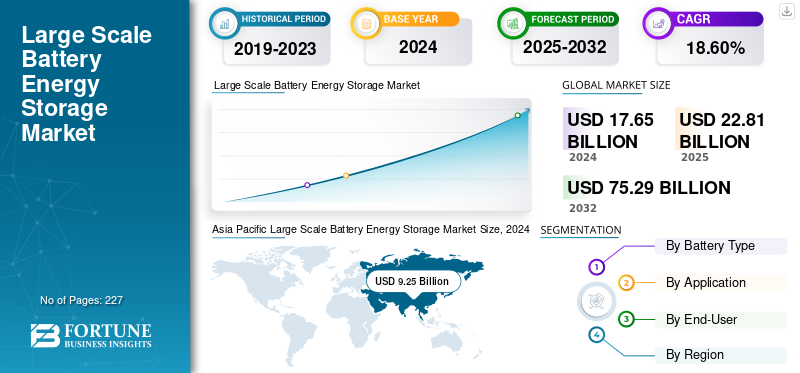
The global large scale battery energy storage market size was valued at USD 17.65 billion in 2024 and is projected to be worth USD 22.81 billion in 2025 and reach USD 75.29 billion by 2032, exhibiting a CAGR of 18.60% during the forecast period.
Large scale energy storage refers to battery technology systems with capacities typically above 1 megawatt or megawatt hours, designed to store electricity at the utility, industrial, or grid level. The increasing adoption of renewable energy sources such as solar power and wind is a key driver for large-scale battery energy storage. Renewable sources are intermittent and unpredictable, leading to fluctuations in power supply. Large-scale battery systems help address this challenge by storing excess energy during peak generation periods and releasing it during low or high demand periods. Energy transition is the major driver of the global market growth. The supply chain for the market is rapidly evolving to support growing global demand.
Tesla rapidly expands its footprint in the market due to several strategic, technological, and market-driven factors. This surge in renewable energy installations drives the global market share.
Download Free sample to learn more about this report.
Large Scale Battery Energy Storage Market Key Takeaways
 Market Size & Forecast
- 2024 Market Size: USD 17.65 billion
- 2025 Market Size: USD 22.81 billion
- 2032 Forecast Market Size: USD 75.29 billion
- CAGR: 18.60% from 2025-2032
 Market Share
- Asia Pacific dominated the large scale battery energy storage market in 2025.
- The lithium-ion segment held the largest market share in 2025.
- Renewable energy integration dominated the market by application in 2025.
 Key Regional Highlights
Asia Pacific
Asia Pacific led the market, driven by rapid renewable energy expansion across China and India.
North America
North America is witnessing significant growth due to increasing solar and wind installations.
Europe
Europe is expanding steadily as rising renewable energy penetration boosts demand for energy storage systems.
U.S.
Accelerating renewable energy adoption and grid modernization initiatives are driving market growth.
Japan
Growing investments in renewable energy and grid resilience are supporting market expansion.
Read More

MARKET DYNAMICS
MARKET DRIVERS
Grid Stability and Reliability to Drive Market Growth
The increasing need for grid stability and reliability drives the large scale battery energy storage market growth. As power grids globally integrate a higher share of intermittent renewable energy generation sources, maintaining consistent frequency, voltage, and power quality becomes increasingly challenging. Large scale battery storage system offers fast response solutions for frequency regulation, power systems, voltage support, load balancing, and black start capabilities, traditionally handled by fossil fuel-based peaker plants. These capabilities enable grid operators to effectively manage electricity supply and demand fluctuations, ensuring uninterrupted power delivery and improved grid resilience. In November 2024, Panasonic India Pvt Ltd and AES India Private Limited declared a collaboration to build a 10 MW energy storage arrangement at Panasonic Technopark manufacturing solution in Haryana. This collaborative project is India's first large-scale battery-based energy storage project.
MARKET RESTRAINTS
High Initial Capital Investment to Restrain Market Growth
Despite strong growth potential, the high initial capital investment required for large scale battery energy storage systems remains a significant challenge to market expansion. These systems involve substantial costs related to battery procurement, power conversion systems, installations, land acquisition, grid connection, and control infrastructure. While declining battery prices have improved economic viability, the overall project cost, especially for multi-megawatt or gigawatt-scale deployments, can still be prohibitive, particularly in developing countries and regions with limited policy support.
MARKET OPPORTUNITIES
Emerging Markets and Rural Electrification to Lead Large Scale Battery Energy Storage Demand
The expansion of emerging markets and the growing focus on rural electrification are expected to significantly drive the growth of the market. In many developing regions, such as Africa, Southeast Asia, Latin America, and the Middle East, access to reliable electricity remains limited, especially in remote or off-grid areas. In September 2021, Siemens Energy declared it would offer four static synchronous compensator installations for LS Power Grid California substation projects in California.
LARGE SCALE BATTERY ENERGY STORAGE MARKET TRENDS
Shift toward Advanced and Diverse Battery Technologies to Foster Market Growth
The market is experiencing rapid transformation due to a strategic shift toward advanced and diverse battery technologies, which are playing a key role in accelerating market growth. This trend is being driven by the need for improved performance, longer lifespan, enhanced safety, and cost-effectiveness. Rise in lithium-iron phosphate technology LFP batteries is increasingly preferred for utility-scale applications due to their higher thermal stability and safety, longer cycle life, and lower cost compared to nickel-based lithium batteries.
Download Free sample to learn more about this report.
SEGMENTATION ANALYSIS
By Battery Type
High Energy Density and Efficiency to Drive Lithium-ion Growth
The market, by battery type covers lithium-ion (Li-Ion), lead acid, and others.
Lithium-ion (Li-Ion) is the dominating segment in the market. Lithium-ion segment is driving the growth of the market due to its superior performance characteristics, cost competitiveness, and increasing demand for grid flexibility.
Lead acid batteries are growing at the fastest rate in the market as they are cheaper than lithium-ion and other advanced chemistries, making them an attractive option for budget-conscious utility, telecom, and industrial projects.
By Application
Time Shifting and Peak Shaving to Push Renewable Energy Integration Growth
The market is segmented, by application into renewable energy integration, back-up and emergency power, and others.
Renewable energy integration dominates the market. Large-scale batteries enable time shifting of renewable energy, storing during the day, and discharging during evening peak hours. Help utilities reduce peak load stress and avoid expensive fossil fuel-based peaker plants.
Back-up and emergency power is the second dominating segment in the market. The segment is growing due to the critical need for an uninterrupted power supply in essential infrastructure and increasing vulnerability to power outages and grid failures.
By End-User
Grid Modernization and Flexibility to Increase Utility Share
By end-user, the market is segmented into utility, commercial & industrial, and others.
Utilities dominate the growth of the market. Utilities are increasing in the market as storage helps utilities to achieve grid reliability, cost efficiency, and clean energy targets.
Commercial and industrial also holds a remarkable share in the market. Commercial and industrial use battery storage for peak shaving, demand charge reduction, and load shifting, helping lower their electricity bills significantly especially where tariffs are high or variable.
LARGE SCALE BATTERY ENERGY STORAGE MARKET REGIONAL OUTLOOK
The market has been analyzed geographically in to North America, Europe, Asia Pacific, and Rest of World.
North America
Asia Pacific Large Scale Battery Energy Storage Market Size, 2024 (USD Billion)
To get more information on the regional analysis of this market, Download Free sample
North America, especially the U.S., is seeing massive solar and wind energy installations. Battery energy storage is essential to store excess power and stabilize the grid during variable generation. Many solar and wind projects are now being deployed with co-located storage systems. Lithium ion batteries costs have dropped significantly by 80% over the last decade. Storage is becoming economically viable for utilities to manage peak loads, defer grid upgrades, and improve energy reliability.
U.S.
The U.S. market is growing rapidly due to the nations accelerating renewable energy adoption, supportive policies, grid modernization efforts, and growing demand for energy reliability and flexibility. Massive growth in solar and wind installations is driving demand for large scale storage to balance intermittent supply and ensure grid stability.
Europe
A rising share of wind and solar is creating intermittent supply batteries are essential to absorb surplus, mitigate curtailment, and stabilize grids. When renewables oversupply power, storage lets operators buy low and sell high later, taking advantage of volatile energy prices. The cost reduction makes large-scale energy storage economically viable, enabling faster ROI and better revenue stacking from markets and services.
Asia Pacific
The Asia Pacific holds the major global large scale battery energy storage market share.
The regions, especially China and India, are rapidly adding wind and solar capacity. Storage systems are essential to absorb surplus power and stabilize the grid. China and Australia have numerous BESS incentives, while India’s SECI and South Asia tenders actively deploy storage. Malaysia, Singapore grid integration via the Australia-Asia power link will include significant buffer capacity.
Rest of the World
Massive growth in wind and solar capacity in Brazil, with over 29 GW wind, and Chile's expanding solar creates intermittency that storage must buffer. Governments across Brazil, Chile, Mexico, and Colombia are deploying storage incentives, auction mandates, and dedicated funding to enhance grid stability and renewable uptake. Furthermore, surging solar and wind deployments in the Middle East, Africa, the UAE, Saudi Arabia, Egypt, and Africa necessitate BESS to stabilize grids and manage intermittency. Middle East & Africa countries, UAE, Saudi Arabia, Oman, have set net zero targets and launched significant tenders: Saudi plans, 10 GW/40 GW standalone BESS by 2030, UAE’s 400 MW/400 MWh EWEC tender.
COMPETITIVE LANDSCAPE
Key Industry Players
Vendors Are Entering Into Strategic Agreements And Partnerships To Accelerate Technology Developments, Driving Market Growth
In May 2025, Tesla registered its first agreement to build a grid-scale battery power plant in China amid a constrained trading relationship between Beijing and Washington. The U.S. company announced on the Chinese social media service Weibo that the project would be the largest in China when finished.
ABB is advancing its global energy storage capabilities through an enhanced collaboration with GridBeyond. In April 2025, ABB have ‘strengthened’ their strategic partnership to deliver ABB’s BESS-as-a-Service offer. ABB made a strategic investment into GridBeyond, which offers intelligent energy management solutions, in 2024, and launched the partnership between the companies. Together, they offer a fully managed energy storage service to commercial and industrial (C&I) customers globally.
List of the Key Companies Profiled in the Report
- Tesla Inc. (U.S.)
- Panasonic Corporation (Japan)
- Fluence Energy Inc. (U.S.)
- ABB Ltd (Switzerland)
- Siemens AG (Germany)
- General Electric Company (U.S.)
- Kokam Co., Ltd (South Korea)
- Hitachi Energy Ltd (Japan)
- Eaton Corporation (Ireland)
- Toshiba Corporation (Japan)
- Enphase Energy (U.S.)
- Honeywell International Ltd. (U.S.)
- NEC Energy Solutions (U.S.)
- Saft Group (France)
KEY INDUSTRY DEVELOPMENTS
- In June 2025, Saft, a TotalEnergies subsidiary, was preferred by major Asian renewable energy investor Gurīn Energy to supply a battery energy storage system (BESS) for the final important energy storage project built in Fukushima, Japan.
- In November 2024, Intelligent power management company Eaton declared the xStorageTM battery energy storage system (BESS) to encourage decarbonization projects and increase the effect of onsite renewables.
- In June 2024, Toshiba Corporation and Sojitz Corporation of Japan, and Brazil’s CBMM, the world’s major builder of niobium, have finished development of a next-generation lithium-ion battery that utilizes niobium titanium oxide (NTO) in the anode.
- In June 2024, Honeywell declared the launch of its Battery Manufacturing Excellence Platform (Battery MXP), an artificial intelligence (AI)-powered software solution built to increase the function of gigafactories from day one by enhancing battery cell yields and speeding up facility startups for manufacturers.
- In November 2021, Hitachi Energy set in motion an enhanced and modern record of its PowerStore battery energy storage system (BESS) products and other modern products and services in its Grid Edge Solutions portfolio.
REPORT COVERAGE
The report provides a detailed analysis of the market. It focuses on key aspects such as leading companies, product/service processes, competitive landscape, and leading large-scale battery energy storage sources. Besides, the report offers insights into the market trends and highlights key industry developments. In addition to the factors above, the report encompasses several factors that contributed to the market's growth in recent years.
Request for Customization to gain extensive market insights.
Report Scope & Segmentation
|
ATTRIBUTE |
DETAILS |
|
Study Period |
2019-2032 |
|
Base Year |
2024 |
|
Estimated Year |
2025 |
|
Forecast Period |
2025-2032 |
|
Historical Period |
2019-2023 |
|
Growth Rate |
CAGR of 18.60% from 2025 to 2032 |
|
Unit |
Value (USD Billion), Volume (MW) |
|
Segmentation
|
By Battery Type
|
|
By Application
|
|
|
By End-User
|
|
|
By Region
|
Frequently Asked Questions
As per the Fortune Business Insights study, the market size was USD 17.65 billion in 2024.
In 2024, the Asia Pacific market value stood at USD 9.25 billion.
The market is expected to exhibit a CAGR of 18.60% during the forecast period of 2025-2032.
The utility segment led the market by end users.
Grid stability and reliability to drive the market growth.
Some of the top major players in the market are Panasonic Corporation, Hitachi Energy Ltd., Kokam Co., Ltd., and Eaton Corporation.
Asia Pacific dominated the market in 2024.


- 2019-2032
- 2024
- 2019-2023
- 227
Get 30-60 hrs Free Customization
Expand Regional and Country Coverage, Segments Analysis, Company Profiles, Competitive Benchmarking, and End-user Insights.














Related Reports
-
US +1 833 909 2966 ( Toll Free )
-
Get In Touch With Us