Low-light Imaging Market Size, Share & Industry Analysis, By Component (Image Sensors, Camera Modules, Optics & Lenses, Illumination Devices, Image Processing Software, and Others (ISPs, etc.)), By Technology (CMOS, CCD, Thermal Imaging, Infrared (IR) & Near-Infrared (NIR), Image Intensifier, and Others (sCMOS, etc.)), By Application (Security & Surveillance, Automotive, Consumer Electronics, Industrial, Medical & Life Sciences, Aerospace & Defense, and Others (Research, etc.)), and Regional Forecast, 2026-2034
 Download Free Sample
LOW-LIGHT IMAGING MARKET SIZE AND FUTURE OUTLOOK
 Listen to Audio Version
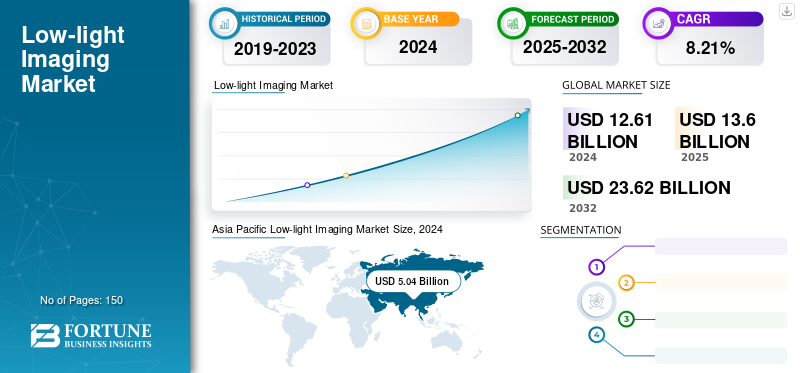
The global low-light imaging market size was valued at USD 13.6 billion in 2025 and is projected to grow from USD 14.67 billion in 2026 to USD 27.12 billion by 2034, exhibiting a CAGR of 7.98% during the forecast period. Asia Pacific dominated the low-light imaging market with a market share of 40.38% in 2025.
Low-light imaging is the act of obtaining images under low-light conditions outdoors, at night, and indoors in dark conditions. It uses wide pixel sensors and greater sensitivity to collect more light in order to show a visual of a scene in low-light conditions where traditional cameras would produce images which are of no use. Low-light technology is valuable for scientific fields of study such as astronomy, night vision and security applications, and general surveillance.
The market is growing rapidly as a result of the increased demand across consumer electronics, automotive, security and surveillance, medical and life sciences, and military and defense. The demand for low light imaging solutions is being driven by the innovations in CMOS sensor technology, the initiation of AI in image processing, and increasing necessity of high-performance imaging in low visibility situations.
The top companies in the industry are Sony Group Corporation, Samsung Electronics Company Limited, OMNIVISION Technologies Incorporated, STMicroelectronics N.V., ON Semiconductor Corporation, and Panasonic Holdings Corporation.
Download Free sample to learn more about this report.
Low-light Imaging Market Takeaways
 Market Size & Forecast
- 2025 Market Size: USD 13.60 billion
- 2026 Market Size: USD 14.67 billion
- 2034 Forecast Market Size: USD 27.12 billion
- CAGR: 7.98% from 2026–2034
 Market Share
- Asia Pacific dominated the low-light imaging market with a 40.38% share in 2025.
- The image sensors segment is expected to account for 38.83% of the market in 2026.
- The CMOS segment is projected to lead with a 57.73% share in 2026, while the overall market grows at a CAGR of 7.98%.
 Key Regional Highlights
North America
North America accounted for USD 3.83 billion in 2025 and is expected to reach USD 4.12 billion in 2026, supported by early technology adoption and robust defense sector demand.
Europe
Europe generated USD 2.86 billion in 2025 and is projected to reach USD 3.05 billion in 2026, fueled by increasing use of ADAS and industrial imaging technologies.
Asia Pacific
Asia Pacific led the global market with USD 5.49 billion in 2025 and is projected to reach USD 5.99 billion in 2026, driven by strong manufacturing activity and growing adoption in security and automotive applications.
U.S.
The market is expected to reach USD 2.43 billion in 2026, driven by strong innovation and rising demand from the automotive and defense industries.
Japan
The market benefits from advanced imaging technology adoption and strong electronics manufacturing, supporting steady growth across industrial and automotive applications.
Read More

Impact of Artificial Intelligence (AI)
Artificial Intelligence (AI) Boosted the Market by Enhancing Image Quality
Artificial intelligence (AI) is fueling substantial growth in the global low light imaging market through improvements in image quality, novel applications, and improvements in efficiency. Algorithms based on AI have the potential to reduce image noise, improve contrast and recover lost details, resulting in a more focused and reliable representation of the scene in low-light conditions. This innovation has contributed to market growth in many sectors including security and surveillance, automotive safety, and consumer electronics such as smartphones. The use of AI also reduces the human burden of image processing, and offers real-time optimization, and will continue driving growth and innovation over the next few years.
MARKET DYNAMICS
Market Drivers
Growing Demand for Advanced Imaging in Security and Automotive Sectors Drives Growth
The market for low-light imaging is experiencing a major expansion due to increased demand from the automotive and security sectors. Low-light image sensors are becoming increasingly important in the automotive sector as ADAS (Advanced Driver-Assistance Systems) and autonomous vehicles are demanding night vision and driver monitoring, among other things. In the security sector, the market is propelled by increased deployment of advanced night vision cameras and thermal imaging drones, as well as AI-enabled surveillance systems that provide continuous monitoring, regardless of the lighting conditions.
Market Restraints
High Production Costs Impede Market Development
One of the main obstacles to the development of low-light imaging technology is its high cost. For small enterprises and customers on a tight budget, the technology is prohibitively expensive due to the high cost of image sensors, manufacture, and installation. Even while the demand for the technology is increasing from industries such as consumer electronics, automotive, and security, this restricts its application and slows down advancements. Cost pressures are made worse by supply chain bottlenecks and regulatory compliance. Manufacturers are compelled to innovate in order to reduce the cost-performance ratio since these variables impede wider market expansion.
Market Opportunities
Infrared and SWIR Innovations Creates New Opportunities in the Market Growth
Developments in infrared (IR) and short-wave infrared (SWIR) have now enabled multiple commercial opportunities for low-light imaging. As a result, these technologies are increasing their commercial use in a number of applications. In defense, these technologies provide a new level of night vision and surveillance to enhance situational awareness. In the automotive space, IR cameras enhance advanced driver-assistance systems (ADAS) through low visibility obstacle and pedestrian detection. In industrial markets, ND testing and quality control can benefit from SWIR for semiconductor inspections or moisture detection in food products. In the medical field, these technologies help facilitate diagnostics such as blood flow detection and skin condition identification.
LOW-LIGHT IMAGING MARKET TRENDS
AI-driven Image Enhancement Emerges as a Major Trend in the Industry
AI-driven image enhancement is a key driver of low-light imaging market growth, fundamentally changing how devices acquire and process images in challenging conditions. This trend is particularly prominent in the realm of consumer electronics, such as smartphones, in which high-end computational photography enables smaller sensors to produce images that are brighter and clearer. Enabling this increases, the user experience while also challenging manufacturers such as Sony and Apple to innovate. For security and surveillance purposes, AI improves cameras’ performance by keeping a camera recording high resolution, full-color images while providing analytic capabilities that can even filter out phenomenon such as rain or leaves in an image. Companies that can deliver real-time, AI-improved processing are evolving to be a differentiating factor in this market, creating a better user experience while also providing overall product value.
SEGMENTATION ANALYSIS
By Component
Ability to Convert Light into High-Quality Digital Signals Boosts Image Sensors Segment Growth
Based on the component, the market is segmented into image sensors, camera modules, optics & lenses, illumination devices, image processing software, and others (ISPs, etc.).
The image sensors segment held the largest revenue share of USD 4.81 billion in the overall global market in the year 2024. The image sensors segment is expected to account for 38.83% of the market in 2026.
The segment is leading because they form the core of every low-light imaging system, providing the primary capability to capture and convert light into high-quality digital signals.
The illumination devices hold the maximum CAGR of 10.43% in the global market. The segment’s growth is mainly due to increasing integration of infrared LEDs and laser illuminators that enhance image clarity in dark or night-time environments across security and automotive systems.
By Technology
CMOS Segment Dominates Market Owing to Its Low Power Consumption and Compact Design
Based on technology, the market is divided into CMOS, CCD, Thermal Imaging, Infrared (IR) & Near-Infrared (NIR), image intensifier, and others (sCMOS, etc.).
The CMOS segment dominated with a market share of USD 7.18 billion in 2024. The CMOS segment is expected to lead the market, contributing 57.73% globally in 2026. The segment is leading owing to its low power consumption, compact design, and widespread adoption in smartphones, surveillance, and automotive cameras for efficient low-light performance.
Infrared (IR) & Near-Infrared (NIR) holds the highest CAGR of 9.97% in the global market. The segment’s growth is mainly due to their demand rises in applications such as ADAS, biometric authentication, and medical imaging for enhanced visibility in minimal light conditions.
By Application
Public Safety Needs Augments the Security & Surveillance Segment Growth
Based on the application, the market is divided into security & surveillance, automotive, consumer electronics, industrial, medical & life sciences, aerospace & defense, and others (research, etc.).
The security & surveillance segment accounted for the largest low-light imaging market share at USD 4.45 billion in 2024. The segment is leading as continuous monitoring and public safety needs drive large-scale deployment of cameras optimized for night and low-illumination environments. The security & surveillance segment will account for 35.8% market share in 2026.
Automotive represent the largest CAGR at 10.21% in the global market. The segment’s growth is mainly due to the rising incorporation of night-vision and driver-assistance systems in vehicles to improve safety and visibility in dark driving conditions.
To know how our report can help streamline your business, Speak to Analyst
LOW-LIGHT IMAGING MARKET REGIONAL OUTLOOK
Geographically the market is segmented into North America, Europe, Asia Pacific, South America and Middle East & Africa.
Asia Pacific Low-light Imaging Market Size, 2026 (USD Billion)
To get more information on the regional analysis of this market, Download Free sample
North America
North America holds the second-largest share in the global market. The region’s growth is attributable to early adoption of technology and high demand from the defense sector. In 2025, North America generated USD 3.83 Billion, contributing 28.16% to global market revenue, and is projected to grow to USD 4.12 Billion in 2026.
The U.S. is at the forefront of the North American market, with expected revenue of USD 2.43 billion in 2026. The growth is attributable to strong innovation and demand from the automotive and defense sectors.
Europe
The Europe market accounted for USD 2.86 Billion in 2025, representing 21.00% of the global industry, and is expected to reach USD 3.05 Billion in 2026. The region’s growth is owing to strong demand in the automotive industry for Advanced Driver-Assistance Systems (ADAS) and by the increasing use of imaging technology in factory automation and other industrial applications.
The U.K., Germany, and France are some of the leading contributors to the growth in the market, with the required revenue stake of USD 0.73 billion, USD 0.63 billion and USD 0.52 billion respectively by 2026.
Asia Pacific
Asia Pacific dominates and grows fastest, attributable to strong manufacturing, rapid industrialization, and high adoption in security and automotive sectors. Asia Pacific recorded a market size of USD 5.49 Billion in 2025, capturing 40.38% of the global market share, and is projected to reach USD 5.99 Billion in 2026.
Download Free sample to learn more about this report.
India and China are major contributors to the market growth with an expected revenue share of USD 1.11 billion, and USD 1.72 billion respectively by 2026.
South America and Middle East & Africa
The market of South America is growing with an expected share of USD 0.88 billion in 2025. The region grows slowly due to limited infrastructure and lower technology adoption.
The market of Middle East & Africa is growing with an expected share of USD 0.54 billion in 2025. The region records the second-highest CAGR owing to rising smart city and security investments.
GCC countries are predicted to have a market share of USD 0.17 billion by 2025.
Latin America
Latin America accounted for USD .88 Billion in 2025, representing 6.47% of the global market share, and is projected to reach USD .93 Billion in 2026.
COMPETITIVE LANDSCAPE
Key Industry Players
Major Players Incorporate Cutting-Edge Sensor Technologies to Improve Their Position
To increase sensitivity and performance, the major players in the low-light imaging market including Sony Group Corporation, Samsung Electronics Company Limited, and OMNIVISION Technologies Incorporated are concentrating on strategies that incorporate cutting-edge sensor technologies such as stacked CMOS architectures and backside-illuminated (BSI). By integrating sensors into smartphones and tablets and expanding their positions in the automobile industry with Advanced Driver-Assistance System (ADAS) solutions, they are also leveraging high-growth industries. Businesses are also using AI and software to improve image quality, developing solutions for industrial, security, and medical applications.
LIST OF KEY LOW-LIGHT IMAGING COMPANIES PROFILED:
- Sony Group Corporation (Japan)
- Samsung Electronics Company Limited (South Korea)
- OMNIVISION Technologies Incorporated (U.S.)
- STMicroelectronics N.V. (Switzerland)
- ON Semiconductor Corporation (U.S.)
- Panasonic Holdings Corporation (Japan)
- Canon Incorporated (Japan)
- Hamamatsu Photonics Kabushiki Kaisha (Japan)
- Teledyne Technologies Incorporated (U.S.)
- Hangzhou Hikvision Digital Technology Company Limited (China)
KEY INDUSTRY DEVELOPMENTS:
- January 2025- Oxford Instruments, leading provider of high technology products and services for research and industry, announced the launch of a high resolution, low noise, back-illuminated sCMOS camera, further strengthening its broad portfolio of cameras for low light imaging in Life Sciences, Physical Sciences and Industrial applications.
- September 2024- Sony Semiconductor Solutions Corporation (SSS) announced that it released the LYT-818, a new effective-50-megapixel*1 CMOS image sensor that significantly reduces noise in low-light conditions and delivers a high dynamic range. This product will be offered under the LYTIA brand, a new product line introduced for mobile image sensors.
- August 2024- OMNIVISION, a leading global developer of semiconductor solutions, including advanced digital imaging, analog, and touch & display technology, introduced the newest image sensor in its broad mobile product portfolio: the OV50M40. The OV50M40 is a versatile 0.61‑micron (µm) pixel CMOS image sensor with 50‑megapixel (MP) output designed for excellent low-light performance and ultra-low power consumption in mobile devices.
- June 2024- Samsung Electronics, a world leader in advanced semiconductor technology, announced three new mobile image sensors designed for both main and sub cameras in smartphones: the ISOCELL HP9, the ISOCELL GNJ and the ISOCELL JN5 to improve low-light performance and autofocus.
- January 2024- Teledyne e2v, a Teledyne Technologies company and global innovator of imaging solutions, announced the launch of OnyxMax™, the next generation of its popular Onyx 1.3M low light CMOS image sensor. This new sensor has been designed for extremely low light conditions, down to 1 mLux.
REPORT COVERAGE
The global low light imaging market report provides a detailed analysis of the market and focuses on key aspects such as prominent companies, deployment modes, types, and end users of the product. Besides this, it offers insights into the low-light imaging market trends and highlights key industry developments and market share analysis for key companies. In addition to the aforementioned factors, the report encompasses several factors that have contributed to the growth of the market over recent years.
Request for Customization to gain extensive market insights.
Report Scope & Segmentation
| ATTRIBUTE | DETAILS |
| Study Period | 2021-2034 |
| Base Year | 2025 |
| Estimated Year | 2026 |
| Forecast Period | 2026-2034 |
| Growth Rate | CAGR of 7.98% from 2026-2034 |
| Historical Period | 2021-2024 |
| Unit | Value (USD Billion) |
| Segmentation |
By Component
By Technology
By Application
By Region
|
Frequently Asked Questions
Fortune Business Insights says that the global market stood at USD 14.67 billion in 2026 and is projected to reach USD 27.12 billion by 2034.
The market is expected to exhibit steady growth at a CAGR of 7.98% during the forecast period.
The growing demand for advanced imaging in security and automotive sectors is speeding up the market growth.
The top companies in the industry are Sony Group Corporation, Samsung Electronics Company Limited, OMNIVISION Technologies Incorporated, STMicroelectronics N.V., ON Semiconductor Corporation, and Panasonic Holdings Corporation.
The Asia Pacific region held the largest market share.
Asia Pacific was valued at USD 5.49 billion in 2025.



- 2021-2034
- 2025
- 2021-2024
- 150
Get 30-60 hrs Free Customization
Expand Regional and Country Coverage, Segments Analysis, Company Profiles, Competitive Benchmarking, and End-user Insights.




















-
US +1 833 909 2966 ( Toll Free )
-
Get In Touch With Us