Lycopene Market Size, Share & Industry Analysis, By Source (Natural and Synthetic), By Form (Liquid, Powder, and Beadlet), By Application (Food & Beverages, Dietary Supplements, Personal Care & Cosmetics, Animal Feed, and Pharmaceuticals), and Regional Forecast, 2026-2034
 Download Free Sample
(Offer valid till 31st Oct 2026)

Lycopene Market Size and Future Outlook
 Listen to Audio Version
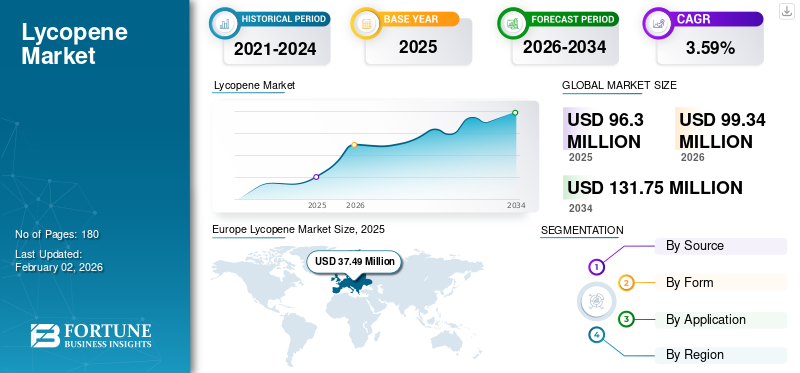
The global lycopene market size was valued at USD 96.3 million in 2025 and is projected to grow from USD 99.34 million in 2026 to USD 131.75 million by 2034, exhibiting a growth at CAGR of 3.59% during the forecast period. Europe dominated the lycopene market with a market share of 5.32% in 2025.
A few key players in the lycopene market include BASF SE, Divi's Nutraceuticals, Lycored, and others.
Lycopene is a red acyclic and lipophilic carotenoid abundantly found in tomatoes and red vegetables/fruits. This ingredient is produced via three major methods: natural extraction, microbial fermentation, and chemical synthesis. Some common natural sources include watermelon, papaya, and pink grapefruit, among others. This ingredient plays a considerable role in food & beverage industry, especially as a functional ingredient or in fortification. Addition of such ingredients enhances visual appeal and offers numerous health advantages. Besides this, carotenoid is utilized in the personal care industry, where it is known to impart natural color. Additionally, it is used in both the animal feed and pharmaceutical sectors. In terms of consumption, North America and Europe are the biggest consumers of lycopene.
The growing use of carotenoids in the dietary supplements industry and the expanding processed food sector propel the global market growth.
Download Free sample to learn more about this report.
Lycopene Market Key Takeaways
 Market Size & Forecast
- 2025 Market Size: USD 96.3 million
- 2026 Market Size: USD 99.34 million
- 2034 Forecast Market Size: USD 131.75 million
- CAGR: 3.59% from 2026–2034
 Market Share
- Europe dominated the lycopene market with a 5.32% share in 2025.
- Synthetic lycopene led the market due to its cost-effectiveness and longer shelf life.
- Powder form dominated the market owing to its versatility and ease of use.
 Key Regional Highlights
Europe
Europe led the market with a value of USD 37.49 million in 2025 and is projected to reach USD 38.66 million in 2026.
North America
North America accounted for USD 33.95 million in 2025 and is expected to grow to USD 34.9 million in 2026.
Asia Pacific
Asia Pacific reached USD 18.59 million in 2025 and emerged as the fastest-growing regional market.
U.S.
The country remained the leading market in North America, supported by strong feed additive production and established industry players.
Japan
Growing demand for dietary supplements and health-focused products is supporting market expansion in the country.
Read More

MARKET DYNAMICS
Market Drivers
Rising Awareness of Health Advantages of Carotenoids Boosts Industry's Momentum
The growing awareness of the health benefits of carotenoids is a major driver contributing to the market's potential. In today's health-conscious era, most consumers are increasingly aware of the benefits of plant-based ingredients, and carotenoids, a naturally derived pigment, align with this ongoing trend. This ingredient is a functional food ingredient and offers numerous health advantages to consumers. Besides imparting color, carotenoid is used as natural preservatives and prevent food and beverages from spoiling. Also, it is recognized as a natural substitute for artificial antioxidants, making it a preferred option for consumers. Due to such advantages, the food companies are concentrating on launching carotenoid-enriched items for consumers, resulting in the global lycopene market growth.
Market Restraints
Instability of Ingredients and Minimal Consumer Awareness Impede Market's Growth
One substantial hurdle carotenoid producers face in the market is the instability of ingredients. Lycopene is highly prone to isomerization and degradation when exposed to heat, oxygen, and light, losing its nutritive value and color. This scenario hampers its effectiveness as a bioactive compound. Moreover, several food processing techniques, such as pasteurization, drying, and others, can lead to degradation of carotenoids, impacting the end product's antioxidant potential, nutritional value, and color.
Limited consumer awareness about carotenoids is another obstacle in the industry. Globally, most of the population has minimal knowledge regarding the benefits of carotenoids and is not fully aware of their optimal dosages and specific mechanisms. Thus, such instances impact the industry's potential.
Market Opportunities
Surging Use of Carotenoids in Personal Care Items Creates Growth Opportunities
The rising usage of carotenoids in cosmetic industries opens numerous business growth opportunities. In the personal care products industry, carotenoids are recognized as a sought-after ingredient, owing to their potential to protect skin from environmental pollutants. This carotenoid improves collagen production, which can enhance skin firmness and minimize the appearance of wrinkles. Moreover, it imparts anti-inflammatory properties that moisturize the skin while reducing inflammation and redness. Additionally, lycopene emulsions can provide skin brightening and whitening effects. Besides this, carotenoid adds natural color to cosmetic items such as tinted moisturizers and lipsticks, appealing to consumers looking for natural ingredients.
Lycopene Market Trends
Growing Inclination Toward Fortified Products is Current Trend
Food fortification is an expanding and ongoing trend, considered a cost-effective strategy to address nutrient deficiencies. Likewise, vitamins & minerals, carotenoids are also used to fortify food products to strengthen their shelf life, color, and nutritional profile. This carotenoid acts as a natural preservative in baked goods, dairy items, and beverages, potentially enhancing the shelf life of products. Moreover, it offers antioxidant properties that protect the human body from free radicals. Apart from color, shelf life, and nutritive value, carotenoid fortification lowers blood pressure, improves cognitive function, and improves skin texture. By seeing such advantages, the prominent players in the market are exploring new ingredients and focusing on launching lycopene-fortified products.
SEGMENTATION ANALYSIS
By Source
Synthetic Led Market Due to Its Economical Nature
Based on the source, the market is distributed into synthetic and natural.
The synthetic segment dominated the market and held a major chunk of share in 2024. Compared to natural ingredients, synthetic lycopene has a prolonged shelf life and is less degradable, making it ideal for bulk production. Moreover, these ingredients are highly preferred for their cost-effectiveness and can be formulated to provide specific results. Thus, such advantages bolster the segment's growth.
The natural sector is the fastest-growing segment and is anticipated to maintain the same growth in the future. The rising trend of clean label and plant-based ingredients and surging emphasis on sustainability facilitate the usage of natural lycopene.
By Form
Powder Form Dominated Market Owing to Its Versatility
Based on form, the market is segmented into liquid, powder, and beadlet.
The powder segment leads in the global market. Powdered ingredients are cheaper and have an enhanced absorption rate than other forms. Moreover, these components can be easily blended and transported compared to liquid ingredients. Additionally, it has an extended shelf life and is flexible in dosing, boosting the segment's growth.
The liquid sector has a high CAGR during the forecast period. This liquid ingredient provides a rapid onset of action and is convenient to use, strengthening the industry's growth.
By Application
Food and Beverages Sector Led Market Owing to their Nutritional Profile
Depending on the application, the market is segmented into food and beverages, dietary supplements, personal care & cosmetics, animal feed, and pharmaceuticals.
The food and beverage sector led the global marketplace, observing a strong growth trajectory. In this sector, lycopene is mainly used as a coloring agent and is added to a range of processed foods, dairy products, and salad dressings to enhance their visual appeal. Moreover, the surging demand for functional ingredients further bolsters its consumption. Additionally, the increasing inclination toward fortification escalates the usage of carotenoids.
Animal feed is considered the fastest-growing segment and is predicted to maintain the same pace in the near term. The augmented focus on animals' nutrition and the wide availability of lycopene additives drive the sales of such carotenoids.
Lycopene Market Regional Outlook
Based on regions, the market is segmented into North America, Europe, Asia Pacific, South America, and the Middle East & Africa.
Europe
Europe Lycopene Market Size, 2025 (USD Million)
To get more information on the regional analysis of this market, Download Free sample
The Europe market accounted for USD 37.49 million in 2025, representing 5.32% of the global industry, and is expected to reach USD 38.66 million in 2026. In this region, most Europeans are actively looking for nutrient-enriched products with fewer additives. This demand increases the use of natural carotenoids, which provide additional benefits beyond traditional advantages. Moreover, the expanding nutraceuticals sector is another key factor encouraging the utilization of carotenoids. In today's era, consumers are becoming highly aware of the link between health and diet, leading them to purchase nutraceuticals. To prevent the risk of diseases, most individuals are switching to natural ingredients that provide innumerable benefits. Additionally, the growing animal feed industry in European countries augments the usage of carotenoids.
Download Free sample to learn more about this report.
North America
In 2025, North America generated USD 33.95 million, contributing 7.91% to global market revenue, and is projected to grow to USD 34.9 million in 2026. North America ranked second in the global marketplace. The increasing trend of health consciousness and the growing dietary supplements industry are the primary drivers promoting the growth. Also, technological advancements such as microencapsulation and microwave-assisted extraction fuel the effectiveness and stability of carotenoids, making them more enticing to consumers. Moreover, the augmented demand for health-promoting claims in the food & beverages sector influences food operators to use carotenoids. Additionally, the improved reliance on organic products further drives the nation's growth.
The U.S. is recognized as the leading nation in the North America region. The rising production of feed additives and the presence of established players propel the country's potential.
Asia Pacific
Asia Pacific recorded a market size of USD 18.59 million in 2025, capturing 4.93% of the global market share, and is projected to reach USD 19.33 million in 2026. The Asia Pacific region emerged as the fastest-growing region with a high CAGR during the forecast period. The regional growth is backed by the surging adoption of Western dietary patterns and the strategic marketing of lycopene-enriched food products. Compared to other regions, the Asia Pacific has a high aging population, which boosts their dependency on dietary supplements. To fulfill the demand, the companies focus on introducing carotenoid-enriched supplements. Moreover, the region is known for a robust agricultural base, which contributes to the production of tomatoes, a main source of lycopene. Additionally, product innovation in the regional market escalates the usage of carotenoids.
South America
South America is at its progressing stage and is expected to grow at a higher pace in the foreseeable years. The surging consumer preferences for nutritious products and the rising availability of raw ingredients upgrade the regional growth.
Middle East & Africa
The Middle East & Africa market generated USD 1.85 million in 2025, representing 2.70% of the global market landscape, and is expected to reach USD 1.9 million in 2026. The Middle East & Africa are also developing and predicted to soar at the same pace in the near term. The increasing demand for natural components and growing local carotenoid producers drive the market's potential.
Latin America
Latin America accounted for USD 4.41 million in 2025, representing 3.17% of the global market share, and is projected to reach USD 4.55 million in 2026.
COMPETITIVE LANDSCAPE
Key Industry Players
Leading Players are Launching Novel Products to Improve Their Brand Image
The key players operating in the market include Lycored, BASF SE, Divi's Nutraceuticals, and others. All the enterprises are responding to the growing consumer demand by launching new lycopene-based products. In this era, consumers are increasingly seeking natural ingredients that help to promote their health & well-being. Via such launches, the companies can enhance their market presence and boost their profitability.
List of Key Lycopene Companies Profiled
- Lycored (U.S.)
- Allied Biotech Corporation (Taiwan)
- Divi's Nutraceuticals (U.S.)
- Vidya Herbs (India)
- BASF SE (Germany)
- Shaanxi Kingsci Biotechnology CO, LTD. (China)
- Wellgreen Technology Co., Ltd. (China)
- Farbest Brands (U.S.)
- Jamieson Wellness (Canada)
- Plamed Green Science Group (China)
KEY INDUSTRY DEVELOPMENTS
- July 2024: Lycored, a well-known natural carotenoids enterprise in the U.S., unveiled a new colorant, "Resilient Red BF," at the Institute of Food Technologists Annual event held in the U.S. This color is sourced from lycopene, which is extracted from their farm-grown tomatoes.
- November 2023: Nutraland Inc., a functional ingredient enterprise in the U.S., introduced Somato, an ingredient derived from dried and whole tomatoes, which is a natural source of lycopene and melatonin. This component can be utilized in dietary supplements and functional food, and beverages across the U.S. market.
- July 2020: Lycored, an ingredients manufacturer in the U.S., announced the news of increasing lycopene production to cater to the rising demand. This expansion of production capacity was achieved at the company's new plant based in the U.S.
- February 2020: Lycored, a U.S.-based ingredients firm, released new digital initiatives to enhance awareness of its lycopene ingredient. The firm aims to fuel this ingredient's sales by captivating consumers' attention via digital tools.
- March 2019: Lycored, a company in the U.S., was granted a patent for a composition containing patented tomato extract lycopene, omega-3 fatty acids, and lutein/carnosic acid.
REPORT COVERAGES
The market research report includes quantitative and qualitative insights into the market. It also offers a detailed market analysis of the market sizing and growth rate for all possible market segments. Key insights in the global lycopene market report include an overview of related markets, a competitive landscape, recent industry developments such as mergers & acquisitions, the regulatory environment in critical countries, and current market trends.
Request for Customization to gain extensive market insights.
Report Scope & Segmentation
|
ATTRIBUTE |
DETAILS |
|
Study Period |
2021-2034 |
|
Base Year |
2025 |
|
Estimated Year |
2026 |
|
Forecast Period |
2026-2034 |
|
Historical Period |
2021-2024 |
|
Unit |
Value (USD Million) |
|
Growth Rate |
CAGR of 3.59% from 2026 to 2034 |
|
Segmentation |
By Source
|
|
By Form
|
|
|
By Application
|
|
|
By Region
|
Frequently Asked Questions
Fortune Business Insights says the global market size was valued at USD 96.3 million in 2025.
The market is expected to grow at a CAGR of 3.59% during the lycopene market forecast period.
By source, the synthetic segment led the market.
Rising awareness of health advantages of carotenoids boosts industry's momentum.
BASF SE, Divis Nutraceuticals, and Lycored are a few of the top players in the market.
Europe held the highest share of the market.
Surging use of carotenoids in personal care items creates growth opportunities.



- 2021-2034
- 2025
- 2021-2024
- 180
-
(Offer valid till 31st Oct 2026)
Get 30-60 hrs Free Customization
Expand Regional and Country Coverage, Segments Analysis, Company Profiles, Competitive Benchmarking, and End-user Insights.




















Related Reports
-
US +1 833 909 2966 ( Toll Free )
-
Get In Touch With Us